
Idea 1
Navigating the Messy Middle
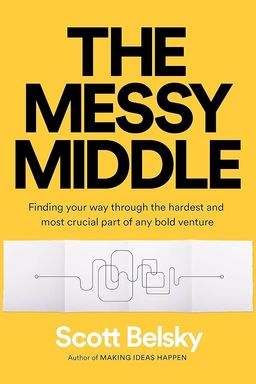
How do creative projects, startups, or major endeavors survive the long, uncertain stretch between naive optimism and visible success? In The Messy Middle, Scott Belsky argues that most creators and leaders underestimate this middle stage—the grueling, ambiguous period where innovation meets resistance, motivation fades, and structure must evolve. Great outcomes aren’t born from genius beginnings or glamorous endings; they’re forged in this murky middle through endurance, disciplined optimism, and thoughtful iteration.
Belsky draws on his experiences founding Behance (later acquired by Adobe) and advising companies like Airbnb, Pinterest, and sweetgreen to show how teams navigate uncertainty, maintain motivation, lead through ambiguity, and balance creative intuition with operational rigor. His core argument: endurance is a design problem. You can’t “power through” the middle by willpower alone—you must design your culture, processes, metrics, and mindset to survive it.
The Anatomy of the Middle
Every ambitious project has three phases: a thrilling beginning fueled by vision, a messy middle defined by doubt and iteration, and a final act of resolution or reinvention. The middle is messy because success signals vanish and feedback loops break down. Customers are few, press ignores you, and morale oscillates between belief and burnout. Without external rewards, founders must manufacture motivation—creating rituals and milestones that signal progress even when the scoreboard is blank. Small, truthful wins become the psychological fuel that keeps teams moving forward.
Belsky warns of “fake wins”—vanity metrics, flattering press, or cosmetic milestones—that give the illusion of progress. The antidote is radical honesty: telling your team exactly where you stand and defining what progress really means. (Ben Horowitz’s rule—tell the truth and then assign meaning—is a recurring touchstone.) Survival in the middle is less about charisma than about discipline.
Leadership in Uncertainty
Leaders in the messy middle must act as narrative stewards—curating the story of progress to orient and energize their teams. Anne Wojcicki’s leadership during 23andMe’s FDA shutdown is one example: she reframed the setback as part of a larger mission (“We’re on the right side of history”). Belsky calls this stewarding perspective—acknowledging pain while contextualizing it within purpose. Leaders who can process uncertainty, invite productive friction, and still end meetings with energy are the emotional barometers that keep teams alive.
Designing for Endurance
You must engineer patience, not just preach it. Enduring organizations like Amazon, Google, and Pinterest design cultural norms and structural protections for long-term bets. Cultural patience celebrates persistence and delayed gratification; structural patience separates long-horizon projects from short-term pressures. Belsky describes this as “chapters”: bite-sized epochs within a long game that keep motivation renewable. Patience becomes a competitive edge because few are willing to sustain unpopular investments long enough to compound.
At the team level, endurance also means embracing suffering without martyrdom. Tony Fadell’s experience moving from iPod to iPhone or Airbnb’s early struggles before product-market fit show that tolerance for ambiguity must be budgeted for—not romanticized. When you commit to suffering explicitly (say, for five years), setbacks feel expected, not catastrophic.
Building Systems that Survive You
The messy middle also tests systems and culture. Structure must evolve from improvisation to iteration. Process becomes a response to misalignment, not a bureaucracy to worship. Tools, physical space, and storytelling become your hidden co-founders—shaping how people work, think, and stay aligned. Internal storytelling (“the bet we made,” “the feature we killed”) cements culture more than slogans. Equally, internal marketing—billboards, prototypes, Done Walls—keeps everyone visually focused on what matters.
Simplicity becomes the final moat. Products, systems, and communications naturally drift toward complexity. Protecting simplicity—by applying “one in, one out” discipline and trimming features that dilute your core value—is what preserves clarity and momentum. (Sweetgreen’s decision to limit its menu, despite investor pressure, demonstrates that simplicity scales better than excess.)
Finishing and Beginning Again
Belsky concludes that the messy middle never truly ends—it just cycles. Whether your outcome is acquisition, restructuring, or reinvention, finishing well requires as much care as starting. Behance’s acquisition by Adobe demanded stewardship, emotional maturity, and clarity; others, like Chef Isuzu Sakurada closing his Michelin-starred restaurant, illustrate the grace of walking away on one’s own terms. You finish not to quit, but to create space for the next messy middle—because creativity is cyclical, not linear.
Core Message
Surviving and thriving in the messy middle requires designing for motivation, truth, patience, and simplicity. When you build systems that generate progress signals and lead with candor and empathy, the middle becomes not a desert—but a forge for enduring greatness.