
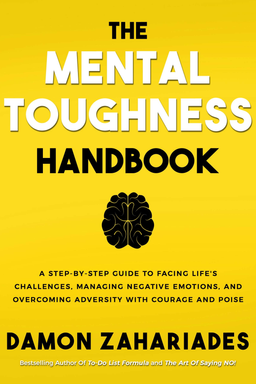
The Mental Toughness Handbook cover

The Mental Toughness Handbook

by Damon Zahariades

The Mental Toughness Handbook by Damon Zahariades is your step-by-step guide to building resilience and overcoming life''s obstacles with confidence. Discover proven strategies to cultivate mental discipline and transform adversity into opportunity. Unlock the power of mental toughness and achieve personal growth with time-tested wisdom.

Building Mental Toughness: The Foundation of Enduring Success

When life throws one challenge after another—missed opportunities, unexpected loss, relentless deadlines—how do some people stay calm, confident, and keep moving forward while others crumble? Damon Zahariades’ The Mental Toughness Handbook answers precisely that question. He argues that mental toughness is not a fixed trait but a trainable state of mind—a disciplined, resilient way of thinking that allows you to endure discomfort, confront fear, and persist toward long-term goals no matter what obstacles emerge. The book isn’t about suppressing emotions or toughing it out stoically; it's about mastering your emotions, reframing adversity, and taking purposeful action even when motivation runs dry.

Why Mental Toughness Matters More Than Talent

Zahariades begins by reminding us that every achiever—from elite athletes to business leaders—possesses one thing in common: mental fortitude. Success is the byproduct of persistence, emotional control, and habit, not luck or genius. As he puts it, “No one reaches lasting success without facing discomfort.” Yet while most personal development books focus on positivity or productivity hacks, this one goes straight to the psychological core: how to toughen your thinking and recover from setbacks with grace. The promise is empowering—because if mental toughness can be trained, anyone can learn it.

The book opens with a clear distinction between grit and mental toughness. Grit, a term popularized by psychologist Angela Duckworth, refers to persistence and passion over the long haul. Mental toughness, however, goes beyond endurance. It’s a full mental architecture of resilience—an attitude of unwavering poise under pressure. Grit helps you push; mental toughness helps you stay centered.

From Reaction to Response: A State of Mind

Zahariades explores how tough-minded individuals manage stress, fear, and emotional chaos. They don’t eliminate these feelings—they neutralize their power. That distinction is vital. Mental toughness doesn’t mean feeling nothing; it means feeling everything appropriately. Parents raising children, first responders in crisis, or entrepreneurs risking everything all demonstrate this mindset when they continue to think clearly amid pressure.

Through short, focused chapters packed with exercises, the author guides you to build self-awareness and deliberate control. You learn to confront your inner critic, dismantle self-deception, and define what lies within your control—echoing ancient Stoic wisdom from Epictetus and Marcus Aurelius. (Zahariades often channels Stoicism, much like Ryan Holiday’s The Obstacle Is the Way, but with a pragmatic, step-by-step focus rather than philosophical exposition.)

The Enemies Within

Before teaching you how to get stronger, Zahariades warns against the eight enemies that erode toughness—self-pity, fear, laziness, emotionalism, self-doubt, perfectionism, self-limiting beliefs, and your inner critic. They are mental traps, not external roadblocks. Through examples—like the entrepreneur paralyzed by analysis, the perfectionist who never starts, or the parent who spirals into frustration when things go wrong—he shows that the real struggle isn’t against circumstance but against mental habits.

One key takeaway: quitting is rarely logical. We rationalize it because discomfort feels unbearable. But once you recognize this pattern, you can begin to rewrite it. Mental toughness is the rewiring of those default reactions—to pause, breathe, and choose strength.

A Training Ground for the Mind

The central sections of the book offer tactical methods for training your own resilience. Emotional mastery comes first—through self-awareness, empathy, and reflection. Then come attitude shifts: reframing failure as feedback, developing patience via delayed gratification, and forming habits that remove reliance on willpower. The result? You learn to rely less on unpredictable motivation and more on disciplined systems that carry you through moments of fatigue and fear.

To demonstrate this, he cites the Finnish concept of sisu: grim courage in the face of near-certain defeat. The Finnish soldiers of the 1939 Winter War, vastly outnumbered by the Soviets, fought on through impossible odds. Zahariades uses their story not as heroic myth but as proof that courage under pressure is learned through adversity and preparation, not bravado.

From Habits to Mastery

A major theme of the book is that resilience depends on habits, not feelings. Zahariades says willpower is like fuel: finite and depleted with use. Habits, by contrast, automate strength. He teaches small, incremental habit-building (borrowing ideas from Leo Babauta’s Zen Habits)—start small, track progress, and associate triggers with desired behaviors. Over time, perseverance, confidence, and emotional balance stop being conscious choices; they become who you are.

The last part of the book outlines a 10-step quick-start training program and a mental toughness maintenance guide. These transform abstract ideas into practice—visualization, gratitude, reframing fear, and micro-goal segmentation. You strengthen your mind just as athletes condition their muscles. And just like muscle, mental strength atrophies without use. Zahariades ends with the reminder: “Life will test you—but it’s also your gym.”

Why This Matters to You

Ultimately, The Mental Toughness Handbook is a blueprint for transforming how you meet stress and setbacks. You learn not just how to survive hardship, but how to use it to grow stronger. Whether you’re managing a business, chasing fitness goals, rebuilding after failure, or simply trying to stay calm amid chaos, Zahariades gives you a set of mental exercises that make persistence second nature. In a world where comfort is easy and quitting is rewarded, this book is a manual for becoming the rare kind of person who stays the course—resilient, rational, and quietly unshakeable.


The Psychology of Resilience

Zahariades dedicates early chapters to defining what mental toughness really means—and what it doesn’t. Many people mistake it for emotional suppression or “grit alone.” The author distinguishes between mental toughness (a mindset) and resilience (a skill). Resilience is the ability to bounce back from a setback. Mental toughness is the ability to anticipate hardship, stay centered during it, and then transform it into growth. In essence, toughness precedes and guides resilience.

From Catastrophic Thinking to Emotional Mastery

A key enemy of resilience, the book stresses, is catastrophic thinking—our tendency to imagine the worst-case scenario and then believe it’s inevitable. Zahariades recounts relatable examples: the employee who panics over an unexpected delay, or the traveler who turns a flight detour into imagined disaster. He shows how such thinking destroys composure before reality unfolds. His fix is cognitive reframing: push back on those thoughts, ground them in fact, and act based on logic rather than panic. It’s mindfulness in practical form.

Reframing Failure as Feedback

Perhaps the most powerful mental shift Zahariades recommends is redefining failure. Quoting legends like Michael Jordan and Thomas Edison, he suggests that setbacks are inevitable tests of endurance, not verdicts on worth. Each failure is feedback to refine your process. This shift aligns closely with Carol Dweck’s growth mindset research: if you see ability as expandable rather than fixed, failure becomes a teacher. Mentally tough people don’t avert their eyes from mistakes—they scrutinize them for data.

In practicing this mindset, you move from “Why me?” to “What can I learn?” The power of this question, repeated in hardship, gradually builds the reflex that defines true resilience: calm curiosity instead of emotional collapse when things go wrong.


Emotional Mastery and Self-Awareness

If mental toughness has a core muscle, it’s emotional regulation. Zahariades points out that tough people don’t deny feelings—they manage them. This process starts with self-awareness: the ability to recognize, label, and understand emotions as they arise. Using habits like mindfulness, reflection, and brief written check-ins, you can learn to pause before reacting—transforming an emotional trigger into a deliberate choice.

Empathy and Perspective

Interestingly, empathy—understanding others’ emotions—is presented not just as kindness but as a cognitive tool. When you practice empathy, you’re also learning emotional literacy; seeing how others handle stress gives you models for your own. This theme connects Zahariades’ work to Daniel Goleman’s Emotional Intelligence, emphasizing that self-awareness and empathy reinforce each other to build composure.

How to Regain Emotional Control

The book offers concrete steps: meditate briefly each morning; reflect on negative emotions before acting; question their reasonableness. If anger arises, dissect whether it’s justified or habitual. Over time, that analytical lens builds a habit of internal calm. Zahariades also links physical care—sleep, diet, exercise—to emotional stability. A neglected body, he reminds us, undermines a strong mind.

This approach mirrors ancient Stoic training: know your impulses, observe them, and act rationally. Emotional mastery is not detachment but intelligent engagement with your inner world.


Habits, Willpower, and Self-Discipline

One of Zahariades’ most practical insights is his distinction between motivation, willpower, and self-discipline. Motivation, he says, is fleeting. Willpower is like fuel—limited and easily drained. Self-discipline, however, can outlast both because it’s automated through habit. The goal of mental toughness, then, is to build a system where doing the right thing becomes second nature, not a daily debate.

Building Micro Habits

Zahariades borrows from the “small steps” philosophy of Leo Babauta (Zen Habits) and James Clear (Atomic Habits): start so small you can’t fail. If you want to run, commit to putting on your shoes. If you want to meditate, do it for one minute. Repetition forms neural pathways that make perseverance easier over time. The principle: shrink the resistance until forward motion feels effortless.

Designing Triggers and Routines

Habits aren’t magic; they’re systems. The book advises linking a new behavior to an existing cue (like making coffee or brushing your teeth). You can even use music, visual reminders, or specific times of day as cue anchors. Over time, these cues trigger action automatically, even when energy or morale is low—a key advantage in crisis moments when willpower fails.

The takeaway: self-discipline isn’t cruelty; it’s freedom from indecision. When your actions run on principle and system instead of mood, consistency—and therefore toughness—follows naturally.


The Enemies of Strength: Overcoming Fear and Self-Doubt

Zahariades identifies fear as the chief saboteur of mental resilience. Fear of failure, fear of embarrassment, and even fear of success can erode confidence and trigger paralysis. However, fear is also data—it reveals what you value and where growth is possible. Mentally tough people confront fear not by denial but through steady exposure, what psychologists call habituation. The more you face small fears, the less hold they have on you.

Reframing Inner Dialogue

The book dedicates an entire section to quieting the inner critic—that invisible bully whispering, “You’re not capable.” Zahariades teaches a cognitive counterattack: ask for evidence. Is there proof of incompetence? Usually not. Then replace the thought with rational reality, balancing self-compassion and truth. As you do this consistently, the critic’s voice shrinks.

Common Pitfalls to Avoid

  • Self-pity, which drains action.
  • Perfectionism, which disguises fear as high standards.
  • Emotionalism, where feeling replaces reasoning.
  • Self-limiting beliefs, which quietly cage potential.

By naming these enemies, you can intercept them before they infect your decisions. Zahariades notes that fear still visits mentally tough individuals—they’ve just learned not to invite it to stay.


Lessons from Navy SEALs and the Power of Sisu

One of the book’s most memorable sections brings lessons from the world’s toughest minds: Finnish soldiers and U.S. Navy SEALs. Each represents the summit of composure amid chaos. For the Finns, that mindset is called sisu—a word roughly translating to “courage and determination in the face of certain failure.” For the SEALs, it’s a regimen of psychological conditioning that transforms fear into focus.

The Sisu Mindset

Zahariades recounts the 1939 Winter War, where Finland resisted a Soviet force that dwarfed its army. Against impossible odds, the Finns endured by embodying sisu: calm courage rooted in preparation. Their story exemplifies toughness as acceptance, not arrogance—acknowledging your disadvantage but acting decisively anyway. You can live this principle whenever you face work deadlines, loss, or rejection by refusing to collapse into despair. Act despite fear; mastery follows action.

SEAL Strategies for Mental Endurance

  • Practice positive self-talk when stress spikes—tell yourself, “Stay calm. You’ve trained for this.”
  • Focus on small, near-term goals—“reach that next tree”—to sustain progress.
  • Visualize successful execution to calm your nervous system.
  • Keep practicing mastered skills to prevent cognitive rust.
  • Anticipate obstacles before they occur, rehearsing responses under calm conditions.

These principles echo throughout Zahariades' 10-step program. Under stress, you fall to your level of training; mental preparation ensures that level is high.


Turning Failure, Boredom, and Adversity into Growth

Perhaps surprisingly, Zahariades argues that boredom and failure are essential ingredients in mastery. Repetition leads to proficiency, but also to monotony. Our culture views boredom as stagnation, yet the author reframes it as practice of patience—the silent teacher that forges champions. Every expert, from a guitarist to an athlete, has endured thousands of dull repetitions. Boredom, then, is the price of greatness.

Similarly, he treats failure as feedback, not a moral flaw. Through historical figures like Babe Ruth and Edison, he demonstrates that persistence through failure precedes innovation. You learn to detach emotion from outcome: each setback is data. This notion also echoes Stoic and psychological philosophies that differentiate pain (inevitable) from suffering (optional).

Five Lessons from Failure

  • Success often follows repeated failure—every strike brings you closer to triumph.
  • Each failure expands experience, sharpening skill and perspective.
  • Persistence outweighs intelligence or talent in long-term achievement.
  • Fear of failure restricts learning; accepting it brings freedom.
  • You control how you interpret failure—choose curiosity over shame.

In short, adversity, boredom, and perceived defeat are not interruptions to the growth process—they are the process. The mentally tough person learns to see them as training sessions for the mind.


A Daily Blueprint for Mental Strength

In the final portion of the book, Zahariades transforms philosophy into habit through a 10-step training program and a maintenance routine. Here, mental toughness graduates from theory to practice. You learn to integrate resilience into everyday routines until it becomes instinct.

Ten Steps to Start Toughening Your Mind

  • Apply mental toughness to personal circumstances—identify where you need it most.
  • Break large goals into micro-milestones to prevent overwhelm.
  • Reframe adversity as opportunity.
  • Control negative emotions through reasoning.
  • Visualize successful outcomes and responses to setbacks.
  • Challenge your inner critic.
  • Melt emotional “icebergs” like perfectionism and victimhood.
  • Practice recovering quickly from failure.
  • Build disciplined habits that remove reliance on willpower.
  • Celebrate small victories to build momentum.

Maintaining the Mindset

Once toughness develops, it must be maintained like a muscle. Zahariades proposes daily "mental workouts": five-minute meditations, reframing fear with a “what’s the worst that can happen?” question, and deliberately leaving your comfort zone. Gratitude, he suggests, neutralizes self-pity; risk-taking inoculates against stagnation. These small, consistent mental exercises keep resilience active even in calm times, ensuring you’re strong when storms return.

Through this structured approach, The Mental Toughness Handbook transforms resilience from a lofty ideal into an everyday practice that enhances productivity, peace, and courage.

Dig Deeper

Get personalized prompts to apply these lessons to your life and deepen your understanding.

Go Deeper

Get the Full Experience

Download Insight Books for AI-powered reflections, quizzes, and more.