
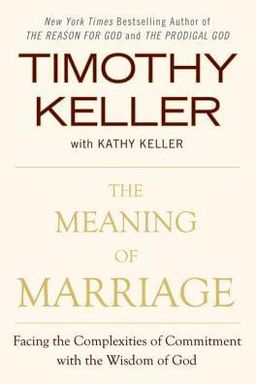
The Meaning of Marriage cover

The Meaning of Marriage

by Timothy Keller with Kathy Keller

The Meaning of Marriage delves into the heart of matrimony, exploring how realistic expectations and deep commitment can foster personal growth, happiness, and shared wealth. Timothy and Kathy Keller provide a Christian perspective on how marriage transcends romantic ideals, offering a path to a more authentic, fulfilling life.

The Meaning of Marriage: Building Love through Grace

What if marriage wasn’t designed to make you happy—but to make you whole? Timothy Keller’s The Meaning of Marriage, written with Kathy Keller, tackles this provocative question head-on. Keller argues that most modern understandings of marriage are broken because they orbit around individual fulfillment rather than spiritual transformation. The core claim: marriage is not a human invention but a divine institution meant to mirror God’s covenantal love—unconditional, self-giving, and redemptive.

At the heart of Keller’s message is a paradox—love flourishes not through personal freedom but through commitment and sacrifice. Drawing from Scripture, theology, and decades of pastoral experience, Keller reframes marriage as both a crucible and a healing community where flawed people learn to give and receive grace. The result is a vision of marriage that’s far more realistic and demanding than Hollywood’s fantasies—and far more fulfilling.

The Cultural Confusion about Marriage

Keller begins by diagnosing our modern confusion. Contemporary Westerners hold two contradictory beliefs: we idolize romantic love while simultaneously fearing commitment. Movies and media portray marriage as the pinnacle of personal happiness—the moment you find your “soul mate” who completes you. Yet sociological data show marriage rates plummeting and cohabitation rising, fueled by skepticism about lifelong love. Keller cites studies revealing that people see marriage as restrictive and risky, a constraint on individuality rather than a foundation for flourishing. He argues this tension comes from a misplaced ideal of self-fulfillment—the “Me-Marriage,” as journalist Tara Parker-Pope calls it.

Keller traces the origins of this shift to the Enlightenment, which transformed marriage from a duty-oriented covenant into a self-oriented contract. In traditional societies, marriage primarily served family stability and child-rearing; in modern ones, it became a vehicle for personal achievement and romantic satisfaction. This new model, Keller contends, is collapsing under the weight of its unrealistic expectations: people now demand that one partner provide all emotional, sexual, and spiritual fulfillment—a role designed for God, not another person.

The Biblical Foundation: Covenant, Not Contract

Against this backdrop, Keller turns to the Bible’s countercultural account. The opening chapters of Genesis depict marriage as God’s idea, not ours—a covenantal bond between man and woman reflecting divine love itself. Paul’s letter to the Ephesians (5:21–33) reveals the “mystery” of marriage: husbands are to love their wives as Christ loved the church, and wives are to respond as the church responds to Christ. In other words, marriage is patterned on the gospel—an act of sacrificial service, not consumer exchange. Keller calls this the “Great Secret” of marriage: it works only when both partners imitate Christ’s self-emptying love, choosing to serve rather than to be served.

This covenantal view contrasts sharply with modern contractual relationships, which rest on reciprocity and performance. A contract says, “I’ll give as long as I get.” A covenant says, “I’ll give myself, regardless of what I get.” Keller insists the latter is not naïve; it’s spiritual realism. Humans are self-centered by nature—what theologians call incurvatus in se, the soul curved inward on itself. Only by experiencing and embodying Christ’s grace can we overcome this inward spiral and learn true love.

Marriage as Gospel Mirror and Sanctifying Venue

For Keller, the gospel and marriage aren’t just parallel; they interpret one another. Marriage reveals the depths of God’s grace: you are known fully—your flaws exposed—and yet loved unconditionally. Likewise, experiencing divine forgiveness enables you to love a spouse who disappoints or wounds you. The harder marriage gets, the deeper the grace grows. As Keller puts it, “Marriage is a major vehicle for the gospel’s remaking of your heart from the inside out.” Difficult seasons—what he calls “the fiery trials” of matrimony—aren’t evidence of failure but opportunities for sanctification.

This perspective resets the question: the goal of marriage isn’t happiness first but holiness first. Happiness emerges as a byproduct of spiritual growth. Keller likens marriage to Christ’s relationship with the church: a love that doesn’t wait for loveliness but works to make the beloved lovely. You don’t marry a perfect person—you marry a “stranger,” someone still becoming who God intends them to be. Through daily acts of repentance, forgiveness, and service, spouses become agents of each other’s transformation.

Why It Matters Today

Keller’s vision cuts through cultural cynicism and sentimentalism alike. Instead of seeing marriage as either utopia or trap, he presents it as a divine apprenticeship in love. The covenant may constrain, but paradoxically, it creates freedom—the freedom to be vulnerable, to change, to grow. His theology of marriage doesn’t romanticize struggle; it redeems it. What looks like dying to self becomes the path to discovering your true self.

By grounding marriage in the gospel, Keller offers hope to singles, married couples, and skeptics alike. Singles learn that marriage’s purpose isn’t to complete you but to reflect the completeness found in Christ. Married people discover that grace—not compatibility or chemistry—sustains love for a lifetime. And readers of all backgrounds see how self-giving love, modeled after divine sacrifice, restores relationships from cynicism to awe.

“We are more sinful and flawed in ourselves than we ever dared believe, yet at the same time we are more loved and accepted in Jesus Christ than we ever dared hope.” —Timothy Keller

This, Keller says, is the blueprint for marriage—and for life.


Self-Centeredness: Marriage’s Hidden Enemy

Timothy Keller calls self-centeredness the silent killer of marriages—the root of nearly every conflict, frustration, and collapse. It’s not income, communication styles, or sexual compatibility that most threaten marriage; it’s the ego’s hunger to make everything revolve around oneself. In Ephesians 5, Keller finds Paul’s antidote: a Spirit-filled life marked by sacrifice and mutual submission. Only spiritual transformation can break the gravitational pull of self-interest that bends each spouse inward.

Seeing Ourselves Clearly

Keller describes the human condition using Martin Luther’s famous idea of incurvatus in se—the self curved inward. When we enter marriage, we bring this curvature with us, expecting our spouse to meet existential needs, validate our worth, and center their life around ours. Inevitably, disappointment follows. In his pastoral counseling, Keller watched couples implode not from irreconcilable differences, but from this unseen contagion of self. Each partner believed, “I’m giving more,” or “I’m not appreciated.” The result is a cycle of blame and withdrawal.

The Gospel as Counterforce

The solution, Keller insists, isn’t more technique but more grace. Paul commands, “Submit to one another out of reverence for Christ.” Submission isn’t weakness—it’s spiritual strength. The Spirit reveals Christ’s self-emptying love, empowering believers to serve because they’ve already been filled by God’s love. When you stop using marriage as a self-esteem factory and begin seeing it as an opportunity to imitate Christ, the power dynamic changes. You’re no longer competing for validation—you’re cooperating in grace.

“You can only afford to be generous if you actually have some love in the bank,” Keller writes. “Fill your spiritual tank with the love of Christ, and you can be generous—no matter how empty your marriage feels.”

Healing from Woundedness

Keller also explores how past hurts magnify self-focus. Many carry emotional wounds from neglectful parents, betrayal, or failed relationships. These wounds breed insecurity and blame-shifting, making self-protection instinctive. Western psychology often prescribes self-love as the cure—telling people to guard themselves or assert personal needs. Keller challenges this: self-centeredness is not caused by pain; it’s inherent in human sin and amplified by pain. Healing comes from receiving Christ’s unconditional love, which dismantles fear and shame and opens us again to serve others freely.

When One Spouse Changes First

Keller notes that transformation often starts with one person. “It only takes one to begin healing,” he writes. When one spouse lives out grace—repenting of selfishness, forgiving freely, serving joyfully—it softens the other’s resistance. This echoes Jesus’ paradox: losing yourself for love’s sake leads to finding yourself. Keller’s own marriage provided examples—moments when mutual frustration gave way to self-examination. Kathy’s honest confrontations and Tim’s humility showed how repentance—not resentment—becomes the real repair strategy.

The Fear of Christ as Motivation

Paul’s phrase “out of fear of Christ” doesn’t mean dread but awe—an overwhelming awareness of divine love that reshapes priorities. Keller explains that true worship breaks self-absorption; you bow not because you’re afraid but because you’re astonished. When reverence replaces fear, submission becomes joy. This reverent love fuels marital service: you can forgive because you’ve been forgiven; you can give because you’ve received.

Ultimately, Keller reframes conflict not as an obstacle but as an invitation to deeper grace. Every argument reveals what you truly worship. If you worship comfort, you’ll resent inconvenience. If you worship self-image, you’ll resist critique. But if you worship Christ, his humility transforms frustration into growth. Marriage becomes less about winning battles and more about daily surrender—where, paradoxically, both partners win by losing themselves in love.


The Essence of Marriage: Covenant over Consumerism

One of Keller’s most insightful chapters contrasts two radically different frameworks for relationships: the consumer model and the covenant model. In a consumer relationship, you stay as long as your needs are met at an acceptable cost. The moment profits dip—emotional, physical, or financial—you “cut your losses.” But in a covenant relationship, the good of the relationship itself outweighs immediate personal satisfaction. The Bible insists marriage is essentially covenantal, not transactional. This single insight reshapes how you define love, commitment, and freedom.

Consumer vs. Covenant Thinking

Modern culture commodifies relationships. Keller cites sociologists who argue that marketplace logic now defines human connection—you “shop” for partners as you would for products. Dating apps embody this mindset: optimize preferences, compare ratings, exit when dissatisfied. But the covenant view runs the opposite direction. A covenant binds you even when feelings wane or costs rise. It is both vertical (made before God) and horizontal (made to your spouse). Breaking faith with your partner, Keller reminds, means breaking faith with God. This is why vows are public—they enlist divine and communal accountability to sustain love beyond convenience.

The Blend of Law and Love

Keller dismantles the false dichotomy between duty and desire. Romanticism claims real love must be spontaneous, unplanned, and driven by passion; any duty kills authenticity. But Keller counters with spiritual realism: “Love needs a framework of binding obligation to make it fully what it should be.” Law and love aren’t enemies but partners. Promises—the “piece of paper”—don’t stifle affection; they stabilize it. Making public vows is an act of courage, saying, “I curtail my freedom so that I can love you freely.”

In covenant love, emotions follow actions. Keller echoes C. S. Lewis’s advice on charity: don’t wait to feel love; act as if you loved, and feelings will follow. Likewise, in marriage, when you serve your spouse even without warm emotion, affection often rekindles. “Actions of love lead to feelings of love,” Keller writes. This principle undercuts sentimentalism and empowers perseverance during dry seasons.

Promise of Future Love

Keller redefines vows not as declarations of current passion but as promises of future love. At a wedding, he says, you stand before God and others and pledge fidelity “in plenty and in want, in joy and in sorrow.” That isn’t naïve—it’s realism about inevitable fluctuations of desire. Like Ulysses tied to the mast to resist the Sirens, vows tether you through temporary madness until clarity returns. Keller quotes studies showing two-thirds of unhappy marriages become happy within five years if couples stay committed—a testament to the power of covenant over mood.

Freedom in Promising

In our age, promising seems restrictive. Keller flips that notion: making vows doesn’t shrink freedom; it deepens it. Promises create stability—the “small sanctuary of trust within the jungle of unpredictability,” as ethicist Lewis Smedes writes. You limit options now to have better options later: the freedom to be dependable, to build intimacy that risk-seekers never know. This covenantal freedom transforms marriage from performance into safety, where vulnerability can thrive because security is assured.

In sum, Keller’s covenant framework turns cultural logic upside down: law enriches love, promises safeguard passion, and duty sustains desire. Without covenant, love withers under pressure; within covenant, it ripens into joy deeper than fleeting romance.


Marriage’s Mission: Spiritual Friendship and Transformation

What is marriage for? Keller answers with striking simplicity: it’s not primarily for happiness, sex, or social status—it’s a lifelong partnership for spiritual growth. Drawing on Ephesians 5:25–27, he shows that Jesus’ love for the church was aimed at sanctification—to make her “radiant, without stain or blemish.” Likewise, our marriages exist to help each other become our “future glory selves,” the people God is crafting us to be.

Marriage as Spiritual Friendship

Keller grounds marriage first in friendship. Friendship, he explains, is not mere companionship or mutual interests; it’s two people journeying toward a common horizon. For Christians, that horizon is Christlikeness. Your spouse isn’t just your lover but your “best spiritual friend,” one who helps you know and resemble God more deeply. Citing Proverbs and C. S. Lewis’s The Four Loves, Keller describes friendship as “side-by-side vision”—two people looking outward at the same truth. Erotic love looks face-to-face; friendship looks shoulder-to-shoulder. A marriage built on that fusion—friendship plus romance—has lasting substance beyond physical attraction.

Helping Each Other to Glory

Keller imagines a future moment when you stand before God and see your spouse in radiant perfection, finally freed from flaws and sin. True love says, “I see who God is making you, and I want to be part of that journey.” This shifts the purpose of marriage from self-satisfaction to sanctification. He uses Michelangelo’s metaphor—looking at marble and “taking away what isn’t David.” Similarly, each spouse helps chip away at the other’s false self through truth and grace. Conflict, therefore, isn’t just irritation—it’s sculpting.

Leaving, Cleaving, Prioritizing

Keller emphasizes priority: biblical marriage means “leaving” parents and “cleaving” to one’s spouse. This act ensures marriage becomes your primary human relationship, even above children or career. Many marriages falter when spouses make their children or parents pseudo-spouses—a theme Keller observed often as a pastor. The healthiest marriages, he says, maintain emotional hierarchy: spouse first, then family, then world. Prioritizing marriage protects intimacy and sets the stage for spiritual influence.

Holiness as Happiness

This theology reframes happiness as the fruit of holiness. Keller quotes Philippians and Corinthians to show that suffering and struggle mature character and deepen joy. For those seeking marriage, this flips the equation: don’t hunt for a finished statue; seek a good block of marble. Choose someone trending toward God, not someone perfect. Holiness doesn’t kill joy—it creates it. In Christlike marriages, pleasure, laughter, and sex become byproducts of mutual refinement, not replacements for it.

Ultimately, Keller’s mission-driven marriage resembles discipleship cloaked in devotion—an adventure where two sinners help each other become saints. The goal isn’t to find your soulmate but to forge one through time, truth, and grace.


Loving the Stranger: Truth, Love, and Grace in Conflict

Stanley Hauerwas’ sobering insight—“We never know whom we marry; we just think we do”—frames Keller’s chapter “Loving the Stranger.” Marriage inevitably reveals hidden parts of each person’s character, exposing the “midnight unmasking” where illusions fall away and true identities appear. Keller argues that marriage, like grace, forces self-revelation. The key to thriving in this exposure isn’t denial or distance—it’s practicing three powers: truth, love, and grace.

The Power of Truth

Marriage reveals what Keller calls “hairline fractures” of the soul. Like a heavy truck driving over a bridge, the weight of intimacy exposes structural weaknesses. Flaws you dismissed as quirks in dating become daily irritants under covenant pressure. The spouse sees you closer than anyone ever has, making denial impossible. Keller tells vivid stories—a man named Rob, whose lifelong lack of empathy became apparent only after marriage, and whose wife’s strength forced him to change. Marriage shows you your own heart not to shame you but to heal you; truth becomes the diagnostic tool of grace.

The Power of Love

If truth exposes, love restores. Keller compares marital love to God’s love—it doesn’t affirm the beloved’s flaws but accepts them while helping transform them. The spouse’s affirmation can redeem years of judgment from others. He writes, “If all the world says you are ugly, but your spouse calls you beautiful, you feel beautiful.” This mutual reprogramming of identity mirrors Christ’s redemptive work—God’s verdict overturns our inner critics. Yet this power also carries danger: if spousal love is harsh or withheld, its wounds cut deepest. Hence Keller calls spouses to wield truth gently and love generously.

The Power of Grace

Truth without love destroys; love without truth falsifies. Grace harmonizes both. Keller likens grace to the “compound” in a gem tumbler—without it, two raw stones either bounce off harmlessly or shatter each other. Grace enables truth-telling without cruelty and love without blindness, because both partners forgive as Christ forgave. Grace also grants humility: you criticize not from superiority but from solidarity. “When a man takes an oath,” Keller quotes Thomas More, “he holds his own self in his hands like water.” Marriage vows and daily forgiveness preserve identity within brokenness.

The Ultimate Power

Grace roots marital love in divine love. Keller closes with the metaphor of the czar who redeemed his adopted son’s debt—a picture of Christ’s costly forgiveness. You can only forgive fully when you see Jesus covering your own sin. “He saw your heart to the bottom and loved you to the skies,” Keller writes. This revelation empowers spouses to extend the same mercy. Over time, truth cleanses, love binds, and grace transforms strangers into companions. Marriage then becomes a microcosm of redemption—slow, painful, yet glorious.


Sex and Marriage: Sacred Passion, Not Mere Performance

Few topics reveal our cultural disconnect from biblical wisdom more than sex. Keller devotes an entire chapter to reclaiming a theology of sexuality—seeing it neither as appetite nor as taboo, but as sacrament. Sex, he writes, is God’s ordained language for total self-giving, a physical sign of the spiritual covenant between husband and wife. When detached from that framework, it loses meaning and power, shrinking into consumption. Within covenant, sex deepens intimacy, joy, and worship.

Beyond Appetite and Shame

Keller dismantles two common distortions. First, the secular view reduces sex to appetite—an instinct to be freely satisfied. Second, the prudish view treats sex as dirty or dangerous, a concession to human frailty. Scripture fits neither. God created bodies and called them “good,” and biblical poetry celebrates erotic delight (Song of Solomon). Keller quotes Tremper Longman describing mutual, joyful passion without shame. This bodily joy mirrors divine creativity. To diminish sex is to deny incarnation itself—the God who took flesh.

Sex as Covenant Renewal

In Genesis 2:24 and Ephesians 5, Keller finds sex defined as “one flesh”—a covenantal act. Each encounter renews vows physically, reaffirming total belonging: “I am wholly yours.” Outside commitment, sex still joins two souls but without the safety of promise, leaving emotional debris of false unity and betrayal. Keller calls sex a “commitment apparatus”—it fuses hearts and therefore damages when misused. Within marriage, however, sex continually re-enacts grace: the merging of vulnerability and trust under promise.

Practical Purity and Joy

For singles, chastity means not repression but preparation. Keller urges spiritual community that upholds sex’s sacredness, countering cultural myths like “sex need not mean anything.” For couples, he emphasizes mutual giving—“the greatest pleasure is seeing your spouse’s pleasure.” Sex, done rightly, is worshipful because it mirrors the Trinity’s self-giving joy. Keller and Kathy’s candid anecdotes—learning patience, fumbling early on, rediscovering grace—illustrate that godly sexuality is learned, not performed. The goal isn’t perfect technique but perfect love.

Keller’s reframing turns physical intimacy into spiritual liturgy. Each act of love whispers the gospel: two bodies declaring one covenant under one Lord.

Dig Deeper

Get personalized prompts to apply these lessons to your life and deepen your understanding.

Go Deeper

Get the Full Experience

Download Insight Books for AI-powered reflections, quizzes, and more.