
Idea 1
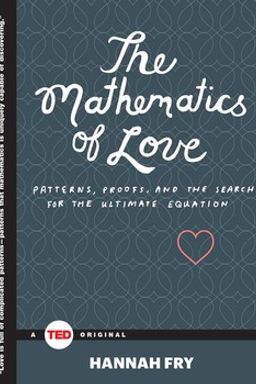
The Mathematics of Love: A Rational Roadmap Through Romance
Why does falling in love often feel unpredictable, yet strangely patterned? In The Mathematics of Love, Dr. Hannah Fry argues that love, far from being purely emotional chaos, follows identifiable patterns that mathematics can illuminate. Fry contends that by applying principles from probability, game theory, and optimization, we can better understand—and even improve—our chances at finding, keeping, and enjoying love. Through humor, research, and relatable examples, she invites readers to see romance as a series of solvable puzzles rather than inscrutable mysteries.
Across nine lively chapters, Fry explores everything from why your odds of finding a partner aren’t as terrible as you think to how algorithms might help (or hinder) your quest for connection. She walks you through mathematical models that describe attraction, dating dynamics, marriage stability, and even sexual networks, demonstrating that numbers can reveal hidden truths about human relationships. Throughout, her tone remains conversational and practically oriented—she doesn’t promise perfect predictions but offers mathematical tools for making more informed, confident decisions about love.
Understanding Love as a Pattern
Fry opens by aligning maths with romance through one audacious claim: both are about patterns. Just as scientists use equations to predict weather or map galaxies, you can use estimation methods to gauge romantic probability. She begins with Peter Backus’s humorous self-study, where he borrowed the Drake Equation—originally designed to estimate alien civilizations—to calculate how many women he might date. His conclusion: fewer potential girlfriends than extraterrestrial species in the galaxy. Although tongue-in-cheek, the method revealed how filtering preferences too narrowly can dramatically reduce your odds of success. Fry suggests loosening rigid criteria to expand one’s dating pool—a mathematical form of emotional openness.
Beauty, Choice, and Probability
From there, she examines how beauty affects attraction, debunking myths like the “golden ratio.” While symmetry and average features matter, Fry reveals that our perceptions are averages of what we deem healthy and genetically sound. She uses examples such as Angelina Jolie’s facial proportions and evolutionary cues like plump lips and strong jaws to explain why humans intuitively prize signs of fertility and health. Yet she notes that preference diversity—those quirks that draw us to asymmetrical smiles or distinctive personalities—is equally mathematical: it emerges from distribution variation. You might love someone because their traits fall slightly outside the average curve, making them statistically singular.
From Party Games to Stable Marriages
In her exploration of courtship, Fry turns dating dramas into equations. She revisits John Nash’s reasoning from A Beautiful Mind to discuss game theory’s role in romantic strategy. Through the “stable marriage problem”—illustrated with humorous characters like Ross, Rachel, Monica, and Joey—she demonstrates that those who do the asking (rather than waiting) mathematically fare better. Whether in love or job placement, initiative statistically yields superior outcomes. Her conclusion is delightfully empowering: taking the risk of rejection produces the best results.
Algorithmic Attraction and Online Matching
When Fry turns to online dating, she dissects platforms like OkCupid that quantify compatibility. Using a playful “Harry and Hermione” example, she teaches geometric mean as a smarter way to calculate match percentages—balancing mutual interest. However, she emphasizes that data fails to predict chemistry; questionnaires can’t capture body language, eye dilation, or emotional synchrony. Future technologies might integrate these subtle cues, but for now, meaningful connection remains beyond mathematical certainty. Her insight: algorithms can’t measure “clicks,” but they reveal the fascinating predictability of human perception.
The Logic of Sex and Settling Down
From physical encounters to lifelong commitments, Fry dives deeper. She describes how sexual networks follow “scale-free” structures, like social media graphs, with hubs (highly connected individuals) that accelerate disease transmission. Mathematically identifying hubs, she explains, helps epidemiologists target treatment efficiently. Later, she discusses the “secretary problem” and optimal stopping theory—the logic behind when to quit searching and commit. Reject the first 37% of your options, then choose the next best one, she suggests, humorously connecting rational optimization to romantic timing.
Mathematics of Marriage and Happiness
Finally, Fry takes us into long-term love with Gottman and Murray’s mathematical marriage model, showing how emotional exchanges can be charted like equations predicting nuclear peace or war. Successful relationships, she explains, correlate with low “negativity thresholds”—couples who address small issues early avoid explosive fights later. This insight translates into an elegant formula for compassion: communicate complaints, repair rapidly, and respect individuality. The message resonates far beyond equations: understanding the math behind emotions teaches empathy through structure.
Together, these chapters form not a cold calculation of romance but an invitation: to see love as a beautifully complex system that mathematics can illuminate but never replace. Fry’s engaging narrative—part science, part storytelling—suggests that pattern recognition isn’t the opposite of passion. It’s how passion persists. Love, she concludes, can be measured not by formulas alone but by the intelligent curiosity that mathematics inspires.