
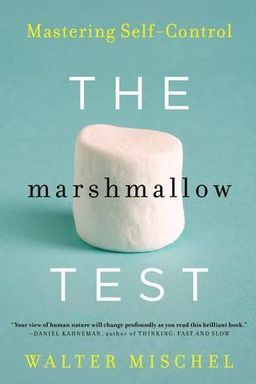
The Marshmallow Test cover

The Marshmallow Test

by Walter Mischel

The Marshmallow Test by Walter Mischel delves into the science of self-control, showing how delayed gratification can lead to lifelong success. Through engaging psychological insights and practical strategies, this book empowers readers to enhance their self-control, make better decisions, and create a fulfilling life.

The Science of Self-Control

How do you delay gratification when every impulse says "now"? In The Marshmallow Test, Walter Mischel reveals the psychology and neuroscience behind willpower. He argues that self-control is not fixed at birth but a skill—an interplay between emotion, cognition, and context—that can be taught, practiced, and strengthened. The famous marshmallow experiment was never a test of destiny; it was a window into how the mind learns to wait.

From treats to lifelong trajectories

The original Marshmallow Test, conducted in the late 1960s at Stanford’s Bing Nursery School, invited preschoolers to choose one treat now or two later. What looked like a simple waiting game turned into one of psychology’s most lasting studies of self-control. Longitudinal follow-ups with over 550 participants showed that children who could wait scored higher on SATs, managed stress more effectively, and enjoyed healthier adult lives. Yet Mischel stressed: the test predicted group trends, not individual destiny. Life circumstances, trust, and learning environments could transform outcomes completely.

Hot and cool systems — the architecture of willpower

At the core of self-control lies a tension between the mind’s hot and cool systems. The hot system—anchored in limbic regions like the amygdala—is impulsive, emotional, and reward-driven. The cool system—the prefrontal cortex—is reflective, strategic, and goal-oriented. When stress or temptation spikes, the hot system dominates; when calm and perspective return, the cool system can reengage. Neuroscientific evidence from fMRI studies confirms this: lifelong high delayers show stronger frontostriatal connectivity and prefrontal activation when resisting rewards, while low delayers light up subcortical reward areas.

Strategies that shape waiting and willpower

Mischel’s preschoolers invented their own coping tools—humming, turning away, pretending, or framing the marshmallow as a picture (“You can’t eat a picture,” Lydia reasoned). Later work showed that distraction, abstraction, and reappraisal powerfully increase delay ability. When you represent the treat in cool terms (its shape or rule structure) instead of hot ones (taste and texture), your impulse weakens. Even mood matters: positive or playful thoughts lengthen waiting, while sadness shortens it. These strategies engage the cool system to override hot impulses.

Context, attachment, and development

Self-control takes root in relationships. Toddlers who could distract themselves during brief maternal separations later waited longer for treats, showing continuity between emotional regulation and delay of gratification. Parenting that balances autonomy with structure—neither intrusive nor neglectful—builds attention control and confidence. Early caregiving, stress exposure, and the environment sculpt the prefrontal circuits that make cool control possible. Genes provide tendencies, but epigenetic switches respond to nurturing or neglect, proving that willpower is shaped as much by nurture as by nature.

From individuality to intervention

Later chapters show how these findings translate into practical methods: forming If–Then plans, rewiring fear through exposure, training executive function, and teaching children structured strategies through programs like Tools of the Mind and Sesame Street. Mischel’s ultimate claim is deeply hopeful: human nature is plastic. You can rehearse cool strategies, design environments that reduce temptation, and cultivate self-control as a lifelong skill. Willpower is not a trait you either have or lack—it’s a set of habits that link imagination, emotion, and choice.

Core truth

The Marshmallow Test is not just about children and candy. It’s about how you, under stress or desire, can learn to cool the present and heat the future—transforming fleeting impulses into lasting purpose.


How Willpower Works

Willpower operates through two competing systems—the emotional “hot” and the reflective “cool.” Mischel and Metcalfe’s framework helps you understand not only what drives impulsive behavior but how to regain control when emotions surge. The hot system pushes toward immediate pleasure or avoidance; the cool system holds long-term goals and rules in mind. Delaying gratification, therefore, means shifting dominance from hot to cool cognitive processing.

Hot system: reflexive and survival-driven

Rooted in limbic structures, the hot system triggers instinctive responses. It evolved to ensure quick reactions to reward or threat. But in modern life—where temptations are constant and rarely lethal—it often misfires, compelling overeating, rage bursts, or impulse spending. (Note: This system mirrors Kahneman’s System 1, fast and emotional.) Under stress, it can hijack reasoning, weakening executive function and distorting perceptions.

Cool system: strategic and slow

The cool system, housed in the prefrontal cortex, lets you forecast outcomes, inhibit impulses, and maintain deliberate control. It matures slowly, explaining why children’s self-regulation increases through adolescence. When the cool system prevails, you can detach from emotion, visualize consequences, and engage strategies like cognitive reappraisal. In adults, chronic stress undermines this system by impairing prefrontal connectivity, a mechanism observed by Amy Arnsten at Yale.

Mood and cognition

Experiments by Jack Wright and Mischel prove how mood can tilt the balance. Sad students who imagined rejection reacted intensely to failure feedback, lowering self-estimates, whereas happy students inflated confidence. Mood primes amplify or dampen the hot system, altering memory and prediction. This finding connects laboratory data to daily experience: if you decide while angry or sad, the hot system dominates and distorts judgment.

Practical control

To strengthen cool control, train awareness of physiological cues that signal heat—racing heart, tension, craving. Then impose distance: pause, breathe, visualize long-term benefits, or engage distraction. Willpower becomes reliable not by suppressing emotion but by recognizing when to cool cognition before acting.


Training the Mind to Wait

What you think determines how strongly temptation grips you. Delay improves when you represent the reward in cool, abstract terms rather than hot sensory detail. The Marshmallow Test revealed that preschoolers intuitively discover this: some sang, covered their eyes, or mentally "framed" the treat, transforming it from irresistible food to an object of study. Mischel called these moves 'cognitive cooling.'

Distraction and reappraisal

Distraction is your simplest weapon: redirect attention from hot cues. Preschoolers who distracted themselves could wait more than ten minutes even with the treat visible. Adults apply similar maneuvers—daydreaming during stress or redefining unpleasant cues. Reappraisal goes deeper: change meaning, not just focus. If you think of chocolate cake as a picture or a symbol of future regret, craving fades. Daniel Berlyne’s work on 'hot versus cool representations' clarified that how you encode the stimulus reshapes emotional strength.

Frame the temptation

Mischel’s teams taught children to imagine the treat as a framed picture (“put a frame around it”). The result was delayed satisfaction almost equal to cases where the treat was absent. Lydia’s comment—“You can’t eat a picture”—captures how cognitive reframing translates into physiological calm. Adults can use the same principle by visualizing long-term outcomes vividly (“heat the later”) while abstracting the immediate urge (“cool the now”).

Emotion and mood effect

Positive priming increases delay; sadness or negative mood shortens it. Compliments or fun thoughts make delayed choices easier. These patterns underline that emotion and cognition are intertwined. Managing your affect—keeping optimism without illusions—is a foundation for cool control both in everyday temptations and clinical resilience.


Automating Self-Control

You can make self-control automatic by using If–Then implementation plans. They tie a specific cue to a pre-decided action, reducing deliberation when the hot system flares. Mischel’s preschool experiment with the 'Mr. Clown Box' proved the point: when children practiced saying 'I’m working' whenever the box buzzed, distractions plunged dramatically.

Mechanism of action

If–Then plans hardwire your cool system’s decision into the hot system’s automatic trigger. Once rehearsed, the cue (“bzzt sound,” sight of dessert, surge of anger) fires the planned behavior. Gollwitzer and Oettingen expanded the method, showing its power for dieting, studying, and managing ADHD. The logic is simple: pre-load the desired reaction so it requires little real-time reflection.

Crafting effective plans

Strong plans specify both cue and response precisely—“If I feel anxious before a call, then I will breathe three times.” Practice reinforces the link until it becomes habitual. Like muscle memory, repeated execution shifts effort from conscious to automatic. Implementation intentions merge psychology with habit design, turning self-control into reflexive behavior that survives stress.

Application beyond lab

From preschool tasks to clinical and educational uses, If–Then planning helps children with ADHD sustain attention and workers resist digital distractions. The technique bridges theory and practice: you code cool intentions into the brain’s hot pathways so the future governs the present instantly.


Roots and Plasticity

Self-control begins in infancy and remains malleable across life. Mischel’s collaborators traced its origins to attachment and caregiver style. Toddlers who could explore and self-distract during brief separations predicted stronger delay capacities years later. Parenting that encourages autonomy while providing structure cultivates executive function—the attentional control that later supports academic and emotional success.

Attachment and caregiving

In Anita Sethi’s observations using Ainsworth’s Strange Situation, toddlers who tolerated brief separation through distraction excelled later in delay tests. Annie Bernier’s research showed that autonomy-supportive parenting enhanced cognitive self-regulation. Overcontrol stifles agency; balanced support builds resilience. These results demonstrate that emotional trust and independence intertwine to form the basis of cool control.

Nature and nurture intertwined

Genes predispose temperament, but experience expresses it. Frances Champagne’s epigenetic studies found that nurturing or neglect altered gene activation linked to stress responses. Rat pups raised by highly caregiving mothers developed calmer, smarter profiles—direct proof that early environments rewire biology. Human parallels include the Flynn Effect and twin results: heritability explains part, but experience explains much. The brain's plasticity allows self-control training long after childhood.

Policy and intervention

Programs like Tools of the Mind and KIPP demonstrate applied plasticity. Structured play, attention games, and teacher modeling elevate executive function, especially in disadvantaged groups. Evidence converges on one conclusion: early environment sculpts willpower circuitry, and timely education can transform life opportunities. You can reshape both mind and brain by designing nurturing contexts that teach self-regulation explicitly.


Fear, Failure, and Rewiring

Emotions like fear and self-doubt can hijack behavior, but they can also be rewired. Mischel extends the hot–cool model to phobia and mood, showing that automatic emotional control—stimulus control—arises from learned associations. Overcoming it demands guided mastery rather than sheer will.

Fear conditioning and recovery

Using John Cheever’s story 'The Angel of the Bridge', Mischel illustrates stimulus control: a man cannot cross bridges after one traumatic storm. His amygdala fires panic automatically. Recovery comes via Joseph Wolpe’s methods of systematic desensitization—pairing feared stimuli with relaxation—and Albert Bandura’s guided mastery models. Watching others act calmly and practicing progressively rewires fear responses.

Psychological immune system

Your mind also has self-protective filters that preserve optimism after setbacks. Mischel’s clinic studies found that cognitive therapy helps depressed individuals rebuild this 'psychological immune system': realistic yet positive self-assessment. But unmoderated immunity breeds illusions and overconfidence—seen in leaders and professionals whose confidence exceeds accuracy. Resilience must be balanced by humility and external feedback.

Practical calibration

To stay resilient without delusion, cultivate affirming self-talk and secure relationships while enforcing accountability. Solicit dissenting advice before major actions and use precommitments that make errors visible. Emotional rewiring and cognitive moderation together sustain self-control under pressure.


Designing Habits and Beliefs

Beliefs about willpower influence how well you use it. The traditional strength model—willpower as a finite muscle—captures part of the truth but misses motivation’s role. You don’t just run out of control; you often stop wanting to try. When effort feels energizing instead of depleting, persistence rises.

The strength and mindset models

Baumeister’s experiments showed that people quit tasks more quickly after resisting temptations, suggesting depletion. Later research by Dweck found that students who believed effort invigorates maintained discipline through exams. Mindset reframes fatigue as signal—not limit. Believing willpower can grow sustains effort under stress.

Precommitment and modeling

Binding precommitments ensure consistency when motivation wavers—like depositing money with a penalty for lapses. Modeling matters too: when adults held strict self-reward standards, children copied them. Values are learned not from words but from witnessed self-discipline. The Navy SEAL example underscores the compound effect of mindset, social reinforcement, and moving goals.

Cognitive reframing and structure

Reframe difficult obligations as identity-affirming choices rather than restrictions. Use structural nudges such as automatic savings or environmental changes to remove temptations. When you configure surroundings and beliefs jointly, you build sustainable self-control across domains—from dieting to ethical conduct.


Personality in Context

People differ not by one global trait but by predictable patterns—If–Then signatures. Mischel’s Wediko camp studies revealed that personality consistency lies in conditional reactions. Jimmy and Anthony, for example, showed similar total aggression but reacted aggressively to different triggers.

Mapping behavioral signatures

Over 167 hours per child, researchers documented behaviors across situations (peer teasing, adult praise, punishment, etc.). Distinct profiles emerged: Jimmy exploded with adults’ warnings; Anthony with peers’ friendliness. These behavioral patterns—stable If–Then profiles—explain variability better than trait labels.

Tailored change

Understanding your personal triggers enables precision interventions. Log situations that provoke hot reactions, then formulate matching If–Then cooling plans (If I feel excluded, Then I will reach out calmly). The same cooling strategies observed in delay tasks reduce aggression and improve social adjustment. Personality becomes a predictable map, not a fixed destiny.

Interpersonal benefits

Once you grasp others' If–Then patterns, empathy and management improve. Teachers, therapists, and leaders can target situations rather than traits. Understanding context-stable signatures is key to personal growth and social harmony.


Human Agency and Change

Mischel closes with a simple declaration: 'I think, therefore I can change what I am.' The final sections of his work synthesize decades of research into one conviction—human beings are remarkably malleable. Executive function, motivation, and goal design together let you sculpt character and destiny.

EF plus purpose

Executive function supplies cognitive control; passion supplies persistence. Bruce Springsteen refining his craft or Mark Owen enduring SEAL training shows how purpose amplifies control. You can rehearse cool strategies endlessly, but they need burning goals to engage.
(Note: This convergence parallels Angela Duckworth’s 'grit' concept—deliberate practice plus fervent interest.)

Choosing malleability over determinism

Across genetics, attachment, and neuroplasticity, the evidence rejects fixed determinism. Believing you can change is itself transformative—mindset modulates both motivation and biology. Intervention studies show that practicing self-control tasks, attention games, and mindfulness literally remodel neural circuits.

Your charge

You can design environments, commitments, and mental cues that continually strengthen willpower. The message is empowering: human nature allows self-design. The research doesn’t tell who you are—it teaches how you can become who you decide to be.

Dig Deeper

Get personalized prompts to apply these lessons to your life and deepen your understanding.

Go Deeper

Get the Full Experience

Download Insight Books for AI-powered reflections, quizzes, and more.