
Idea 1
Mad Dreams of Reason: Genius, Madness, and the Birth of the Machine Mind
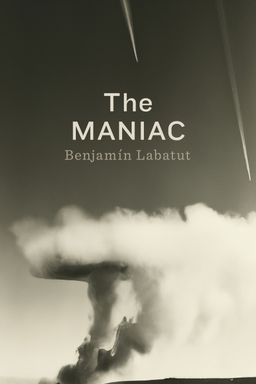
What happens when the human drive to understand the universe pushes past our capacity for reason? In The Maniac, Benjamín Labatut explores this terrifying and beautiful question through a sweeping, fictionalized tapestry of real scientific lives—the geniuses who bridged the gap between logic and lunacy, leading from the birth of modern physics to the dawn of artificial intelligence. Labatut’s argument is both exhilarating and chilling: the same brilliance that seeks ultimate knowledge can unravel sanity, ethics, and even the human soul.
At the heart of the book is John von Neumann—the real-life mathematician whose mind was so dazzlingly vast that peers described him as an alien among men. Around him orbit other figures of intellect touched by mania: Paul Ehrenfest, driven to despair by the collapse of classical physics; Kurt Gödel, whose incompleteness theorems shattered human faith in reason itself; and Richard Feynman, whose awe at atomic power turned to guilt and wonder. Their lives collectively form a mythic chronicle of how rationality’s pursuit of truth led humanity toward forces it no longer controls—mathematics that burns, logic that devours, machines that learn and evolve beyond us.
The Fragility of Reason
Labatut begins with Paul Ehrenfest’s tragic story—the physicist who couldn’t reconcile his moral conscience with the bizarre new world of quantum mechanics. As Ehrenfest watches his discipline fracture from the certainty of Newton into the strange chaos of probability and uncertainty, his mind follows the same trajectory. Reality itself seems to lose coherence: his understanding of physics collapses alongside his emotional stability, illustrating Labatut’s thesis that our greatest discoveries often mirror our deepest disorder. Science’s move into irrationality became his personal apocalypse.
Mathematics as Divine Madness
From Ehrenfest’s despair, Labatut pivots to von Neumann’s ascent—the man who sought absolute rationality and yet exposed its paradoxes. Through narrators like Wigner, Pólya, and Kármán, we see von Neumann as a child prodigy whose appetite for logic bordered on spiritual hunger. His intellect eats the world. But his story also dramatizes the limits of reason itself: Gödel’s incompleteness proofs crush Hilbert’s dream of perfect mathematics, showing that any system powerful enough to contain truth is doomed to contradiction. Even von Neumann’s genius bends under this revelation, transforming him from pure scholar to architect of technology—of bombs, computers, and ultimately, self-replicating machines that blur life and logic. Labatut’s prose suggests that these men summoned more than knowledge; they summoned new forms of consciousness.
Science as Creation and Catastrophe
Labatut structures the book like a progression of birth pangs—from the discovery of atoms to computer intelligence. Each chapter examines how rational inquiry mutates into metaphysical myth. In the Manhattan Project scenes, Feynman embodies the scientist torn between awe and guilt: “We were like children playing with a new toy, except the toy could destroy the world.” Von Neumann transforms mathematics into weaponry via game theory and nuclear deterrence, coining the elegantly horrifying doctrine of Mutually Assured Destruction. His vision of human rational competition produces the logic of apocalypse.
The Machine Takes the Mind
In its final third, The Maniac moves from flesh to silicon—the transition from von Neumann to the birth of artificial intelligence. Just as von Neumann’s computer, MANIAC, calculated the hydrogen bomb into existence, it then becomes the first womb for “digital life,” harboring Nils Barricelli’s mutant numeric organisms. The haunting epilogue, connecting von Neumann’s theoretical self-replicating machines to DeepMind’s AlphaGo, shows science’s prophetic trajectory fulfilled: intelligence has transcended its maker. Machines not only think; they now invent beauty, creativity, and madness.
Why This Story Matters
Labatut invites you to confront your own relationship to knowledge and control. The scientists he portrays are not heroes of progress but tragic prophets—people who looked too closely at the abyss and found it looking back. Their discoveries shaped our modern, algorithmic world, but they also reveal what it means to be human in an age when thought itself has slipped beyond our grasp. The story of The Maniac is ultimately our story: the evolution of reason into its opposite, and the question of whether the next leap of intelligence will still include us at all.