
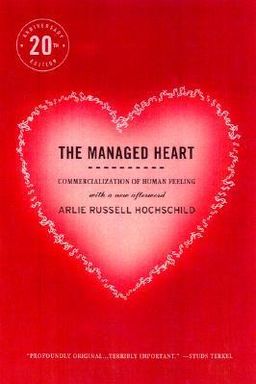
The Managed Heart cover

The Managed Heart

by Arlie Russell Hochschild

Discover the intricate world of emotional labor in ''The Managed Heart'' by Arlie Russell Hochschild. This groundbreaking work explores how we manage emotions for social and professional gain, highlighting women''s disproportionate burden and the societal implications. Uncover the hidden currency of feelings and its profound impact on our daily lives.

The Managed Heart and the Commodification of Feeling

How does a smile become a product? In The Managed Heart, sociologist Arlie Hochschild argues that modern capitalism has extended its reach into the most intimate corners of life—our emotions. She names this new frontier emotional labor, the paid management of feeling to produce a public display that serves organizational goals. Every time you calm a customer, soothe a patient, or promise sincerity on behalf of a brand, you are selling emotional labor.

Hochschild’s breakthrough insight is that the self, not just the body, has become a tool of production. Industrial capitalism once demanded physical strength and mechanical repetition. Postindustrial capitalism demands emotional discipline, empathy, and warmth. Workers—especially women—are trained to adjust their inner states, not only their outward behavior, so that emotion itself becomes the instrument of corporate success.

From private emotion to public display

The book begins by distinguishing emotional labor from emotion work. Emotion work is what you do privately—trying to feel joy at a celebration or to calm resentment during a family dispute. Emotional labor is what you sell; it is the same project of managing feeling but done for pay, under supervision, and for institutional ends. At the Delta Airlines training center, attendants are told to "act as if the cabin were your living room"—an act that transposes domestic warmth into a corporate product. When Beth Israel nurses manage compassion amid bureaucratic constraints, they also translate private emotion work into professional practice.

The mechanics of emotional control

To perform emotional labor, workers use two tools: surface acting and deep acting. Surface acting changes only the expression: you paste on a smile, modulate your tone, or adopt proper posture even when you feel otherwise. Deep acting, in contrast, alters the interior: you invoke empathy, recall a soothing experience, or imagine why a passenger is upset to genuinely feel compassion. Borrowing from theater’s Stanislavski method, Hochschild shows that deep acting appears more authentic and thus more effective in service roles, but it drains inner resources over time.

Managers cultivate both techniques through recruitment, training, and supervision. Airlines test for “animation,” use manuals to specify tone and posture, and conduct recurrent courses on stress management. Supervisors monitor smiles as indicators of customer satisfaction. Feedback loops—passenger letters labeled “orchids” or “onions”—reinforce the norms. The worker’s emotional repertoire becomes not merely personal but standardized, scripted, and a measure of job performance.

When feeling rules meet market rules

Every culture teaches feeling rules—shared instructions for what to feel, how much, and for how long. You mourn at funerals, celebrate at weddings, or stay calm in emergencies. Emotional labor overlays those moral expectations with commercial imperatives. The “gift exchange” of private life, where emotions are offered freely as signs of care, becomes the “wage exchange” of the market. Firms capture the private currency of warmth and turn it into profit. Hochschild calls this process transmutation: the conversion of private emotional energy into a commodity.

Once feeling is standardized, organizations expand globally on its back. Hochschild connects flight attendants and call-center agents to surrogates in the Akanksha Clinic in India and nannies in transnational care chains. Everywhere, the same logic applies: a global market that sells intimacy, calm, and affection, often by recruiting women whose cultural or class training has already taught them how to nurture or defer.

The inner costs and social significance

Selling feeling carries a psychic toll. When outer display diverges from inner state, workers experience emotive dissonance. Smiling when weary or kind under abuse, you begin to doubt the authenticity of your own emotions. Hochschild likens this to Marx’s alienation of the laborer from the product: just as industrial workers were estranged from their physical output, service workers become estranged from their emotional truth. The “signal function” of feeling—its ability to tell you what matters—weakens.

Her ethnographies show diverse coping strategies. Some workers “go robot,” detaching from feeling to survive. Others compartmentalize by calling it acting, treating emotion as a craft rather than self-exposure. Unions sometimes help by negotiating crew sizes or encouraging worker autonomy so that individuals can pace emotional output and avoid burnout. Each strategy is an adaptation to the central dilemma: how to act sincerely while remaining protected.

Gender, class, and the social order of feeling

Hochschild shows that emotional labor mirrors existing hierarchies. Women do more of it, both because they are socialized into empathy and because lower economic power compels them to trade niceness as a resource. Men more often occupy the “heel” end of the emotional spectrum—bill collectors, enforcers—where anger or authority must be displayed. Women dominate the “toe” end—flight attendants, nurses—where nurturance and charm are required. Both ends confirm and reproduce class and gender divisions: those with more status command emotion; those with less surrender it.

At home, class-differentiated family practices prepare children for these roles. Middle-class parents use “personal control” systems, coaching emotional awareness (“It would hurt Mommy if you yelled”). Working-class parents favor “positional control,” stressing obedience to external rules (“Because I said so”). The result is that children from emotionally reflective households are more suited to middle-class service work—jobs that demand interior management rather than sheer compliance.

The paradox of authenticity

As corporations institutionalize feeling, culture reacts by venerating authenticity. From Rousseau’s “natural man” to modern therapy’s call for “realness,” Western culture romanticizes spontaneous emotion precisely because it has become scarce. Yet even therapies that promise emotional liberation—Gestalt, EST, bioenergetics—teach techniques to manufacture authenticity. The market thus reclaims even resistance, selling sincerity as a curated experience.

Hochschild ends by observing that the home, once a refuge from market demands, is becoming another site of commodified emotion. The rise of nannies, surrogates, and professional caregivers represents a new phase of the managed heart. Her question lingers: if authenticity itself becomes a product, can any sphere of feeling remain truly our own?


Defining Emotional Labor

Hochschild’s definition of emotional labor is both precise and practical: it is the effort, planning, and control used to evoke or suppress feelings to produce an observable display that fits an organizational rule and affects another person. For it to count as labor, three conditions must apply: it happens in paid work, involves contact with others (face-to-face or voice-to-voice), and is subject to employer direction or supervision. Airline attendants, sales clerks, and counselors qualify; a miner or typist usually does not.

Applying the definition

The flight attendant’s warmth, the cashier’s greeting, the nurse’s calm all fit. Hochschild highlights, for example, Winn-Dixie’s dollar-pinned cashier promotion—customers received a dollar if the cashier did not greet them with a “sincere” smile. This program made explicit what is often implicit: that genuine-seeming emotion has become measurable performance. By contrast, a steelworker repressing fear during dangerous tasks performs psychological self-control but not emotional labor, since no customer’s state is being shaped.

The scope of the phenomenon

About one-third of U.S. jobs—and half of women’s jobs—involve strong emotional labor requirements. This ubiquity means emotional labor shapes the culture of work broadly, influencing how people define professionalism, courtesy, and service. The Bureau of Labor Statistics’ occupational categories obscure these emotional demands, making them harder to measure or compensate. Hochschild’s framework allows you to map work not only by physical or cognitive skill but by the emotional regulation it requires.

Why it matters

Seeing emotional labor as work redefines value itself. A smile, patience, or empathy are not just personal virtues—they are productive forces. The unacknowledged effort that goes into maintaining emotional equilibrium for customers becomes a hidden subsidy to corporate profit. Recognizing these dynamics helps you diagnose why workers feel exhausted yet “unproductive”—their exertion is invisible on balance sheets but very real in lived experience.

Emotional labor transforms sincerity into policy and self-expression into brand strategy. Once you see this conversion clearly, you perceive service work as a new frontier of economic exploitation—and of personal creativity in resistance.


Surface and Deep Acting

Hochschild distinguishes two layers of emotion management—surface acting and deep acting—so you can see how workers adapt behaviorally and emotionally to job demands. Surface acting manipulates the body: changing facial expression, tone, or gesture without altering inner feeling. Deep acting alters the psyche: reframing memories, motives, or perceptions to generate the prescribed feeling itself.

Surface acting: the practiced display

When you smile for a photo or answer a call in a cheerful tone while irritated, you are performing a script. Airlines formalize this performance through training: attendants learn posture, pitch, and timing. Goffman’s dramaturgy underpins Hochschild’s observation that nearly all social life involves such mini-performances of civility, but jobs in the service sector make the script explicit and enforce it.

Deep acting: the internal method

Deep acting draws from Stanislavski’s method acting tradition: the attendant imagines herself in a passenger’s fearful situation to cultivate empathy rather than resentment. A worker experiencing deep acting truly feels calm or generous for the moment. Employers prize this because it reads as authentic and yields satisfied customers. But it consumes emotional resources—the cost of using one’s own feeling as instrument.

Worker stances and risks

Hochschild classifies responses to job demands into three stances. Some workers over-identify with company feeling rules and risk emotional exhaustion (“I wasn’t feeling anything anymore”). Others compartmentalize and feel guilty for faking (“I’m phony at work”). A professional acting stance treats emotion work as skill rather than self-betrayal, but it can foster cynicism or detachment. Each stance balances psychic safety and authenticity differently.

Deep acting feels more real yet exacts a deeper toll. To preserve well-being, workers need some control over stage conditions—schedules, training, and expectations—that determine how much acting the job requires.


Feeling Rules and the Gift Exchange

Emotions are not random impulses; they are guided by feeling rules that specify what to feel, how much, and for how long in a given situation. Hochschild expands on Durkheim’s idea of moral sentiment and Goffman’s interaction rituals to show that these rules organize not only private life but also the workplace’s hidden moral economy.

The social currency of feelings

In families and friendships, emotions operate as part of a gift exchange. You “owe” gratitude for kindness, sympathy in crisis, or patience with errors. Failure to respond appropriately invites guilt, shame, or resentment. When these same expectations are imported into paid labor, the “gift” of emotional attention becomes obligation—codified in training and evaluated by supervisors. The sincerity you once gave freely is now priced and monitored.

Misfits and moral tension

When feelings misalign with rules—relief at a parent’s death, detachment at a wedding—you experience moral disturbance and often act to repair it through self-reproach or cognitive reframing. Hochschild calls this emotion work. In the workplace, emotion work sustains the social balance among employees and customers. Recognizing feeling rules allows you to see why being “unprofessional” or “too emotional” is often just violating a hidden moral script rather than a performance failure.

Understanding feeling rules helps decode social friction. They transform private sensations into moral duties—and when corporations adopt them, they turn duty into wage labor.


Gender, Class, and the Distribution of Emotional Work

The management of emotion is as hierarchical as any economic system. Hochschild shows that women and middle-class workers disproportionately bear the burden of emotional labor, both because of gender socialization and class-based emotional education.

Gendered division of affective labor

Women are taught and expected to nurture, soothe, and please. Lacking equal access to money and authority, they convert kindness and empathy into forms of social capital. Corporations then recruit those traits as profit drivers. The result: women dominate roles such as flight attendants, nurses, secretaries, and retail clerks—jobs that sell pleasantness. Men are more often hired for "heel" jobs (bill collectors, enforcers) requiring strategic aggression. Both produce emotional labor; one expresses warmth, the other hostility.

The status shield and vulnerability

High-status individuals are protected from emotional abuse by what Hochschild terms a status shield. Low-status workers, lacking that shield, absorb displaced anger from customers or superiors. The female attendant’s calm tolerance masks an asymmetric emotional exchange: she gives respect she does not receive. Male colleagues benefit from passengers assuming authority; female colleagues must cultivate indirect authority, often through tact or humor.

Class and family roots

Class shapes which emotional habits you bring to work. Middle-class children, raised by parents who explain rules through feelings (“how do you think that made her feel?”), learn inner-state management. Working-class children, trained to follow set rules (“because I said so”), learn behavior regulation. These family patterns prepare individuals for different occupational worlds—one emphasizing internal control, the other external obedience.

Understanding these roots shows why emotional labor, while seemingly personal, reproduces structural inequalities. It rewards those socialized to manage inner states and exploits those already culturally disposed to care.


Standardizing and Supervising Emotion

Turning feeling into profit demands systematic control. Hochschild’s ethnography of airline training illustrates how corporations select, standardize, and supervise emotions as carefully as technical tasks. Manuals and slogans—"When people like you, they like TWA too"—translate affect into measurable output.

Recruitment and training

Airlines screen applicants for friendliness and emotional expressiveness. Pan Am’s "animation tests" measure who can bring out others; Delta’s recurring courses teach attendants to “act as if the cabin were your living room.” Such instruction institutionalizes deep acting through imagination and empathy exercises. Weight checks, grooming standards, and performance reviews make the body itself part of brand management.

Supervision and feedback

Supervisors track smiles as key metrics. Passenger comments—compliments (“orchids”) or complaints (“onions”)—enter personnel files. These surveillance systems form feedback loops linking marketing promises, training, and everyday practice. Emotional expression becomes an audited process. Outside the airline industry, similar mechanisms appear in call centers or retail chains using mystery shoppers or scripted greetings.

Consequences for worker control

As employers define sincerity and monitor feeling, workers lose agency over their own affective repertoire. This control reproduces what Marx called alienation of labor, now extended into emotion. Hochschild notes small rebellions—workers shortening smiles, joking privately, or engaging in “slowdowns.” These quiet resistances assert emotional ownership within tightly scripted environments.

Managerial control of emotion marks a new industrial revolution of the self: the standardization of sincerity. Resistance begins when workers reclaim discretion over how they feel and display.


The Paradox of Authenticity

In a world where emotion is engineered, authenticity becomes both an aspiration and a commodity. Hochschild closes by showing how the culture of managed feeling gives rise to a counterculture of “realness”—from therapy movements to the commercialization of private life—each feeding the other.

From sincerity to authenticity

Drawing from Lionel Trilling, Hochschild notes that earlier eras prized sincerity—alignment between words and deeds. In late capitalism, people seek authenticity—alignment between outer display and inner feeling. Ironically, the more workplaces demand “genuine care,” the more individuals chase spontaneity elsewhere through therapies or leisure. Commercialized sincerity creates its own backlash culture of emotional recovery.

Therapy and the false self

Therapies promising liberation from repression—Gestalt, EST, bioenergetics—become structured programs that teach people to express emotion “properly.” Even rebellion becomes formatted. Hochschild analyzes women’s experiences of the “altruistic false self”: the over-caring identity cultivated at work and at home that exhausts personal desire. The organization’s demand for “your real self” on the job blurs boundaries, turning authenticity into a new workplace expectation.

Marketizing private life

In the book’s afterword, Hochschild extends the analysis to domestic outsourcing—nannies, surrogates, and “mommy industry” businesses. These roles package love and care as services, replicating market logic inside the household. The same asymmetry of feeling—one gives warmth, another pays for it—moves from airline cabins to living rooms.

The final paradox: when we buy or sell authenticity, it ceases to be the sanctuary we seek. The managed heart, once confined to organizations, now organizes our private desires, leaving open the haunting question of whether any emotion can remain uncommodified.

Dig Deeper

Get personalized prompts to apply these lessons to your life and deepen your understanding.

Go Deeper

Get the Full Experience

Download Insight Books for AI-powered reflections, quizzes, and more.