
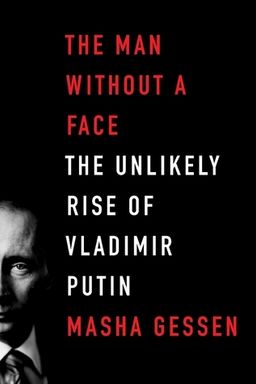
The Man Without A Face cover

The Man Without A Face

by Masha Gessen

Dive into the shadowy world of Vladimir Putin''s Russia, where power is seized through cunning maneuvers and fear, revealing the inner workings of a regime that continues to shape global politics with its authoritarian grip.

The System Putin Built

How does an ordinary intelligence officer become the architect of a twenty-first-century autocracy? This book traces Vladimir Putin’s rise from a provincial KGB operative to Russia’s paramount ruler, showing how institutions, networks, and crises combined to erode democracy and recentralize state control. It’s not only a biography but a map of power—how secrecy, loyalty, and fear replace law, competition, and accountability.

At its core, the book argues that Putin’s ascent was not an accident of personality but the predictable outcome of post-Soviet institutional decay. What begins as an attempt by Russia’s ruling elite to protect themselves from prosecution evolves into a durable structure of control. The central theme you discover is continuity: men trained in the KGB reemerge in new roles, the security culture of St. Petersburg scales up to the entire state, and the myths and crises that made Putin popular become permanent tools of governance.

From collapse to control

You begin in the ruins of the Soviet Union. Institutions falter, elites fight over privatized assets, and the old intelligence networks quietly persist. The 1990s are chaotic: corruption scandals like the “meat and metals” barter schemes show how state functionaries repurpose regulation for personal profit. In St. Petersburg, where Putin serves under mayor Anatoly Sobchak, political murder, surveillance, and corrupt privatization coexist. The city becomes the model of a ‘state within a state’—secretive, loyal, and dependent on informal ties rather than public law.

When Yeltsin grows frail and unpopular, his entourage—the “Family”—looks for a successor who can guarantee their safety. Putin, a quiet bureaucrat with KGB discipline and no base of his own, seems perfect. This decision, made in private apartments and on seaside vacations, shows how power in late 1990s Russia operates through personal fear, not institutions. What the Family mistakes for pliability turns out to be adaptive cunning.

Fear and opportunity

The 1999 apartment bombings—real or manipulated—become the pivotal event that launches Putin’s legitimacy. He presents himself as the strongman who will avenge a wounded nation. His coarse language, military tone, and media saturation transform fear into political capital. The “Election by Fear” sequence shows that modern autocracy can arise not by abolishing democracy but by ruling through emotion: anxiety replaces debate, and safety eclipses liberty. You realize how a new contract is drawn between ruler and ruled—security in exchange for silence.

Consolidation by media and myth

The early presidency is defined by the capture of television and narrative. Disasters like the Kursk submarine tragedy expose the fragility of the regime’s image control, yet also teach the Kremlin a lesson: control information or be destroyed by it. Oligarchs who built media empires—Boris Berezovsky, Vladimir Gusinsky—are neutralized through raids, coerced stock transfers, and exile. Broadcast news transforms from watchdog to mouthpiece. At the same time, Putin’s own PR—his childhood fights, judo, and KGB romance—is broadcast as national myth. The man becomes a story, and the story becomes a political instrument.

The architecture of authoritarian legality

Once secure, Putin uses legality itself to dismantle democracy. Decrees replace elections for governors, “federal districts” staffed by ex-KGB envoys oversee regions, and electoral rules become traps for opposition parties. The state borrows the vocabulary of law to execute the opposite. This “vertical power” philosophy seeps into every institution: courts, bureaucracy, and media operate under the same implicit rule—loyalty above law. When big business steps outside that rule, as in the Khodorkovsky affair, the response is swift and exemplary: arrest, asset seizure, and redistribution to state companies like Rosneft under the guise of due process.

Crises as instruments

Terror and tragedy reinforce this centralization. The Moscow theater siege and the Beslan school massacre, covered in later chapters, reveal how national traumas are instrumentalized. Rather than prompt transparency, both become reasons to further tighten control. The security organs regain primacy, and public debate is curtailed in the name of national security. Even when errors or complicity emerge, investigations falter—journalists like Anna Politkovskaya or Alexander Litvinenko who pursue the truth are killed or poisoned. You see how fear, once mobilized to win elections, becomes institutionalized as a governing tool.

Resistance and fragility

By the 2010s, civic fatigue and digital networks fracture this illusion of stability. The 2011 protests—the “Snow Revolution”—bring thousands to the streets wearing white ribbons, protesting rigged elections. Bloggers like Alexei Navalny, citizens’ groups, and volunteer observers reveal the falsifications and reclaim public space. The movement shows both the regime’s vulnerability and society’s resilience. While the protests are suppressed, they reveal an essential contradiction: authoritarian stability depends on an informed, compliant populace, yet control of information eventually provokes rebellion.

A central lesson

What this book ultimately teaches you is that modern autocracy operates less by ideology than by systems of control—networks, crises, and narratives. Putin’s Russia becomes the case study of how security culture evolves into governance, how democracy dies not through coups but through institutional substitution, and how myth and fear together sustain an empire of obedience.


Origins in St. Petersburg

To understand Putin’s rule, you first explore the microcosm where it was invented—St. Petersburg in the 1990s. This city becomes a laboratory for the fusion of bureaucracy, business, and the security services. Under mayor Anatoly Sobchak, the local government is full of KGB veterans who treat civic administration as an extension of intelligence work. Surveillance, privatization, and coercion mingle. The murder of reformer Galina Starovoitova shows the deadly consequences of challenging these networks.

Corruption and the “meat contracts”

Marina Salye’s investigation into missing food-import contracts exposes a corrupt barter system where city officials authorize exports of raw materials in exchange for promised food shipments that never arrive. Putin’s own paperwork appears in the file. Yet nothing happens—Sobchak ignores the findings. The case demonstrates that corruption isn’t a breakdown; it’s a method of governing transition, rewarding insiders who control access to licenses and signatures. This is how power functions when legality becomes a negotiable commodity.

Once a spy, always a spy

The KGB’s “active reserve”—officers embedded in civilian posts—creates continuity between Soviet repression and capitalist privatization. Putin’s move from the KGB to the university and then city hall fits the pattern. Whether he truly resigned or was redeployed remains ambiguous, but the system’s purpose is clear: to ensure loyalty and gather intelligence inside new institutions. (Note: this mirrors what Hannah Arendt described as the transformation of ideology into routine administration.)

You leave St. Petersburg understanding that post-Soviet governance did not erase the Soviet state; it privatized its methods. Loyalty replaces competence, opacity replaces accountability, and the men who master secrecy soon bring their system to Moscow.


How Power Was Inherited

Power passes to Putin not through popular mandate but through elite necessity. In 1999, Boris Yeltsin’s health and scandals erode his presidency, and his advisers—Tatyana Dyachenko, Alexander Voloshin, Boris Berezovsky—search for a successor who can protect their interests. Putin, then a low-profile intelligence officer loyal to Sobchak, looks insignificant enough to control. The Family mistakes obedience for harmlessness.

Projecting strength amid fear

Soon after his appointment as prime minister, Russia faces the 1999 apartment bombings and renewed war in Chechnya. Putin’s aggressive response defines him publicly as a man of action. The phrase “we will rub them out in the outhouse” becomes the axis of his appeal. Fear reshapes public life: chaos gives way to the illusion of control, and the new leader embodies national revenge and stability. Whether or not the security services staged or exploited the attacks, they transform terror into a political engine.

Manipulating elections

The December 1999 Duma elections and the March 2000 presidential race rely on media orchestration. Berezovsky’s channels glorify Putin while attacking opponents. Yeltsin’s calculated resignation on New Year’s Eve makes Putin acting president—granting him incumbency and immunity for Yeltsin’s clan. You see how elite calculation replaces democratic choice. (In comparative terms, this is closer to elite succession in hybrid regimes described by Steven Levitsky and Lucan Way.)

Key takeaway

Putin’s rise isn’t a coup or a popular revolt but a controlled succession—fear outside, bargaining inside, and projection in between. The new ruler emerges as the solution to problems the old system created.


Image, Media, and Control

Putin’s first years hinge on mastering image. His official biography—commissioned by Berezovsky—turns street-fighting anecdotes and KGB loyalty into a myth of discipline and strength. The controlled media broadcast these narratives relentlessly. Crises reinforce this dependency: when perception falters, the Kremlin moves to eliminate independent broadcasters.

The Kursk and televised leadership

The 2000 Kursk submarine disaster exposes the limits of image control. Putin’s delayed response and the dismissive “It sank” comment enrage Russians. The media briefly rebel—Sergei Dorenko’s program airs footage defying the official line. For the Kremlin, this humiliation redefines television as a battlefield, not a forum. Within months, raids on Media-Most and the coercion of Gusinsky signal that independent coverage will not be tolerated.

From propaganda to monopoly

The state takeover of television follows a pattern: pressure through debt, controlled corporations like Gazprom, and threats of arrest. Gusinsky’s NTV and Berezovsky’s Channel One fall under state control via forced share transfers. By 2001, the Kremlin controls nearly all national broadcasting. The result is narrative monopoly—television becomes an extension of the Kremlin’s press office. Critical journalists, from Babitsky to Parfenov, are dismissed or exiled.

You watch how control of the image becomes control of the state. Once the cameras serve the throne, no institution remains independent enough to check authority.


Law, Oligarchs, and Predation

Legalism becomes the camouflage for seizure. After conquering the media, the Kremlin turns to business. Early oligarchs—formed in privatization’s chaos—had traded loyalty for access. But by 2003, loyalty means submission. The Yukos affair crystallizes this transformation.

Khodorkovsky’s fall

Mikhail Khodorkovsky’s company, Yukos, is profitable, transparent, and modernized with Western auditing. He funds civil projects and independent parties. When he publicly lectures Putin about corruption, he crosses an invisible line. His arrest in October 2003—filmed on a runway—signals that economic power cannot coexist with political dissent. The trial is a show of procedural form and political intent, ending in imprisonment and the forced sale of Yuganskneftegaz to Rosneft via a shell company. In one stroke, the state reclaims oil and asserts ownership of capital.

Economic power as political obedience

Other oligarchs take note: cooperation ensures wealth, defiance ensures exile. This pattern consolidates the “vertical” economy—corporations become vehicles of state influence, not independent enterprises. The phrase “rule of the boss” replaces “rule of law.” What began as anti-oligarch reform reveals itself as selective expropriation, shaping a new economic elite defined by loyalty and dependency.

Essential observation

When legality becomes an instrument of control, every citizen is vulnerable. The Yukos case teaches you that autocracies don’t abolish courts—they weaponize them.


Crises, Violence, and Power

The early 2000s bring new tragedies that test—and justify—centralization. The Moscow theater siege (2002) and the Beslan school massacre (2004) demonstrate how the regime responds: by valuing control over life. These disasters produce hundreds of deaths, ambiguous official narratives, and political consequences that further weaken pluralism.

Terror as pretext

In both crises, negotiations yield to armed assault. The FSB withholds information, doctors lack antidotes, and public investigations are obstructed. Yet the state declares success, blaming terrorists and silencing questions. The result is paradoxical: every catastrophe strengthens central authority. The abolition of regional elections after Beslan is justified as national defense. You see how fear permanently fuses with politics: every incident of terror widens executive power and narrows accountability.

Killing critics

Those who investigate—the journalists and ex-agents—die. Anna Politkovskaya is shot in her apartment building; Alexander Litvinenko is poisoned with polonium in London; Yuri Shchekochikhin and Sergei Yushenkov collapse under mysterious conditions. These are not isolated crimes but symptoms of a system where coercion spills beyond borders. The message is unmistakable: truth has jurisdiction, but in this Russia, death enforces silence.

You come away recognizing that state violence in Putin’s system is not always declared; it’s ambient—a background condition that makes opposition dangerous even without open repression.


From Managed Democracy to Protest

By the late 2000s, formal democracy remains, but substance vanishes. Governors are appointed, opposition parties face bureaucratic traps, and election tallies defy mathematics. Yet digital spaces introduce new cracks. The 2011–2012 protests, fueled by social media and civic coordination, revive public life long suppressed.

The mechanics of control

The Kremlin uses notaries, forms, and tax audits as weapons. Signatures invalidated on technicalities, rallies canceled for “safety,” and television monopolized by presidential coverage—all make the electoral field unequal. Analysts like Darya Oreshkina label it “special electoral culture”: instead of falsifying every vote, you falsify the environment itself.

The Snow Revolution

December 2011’s “white ribbon” movement unites liberals, communists, small-business owners, and parents. Bloggers like Navalny coordinate donations and volunteers; citizen observers document ballot-stuffing in real time. Bolotnaya Square fills with optimism. While the Kremlin suppresses the movement, it’s shaken by something new: decentralized legitimacy. Every subsequent crackdown—foreign agent laws, network restrictions—stems from the fear unleashed by this unexpected pluralism.

Enduring lesson

Authoritarianism survives by managing perceptions, not votes. But once perception slips— once citizens see falsification live—the regime’s invincibility turns brittle.

Dig Deeper

Get personalized prompts to apply these lessons to your life and deepen your understanding.

Go Deeper

Get the Full Experience

Download Insight Books for AI-powered reflections, quizzes, and more.