
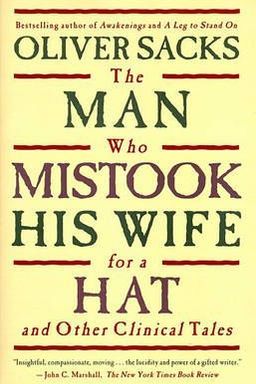
The Man Who Mistook His Wife for a Hat and Other Clinical Tales cover

The Man Who Mistook His Wife for a Hat and Other Clinical Tales

by Oliver Sacks

Explore the extraordinary effects of brain damage on human perception and behavior through Oliver Sacks'' captivating clinical tales. This book delves into the bizarre and remarkable transformations of individuals, revealing hidden talents and reshaping our understanding of the mind''s resilience and adaptability.

The Human Mind Seen Through Neurological Stories

What if losing your memory, identity, or senses didn’t just break your body—but rewrote your very self? In The Man Who Mistook His Wife for a Hat, Oliver Sacks asks this disturbing and beautiful question through a series of real stories from his decades as a neurologist. His patients—lost mariners, disembodied ladies, aphasic speakers, and autistic artists—are not merely cases to be studied. They are portraits of human beings navigating the fragile line between disease and identity, deficit and adaptation, science and art.

Sacks contends that the human brain is not simply a machine of functions, defects, and equations. Modern medicine often reduces people to charts and symptoms, but Sacks insists that neurology must also tell stories. Each patient’s narrative reveals how we adapt and survive when the structures of perception, emotion, or memory collapse. He calls this approach a return to romantic science—a discipline that sees medical cases not only as phenomena, but as lives filled with meaning.

A Doctor Who Writes Lives, Not Just Diagnoses

Sacks grew up in a medical family surrounded by stories of illness and recovery. He inherited both the clinical precision of neurology and the empathy of storytelling. In his prefaces, he laments how twentieth-century medicine abandoned case history—the vivid, personal narratives of nineteenth-century neurologists—in favor of data. His mission is to revive that tradition. His case histories study the brain’s failures, but with literary compassion, he transforms these failures into fables of survival. (He compares his work to Luria’s The Man With a Shattered World, calling it complementary: one depicts loss, the other mystery.)

The Structure of Human Experience

The book unfolds in four parts—Losses, Excesses, Transports, and The World of the Simple. Each part explores a different dimension of how brain disorders alter, erase, or expand the sense of self. In “Losses,” patients like Dr. P., who mistakes his wife for a hat, or Jimmie, the man trapped in 1945, reveal what happens when fundamental identity fractures. “Excesses” depicts minds bursting with unnatural vitality—Tourette’s, mania, and other states of overactivity. “Transports” ventures into visionary or spiritual episodes where disease evokes mystical experience, while “The World of the Simple” celebrates people with intellectual disabilities whose imagination and concreteness reveal a different kind of wholeness. Through these lenses, Sacks shows how the boundaries between sickness, genius, and individuality blur.

The Soul in the Science

At its heart, this book argues that neurology must rescue the human subject from sterile science. Every illness is also an attempt by the body or mind to preserve identity in adverse circumstances. This idea—initially expressed by Ivy McKenzie and echoed by Sacks—defines each story: disease is never just destruction but an adaptation, often ingenious, sometimes tragic, always human. A stroke survivor rotates endlessly in her wheelchair rather than turns left because her brain has lost the concept of “left.” A blind sculptress learns to use touch to perceive the world anew. A woman with musical seizures rediscovers forgotten childhood memories through epilepsy. These stories make science personal: each symptom becomes an existential strategy.

Why It Matters to You

Sacks’s case histories remind you that intellect and emotion cannot be separated. When cognition fails—through aging, injury, or disorder—the will to live, imagine, and connect often persists. His patients reveal what it means to be human when reason collapses. They force you to consider questions of moral worth and consciousness: Are we still ourselves when memory, perception, or control dissolves? The stories suggest that our identity survives even in fragments, shaped not just by function but by feeling, relationship, and narrative. In this way, Sacks positions neurology as a window not into dysfunction but into human possibility. His writing—part scientific observation, part literary meditation—encourages every reader to see the brain not as a mechanism but as the seat of experience, imagination, and soul.

A Legacy of Compassionate Neuroscience

By intertwining clinical precision with empathy, Sacks pioneers a deeply humane vision of medicine. He helped revive “narrative medicine,” inspiring generations of doctors and thinkers to see the patient’s story as essential data. (Modern programs at Columbia University and Harvard Medical School now teach Sacks’s narrative methods.) The Man Who Mistook His Wife for a Hat is thus both a window into extraordinary minds and a manifesto for how we care, imagine, and understand. It reveals that identity persists even when consciousness falters—and that in every neurological disorder, there remains the enduring mystery of the human self.


Seeing and Losing Reality

The book’s iconic story, “The Man Who Mistook His Wife for a Hat,” opens with Dr. P., a gifted musician whose visual world has become abstract and fragmented. With a stroke of irony that borders on the surreal, Dr. P. quite literally mistakes his wife’s head for his hat. Through this case, Sacks examines visual agnosia—a condition that erases the brain’s ability to recognize familiar forms or faces while leaving memory and intellect intact. What’s lost in Dr. P. isn’t sight, but meaning.

Perception Without Connection

Dr. P. can describe objects logically—the color, shape, or geometry—but cannot comprehend what he sees as belonging to reality. Asked to identify a rose, he describes it as “a red convoluted object with a linear green attachment.” For him, the flower becomes a mathematical shape, devoid of emotional recognition. His world has turned into an abstract puzzle detached from life. This reveals, Sacks explains, that recognition is not just mechanical processing—it depends on emotional and personal engagement. Without feeling, we lose the living reality of things. (Kurt Goldstein once argued that brain damage robbed patients of abstraction, reducing them to the concrete. Sacks reverses this idea: some patients lose the concrete itself and become trapped in abstraction.)

Music as the Last Anchor

Dr. P.’s condition, though tragic, also offers insight into adaptation. Sacks discovers that while Dr. P.’s visual reality has disintegrated, his musical reality remains intact. He can navigate daily life only through song—his speech, movements, even eating follow musical rhythm. “He sings everything,” his wife explains. Music replaces vision as his mode of meaning; melody becomes the structure through which he identifies and interacts with the world. This reinforces Sacks’s central thesis that we survive loss not by repair but by invention. Dr. P.’s brain has built a new order around function that remains—his auditory and rhythmic intelligence.

Science and Human Mystery

The story raises questions that science alone cannot answer: Is Dr. P. still a coherent self when perception has lost substance? Are melody and structure enough to sustain identity? Sacks doesn’t offer a formulaic solution. Instead, he shows neurology as a philosophical inquiry—a study of how the brain gives rise to meaning, art, and selfhood. Dr. P.’s ability to live through music evokes Schopenhauer’s idea that melody is “pure will,” the deepest form of being. Through him, Sacks challenges the boundaries between reason and art, mechanism and soul.


Memory and the Self

What happens when memory dissolves, but personality persists? In “The Lost Mariner,” Sacks meets Jimmie G., a genial man forever living in 1945. He recalls the war, the Navy, and youth, yet forgets everything that happens minutes later. This devastating amnesia—Korsakov’s syndrome—reveals how memory is not just a function but the foundation of identity. Without continuity, existence fractures into a stream of disconnected moments.

Living in the Eternal Present

Jimmie’s brain can no longer form new memories. He greets his doctor like a stranger every time. He is trapped in what Sacks calls “a single moment of being, with a moat of forgetting all around.” Yet Jimmie’s case transcends tragedy. Even without memory, he reveals flashes of moral and spiritual continuity. When he takes communion, or listens to music, he feels whole. Sacks calls this the soul’s endurance beyond mechanism—the persistence of “moral attention and action” that survives cognitive collapse.

Memory as Identity

Through Jimmie, Sacks echoes philosopher David Hume’s claim that we are “nothing but a bundle of perceptions.” If memory fails, continuity vanishes. But Sacks differs: he finds that identity can survive even when cognition disintegrates. Jimmie forgets events but not values; his spiritual life anchors him where logic cannot. This suggests that personal meaning arises not only from remembering but from connection—with others, with art, and with faith. (The neurologist A.R. Luria similarly found that moral awareness could persist after massive brain damage.) The story thus captures Sacks’s faith that even amid neurological devastation, the human spirit can endure intact.


Illness as Adaptation

Sacks’s most striking insight is that disease is not just failure—it’s adaptation. When the body breaks, the self improvises. His patients don’t merely suffer neurological losses; they invent substitutes. The woman in “The Disembodied Lady,” for instance, loses all proprioception—the ability to feel her body. She becomes, in her words, “a pithed human being.” Yet she learns to stand and move by watching her body with her eyes, turning vision into a new sensory language. Loss sparks creativity.

The Will to Recreate the Self

Faced with body blindness, Christina teaches herself to operate entirely by sight, posture, and will. She lives as “a physiological experiment,” showing that identity is not fixed but flexible. Her story embodies what Sacks calls the patient’s striving to preserve identity in adverse circumstances. The instinct to adapt—whether by song, sight, touch, or imagination—defines what it means to be human.

Disease as Meaning, Not Just Mechanism

Modern science might reduce Christina’s illness to failed neurons, but Sacks sees meaning where others see malfunction. Illness reveals the boundaries of consciousness and creativity. When Christina learns to live without proprioception, she moves from despair to mastery. Her transformation, like that of other patients, shows that the human mind continually rewrites itself. Sacks argues that medicine must study both physiology and phenomenology—the how it feels to exist after change. Through such stories, he invites readers to see adaptation as the core of life itself.


Excess and the Overflowing Brain

Not all neurological disorders are losses. Some are surges of uncontrollable vitality. In “Excesses,” Sacks explores conditions of superabundance—Tourette’s, mania, and euphoric brain disease—that blur the boundary between health and madness. The brilliant “Witty Ticcy Ray,” a jazz drummer with Tourette’s syndrome, lives on the edge between creativity and chaos. His tics, involuntary bursts of movement, fuel his musical genius. When medicated, his rhythm dulls; off medication, his Tourette’s makes him electrifying. Life demands a balance between inhibition and freedom.

Finding Harmony in Disorder

Ray learns to divide his world: “Haldol during the workweek, freedom on weekends.” Through him, Sacks ponders whether illness can be a form of adaptation. Tourette’s becomes not only pathology but personality—a manic gift. Similar paradoxes appear in “Cupid’s Disease,” where an elderly woman’s neurosyphilis releases youthful joy, and in “The Possessed,” where a Touretter’s frenzy transforms the streets of New York into a living pantomime. Sacks compares these conditions to “dangerous wellness,” echoing Nietzsche’s idea that pain and disease can liberate the mind. In such excesses, life shines too brightly, reminding us that health may also be a form of limitation.

When Too-Muchness Becomes a Way of Being

These exuberant disorders force you to rethink normalcy. The human brain, Sacks suggests, is not built for static equilibrium but for movement, passion, and creation. In patients driven by impulse or song, life spills past boundaries. Against reductive medicine, he argues that such “hyper” states can reveal the brain’s creative powers, even its spirituality. Disease, here, opens the door to transcendence—and reminds us that we are more than chemistry; we are beings capable of art, joy, and dangerous intensity.


Transports of Spirit and Memory

In the section “Transports,” Sacks explores the paradoxical states where disease evokes transcendence—visions, ecstasies, and emotional awakenings. For patients like Mrs. O’C., who hears Irish songs after a stroke, and Bhagawhandi, dying of a brain tumor, hallucination becomes revelation. Each experiences involuntary memory that carries them beyond ordinary consciousness. Drawing on Hughlings Jackson and Wilder Penfield’s research, Sacks argues that temporal lobe seizures can unlock vivid “reminiscences”—real events replayed as visionary experiences.

The Healing Power of Reminiscence

Mrs. O’C.’s hallucinations transport her back to her childhood in Ireland, rekindling lost memories and feelings of love. Though caused by epilepsy, the experience heals a lifelong wound—her forgotten mother. When the music fades, she feels restored, “complete in a way I never had before.” Sacks calls this strange grace an “anamnesis,” merging Jackson’s physiology with Freud’s notion of emotional remembrance. Disease paradoxically becomes a bridge between body and soul.

Visions, Art, and Revelation

Other stories—like Hildegard of Bingen’s migraine-inspired visions—extend this theme. Sacks shows that neurological events can spark profound artistic and spiritual creativity. These transports raise questions about the nature of the mind: can mechanical seizures evoke genuine meaning? He suggests that the brain’s representations are inherently iconic, like music or art—a physiology of experience that transcends computation. Through them, Sacks imagines a “personalistic neurology,” one that embraces narrative, memory, and transcendence as part of science.


The Wisdom of the Simple

“The World of the Simple,” Sacks’s final section, defends those often dismissed as “mentally defective.” He finds in his patients—Rebecca, Martin the chorister, and José the autistic artist—a purity of perception that reconnects science with wonder. Unlike intellectual minds that live in abstraction, the simple live in concreteness. They see the world vividly, aesthetically, and spiritually. Their disabilities often reveal strengths: direct feeling, creative expression, and moral depth.

Truth Through Art and Music

Rebecca, though unable to think abstractly, finds meaning in poetry and ritual. Martin, with cerebral injury, achieves transcendence through Bach’s music. José, an autistic savant, expresses connection through exquisite drawings. Each transforms limitation into artistry. Sacks argues that narrative, music, and drama organize their world—the same way language and logic organize ours. (Psychologist Jerome Bruner would later echo this, distinguishing the “narrative” and “paradigmatic” modes of thought.)

The Dignity of Being Whole

Sacks’s vision overturns the hierarchy of intellect. Intelligence may fail, but imagination redeems. His simple patients invite you to see wholeness where society sees defect. As Kierkegaard wrote, “The symbolism of the Scriptures…is for all.” Sacks sees in these minds not retardation but revelation—proof that humanness lies not in abstraction but in emotional depth, creativity, and faith. Their stories end the book not in tragedy but affirmation: nature gives all minds, even broken ones, the power to find meaning.

Dig Deeper

Get personalized prompts to apply these lessons to your life and deepen your understanding.

Go Deeper

Get the Full Experience

Download Insight Books for AI-powered reflections, quizzes, and more.