
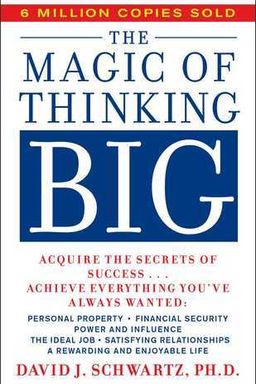
The Magic of Thinking Big cover

The Magic of Thinking Big

by David J Schwartz

The Magic of Thinking Big reveals how self-belief is the cornerstone of success, offering powerful strategies to unleash your potential. Through practical examples and insights, David J. Schwartz empowers readers to achieve their dreams by fostering creativity and building a supportive environment.

The Magic of Thinking Big: How Expansive Thinking Transforms Your Life

Have you ever wondered why two people with similar talents, education, and opportunities achieve drastically different results? In The Magic of Thinking Big, David J. Schwartz contends that success is not determined by intelligence, luck, or background—but by how big you think. Your thoughts, he argues, create a self-fulfilling reality: think small, and you will live small; think big, and you will shape a larger, richer, and more satisfying life.

Schwartz’s core message is deceptively simple but profoundly powerful: “There is magic in thinking big.” He shows how great achievements—in business, relationships, and personal fulfillment—emerge not from extraordinary ability but from ordinary people who cultivate extraordinary belief. The book offers practical psychology, motivational techniques, and examples drawn from everyday situations that demonstrate how adjusting your mental scale upward can open doors others never see.

The Power of Mindset

Schwartz begins with an insight echoed by modern psychology (and later reinforced by authors like Carol Dweck in Mindset): belief acts as a mental thermostat that governs achievement. When you truly believe you can succeed, your mind finds ways to create that success. When you doubt yourself, it conjures excuses to justify failure. This principle applies universally—from career growth to relationships, from starting a business to learning new skills.

Schwartz illustrates this idea with vivid stories. A sales representative named Harry didn’t earn five times more than his peers because he was smarter or worked harder—he just thought five times bigger. He imagined greater possibilities, aimed higher, and as a result, accomplished more. His belief expanded the range of what was possible.

A Cure for “Excusitis”

Before you can think big, Schwartz says, you must purge the thought disease he calls “excusitis.” This is the tendency to rationalize failure—blaming health, intelligence, age, or luck instead of addressing one’s mindset. Successful people have health issues, imperfect education, and ordinary lives, but they refuse to make excuses. Excusitis is curable, he insists, if you begin believing in your capacity to grow and act decisively instead of waiting for perfect conditions.

Schwartz’s antidote to excusitis includes gratitude, perspective, and proactive effort. Every challenge can become a springboard if you address it with possibility thinking rather than resignation.

Thinking Big vs. Thinking Small

Many people underestimate their own value. They look at others and see greatness, while seeing mediocrity in themselves. Schwartz argues that self-deprecation—seeing yourself as less than you truly are—is success’s biggest criminal. His style resembles Dale Carnegie’s (How to Win Friends and Influence People) optimism but goes further: Schwartz demands you consciously expand your expectations of what is possible for you.

He provides tools to practice big thinking: use optimistic language, visualize future possibilities instead of present limitations, and focus on major goals rather than petty issues. He even encourages building a “sell-yourself-to-yourself commercial,” reminding you of your strengths daily until confidence becomes second nature.

The Action-Oriented Mind

Big thinking alone isn’t enough—you must act. Schwartz distinguishes between activationists, who do things, and passivationists, who wait. Successful individuals cultivate an “action habit.” They start before conditions are perfect, meet problems as they come, and learn by moving forward. Action, he says, cures fear, while hesitation fertilizes it.

Goals, Leadership, and Environment

Later in the book, Schwartz shows how big thinking translates into practical success: use clear goals to focus your energy, manage your environment to surround yourself with positivity, and learn to act like a leader by trading minds with people you influence. Your psychological climate—your relationships, workplace, and habits—feeds your success just as physical nourishment feeds your body.

Ultimately, The Magic of Thinking Big is not an abstract motivational treatise. It’s a manual for self-development that teaches you to think expansively, act decisively, and live purposefully. The book’s enduring message is that success demands neither genius nor luck—it demands belief, initiative, and big thinking. And once you adopt that mindset, you stop asking whether you deserve success and start asking how you’ll use it.


Believe You Can Succeed and You Will

Schwartz begins with the boldest of declarations: belief is the foundation of success. Success, he insists, isn’t reserved for the brilliant or the lucky—it’s accessible to anyone who believes genuinely that they can achieve their goals. This belief triggers internal motivation, creative energy, and persistence, ultimately turning hope into tangible success.

The Thermostat of Achievement

Your mind works like a thermostat—it regulates everything you do according to your level of belief. If you believe you’re capable of remarkable things, your brain generates creative strategies, bold actions, and perseverance to reach them. But if you believe you’re limited, the same thermostat keeps you in the comfort zone of mediocrity. Schwartz tells real stories, like that of Harry, a salesman whose earnings were five times higher than his colleagues’. Harry’s secret? He simply “thought five times bigger.”

The Power of Thought: Mr. Triumph vs. Mr. Defeat

Schwartz compares the mind to a factory run by two foremen—Mr. Triumph, who manufactures positive, confidence-building thoughts, and Mr. Defeat, who produces negative, self-sabotaging ones. When you feed Mr. Triumph commands like “I can do it,” he puts your mental machinery to work finding opportunities. When you feed Mr. Defeat “I can’t,” he generates excuses and fear. The key is firing Mr. Defeat permanently and using Mr. Triumph’s positive thinking full-time.

Belief in Action

Schwartz urges you to replace doubt with belief through disciplined mental habits. Every time you face a challenge, substitute success thoughts (“I’ll find a way”) for failure thoughts (“It’s too hard”). He also teaches the importance of thinking success throughout your day—in appearance, conversation, and effort. Successful people simply think and act as if they belong in success, and over time, others begin to believe it too.

The chapter’s essence is timeless: whether you’re chasing career advancement or personal happiness, belief activates your hidden potential. As industrialist Henry Ford famously said, “Whether you think you can or you think you can’t—you’re right.” Schwartz proves that truth with human stories and actionable steps for recalibrating your inner thermostat toward greatness.


Cure Yourself of Excusitis, the Failure Disease

To think big, you must first rid yourself of the mental affliction Schwartz calls excusitis, the tendency to justify why you can’t succeed. This disease manifests through common excuses—poor health, insufficient intelligence, being “too old” or “too young,” and bad luck. Every failure, Schwartz insists, suffers from excusitis in one form or another.

Health Excusitis

People often imagine their health problems prevent success. Schwartz counters with examples of individuals who thrive despite physical setbacks. His diabetic colleague travels, works, and enjoys life fully. A one-armed lawyer becomes a respected community leader. The lesson: don’t talk about your health constantly. Gratitude and action—rather than worry—keep you well and confident.

Intelligence Excusitis

Another common excuse: “I’m not smart enough.” Schwartz challenges this notion, stating that how you use your brain matters more than IQ itself. People with average intelligence who think positively and act decisively outperform highly intelligent negative thinkers. He cites examples of “fact men” who memorize but don’t apply knowledge—contrasting them with “idea men” who innovate and succeed.

Age and Luck Excusitis

Some say they’re too old to start anew; others, too young to be taken seriously. Schwartz destroys both myths with inspiring stories: a fifty-one-year-old began college and became a department chair by fifty-five; a twenty-three-year-old led a sales team of older men by combining respect with confidence. Luck, the final excuse, is equally deceptive. Success isn’t randomness—it’s the consequence of preparation and persistence.

“Don’t wait for luck. Create it.”

By acting instead of waiting, you generate circumstances that others call luck. Every success story is simply someone’s deliberate effort repackaged as fortune by outside observers.

The cure for excusitis, Schwartz concludes, is to focus on what you can control—your thoughts, your effort, and your actions. Reject excuses and you will instantly separate yourself from the majority of people waiting for life to change. In doing so, you reclaim responsibility for success.


Build Confidence and Destroy Fear

Fear is success’s biggest enemy, and the only way to destroy it is through action. Schwartz reveals that confidence isn’t innate—it’s built by managing fear and acting despite discomfort. Fear feeds on inaction, while courage thrives on movement. Every step you take toward what you fear weakens its grip until it vanishes entirely.

Action Cures Fear

Schwartz’s principle is clear: when fear appears—act. The Navy trained sailors to overcome fear of water by pushing hesitant recruits off diving boards; the moment they hit the water, their fear vanished. Similarly, an executive afraid of losing his job reversed decline by actively tackling his sales problems instead of worrying. Action transforms fear into strength.

Memory Bank Management

Your mind stores positive and negative experiences like a bank. Most people keep withdrawing negative memories—failures, rejections, disappointments—and sink into insecurity. Schwartz advises depositing positive thoughts daily: achievements, gratitude, happy moments, and sincere compliments. Over time, these positive deposits compound into self-assurance.

Mastering the Fear of People

We often feel inferior to others. Schwartz offers a simple cure—see people not as giants, but as equals. Everyone struggles, worries, and dreams. Remembering this truth dissolves fear. Practice meeting people confidently—by making eye contact, speaking clearly, and smiling sincerely. When you act important, you begin to feel important.

Practical Confidence Builders

  • Sit in the front row—it signals courage and engagement.
  • Walk 25% faster—it creates energy and purpose.
  • Speak up—express opinions confidently.
  • Smile big—it disarms fear and invites connection.

Schwartz’s formula for confidence balances psychology and practicality. Replace hesitation with action, nourish the mind with positive memories, and treat people as equals. Fear melts away when you move toward it, leaving confidence as the natural residue of courage.


How to Think Big

Thinking big means expanding your view of yourself, your work, and your potential. Schwartz argues that most people sabotage themselves through self-deprecation—seeing themselves as smaller than they really are. True success begins when you enlarge your mental scale and imagine the highest version of who you can become.

Self-Evaluation and Belief

Schwartz encourages readers to list five assets and compare themselves with successful people who possess less of each. This exercise proves you already have advantages and potential. You simply need to act as though you deserve more. When you think big, your behaviors—speech, posture, and commitment—transform accordingly.

Language Shapes Thought

Words create mental movies. A big thinker uses positive, future-focused language: challenges instead of problems, investments instead of expenses, opportunities instead of obstacles. Small thinkers use negative words that shrink possibilities. Changing your vocabulary is like changing the lens through which you view reality—it enlarges what you see.

Visualization: Seeing What Can Be

Big thinkers visualize potential rather than the present. A successful real estate agent sells land not as it is but as it could be—as farms, homes, or blossoming communities. Likewise, leaders see people not just as they are today but as capable of growth and greatness. Visualization adds value to everything—it converts possibilities into goals.

Avoiding Petty Thinking

Petty thinkers waste energy on trivia—office sizes, grammar mistakes, small irritations. Big thinkers stay focused on major objectives and ask, “Is this really important?” Leadership demands the ability to ignore the small stuff and prioritize what moves the mission forward.

To think big is to act big—to speak with vision, to plan like a leader, and to look beyond current constraints. As Napoleon Hill advised in Think and Grow Rich, success begins with a dominant purpose and faith in your own greatness. Schwartz’s approach complements that wisdom: your capacity expands in proportion to your thinking.


Manage Your Environment: Go First Class

Schwartz reminds us that your mind, like your body, reflects what it’s fed. You are the product of your environment—of the people, conversations, and attitudes that surround you. Just as junk food harms your body, negative talk and petty surroundings poison your mind. The cure? Go first class—in thought, in company, and in the physical world you inhabit.

Reconditioning for Success

Most people unconsciously adopt limiting beliefs from those around them. Schwartz categorizes people into three groups: those who surrender completely to mediocrity, those who surrender partially, and the small few who never surrender and continue to seek growth. Reconditioning means deliberately surrounding yourself with ambitious, positive people and environments that spark progress instead of complacency.

Mind Food and Psychological Sunshine

Feed your mind with uplifting ideas, diverse experiences, and inspiring company. Schwartz compares two coworkers—John, who plans enriching weekends, meets new people, and reads widely, and Milton, who drifts aimlessly through dull routines. Over time, John’s “psychological diet” keeps him energized and upwardly mobile, while Milton’s stagnation leads to frustration and decline.

Eliminate Thought Poison

The deadliest pollutant in your mental environment is gossip—what Schwartz calls “thought poison.” Bad-mouthing others and focusing on negativity shrinks your character and breeds distrust. As with body poison, the only cure is complete avoidance. Successful people talk ideas and progress; unsuccessful ones talk people and problems.

Go First Class

Going first class isn’t about extravagance; it’s about quality. Buy fewer things, but better ones. Seek friendships that elevate you. Read publications that stimulate growth. Choose experiences that expand your horizon. You can’t afford to think second-class, Schwartz insists—because small environments breed small lives.

When you deliberately curate your surroundings, you build an ecosystem that nourishes ambition. Success, like health, thrives in good air and dies in pollution. Surround yourself with excellence, and you will breathe possibility every day.


Think Right Toward People

Success depends on the support of others. Schwartz insists that your relationships are the lifeblood of progress. If people like you and trust you, they help you rise. To win this support, you must think right toward people—not with manipulation but with genuine respect and positivity.

The Importance of Likability

In every promotion, hiring, or leadership decision, “likability” matters more than technical expertise. Schwartz explains that people are “lifted” to success by those who like and support them. President Lyndon Johnson’s ten-point formula—learning names, being comfortable, avoiding egotism, expressing sympathy—embodies this truth.

Initiate Friendships

Take the lead in connecting with others. Instead of waiting for introductions, extend your hand first. Successful people treat everyone—from customers to colleagues—as guests in their home. Salesmen who genuinely like their prospects eventually win their trust (and their business). Friendship built on sincerity is an investment that compounds over time.

Channel P vs. Channel N

Your mind broadcasts on two frequencies: Channel P (positive) and Channel N (negative). Tune in to Channel P when thinking about people—search for qualities to admire, not flaws to condemn. Negativity toward others breeds stress and failure; positivity builds harmony and wins cooperation. When tempted to criticize, switch the channel and think one good thought about that person.

Conversation Generosity

Successful people talk less and listen more. They practice “conversation generosity” by encouraging others to speak about their interests and accomplishments. This technique not only wins friends but also provides valuable insight into how people think and what they value.

Schwartz concludes that right-person thinking eliminates friction and amplifies cooperation. As Benjamin Fairless, a former CEO of U.S. Steel, advised, when things go wrong, ask “What can I do to make myself more deserving of the next opportunity?” Treat people generously, and they will lift you higher.


Use Goals to Help You Grow

Every form of progress—from inventions to personal growth—begins with a goal. Schwartz argues that goals are not arbitrary wishes; they are dreams in action. They focus your energy, anchor your decisions, and create internal navigation that steers you steadily toward success, no matter how many detours you encounter.

Long-Range Vision

Like corporations planning ten years ahead, individuals should develop long-term goals across three departments of life: work, home, and social. By imagining where you want to be a decade from now—your lifestyle, relationships, responsibilities—you create emotional power and clarity to move toward that image. “You are measured by the size of your dreams,” Schwartz reminds us.

Automatic Instrumentation

Once you surrender to a goal, it absorbs into your subconscious and guides your decisions automatically, like a plane’s autopilot. A man who sets his sights on becoming a vice president starts unconsciously dressing, speaking, and thinking like one. Each choice becomes a step toward the destination. This self-direction turns confusion into purpose.

Step-by-Step Growth

Schwartz promotes the “next mile” principle: don’t obsess over the full distance—just take the next step. Large goals are achieved through small actions, just as books are written one paragraph at a time or success built one sale at a time. Setting daily or thirty-day improvement goals ensures consistent forward motion.

Investing in Yourself

To reach big goals, you must invest—in education, skills, and idea starters. Lifelong learning is the cheapest and most powerful form of self-investment. Read stimulating material regularly, engage in professional and personal courses, and surround yourself with thinkers.

Clear goals give your thoughts direction and your actions meaning. Without them, you drift. With them, even setbacks become detours toward ultimate success. Schwartz closes by urging you to live by written goals—so your life’s growth isn’t accidental, but designed.

Dig Deeper

Get personalized prompts to apply these lessons to your life and deepen your understanding.

Go Deeper

Get the Full Experience

Download Insight Books for AI-powered reflections, quizzes, and more.