
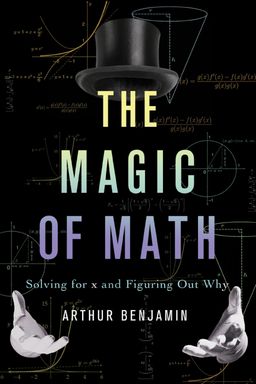
The Magic of Maths cover

The Magic of Maths

by Arthur Benjamin

The Magic of Maths reveals the enchanting world of mathematics, uncovering beautiful and surprising patterns. It expands your understanding of geometry and algebra, teaches impressive numerical tricks, and explores the fascinating properties of numbers like pi. Perfect for those eager to appreciate the hidden magic in mathematics.

The Magic of Mathematics

Have you ever wondered why mathematics can feel both intimidating and beautiful at once? In The Magic of Math, Arthur Benjamin invites you to rediscover math not as a set of dry formulas but as a source of wonder—full of patterns, logic, humor, and even poetry. He argues that math is not reserved for specialists or geniuses; it's a magical art form anyone can learn to appreciate when stripped of rote memorization and revealed in its playful elegance.

Benjamin contends that beneath every equation lies a story—a story of discovery, creativity, and timeless principles that connect arithmetic, algebra, geometry, trigonometry, and calculus. He approaches these subjects not through repetition or drills, but by demonstrating how simple concepts, like the number nine or triangular shapes, contain secrets that unlock entire worlds of logic.

Seeing Math as Magic

Benjamin views mathematics as akin to stage magic: an art of astonishment built on hidden methods. Like a magician pulling a rabbit from a hat, mathematicians conjure results that seem miraculous—until the reasoning is revealed and the magic transforms into deeper understanding. He invites you to see the delight in each problem, treating proofs as punchlines and patterns as poetic rhythms. (In the spirit of Martin Gardner’s recreational mathematics, Benjamin makes math a performance that teaches as it entertains.)

Core Ideas Covered in the Book

The book unfolds across twelve chapters, each devoted to a particular kind of magic. It begins with number patterns—the playful structure behind everyday arithmetic—then moves to algebraic shortcuts, the mystique of the number nine, and the wonders of counting found in Pascal’s triangle and Fibonacci numbers. Later chapters explore proofs, geometry, and the timeless constants π, e, and i. Finally, the journey culminates in calculus and infinity, where math touches philosophy and imagination.

Why These Ideas Matter

Benjamin’s approach matters because math often loses its charm in school settings, reduced to mechanical tasks rather than creative exploration. He reminds you that the ideas behind math—balance, symmetry, reasoning—are not just academic but universally relevant. Understanding them sharpens thinking, promotes curiosity, and unveils connections between logic and nature.

Math Beyond Numbers

Throughout, Benjamin humanizes math. He shares anecdotes from his life and from history: how Karl Friedrich Gauss stunned his teacher by summing numbers instantly, how Fibonacci modeled rabbit populations, and how Leonhard Euler united algebra, geometry, and calculus in one sublime equation—eiπ + 1 = 0. Each narrative transforms mathematics into a living subject that reveals beauty rather than mere correctness.

The Book’s Appeal

Benjamin’s book stands alongside popular works like Steven Strogatz’s The Joy of x or Alex Bellos’s Here’s Looking at Euclid. But unlike many primers, it combines breadth with immediacy—offering problems you can solve, tricks you can perform, and insights that spark curiosity. Whether you’re math-shy or math-loving, the book encourages you to play with ideas, question patterns, and see the equations as stories.

The Takeaway

As you move through The Magic of Math, you discover that mathematics isn’t about memorizing formulas—it’s about seeing relationships that repeat across the universe. Numbers describe natural rhythms, geometrical shapes mirror the art of balance, and algebraic reasoning reflects the structure of thought itself. Benjamin’s enduring lesson is simple yet profound: if you learn to look closely, mathematics can turn even ordinary numbers into extraordinary magic.


Discovering Patterns in Numbers

Benjamin begins his mathematical journey where math first lives—in the world of numbers. He demonstrates that even simple arithmetic contains elegance. For instance, he revisits the famous childhood story of Karl Friedrich Gauss adding 1 through 100 in seconds by pairing numbers—1 + 100, 2 + 99—each sum equal to 101, so 50 pairs total 5050. In that single insight, Gauss transformed drudgery into delight. Benjamin uses this to show that understanding structure makes calculation feel magical rather than mechanical.

Triangular and Square Numbers

From Gauss’s pattern, Benjamin moves to figurate numbers—those that form geometric shapes when represented with dots. Triangular numbers (1, 3, 6, 10, 15...) illustrate addition beautifully. By stacking dots into triangles, then doubling them to form rectangles, Benjamin proves that the sum of the first n integers equals n(n+1)/2. He then explores square numbers by arranging odd numbers into L-shaped patterns on checkerboards, showing that 1 + 3 + 5 + 7 + … = n²—each square growing by the next odd count. These visual proofs evoke both simplicity and wonder.

Cube Patterns and Sums

The progression advances to perfect cubes—where layered sums reveal deeper symmetry. The sum of cubes, 1³ + 2³ + … + n³, equals [n(n+1)/2]², a poetic statement that the sum of cubes equals the square of the sum. Benjamin likens this relationship to harmony in music—different scales (addition and multiplication) following the same rhythm. (This idea also appears in proofs by induction, later in Chapter 6, showing mathematics as both rigorous and lyrical.)

Mental Mathematics as Play

These patterns are practical too. Benjamin explains clever methods for squaring numbers quickly, multiplying near 100, and estimating answers. A key trick: A² = (A + d)(A − d) + d². Using this, you can square numbers like 98 with ease—98² = (100 × 96) + 4 = 9604. His playful methods turn arithmetic into mental artistry, echoing his Secrets of Mental Math course. He argues that mental flexibility, not memorization, makes math empowering in daily life.

Seeing Beauty in Arithmetic

Benjamin’s broader message is that arithmetic’s beauty lies in patterns, not speed. Each relationship between numbers reveals unity—the way squares, triangles, and cubes coexist through simple logic. He urges you to find delight in recognizing these patterns yourself, because once you see the architecture hiding inside numbers, you can never unsee it. Arithmetic becomes an art form, one where each equation paints a picture of balance.


The Magic of Algebra

When Benjamin turns to algebra, he treats it as the art of replacing numbers with symbols to generalize patterns. He recalls his father’s playful introduction: “Doing algebra is just like arithmetic, except you substitute letters for numbers.” This sets up algebra as an extension of intuition rather than abstraction. Through humor and real-world riddles, Benjamin conveys algebra’s power—to model problems, uncover shortcuts, and reveal logic invisible to raw arithmetic.

Algebra Explains Magic

Benjamin decodes mental tricks with algebra. When a simple puzzle predicts that everyone ends up with “5,” he reveals that the secret lies in variable manipulation—starting with N, doubling, adding, dividing, and subtracting until only a constant remains. Algebra becomes not only a tool of calculation but a window into cause and effect. It explains why magic works. (Similarly, educator Steven Strogatz praises algebra as “the Language of Patterns,” emphasizing the same clarity Benjamin celebrates.)

FOIL and the Distributive Law

He introduces the distributive law—“a(b + c) = ab + ac”—then expands it into the FOIL rule: First, Outer, Inner, Last. With this he shows how (x+3)(x+4)=x²+7x+12, simplifying polynomial multiplication. A mix of geometry and algebra follows: rectangles reveal why this law works visually. Even negative numbers unfold logically, justified by the desire to maintain consistency with the distributive rule rather than arbitrary definitions. The result is algebra made tangible.

Quadratic Equations and Graphs

Benjamin ventures into solving x² + bx + c = 0 using factoring, completing the square, and the quadratic formula. He encourages seeing these formulas as storytelling—the journey of transforming equations, isolating variables, and interpreting results geometrically. Every line corresponds to a parabola, every solution marks where your curve meets the x-axis. Algebra and geometry merge, leading toward calculus.

Visual Algebra and Real Life

For Benjamin, visualization is key. Graphs illustrate how equations form straight or curved relationships—lines show stability, parabolas capture motion, and intersections reveal solutions. He blends playfulness and practicality, exemplifying how algebra solves puzzles from movie revenue to mental multiplication. You come away sensing algebra not as rules but as reasoning in action—a magic that lets you think deeper, not just compute faster.


The Power of Nine

Benjamin calls nine the most magical number of all. Why? Because 9 contains surprising self-consistency. Every multiple of 9 adds up to another multiple of 9. He demonstrates this through simple experiments—multiply 9 by any integer, sum its digits, and you’ll land back at 9. Behind the scenes lies modular arithmetic, the idea of numbers wrapping around like hours on a clock.

Casting Out Nines

The ancient technique of “casting out nines” helps verify arithmetic by digital roots. As Benjamin explains, you repeatedly add digits until reaching a single digit, revealing the remainder when divided by 9. If multiplication or addition preserve this root, your calculation is likely correct—a quick check even ancient merchants used. He demonstrates how digital roots catch errors, and how nine’s modular magic underpins modern error-check systems in ISBNs and credit cards.

Everyday Mod Mathematics

Benjamin extends this to modular arithmetic—9 acting as a “modulus” like 12 on a clock. He shows how you can predict remainders, understand time cycles, or spot patterns in cryptography. When explaining ISBN verification, he shows that each digit’s weight ensures error detection under mod 11—proof that magical number patterns ensure digital trust.

Mathematical Magic Tricks

He couldn’t resist a true magician’s flourish: nine-based puzzles where any secret number leads to predictable results. These tricks entertain but also teach modular logic—that consistency, not coincidence, drives the wonder. Benjamin’s approach reminds you that math’s magic is its reliability—each pattern a closed system of truth that still sparks surprise. Nine is not lucky; it is logical perfection beautifully disguised.


Counting and Combinations

In exploring counting, Benjamin moves into the realm of combinatorics—the discipline of possibilities. He opens with the definition of factorials (n!): a notation that makes large arrangements manageable. Each concept, though simple, scales rapidly; 52! possibilities when shuffling cards exceed the number of atoms in the universe. Numbers here are vast yet meaningful, turning counting into awe.

The Rule of Sum and Product

Benjamin simplifies counting through two elegant principles: if you have different types of choices, you add possibilities (the rule of sum); if actions combine sequentially, you multiply them (the rule of product). From shirts to zip codes, these simple operations explain complex arrangements, grounding combinatorics in everyday logic.

Pascal’s Triangle and the “Wow Factor”

He connects combination formulas to Pascal’s Triangle—the ancient structure encoding binomial coefficients. Each entry equals the sum of the two above, forming a recursive universe of counting relationships. Benjamin calls it “pure mathematical poetry.” Rows exhibit powers of 2, diagonals reveal triangular numbers, and diagonally summed patterns form Fibonacci sequences. This visual masterpiece makes abstract formulas tactile, even beautiful.

Probability and Play

Benjamin applies these ideas to cards and lotteries. Calculating poker hands or chance of winning reveals how combinatorics quantifies luck. The book’s humor softens complexity—your odds of a flush? 1 in 500. A lottery jackpot? About 1 in 40 million. He emphasizes awe over arithmetic: every possibility quantified proves how rare real chance is.

Patterns as Proof

Combinatorics leads naturally to proof. Benjamin calls them “proofs that really count”—each identity justified by counting in two ways. The joy lies in discovering that logic itself is the ultimate magician—no trick, just truth. (He notes Jen Quinn’s Proofs That Really Count as a deeper dive.)


The Poetry of Fibonacci

Benjamin devotes an entire chapter to the Fibonacci sequence, the most romantic series in mathematics. Starting with 1, 1, 2, 3, 5, 8, 13…, its recursive rule Fₙ = Fₙ₋₁ + Fₙ₋₂ generates patterns found in nature—from petals to pinecones. He recounts Fibonacci’s 1202 problem of immortal rabbits to show how simple logic models life itself.

Mathematical Patterns and Proofs

Benjamin explores identities like F₁ + F₂ + … + Fₙ = Fₙ₊₂ – 1, proving them through cancellation and induction. He shows geometric models—tiling strips into squares and dominos—that make these relationships visible. Such tangible reasoning transforms abstraction into artistry, where every number counts both literally and visually.

The Golden Ratio

From Fibonacci emerges φ ≈ 1.618, the golden ratio. Benjamin connects φ to aesthetics: the proportion that recurs in nature, art, and architecture (the Parthenon, Da Vinci’s sketches, and Luca Pacioli’s “Divine Proportion”). Algebra reveals that the ratio of successive Fibonacci numbers approaches φ, tying life patterns to numerical beauty.

Lucas Numbers and Extensions

He introduces Lucas numbers, cousins of Fibonacci, weaving together algebraic identities and geometric visuals. Both sequences mirror the creative relationship between logic and art. Fibonacci, for Benjamin, symbolizes how math breathes within nature and poetry. The chapter closes, fittingly, with a Fibonacci limerick—a rhythmic celebration of mathematics turned verse.


Proofs and Mathematical Storytelling

Benjamin celebrates proof as the heart of mathematics—the place where logic and imagination meet. He insists that proofs aren’t dry legal arguments but stories that make sense forever. Through examples like domino tilings and checkerboard puzzles, he illustrates how simple insights demonstrate impossibility and necessity with elegance.

Methods of Proof

He introduces several proof styles: direct proof (showing truth via logic), contradiction (assuming the opposite until nonsense arises), and induction (establishing infinite truth one step at a time). Each method feels like a magician’s reveal—step by step the illusion dissolves into clarity. Gauss’s formula, the irrationality of √2, and the infinitude of primes all appear as examples of how reasoning outlives time.

Proofs as Art

For Benjamin, a good proof has rhythm and surprise. He quotes G. H. Hardy: “A mathematician…is a maker of patterns.” A proof’s beauty lies in symmetry, economy, and permanence. Induction, he says, is like climbing a ladder—you show you can step on the first rung and reach the next, so every rung follows eternally.

Teaching Logical Wonder

Benjamin encourages readers to enjoy proofs as intellectual magic shows. Once you see one, the world feels more orderly. They transform confusion into conviction. Whether proving that all primes are infinite or that √2 cannot be rational, each proof teaches that math’s greatest power is certainty wrapped in creativity.


Geometry and the Visualization of Truth

Benjamin reaches classical beauty in geometry—the field where form meets function. Beginning with Euclid’s axioms, he revisits timeless truths: parallel lines, triangles, and circles forming the foundation of spatial logic. He emphasizes geometric intuition, asking you to visualize patterns before calculating them.

Shapes, Angles, and the Pythagorean Mystery

He walks through why triangle angles sum to 180°, why isosceles triangles balance, and how rectangles maximize area for given perimeter. Multiple proofs of the Pythagorean theorem illustrate how visual reasoning equals algebraic reasoning. Each depict squares rearranged like stage props—geometry as logical choreography.

Polygons, Parallelograms, and Perspective

Benjamin links practical geometry—farming fence problems, ropes between goalposts—to abstraction through formulas. He celebrates mathematical surprises: connecting midpoints of any quadrilateral always forms a parallelogram, regardless of shape. These discoveries reaffirm that geometry reveals hidden order within chaos.

Bridging Art and Science

Finally, geometry mirrors art and perception. Using parallels to Escher’s tessellations and Greek temple design, Benjamin reminds you that proportion governs aesthetic beauty as much as mathematical truth. Geometry, in essence, teaches you to see the world rightly—with reason as your lens.


The Infinite Adventure

Benjamin ends with infinity—a concept both dizzying and divine. He contrasts finite patterns, like Gauss’s sum, with infinite series that stretch beyond comprehension. Infinity, he shows, exposes mathematics’ philosophical heart: the tension between boundless growth and human reasoning.

Infinite Sums and Limits

He explains convergence with simple yet astonishing examples like 1 + ½ + ¼ + ⅛ + … = 2. You walk toward a wall, halving the distance each time—never reaching yet summing exactly to 2. Infinity, paradoxically, is measurable. Benjamin turns jokes (“An infinite number of mathematicians walk into a bar…”) into lessons about persistence and precision.

Harmonic and Geometric Series

He moves from geometry to algebra of infinity: the harmonic series diverges despite shrinking terms; geometric series converge beautifully if |x| < 1. These paradoxes demonstrate that infinity behaves with personality, not uniformity—a playground for subtle thought rather than chaos.

Infinity and Imagination

Benjamin closes with Cantor’s discoveries—some infinities larger than others—and with magic squares, symmetry patterns that reflect order amid endlessness. His message is that infinity isn’t about numbers beyond reach but about thinking beyond boundaries. The pursuit itself is what makes mathematics—and life—beautifully infinite.

Dig Deeper

Get personalized prompts to apply these lessons to your life and deepen your understanding.

Go Deeper

Get the Full Experience

Download Insight Books for AI-powered reflections, quizzes, and more.