
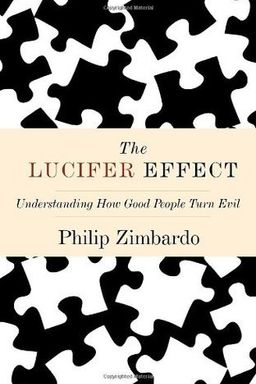
The Lucifer Effect cover

The Lucifer Effect

by Philip Zimbardo

The Lucifer Effect delves into the psychological mechanisms that can turn good people evil. By studying famous experiments and real-world events, Philip Zimbardo reveals how situational forces and authority can corrupt individuals, while offering strategies to resist and foster heroism.

The Situational Nature of Evil: How Ordinary People Commit Extraordinary Crimes

Have you ever wondered how seemingly decent, ordinary people can commit acts of shocking cruelty? Why good people sometimes make terrible choices when placed in unusual circumstances? This is the haunting question at the heart of Philip Zimbardo’s exploration of human behavior and morality. Drawing on decades of psychological research—from his own Stanford Prison Experiment to the infamous Milgram obedience studies—Zimbardo argues that evil is not a fixed trait possessed by a few depraved individuals but a potential that resides within each of us. It’s the situation, not simply the person, that often determines whether we act heroically or horrifically.

Zimbardo’s central claim dismantles the comforting illusion that evil is committed only by monsters. He invites you to look more closely at the psychological and social conditions that permit good people to become perpetrators. If you’ve ever assumed that you’d never succumb to peer pressure, follow immoral orders, or harm another human being, this book challenges that assumption head-on. Through real-world cases, controlled experiments, and historical atrocities, you’ll see how authority, anonymity, ideology, and dehumanization can warp moral judgment and unleash the darker sides of our nature.

The Permeable Boundary Between Good and Evil

Zimbardo begins by reminding us that the line between good and evil is not a chasm separating saints from sinners but a shifting boundary that nearly everyone is capable of crossing given the right conditions. He illustrates this with the story of Ivan “Chip” Frederick, a corrections officer at Abu Ghraib prison who participated in the abuse of Iraqi prisoners in 2003. Frederick had no prior history of cruelty, violence, or psychological disturbance. Yet, thrust into a corrupt system that normalized brutality, he became capable of horrifying acts. The transformation, Zimbardo explains, was not the product of innate wickedness but of a toxic environment that rewarded obedience, anonymity, and aggression.

From Personality to Situation

Traditional psychology often looks for dispositional causes—static traits such as personality flaws, genetics, or pathology—to explain evil behavior. Zimbardo challenges this perspective with the situational approach, which focuses instead on the power of context. In different situations, we display dramatically different versions of ourselves. You may be kind at home but ruthless in competition, empathetic toward one friend yet indifferent toward strangers. The environment—its rules, pressures, and social signals—shapes your conduct more than you might like to admit. (This situational lens connects with research by social psychologist Lee Ross, who coined the term “fundamental attribution error,” describing our tendency to overestimate personality and underestimate circumstance.)

To make this concept visceral, Zimbardo revisits famous experiments that stripped away participants’ moral bearings. In Stanley Milgram’s obedience experiment, average people were persuaded to administer painful electric shocks to others simply because an authority figure assured them it was necessary. Even as victims screamed in pain, 65 percent of participants continued to deliver what they believed were life-threatening jolts. The experiment’s chilling conclusion: ordinary individuals can inflict extraordinary harm when they surrender responsibility to authority.

The Systemic Roots of Human Cruelty

Zimbardo expands these findings into a broader social critique. Evil flourishes when institutions create conditions of deindividuation, anonymity, and unaccountability. From the streets of the Bronx to battlefield prisons, he shows that when people feel unseen or absolved of responsibility, moral inhibitions erode. Language and ideology serve as powerful accomplices: bureaucratic euphemisms and noble-sounding narratives (“national security,” “restoring order,” “following protocol”) can obscure the reality of atrocities. These mechanisms, subtly interwoven, explain how governments justify torture, corporations enable exploitation, and communities permit discrimination.

Why This Matters to You

The implications of Zimbardo’s argument reach far beyond the laboratory or history book. Understanding situational evil helps you recognize the moral vulnerabilities in your own life—from yielding to peer pressure at work to ignoring wrongdoing when silence seems safer. But Zimbardo doesn’t end with despair. He believes the same psychological mechanisms that enable evil can also produce heroism. When you accept responsibility, question authority, and challenge harmful ideologies, you strengthen your capacity for moral resistance. The final chapters of the book offer a roadmap for cultivating heroic behavior: choosing awareness over apathy, and moral courage over obedience.

Ultimately, Zimbardo’s message is both unsettling and empowering. It reveals that evil is not alien—it’s human. And because it’s human, it can be understood, resisted, and overcome. The choice between cruelty and compassion, submission and defiance, villainy and heroism—these are all situational decisions. The question is not whether you’re capable of evil, but whether you can recognize the situation that invites it—and choose to rise above it.


Situations Shape Behavior More Than Personality

Many of us like to believe that we’re consistent people. We think we have a stable moral compass that guides us across all circumstances. Yet, as Zimbardo explains, this isn’t how human nature works. Our behavior is surprisingly fluid; it morphs in response to context, expectations, and social cues. The same person who’s gentle with friends might become harsh when given authority or anonymity. The idea that your environment can reshape your behavior lies at the heart of the situational approach to psychology.

How Context Rewrites Character

The contrast between “you with friends” and “you at work” may seem trivial, but it speaks to a larger truth: personality is porous. The Milgram experiment showcased this vividly. Volunteers were told they were aiding a scientific study on memory improvement. Standing behind a machine labeled with voltages from 15 to 450, they delivered shocks to a “learner” (really an actor). As screams grew louder, most participants hesitated—but when urged by the lab-coated “authority” to continue, two-thirds obeyed. They weren’t sadists; they were normal people responding to an extraordinary situation that turned empathy into obedience.

The Myth of Stable Morality

The situational perspective dismantles the myth of fixed morality. Goodness and cruelty, Zimbardo argues, depend less on who you are than where you are—and what pressures surround you. Consider how cultural norms affect behavior: in honor-based societies, aggression can be a virtue; in collectivist cultures, obedience can outweigh individual conscience. In each case, the situation dictates what counts as “moral.” (This echoes research from social psychologist Kurt Lewin, who claimed that “behavior is a function of person and environment.”)

What This Means for Everyday Life

Recognizing situational influence doesn’t absolve responsibility—it deepens self-awareness. When you understand that you’re susceptible to contextual pressures, you can prepare yourself to resist them. The next time you’re tempted to justify a questionable action because “that’s how things are done,” remember Milgram’s volunteers. Context can distort judgment. But awareness gives you the power to reclaim it.


When Authority Turns Good People Cruel

Authority is one of the most powerful—and dangerous—forces shaping human behavior. Zimbardo illustrates how the instinct to obey can override empathy, morality, and personal responsibility. Whether it’s a soldier following orders, a participant obeying an experimenter, or a follower listening to a charismatic leader, the authority trap operates through a potent psychological lure: the relief of not having to decide what’s right or wrong for yourself.

Milgram’s Lesson in Blind Obedience

The Milgram experiment serves as a disturbing demonstration. Participants weren’t coerced physically—they were persuaded psychologically. The “scientist” assumed moral responsibility, telling them the shocks were necessary. By transferring accountability upward, participants convinced themselves they were only instruments, not agents. This diffusion of responsibility enabled cruelty without guilt. (Psychologist Erich Fromm made a similar observation in Escape from Freedom, arguing that submission to authority is often an escape from moral anxiety.)

The Tragedy of Jonestown

Zimbardo reinforces this principle with the Jonestown tragedy. Jim Jones began as a caring, idealistic preacher. Yet, under his tightening control, followers surrendered their will. When ordered to commit mass suicide, over 900 people obeyed. This wasn’t mass insanity—it was obedience gone malignant. When authority wraps itself in moral language, even murder can masquerade as virtue.

Learning to Defy Unjust Power

To resist authority, you must reclaim moral agency. That means pausing when someone in power tells you to act against conscience. Zimbardo’s takeaway is hopeful: obedience is powerful, but defiance is possible. In Milgram’s study, a minority stopped early, refusing to shock. They prove that courage, though rare, can break the chain of command.


The Disguise of Evil: Deindividuation and Anonymity

Why do people commit atrocities in crowds, behind masks, or under uniforms? Zimbardo points to deindividuation, a psychological process that emerges when individuals lose their sense of personal identity. When you’re anonymous, you feel less accountable—and morality becomes negotiable.

Uniforms, Masks, and Unaccountability

In the Stanford Prison Experiment, student guards wearing mirrored sunglasses transformed from calm peers into abusive enforcers. The uniform eliminated individuality. No longer “John the psychology student,” they became “Guard #3.” This depersonalization dissolved empathy and unleashed aggression. Similarly, anonymity in riots or online spaces produces moral disengagement, enabling behaviors people would never attempt face-to-face.

Environment and the Hidden Self

Zimbardo’s field study of abandoned cars highlights environmental anonymity. In the Bronx—where social bonds were weak—the car was stripped within hours. In Palo Alto—where community identity was strong—it remained untouched. The difference wasn’t morality but context: where anonymity reigns, accountability vanishes.

How to Stay Accountable

Accountability is moral armor. Whether online, in uniform, or within a corporation, remind yourself that anonymity doesn’t erase responsibility. Zimbardo’s insight is simple yet profound: if you want to stay humane, stay identifiable—to yourself and to others.


Dehumanization: Seeing Others as Less Than Human

No psychological mechanism fuels cruelty more effectively than dehumanization. When you stop seeing another person as fully human, empathy collapses. Zimbardo shows that this process turns ordinary individuals into perpetrators of systemic violence—from discriminatory attitudes to genocidal atrocities.

The Psychology of Dehumanization

Stanford psychologist Albert Bandura demonstrated how labeling others as “animalistic” or “inferior” changes behavior. In his study, students punished peers more harshly when they believed them to be “a rotten bunch.” Perception became justification. Words stripped away humanity, and cruelty followed. History echoes this pattern: Nazi propaganda calling Jews “vermin,” or soldiers referring to enemies as “targets.” Each label distances the actor from the victim.

Real-World Consequences

In the “Rape of Nanking,” Japanese soldiers massacred Chinese civilians they regarded as subhuman. Similar patterns appear in every genocide and war crime. The script repeats: redefine a group as “less than,” and morality’s restraints disappear. Zimbardo’s research links this to systemic ideologies that encourage moral disengagement on a massive scale.

Rehumanizing as Resistance

To counteract dehumanization, consciously emphasize shared humanity. Names, stories, and face-to-face connection reawaken empathy. In every setting—from policing to politics—the antidote to cruelty begins with seeing people not as categories, but as individuals.


The Power of Ideology and Language

Sometimes cruelty hides behind noble intentions. Zimbardo explores how ideology and euphemistic language justify atrocities by reframing them as moral or necessary. In psychology experiments, this mechanism is known as the “cover story”; in politics, it’s called propaganda.

The Cover Story Concept

In the Milgram study, participants believed they were contributing to research that would improve memory performance—a socially valuable goal. This belief masked the reality of their actions. Likewise, soldiers at Abu Ghraib rationalized torture as defending national security. The logic is insidious: if the end sounds noble, any means becomes defensible.

Language That Sanitizes Violence

Language serves as a moral anesthetic. Bureaucratic terms like “collateral damage” or “enhanced interrogation” replace plain words such as “civilians killed” or “torture.” This linguistic sleight of hand numbs outrage and maintains a facade of legitimacy. (George Orwell warned of this in Politics and the English Language, arguing that euphemism makes evil respectable.)

Questioning the Stories We’re Told

To resist ideological manipulation, examine narratives that label harm as help or war as peace. Zimbardo invites you to pause and ask: who benefits from this language, and what truths does it conceal? Clear-eyed skepticism is the first step toward moral clarity.


Becoming a Hero in Everyday Life

Evil may be situational, but so is heroism. In closing, Zimbardo argues that just as certain conditions can corrupt, others can inspire courage. We all have the potential for moral heroism—the willingness to act when others stand by. He contrasts passivity with principle, urging you to cultivate what he calls the “hero in waiting.”

Personal Responsibility and Moral Defiance

The first step toward heroism is owning your actions. When you refuse to hide behind excuses, uniforms, or authority, you reclaim moral agency. The second step is the courage to defy unjust commands. Some of Milgram’s participants stopped administering shocks; they proved heroism isn’t about grandeur but moral refusal. Even small acts of conscience matter.

Challenging Ideologies

Zimbardo asks you to question the frameworks that justify harm. Whether it’s “bringing freedom” through war or “disciplining” through humiliation, moral rhetoric can mask immorality. Heroism begins with seeing through the story—and speaking out against it.

Ordinary People, Extraordinary Choices

True heroism is rarely grandiose. It’s the subway passenger, Autrey Wesley, who leapt into the tracks to save a stranger. It’s anyone who chooses conscience over comfort. By preparing yourself mentally to act before the situation arises, Zimbardo says, you transform morality from an abstract theory into a lived reality.

In the end, understanding evil isn’t about despair—it’s about preparation. Once you see how situations shape behavior, you can shape the situation instead. Knowing your potential for both good and harm allows you to choose, deliberately, to do good.

Dig Deeper

Get personalized prompts to apply these lessons to your life and deepen your understanding.

Go Deeper

Get the Full Experience

Download Insight Books for AI-powered reflections, quizzes, and more.