
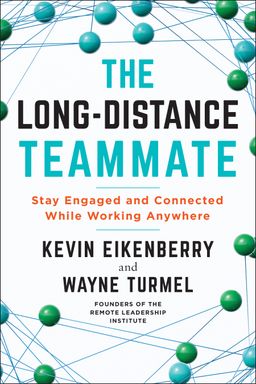
The Long-Distance Teammate cover

The Long-Distance Teammate

by Kevin Eikenberry and Wayne Turmel

The Long-Distance Teammate offers a comprehensive guide for remote workers to maintain engagement and connection. With actionable insights on productivity, communication, and self-care, it empowers you to thrive in a remote work environment, fostering teamwork and personal growth.

Becoming a Long-Distance Teammate

How can you stay connected, motivated, and truly part of a team when your colleagues are miles—or even continents—away? In The Long-Distance Teammate, Kevin Eikenberry and Wayne Turmel argue that remote work isn’t just about logging in and getting tasks done. It’s about cultivating engagement, connection, and purpose, even when we’re physically separated. Their central claim is that success in remote work depends on shifting from being a remote worker to being a real teammate—someone who cares not only about outcomes, but also about relationships, trust, and collaboration.

Eikenberry and Turmel explore the hidden challenges of modern work, especially after the seismic shift brought about by COVID-19. The rapid move to home offices created vast technical connectivity but little emotional connection. Teams were equipped with Zoom and Slack, yet people began to feel isolated, overlooked, and uninspired. This book contends that simply working remotely is not enough—you must work remotely together. It’s a call to rethink success through three foundational principles: productivity, proactivity, and potential.

The 3P Model for Remote Success

At the heart of the book is the 3P Model, which identifies the three critical ingredients of thriving at a distance: Productivity (doing the right work efficiently), Proactivity (taking initiative without waiting for instructions), and Potential (considering long-term growth, reputation, and impact). The authors show that while remote work promises freedom, it also demands discipline and foresight. You can’t rely on office cues or quick hallway chats—you must deliberately manage your output, decisions, and visibility.

For instance, remote workers often equate long hours with productivity. Eikenberry debunks that myth. Real productivity isn’t about hours worked but value created—about completing the right tasks that move the team or organization forward. Similarly, proactivity means being brave enough to speak up, clarify miscommunications, and take responsibility before problems escalate. Finally, potential challenges you to think long-term: how are your choices, tone in emails, and follow-through shaping your career trajectory?

The Shift from Worker to Teammate

This shift from simply doing a job to being a teammate means expanding your perspective. You may complete projects at your kitchen table, but your success depends on thinking beyond your own desk. The authors encourage readers to see their work in context—each task connects to teammates, leaders, and organizational goals. True teammates ask: “How does what I do help others succeed?” The equation becomes: Your job = Your work + Team work.

To support this mindset, Eikenberry and Turmel guide readers through practical transitions. A worker might focus on crossing items off a personal list; a teammate engages others, shares insights, and checks whether output meets team needs. The benefits are mutual: stronger relationships, more trust, and less stress. The book emphasizes that engagement is a personal choice—it’s not waiting for a boss to motivate you but actively deciding to care about your work and coworkers. As the authors put it, “Engagement belongs to you.”

Engagement and Connection in Remote Work

The authors present engagement not as employee satisfaction but as discretionary effort—the extra energy you invest when you care deeply. Remote environments risk draining that energy if you feel unseen or undervalued. Eikenberry and Turmel show that engagement fuels meaning and joy, even when no one’s watching. It allows you to enjoy work more, notice opportunities, and be recognized instead of disappearing into the screen background.

“Working remotely isn’t new normal—it’s an opportunity to create better collaboration and higher fulfillment, measured not by presence but by connection.”

Why This Matters Today

The significance of this shift can’t be overstated. In an era when the boundaries between work and personal life blur, being intentional about how you communicate, build trust, and show up makes the difference between burnout and balance. The authors urge organizations and individuals alike to see remote work as a permanent evolution—not a temporary fix. Technology may enable remote operations, but human thoughtfulness sustains engagement. (For comparison, thinkers like Cal Newport and Adam Grant also highlight how meaning and deep focus—not mere connectivity—drive high performance in knowledge work.)

Ultimately, The Long-Distance Teammate is a manual for intentional work. It gives you the skills, mindsets, and habits to thrive as part of a distributed workforce. You’ll learn how to build trust and relationships, give and receive feedback, manage expectations, communicate effectively, and maintain motivation. You’ll discover how to design routines, care for yourself, and even envision your long-term career path—all while remaining a true contributor to something larger than yourself. In short, it’s not a book about working alone; it’s a blueprint for working apart, together.


The 3P Model: Productivity, Proactivity, and Potential

Eikenberry and Turmel introduce the 3P Model as the backbone of remote-work success. It’s simple to grasp but profound when applied: whether you’re in an office or a Zoom room, your quality of work and relationships depend on three factors—Productivity, Proactivity, and Potential.

Productivity: Focus on Results, Not Activity

While many remote workers pride themselves on checking boxes and clocking long hours, productivity is not about doing more—it’s about doing what matters most. When working from home, distractions blur focus, and the line between busy and productive fades. The authors redefine productivity as “work yielding results, benefits, or profits.” You aren’t measured by motion but by contribution. For example, Alice, a remote employee, initially enjoyed fewer interruptions at home but later realized she was spending more time responding to emails than accomplishing meaningful goals. Real productivity meant aligning tasks with her team’s objectives, not just her to-do list.

Proactivity: Act Before Being Asked

The authors identify proactivity as the most surprising ingredient of great teamwork at a distance. It’s about acting before problems arise and taking initiative even in uncertainty. “If you see something, say something” applies metaphorically in remote settings. Great teammates don’t wait to be told—they anticipate needs, ask clarifying questions early, and help when others are struggling. Eikenberry likens proactive workers to careful drivers who scan the road ahead, anticipating turns and hazards, rather than reacting abruptly. Being proactive requires courage and trust; when you speak up to redirect a meandering meeting or suggest a process improvement, you’re asserting ownership of shared success.

Potential: Think Beyond the Task

The final “P”—Potential—reminds you that today’s choices affect tomorrow’s opportunities. Remote isolation often limits visibility, making it easy to slip off the radar. But every email, meeting, or deliverable shapes how colleagues and leaders perceive your reliability and capability. The authors prompt readers to ask: “Is this helping me build the skills and relationships I want for the future?” That means treating interactions not as transactions but as investments in long-term credibility. Neglecting relationship-building or tuning out during meetings can quietly stall your progress. Small gestures, such as offering help or maintaining professionalism, create echoes of trust that open future doors.

“Consider the 3Ps your compass—pointing you toward excellence in results, initiative, and growth no matter where your desk sits.”

Together, the three Ps form a holistic mindset for remote success. Productivity ensures you deliver; Proactivity connects you with others and keeps momentum; Potential reminds you to look up from your desk and see the horizon. When you balance these three, you don’t just work remotely—you thrive collectively.


Mindset and the Teammate Equation

Before skills and tools come mindset. Eikenberry and Turmel argue that remote success begins when you see your job as both individual work and team work. Your results hinge not only on what you accomplish but on how you contribute to the group. They present this equation: Your job = Your work + Team work.

Seeing Work Beyond the Screen

When working from home, it’s easy to narrow focus to your immediate tasks, losing sight of the people behind the pixels. José, for instance, transitioned from office life to remote work and believed his responsibilities remained unchanged. Yet, he found collaboration harder and realized his mindset needed recalibration. The authors emphasize moving from solitary productivity toward collective purpose. That involves intentionally maintaining situational awareness—knowing your teammates’ challenges, your leader’s priorities, and the organization’s goals.

Engagement Is a Choice

Eikenberry drives home a transformative idea: engagement belongs to you. Waiting for others—leaders or HR—to inspire you is passive. Instead, you choose to be engaged by aligning personal motivation with collective outcomes. Engagement means bringing curiosity, joy, and a sense of ownership to your remote contributions. On tough days, when isolation sets in or feedback is scarce, reconnecting to this choice reenergizes your focus.

Balancing Work and Teamwork

To balance both, you must clarify expectations with leaders and teammates, seek feedback continuously, and reflect on how your efforts impact others. Eikenberry’s equation encourages proactive reflection: Are you scheduling enough time for collaboration? Are you tending to relationships as much as results? This perspective mirrors the collaborative approach advocated by Patrick Lencioni in The Five Dysfunctions of a Team, where trust and commitment are as vital as competence. Both models contend that understanding collective purpose transforms individual performance into team excellence.


Motivation and Personal Energy at a Distance

Working remotely offers flexibility—but it also demands self-motivation. In chapter 3, the authors describe how even high-performing professionals like Susan can lose enthusiasm over time. Alone with your laptop, days blur together, and energy ebbs. The solution isn’t just willpower; it’s managing the physical, emotional, and relational energy that fuels you.

Recognizing Energy Drains

Common demotivators—loneliness, lack of feedback, endless meetings—chip away at engagement. Like a phone running on battery, you eventually shut down unless you plug back into human connection. The authors categorize the main causes of demotivation into four buckets: lack of energy, focus, purpose, and feedback. Each is solvable if addressed deliberately.

Restoring Energy and Focus

Practical advice abounds: set working boundaries, take breaks, keep healthy routines, and interact with positive people. Treat your energy like a renewable resource you must safeguard. When motivation dips, stop multitasking and refocus intentionally on one meaningful task. Eikenberry notes that our brains sustain peak focus for only 30–40 minutes at a time; thus, scheduling shorter work sprints beats grinding through exhaustion.

Reconnecting to Purpose

Purposeful work restores motivation. Revisit the “why” behind each project—whom does it help? What bigger outcome does it serve? Whether it’s ensuring a colleague gets paid or improving customer satisfaction, connecting to tangible impact revives your sense of worth. Finally, seek feedback actively. A simple “thanks” or confirmation builds emotional momentum and replaces silence with affirmation.

“You can’t wait for others to plug you in—recharge yourself by focusing on purpose, rhythm, and interaction.”


Communication and Connection Across Distance

Poor communication is the Achilles’ heel of remote work. Eikenberry and Turmel remind readers that every misunderstanding costs time, trust, and sanity. They simplify communication into a powerful triad: message sent, message received, message understood. At a distance, we can’t rely on tone or body language, so intentional communication becomes essential.

Choosing the Right Tool

The authors distinguish between richness and scope. Rich communication—like face-to-face or webcam—offers emotional and visual cues. High-scope tools like email deliver uniform messages to many people quickly but risk confusion. The right choice depends on purpose, timing, content, and audience. For complex or relational topics, favor richness; for simple updates, use email or chat. Overreliance on text-only media drains empathy.

Building Real Understanding

To ensure “message understood,” the sender must think audience-first. Tailor messages to how recipients best absorb information. Use feedback loops—ask “Does this make sense?” or “Anything unclear?”—to confirm comprehension. On the receiver side, respond with short signals like “Got it” or thumbs-up emojis to close the loop. These microconfirmations build clarity and trust.

Tools as Connectors, Not Crutches

The authors list technological categories—from telephony to videoconferencing—but caution against worshiping the tools. Technology should amplify human communication, not replace it. Eikenberry encourages balancing text with vocal and visual media. Using webcams and real-time calls invites emotional connection missing from asynchronous messages. This echoes Marshall McLuhan’s insight that “the medium shapes the message”—our chosen channels influence understanding and relationships.

In the end, great remote communication depends less on bandwidth than on mindfulness. When you intentionally choose platforms, personalize tone, and prioritize listening, you turn distance back into connection.


Trust, Visibility, and Ethical Relationships

Trust is the currency of remote collaboration. Without face-to-face proximity, even minor missteps can snowball into doubts about competence or intent. The authors introduce the Trust Triangle, defining trust through three pillars: common purpose, competence, and motives. When any pillar cracks, relationships suffer.

Building Trust Intentionally

Common purpose means shared direction. Competence demands visible reliability—your teammates can’t see your effort but can judge your output. Motives refer to your perceived goodwill: are you collaborating or self-serving? Demonstrating competence remotely means transparency—share progress updates, meet deadlines, and communicate setbacks early. Exhibit positive motives by offering help and celebrating others’ wins.

Ethical Visibility: Being Seen Without Self-Promotion

Sara’s story illustrates the pain of invisibility: she contributes tirelessly but feels unnoticed when her name is left off team recognition emails. The authors propose ethical visibility—a balance between humility and presence. Volunteer ideas, participate in meetings, and share achievements in “we” language rather than “I” statements. This approach makes your value visible while reinforcing team goals. Ethical visibility is judged by behavior, not intent; ensure your actions communicate collaboration rather than vanity.

Trust grows through reciprocity—you trust those who trust you. In remote ecosystems, trust accelerates productivity and eases communication friction. By proving purpose, showing skill, and acting ethically visible, you establish credibility that transcends distance.


Routines, Habits, and Sustainable Work-Life Balance

Freedom without structure leads to chaos. Eikenberry and Turmel champion routines as the scaffolding of remote success. While habits are automatic behaviors, routines are intentional sequences—how you start and end each day. When routine replaces randomness, you reclaim control over time and mental clarity.

Morning and Evening Rituals

The authors explain that a morning routine sharpens productivity and reduces stress. Instead of waking to your phone’s glare, start with breathing, exercise, and a healthy breakfast. Wayne Turmel recounts his own ritual: checking eastern time messages briefly, then setting coffee, showering, dressing for work, and creating a mental boundary between home and office. Likewise, end-of-day rituals—closing your laptop, changing status to “away,” or dimming lights in your workspace—signal psychological closure.

Healthy Habits and Balance

Routine and habit converge in physical and psychological health. The authors dedicate later chapters to self-care—adequate sleep, movement, and mindful nutrition. They argue that sustaining engagement requires caring for body and mind. Establish meal patterns, take outdoor breaks, and protect family time. Routines provide rhythm that distinguishes work from rest, critical when your workspace is ten feet from your kitchen.

Their advice parallels productivity experts like James Clear (Atomic Habits) who describe small, repeated actions as levers for identity change. A strong routine signals professionalism and discipline, convincing both you and others that remote work can be intentional, not improvised.


Growth, Learning, and Long-Term Career Planning

Remote work shouldn’t stunt your career—it should reshape how you learn and advance. The authors devote final chapters to helping teammates build professional growth and future paths independent of physical proximity. Whether pursuing skill upgrades or networking, you are your own career manager.

Planning Forward

Jim’s story illustrates a common dilemma: remote workers get overlooked for leadership roles. The authors encourage active career conversations with managers—ask what long-term opportunities align with your aspirations and clarify how visibility affects promotions. If relocation or hybrid work is required, weigh lifestyle against ambition consciously. Your responsibility is to make your goals known; “if you don’t, who will?”

Continuous Learning

Eikenberry and Turmel highlight learning as the engine of potential. Explore formal training, online classes, podcasts, and reading. Exchange insights with teammates and document accomplishments—certificates, course completions, or skill badges bolster credibility. Even brief webinars can rejuvenate curiosity. The authors suggest curating learning through dedicated folders and calendars; free resources abound, but you must manage them intentionally.

Investing in Yourself

Ultimately, your development mirrors your engagement: it’s a proactive choice. Whether building expertise via Coursera or simply sharing knowledge in a team “learning corner,” continual growth transforms remote work from isolation into evolution. You’re not just maintaining performance—you’re building your future self.

Dig Deeper

Get personalized prompts to apply these lessons to your life and deepen your understanding.

Go Deeper

Get the Full Experience

Download Insight Books for AI-powered reflections, quizzes, and more.