
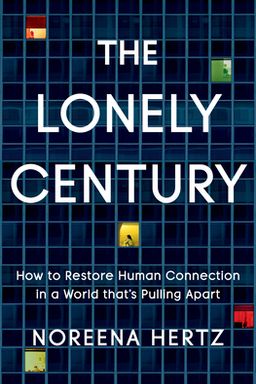
The Lonely Century cover

The Lonely Century

by Noreena Hertz

The Lonely Century delves into the modern epidemic of isolation, revealing how neoliberal policies and technological advancements have led to widespread loneliness. Through compelling research, Noreena Hertz offers insights and strategies to rekindle connections and rebuild communities in an era defined by solitude.

The Age of Loneliness

What if loneliness isn’t just a feeling, but the defining social disorder of our time? In The Lonely Century, Noreena Hertz argues that loneliness today goes far beyond being physically alone. It has become a civic, economic, and political epidemic — a symptom of how 21st-century capitalism, technology, and urban design have eroded the shared spaces and civic trust that once bound us together. You may think of loneliness as a private ache; Hertz reframes it as a public and structural crisis.

You learn that loneliness manifests both internally — through emotional pain and health deterioration — and externally, through the breakdown of common life. The book connects personal disconnection to larger social patterns: the rise of populism, workplace alienation, commodified intimacy, and civic disengagement. Hertz weaves data, interviews, and global stories to show that the loneliness crisis is not confined to individual psychology but extends into the architecture of cities, institutions, and economies.

Loneliness as structure, not symptom

Hertz challenges the idea that loneliness results mainly from personal failure or social awkwardness. She shows how declining unionization, austerity policies, privatized public spaces, and gigified labor markets have created material conditions of disconnection. People feel unseen by their governments, unheard by employers, and left behind by global markets. Surveys reveal that two-thirds of citizens in democracies feel their governments don’t act in their interests, and 85% of workers feel alienated from their companies. Loneliness thus becomes a political and economic diagnosis — a state-driven by systemic neglect as much as by private isolation.

This view expands loneliness from a personal mood to a structural issue — a lens that lets you see connections between closed libraries, insecure work, and polarized politics. If you accept this broader framing, then remedies must go beyond friendship advice toward redesigning systems that foster trust, fairness, and belonging.

The body under siege

Hertz also reveals loneliness’s measurable biological effects. Chronic loneliness triggers stress responses that impair immunity and cardiovascular health, raising risks of heart disease, stroke, dementia, and early death — equivalent in impact to smoking fifteen cigarettes a day. In contrast, cohesive communities like Israel’s Haredi neighborhoods or mid-century Roseto, Pennsylvania, enjoy unexpected longevity despite economic adversity. Loneliness is not only emotional; it’s lethal. Community, by contrast, acts as preventive medicine.

The contactless society

From cashier-free Amazon Go stores to gig apps and delivery platforms, convenience increasingly replaces connection. Every tap and swipe removes a micro-interaction — a smile, a chat, a nod — that once affirmed your social existence. During the pandemic, this pattern deepened through contactless everything: yoga, groceries, worship. Hertz calls this the rise of the ‘Loneliness Economy,’ where markets fill the emotional vacuum by selling rented friends, social robots, or curated “communities” wrapped in corporate branding. These commodified forms of care offer transient relief but often weaken our habit of practicing empathy and reciprocity.

Politics of isolation

Hertz links widespread loneliness to democratic decline. Drawing on Hannah Arendt, she argues that atomized citizens — deprived of belonging — gravitate toward populist leaders who promise identity and meaning. Whether it’s Trump’s rallies or far-right movements in Europe, populism thrives when people seek recognition in “us versus them” narratives. The antidote, she insists, is rebuilding inclusive civic ties: associations, unions, and local forums that teach cooperation and restore pride without scapegoating.

Reclaiming connection

Hertz closes with a call for reconstruction. Real connection, she writes, must be rebuilt through cities designed for encounter, workplaces governed by dignity, technologies aligned with human well-being, and policies that reconnect capitalism with care. She advocates policies like social prescribing, robot taxes to fund retraining and community infrastructure, and civic programs that compel diverse citizens to meet and collaborate. Her message is both warning and invitation: rebuilding belonging is possible — but only if we recognise loneliness as a systemic failure requiring collective courage and design.

Key takeaway

The true crisis of the twenty-first century is not silence or solitude, but the erosion of the social infrastructure that teaches care, trust, and reciprocity. Solving loneliness requires rebuilding democracy, economy, and community around the ethic of human connection.


Embodied Loneliness

You already know loneliness feels painful — Hertz documents why it’s physiologically dangerous. When you endure chronic isolation, your brain’s alarm systems remain permanently on. The amygdala signals threat; cortisol and blood pressure rise; inflammation spreads. Over years, this leads to cardiovascular disease, dementia, and premature mortality. Loneliness thus exists not just in your mind but in your bloodstream.

The community effect

Strong bonds literally buffer the body. In the Haredi communities of Israel, poor but tightly connected, life expectancy is unexpectedly high. In mid‑century Roseto, Italian immigrants’ dense social networks dramatically reduced heart disease; when that cohesion faded, so did their health advantage. Hertz calls this the ‘Roseto Effect,’ proof that civic connection functions as collective medicine.

Giving as prevention

Community’s power lies not only in receiving care but in giving it. Acts of service — volunteering, helping a neighbour — trigger what psychologists term the “helper’s high.” Such practices release endorphins, lower stress, and enhance longevity. Hertz integrates this with policy: governments and workplaces that enable citizens to give back—through paid leave for volunteering, flexible hours, or community credits—promote both social and physical well-being.

Key message

Loneliness is both a biological hazard and a civic failure. If you treat public health solely as medical treatment rather than social connection, you miss one of the body’s deepest needs: belonging.


Technology and the Erosion of Empathy

Your phone is both companion and thief. In Hertz’s analysis, the smartphone is today’s kaleidoscope — a tool that enchants even as it fragments your attention and dulls empathy. Studies reveal that when a phone is visible, strangers smile less and conversations lose openness. Constant notifications fracture attention, leaving relationships shallow and restless.

Curated lives and invisible exclusion

Social media deepens the wound through curation. Hertz introduces “BOMP” — the Belief that Others are More Popular. Teenagers excluded from WhatsApp groups experience a new form of public humiliation: exclusion broadcast in real time. You scroll through lives more glamorous than yours, absorbing microdoses of inadequacy. These patterns distort comparison, producing a permanent sense of being unseen and unworthy.

Manipulated attention

Hertz cites former tech executives like Sean Parker admitting that platforms were designed to “consume as much of your time and conscious attention as possible.” Algorithms reward outrage and polarity because division keeps users engaged. Thus loneliness multiplies — not only because you scroll alone, but because the social fabric itself frays under engineered hostility. (Note: Sherry Turkle’s work, Alone Together, parallels this argument by showing how devices simulate intimacy while undermining it.)

Designing digital sanity

The author offers both personal and policy responses: delete apps that breed comparison, take digital sabbaths, hide like counts, and demand regulation imposing duty of care on tech firms. Her broader claim: digital detox is not enough; collective redesign of incentives is necessary if empathy is to recover. You must resist platforms that monetize your loneliness and reclaim attention as public good.


Urban Loneliness

Cities ought to be vibrant human hives, yet Hertz demonstrates they often deepen solitude. In dense urban zones, anonymity and turnover make stable ties rare. Frank, a gig worker in Manhattan, epitomizes this: surrounded by millions yet speaking to no one beyond app interfaces. Because city dwellers cope by withdrawing — headphones in, gaze down — micro‑encounters that sustain belonging vanish.

Hostile architecture

Modern design too often signals exclusion. The Camden Bench, anti‑homeless spikes, and ‘poor doors’ in luxury towers communicate who belongs. Hertz connects these details to civic alienation: when public design excludes, empathy contracts. Urban loneliness is therefore not inevitable but engineered.

Social infrastructure loss

Post‑2008 austerity closed hundreds of libraries and youth clubs, gutting what sociologist Eric Klinenberg calls “social infrastructure.” Without neutral gathering spaces, cities degrade into transactional zones. Yet positive redesign exists: Barcelona’s superblocks that reclaim streets for pedestrians, and Chicago’s combined library‑housing complexes under Rahm Emanuel. Design can reverse alienation — but only if it re‑embeds encounter and accessibility over profit.


Work Without Belonging

Work used to be a hub of identity, yet modern employment now isolates. Hertz dissects open‑plan offices, surveillance technology, and the gig economy to show how efficiency has displaced solidarity. Studies reveal that after the shift to open‑plan layouts, employees interact face‑to‑face 70% less and rely more on email. Hot‑desking and precarity turn colleagues into competitors for visibility. The result: solitude amid noise.

Algorithmic oversight

At Amazon warehouses and on gig platforms, workers are monitored by wristbands or rating systems. Remote employees face screenshot surveillance and keystroke tracking. Hertz details systems like Cogito, which gauges empathy in call‑center voices, or HireVue, an AI tool that scores facial expressions. These technologies create the psychological equivalent of a panopticon — presence without trust, performance without community.

Automation anxiety

As robots like Flippy at Caliburger replace human labor, workers lose income and meaning. Hertz proposes robot taxes and algorithmic transparency laws to slow displacement and fund retraining. But deeper renewal, she argues, requires workplace democracy: unions, worker boards, and cultures that restore agency. Only shared agency transforms employment from a lonely transaction into a source of purpose.


Love, Machines, and the New Intimacy

Faced with emotional scarcity, many people now buy comfort. Hertz explores paid cuddlers, digital assistants, and social robots that fill emotional gaps. Carl, a Los Angeles programmer, spends thousands on professional cuddlers; others form attachments to robots like Aibo or Pepper. These companions are nonjudgmental and predictable — qualities increasingly absent in overstretched human networks.

The paradox of artificial companionship

Hertz shows why robots “work”: they offer consistency and gentle feedback, helping elderly or autistic users practice social skills. Yet she warns of a paradox: devices that soothe personal loneliness can collectively weaken human social muscles. If you outsource empathy to machines, you lose the practice of care that sustains collective life. The officer who mourns his destroyed bomb‑disposal robot illustrates the depth of attachment, but also the blurring boundaries between emotional aid and substitution.

Gender, ethics, and behavior

Hertz links abuse of virtual assistants and sex robots to social norms. Devices with default female voices that tolerate rudeness risk training users — especially children — into habits of command and incivility. The UN’s report I’d Blush If I Could criticizes this bias. Designers are beginning to counter with politeness prompts or shutdown features when violence occurs. Hertz argues that maintaining civility toward machines protects humanity’s standards of empathy, not the machines themselves.

Ethical conclusion

Robots can supplement but not replace care. They relieve symptoms of loneliness, but only thriving human networks prevent society-wide withdrawal. Ethics in design must safeguard reciprocity, privacy, and genuine social exercise.


Commodifying Belonging

Where public life recedes, markets rush in. Hertz terms this the Loneliness Economy — industries that monetize togetherness. Festivals like Glastonbury and fitness cults like SoulCycle promise collective effervescence for a price. Board‑game cafés or co‑living companies market connection as a service. The pattern is double‑edged: it reveals how much you crave community, yet it commodifies what should be freely shared.

Authentic vs. branded community

Authentic belonging arises from participation and shared responsibility, not curated aesthetics. In WeWork or The Collective, residents and workers often find marketed togetherness hollow — headphone isolation in open lounges, friendships measured in transactions. By contrast, co‑living organization Venn succeeded by involving residents in co‑creating meals and events. Shared labour builds trust.

Mission Pie’s lesson

Mission Pie, a San Francisco café that combined ethical business with community ritual, thrived as a local commons until tech‑era rent hikes and delivery app fees forced its closure. Its demise illustrates how genuine social spaces collapse under market logics unless supported by policy and citizen loyalty. Hertz calls for resisting 'WeWashing' — corporations co‑opting the language of community without providing care.

Guiding principle

You can pay for proximity, but not for belonging. Real community depends on contribution, stability, and mutual obligation — features no app can automate.


Rebuilding Civic Life

If loneliness is structural, solutions must be systemic. Hertz’s policy blueprint seeks to reconnect capitalism with care. She identifies decades of deregulation, weakened unions, and privatization as root causes of atomization. The cure begins with reinvesting in public goods, redesigning welfare around dignity, and treating connection as infrastructure.

Policy levers

Among the proposed remedies: higher social spending, living wages, and ‘green’ public‑works programs that restore both employment and purpose. She praises social prescribing — where doctors refer patients to community activity coordinators — as a model for turning healthcare into social care. International precedents, such as New Zealand’s Wellbeing Budget, show governments measuring success by belonging as well as GDP.

Technological governance

To mitigate automation’s isolating effects, Hertz advocates robot taxes and algorithmic transparency. She cites Amazon’s firing of organiser Chris Smalls as emblematic of why voluntary corporate ethics aren’t enough; legal protections for workers and community-owned platforms are required. In short, reconnecting capitalism and care demands redesigning incentives so profit aligns with social trust.


Practising Connection and Democracy

Loneliness does not end with awareness; it ends with practice. Hertz concludes that empathy, like any muscle, must be trained through structured, repeated contact across difference. Civic experiments worldwide illustrate how.

Deliberate bridging

In the UK, Camden’s citizens’ assembly convened diverse residents to debate climate policy — leading to consensus recommendations later enacted. Taiwan’s digital democracy platforms, involving over 200,000 citizens, show how structured dialogue restores trust. Germany’s program “Deutschland Spricht” paired ideological opposites for conversation, reducing prejudice after minutes of direct talk. Each proves that dialogue, not algorithms, rebuilds trust.

Compulsory community service

Some nations institutionalize connection. Rwanda’s Umuganda — monthly neighbourhood service followed by discussion — has rebuilt schools and trust post‑genocide. France’s pilot civic service for teenagers bans phones and mixes classes across backgrounds. Such structured face‑to‑face labor revives civic habits that democracy requires. Hertz stresses safeguards: voluntary spirit, inclusivity, and fair compensation must accompany obligation.

Final call

Reconnection is daily work. To rebuild democracy, you must practise small civic acts—listening, helping, showing up. Loneliness may be structural, but its antidote begins with personal agency exercised in the public square.

Dig Deeper

Get personalized prompts to apply these lessons to your life and deepen your understanding.

Go Deeper

Get the Full Experience

Download Insight Books for AI-powered reflections, quizzes, and more.