
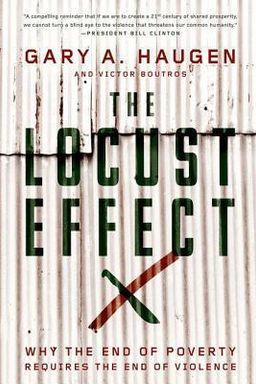
The Locust Effect cover

The Locust Effect

by Gary A Haugen and Victor Boutros

The Locust Effect reveals how violence in developing countries undermines foreign aid efforts. By highlighting the need for robust criminal justice systems, it offers a transformative perspective on how to make aid effective and sustainable, ultimately paving the way for true economic growth and protection for the impoverished.

The Locust Effect: How Violence Devours the Poor

Gary Haugen and Victor Boutros’s The Locust Effect opens with a searing metaphor: violence as a plague of locusts that destroys everything the poor struggle to grow. You can build schools, dig wells, distribute medicine, and fund microloans, but none of those blessings matter if a machete, gun, or corrupt officer can sweep them away overnight. The book’s central claim is stark: common criminal violence—rape, forced labor, extortion, land theft—devours progress and traps billions in poverty.

The Hidden Epidemic of Everyday Violence

The authors urge you to see what most development workers miss: everyday violence is as pervasive as hunger or disease. It is hidden three ways—by perpetrators who bury evidence, by victims who stay silent from fear or shame, and by societies that look away. Unlike war or terrorism, this is the quiet brutality inside homes, factories, and alleys. Stories like Yuri’s murder in Peru, Mariamma’s bondage in India, or Laura’s assaults in Nairobi show how predators strike where law has vanished and impunity reigns. These victims do not need handouts; they need protection.

Violence as the Missing Variable in Development

Development policy long focused on material needs—health, education, microfinance—assuming safety would follow progress. Haugen reverses that logic: without safety, progress collapses. Violence drains GDP (as in Guatemala, where it costs billions), reduces school attendance, destroys social trust, and inflicts lifelong trauma. The poorest live in a state of chronic crisis, unable to plan, invest, or dream. The psychological wounds perpetuate cycles of fear and lost potential. If aid ignores this reality, it amounts to feeding people as the locusts swarm again.

Broken Justice Systems as the Core Mechanism

The book’s moral heart lies in exposing how weak and corrupt criminal justice systems empower violence. In many poor countries, policing functions as extortion: officers beat or detain the innocent for bribes; pre-trial detention lasts for years; rape victims cannot obtain medical exams; and evidence vanishes conveniently for the rich. Haugen calls this the failure of protection—a collapse of the basic social contract. The police and courts often resemble predators more than shields, turning poverty into a market for impunity. The poor thus face two threats: criminals without conscience and lawmen without accountability.

Historical Roots and Elite Incentives

This dysfunction has deep roots. Colonial powers built police forces to control natives, not protect them, leaving behind militarized, top-down institutions that post-independence elites adapted to their own advantage. As the wealthy retreated into gated compounds with private security, they abandoned the public systems the poor must rely on. That withdrawal removed political pressure for reform. Meanwhile, elites profit from corruption: their money can buy immunity, silence witnesses, and turn police into bodyguards for privilege. Violence thrives where injustice is valuable.

From Despair to Possibility

Despite the horror, the book is not fatalistic. It demonstrates that justice systems can change. Like the U.S. police of the 1890s or Paris’s corrupt forerunners, today’s failing institutions are not doomed—they are unfinished. Haugen’s case studies—from Project Lantern in Cebu to Brazil’s anti-slavery inspections—show that targeted, collaborative interventions can yield measurable success. Reform requires political courage, local ownership, and incremental testing, not utopian theory. It is slow statecraft born of humility and persistence.

Core Thesis

You cannot end poverty without ending the epidemic of everyday violence—and you cannot stop that violence without building justice systems that protect the poor. Development without protection is seed without soil.

Through vivid stories, quantitative data, and historical reasoning, The Locust Effect invites you to redefine what fighting poverty really means. It is a call to replace neglect with protection, chaos with justice, and despair with the deliberate construction of safety for the world’s most vulnerable.


The Hidden Violence Beneath Poverty

You may associate poverty with hunger or disease, but Haugen exposes another parasite—unseen, pervasive violence that stalks the poor. This violence is “everyday” because it happens in homes, fields, and factories, not battlefields. It includes rape, kidnapping, forced labor, and land theft that enslave families for generations. Unlike war, it lacks visibility—its victims are isolated, its evidence erased, and its perpetrators hidden behind local respectability.

Stories That Unveil the Epidemic

Yuri’s murder in La Unión, Peru, is a case study in impunity. An eight-year-old girl raped and killed, her family bullied, prosecutors bribed, and a poor innocent man imprisoned so that the wealthy Ayalas walk free. Or Mariamma, enslaved in a brick kiln near Bangalore, beaten, raped, and starved under debt bondage. These are not narrative exceptions—they are system norms. Violence persists not because of cultural fatalism but because predators face no risk of punishment.

Why the World Doesn’t See It

The world’s blindness is structural. Data-driven aid frameworks like the Millennium Development Goals never included personal security metrics. The World Bank’s own Voices of the Poor revealed fear of violence as one of the top concerns, yet aid actors treated it as peripheral. Development photography and statistics capture visible suffering, not terror behind walls. For outsiders measuring GDP or malnutrition, the rape of an orphan leaves no data trail—but for the community, it destroys everything.

The Costs of Silence

When violence is normalized, people shrink their lives. Parents keep girls home from school, families avoid markets, workers refuse opportunities that expose them to predatory police. This collective retreat dismantles the fragile machinery of development. (Note: similar patterns emerge in global conflict studies, where fear undermines economic participation and civic life.) Recognizing the hidden epidemic is step one; confronting it requires reorienting aid around protection, not just provision.

Essential Idea

Endemic violence is development’s unseen enemy. Until safety becomes as measurable and prioritized as sanitation or health care, the poor will remain unprotected and progress will remain reversible.


Broken Justice and Predatory Policing

If violence is the plague, then the failure of justice is its breeding ground. Haugen calls policing and courts the first line of defense—and in much of the developing world, that line is broken. Instead of protection, the book documents how policing often becomes corruption in uniform.

When Police Become Predators

Across Nairobi’s slums, young men like Bruno and Caleb are arrested without charge, beaten, and jailed until relatives pay a bribe. Women reporting rape face humiliation or assault at the station. In Malawi and India, pre-trial detention drags on for years, punishing the innocent simply for being poor. This predation works through daily extortion: police exploit fear to extract payment, knowing that no one dares resist.

The Machinery of Impunity

Weak enforcement and procedural absurdities cripple accountability. In Kenya, only one police doctor certifies sexual assault cases, forcing survivors to wait months. Prosecutors often lack training or independence; judges postpone hearings indefinitely. Meanwhile, wealthy perpetrators bribe courts into paralysis. Victims see an opaque system that punishes poverty and rewards power.

Deep Structural Causes

The roots reach back to colonial systems designed for control, not justice. Under the Indian Police Act of 1861, the police existed to guard rulers from subjects. After independence, elites preserved this arrangement, using it to maintain power. As the rich privatized security—hiring millions of guards in places like India and Brazil—they abandoned the poor to decayed public forces. The result is a vicious cycle: elite opt-out leads to neglect, which breeds more inequality and lawlessness.

Central Insight

In contexts of broken justice, the uniform confers not trust but terror. Protecting the poor begins by transforming police and courts from instruments of exploitation into instruments of safety.

Only when law enforcement itself is accountable can other development gains take root. Otherwise, as Haugen warns, the state becomes just another predator wearing a badge.


Economic Violence: Sexual Exploitation and Bonded Labor

The book insists that some forms of violence are not random—they are deliberately monetized. Sexual exploitation and bonded labor are markets driven by violence, demand, and impunity. When predation becomes profitable, it reproduces itself like an industry.

The Business of Sexual Violence

Millions of women and children are trapped in forced sexual exploitation, generating billions in illegal revenue. The story of Maya, abducted in Kolkata, beaten by the trafficker Nakul Bera, and later testifying against him, captures the mix of brutality and enterprise. Coercion is the product: traffickers use deception to recruit, rape to control, and police corruption to sustain operations. Because the first act of violence (the rape) locks victims into submission, enforcement that fails to punish that act ensures the business survives.

Debt as a Tool of Enslavement

Bonded labor works through false economic logic: a small advance turns into an infinite debt. Workers like Gopinath in India borrow $10 but end up enslaved for decades as debts inflate through rigged accounts and threats. Violence, not poverty alone, sustains the trap—attempting escape invites beatings or murder. Haugen reframes slavery not as relic but as modern business: a way to own productive bodies cheaply. In brick kilns, quarries, and factories, labor becomes an exploitable asset protected by impunity, not law.

Why Enforcement Fails

Both trafficking and bonded labor persist because police and courts often collude with perpetrators. Bribes close files; evidence vanishes. Until authorities treat these crimes as enforceable economic offenses—tracing profit chains, seizing assets, and jailing owners—moral outrage remains symbolic. (Note: economists studying illicit markets affirm that cutting profit exceeds moral appeals in impact.)

Takeaway

To dismantle violence-for-profit, you must think like both regulator and rescuer: protect victims, prosecute offenders, and eliminate the incentives that make human suffering a viable business model.


Why the Aid System Missed Justice

Haugen exposes one of the book’s most sobering revelations: despite billions spent on aid, donors largely ignored ordinary criminal justice. For decades, the international development system treated “rule of law” as political reform, not personal safety. Police and prosecution were viewed as too coercive, too political, or too risky for donor involvement.

Structural Blind Spots

The U.S. government banned most police assistance abroad after abuses in the 1970s (Section 660), and the World Bank refused to fund security sectors, claiming they were outside its economic mandate. As a result, donor spending for ordinary criminal justice—protection against rape, assault, or forced labor—remained around one to two percent of aid budgets. The money flowed instead to post-conflict reconstruction, counterterrorism, and business-friendly anti-corruption programs. The poor, facing daily violence, were simply left out of protection budgets.

Conceptual Confusion

By conflating “rule of law” with democratic governance, reformers missed that enforcement institutions—the police, prosecutors, courts—form the backbone of safety. Drafting constitutions does not stop murderers. Training judges without fixing police does not protect girls walking to school. Haugen argues for precision: real rule of law begins where the state credibly deters violence against its citizens. You cannot outsource that responsibility to NGOs or microcredit programs.

Critical Lesson

Poverty agencies failed to protect the poor not because they lacked compassion, but because they lacked policy permission. Reform begins by changing that mandate: make criminal justice a legitimate, fundable part of development itself.


From Dysfunction to Reform: Building Protection That Works

After unraveling failure, the book turns toward hope: justice systems can be fixed. The past proves it—19th-century New York, Paris, and Tokyo were once corrupt, abusive, and chaotic. What transformed them were local coalitions that demanded integrity and professionalism. Likewise, today’s communities can rebuild broken justice from the ground up.

Models of Transformation

Haugen showcases how targeted reforms worked across continents. In Cebu, the Project Lantern collaboration between IJM, local police, prosecutors, and social services rescued hundreds of children and reduced child sex trafficking by 79 percent in four years. Brazil’s mobile inspection teams shut down slave-labor camps; the Democratic Republic of Congo’s mobile courts delivered rare rape convictions; Georgia’s post-revolution purge of corrupt police rebuilt trust through higher pay and accountability. Each success followed the same pattern: local leadership, coordinated partnerships, measurement, and courage.

Principles That Drive Change

  • Local ownership: reforms work only when insiders lead—journalists, judges, civic advocates.
  • Collaborative casework: fixing the system by walking cases end-to-end to diagnose leaks.
  • Incremental testing: pilot small, measurable interventions with external audits.
  • Safeguards: vet units carefully, train on human rights, embed civil oversight.
  • Trust and prevention: judge success by reduced victimization and rising public confidence.

The 15–70–15 Rule

Roughly 15 percent of officers are irredeemably corrupt, 15 percent are reformers, and 70 percent follow whichever culture dominates. Reform accelerates when you shift that 70 percent toward integrity through leadership and incentives.

Investing in Hope

The authors end with a call to transform how we talk about poverty. Make justice central to the conversation. Fund projects that measure safety, not just income. Bring prosecutors, police, and defense lawyers into development forums. Above all, believe that protecting the poor is possible. Haugen closes with a conviction both practical and visionary: efforts to build justice for the poor have not failed—they have barely been tried.

Dig Deeper

Get personalized prompts to apply these lessons to your life and deepen your understanding.

Go Deeper

Get the Full Experience

Download Insight Books for AI-powered reflections, quizzes, and more.