
Idea 1
Talent Is Grown, Not Born
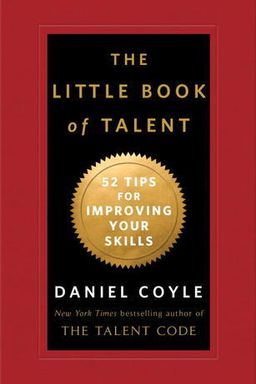
What if the difference between an ordinary life and becoming exceptional wasn’t about gifts you’re born with, but about habits you build? In The Little Book of Talent, Daniel Coyle argues that talent is not an inborn trait—it’s grown through specific methods of practice, motivation, and perseverance. He contends that anyone can cultivate world-class ability if they learn to practice deeply, ignite lasting motivation, and sustain their effort with deliberate structure.
Coyle’s core idea builds on the science of skill formation, explored in his earlier work The Talent Code. Through his research at places he calls “talent hotbeds”—from a gritty Moscow tennis club to a Dallas music school and a Vermont ski academy—he discovered a pattern: the same small, deliberate, consistent practices shaped extraordinary performers. These environments prove that excellence isn’t magic—it’s methodical.
The New Science of Growing Talent
The most revolutionary idea in the book centers on how the brain builds skill. Coyle draws on neuroscience showing that practice doesn’t “build muscle memory”; instead, it builds myelin, a fatty tissue that wraps around neural circuits. Each time you perform a skill correctly, a layer of myelin strengthens that pathway, allowing the signal to fire faster and smoother. In this model, practice literally remodels your brain—and the quality, not just quantity, of repetition determines the speed of growth. This transforms the way we think about talent: it’s not genetic destiny but neurological craftsmanship.
Rather than focusing on outcomes or natural aptitude, the goal is to strengthen your brain’s circuitry through careful, intensive practice. When you repeatedly reach for something slightly beyond your grasp, those neural “wires” get reinforced. Over time, your deliberate mistakes and corrections literally build a faster operating system for that skill.
The Three-Part Blueprint for Mastery
To make this process actionable, Coyle condenses his research into fifty-two short, field-tested tips, divided into three sections—Getting Started, Improving Skills, and Sustaining Progress.
- Part One: Getting Started focuses on sparking motivation, clarifying what kind of skill you’re learning, and shaping your learning environment. Coyle calls this stage ignition—the emotional spark that turns interest into commitment. He explains how “staring at who you want to become,” choosing minimalist over luxurious spaces, and finding the right mentor can ignite your drive.
- Part Two: Improving Skills teaches how to practice effectively—what he calls deep practice. This involves finding your “sweet spot,” breaking tasks into small chunks, embracing struggle, and creating high-engagement routines. Coyle helps you see mistakes not as failures but as essential information for building better neural patterns.
- Part Three: Sustaining Progress shows how to stay consistent over time. Here, he stresses the value of repetition, grit, and patience. You’ll learn to think like a gardener—nurturing slow, steady growth—and to develop habits that protect your progress, like keeping big goals private, teaching others, and persisting through plateaus.
Why These Ideas Matter
Coyle’s message matters because it dismantles one of the most damaging myths in learning—that talent is fixed. We’ve been taught to admire “prodigies” and to assume that success comes from intrinsic genius. But Coyle shows that supposed prodigies thrive because they grow up around deep practice and motivational ignition—from Mozart’s disciplined household to Michael Jordan’s early setbacks. Ordinary people can duplicate those same environmental and mental conditions.
This also reframes how we teach and coach. If talent is built through the brain’s wiring, then creating the right conditions—good feedback, repetition, challenging practice, and supportive mentors—is more valuable than innate aptitude. As Coyle puts it, “Small actions, repeated over time, transform us.”
From Knowledge to Craft
Ultimately, The Little Book of Talent is less about theories and more about tools. Each tip acts as a daily practice—something you can apply whether you’re learning a language, building a business, or mastering a musical instrument. It’s a compact “owner’s manual” for human performance, one that brings scientific insights down to the level of simple, doable habits.
“You are born with the machinery to transform beginners’ clumsiness into fast, fluent action,” Coyle reminds us. “That machinery is not controlled by genes—it’s controlled by you.”
In short, this little book delivers big implications: anyone can become excellent by understanding how their brain learns, how motivation is sparked, and how persistence rewires ability. Talent isn’t a gift—it’s a construction project. And with the right blueprint, you can build almost anything.