
Idea 1
Living with Resilience and Tranquility Through Stoicism
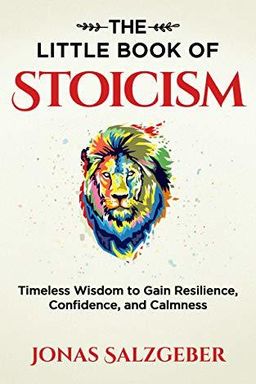
How do you stay calm and resilient when life throws storms your way? In The Little Book of Stoicism, Jonas Salzgeber updates the ancient wisdom of Stoic philosophy for a modern audience craving stability, courage, and peace of mind. Drawing from the teachings of Marcus Aurelius, Seneca, Epictetus, and other classical thinkers, Salzgeber argues that we can live better—not by avoiding difficulties—but by transforming them into opportunities for growth. He calls Stoicism “the art of living”: a practical discipline aimed at helping you thrive, not merely survive.
For Salzgeber, Stoicism isn’t about suppressing emotions or pretending to feel nothing. Instead, it’s the art of taming destructive emotions, aligning your actions with your highest values, and focusing only on what you can control. As he puts it, life is not a calm river—it’s more like a training ground. The Stoic philosophy teaches you how to live well in this arena: serene, self-disciplined, courageous, and committed to the common good. Ancient philosophers, he argues, were essentially "warriors of the mind"—individuals who tested wisdom not in classrooms but in the unpredictable battles of everyday life.
The Timeless Promise of Stoicism
Salzgeber begins by highlighting Stoicism’s two main promises: first, to help you achieve eudaimonia—a flourishing, smoothly flowing life—and second, to build emotional resilience so you can maintain that flourishing even amid adversity. The Stoics believed happiness isn’t dictated by external events but by your inner character and mindset. Marcus Aurelius, Rome’s philosopher-emperor, called it living “in harmony with your highest self.”
The key lies in mastering your perception and choices. Every challenge becomes a chance to practice courage, patience, justice, and wisdom—the four cardinal virtues of Stoicism. Salzgeber points out that, just as heavy winds strengthen trees, adversity strengthens people. That’s why true Stoics welcome challenges: they give you opportunities to grow roots and rise stronger.
Why It Matters Today
Modern life, Salzgeber argues, leaves us emotionally fragile and easily disturbed. We chase achievements and possessions hoping they’ll make us happy, only to find emptiness and anxiety on the other side. Schools teach calculus and chemistry but not how to face heartbreak, failure, or fear. Stoicism fills that gap—it’s a guide to living deliberately and mentally strong, something the author learned from his own struggles with uncertainty and loss. Rather than being archaic, Stoicism feels strikingly relevant in an age of emotional turbulence and constant comparison.
The author correlates Stoic principles with findings in modern psychology, especially cognitive-behavioral therapy (CBT) and positive psychology. Both show that thoughts shape emotions and that mental training can cultivate well-being—something Stoics knew 2,000 years ago. Thus, Stoicism becomes a timeless bridge between ancient philosophy and modern science, offering clear, actionable wisdom for building tranquility in chaos.
Two Parts: From Understanding to Practice
Salzgeber divides the book into two parts. Part One explores the “theory,” unpacking Stoic principles through the lens of history, philosophy, and psychology. It introduces what he calls the Stoic Happiness Triangle, a simple framework explaining how to live with virtue (areté), focus on what you control, and take full responsibility for your happiness. Within this triangle, he distills centuries of Stoic insight into practical, memorable ideas—accessible enough for beginners but profound enough for lifelong reflection.
Part Two becomes the “practice field.” It offers 55 Stoic exercises to put philosophy into action—from negative visualization and voluntary discomfort to routines for mindful mornings and reflective evenings. Here, Stoicism transforms from theory to daily discipline—something you live, not simply think about. It’s like going from reading about surfing to catching your first wave.
Reclaiming Control of Your Inner World
The book’s central message is empowering: no one can ruin your life except you. Your freedom lies in how you respond, not in what happens to you. Salzgeber draws on Seneca’s metaphor of the mind as an impregnable fortress—safe from the missiles of fate. The only way to be miserable, he reminds us, is to hand over that fortress to external events: a bad boss, a failed relationship, a social media slight. By withdrawing your happiness from external control, you reclaim invincibility.
As he writes, Stoicism doesn’t promise a life free from trouble; it promises strength in trouble. Tranquility—what the Stoics called euthymia—is not a goal you chase, but a by-product of living according to reason and virtue. This serenity comes when your actions reflect your values and your judgments match reality. Instead of getting dragged by life’s cart like a dog fighting its leash (a classic Stoic metaphor), you choose to run alongside it, willingly embracing what is.
Why Stoicism Is a Philosophy for All Seasons
Ultimately, Salzgeber’s Little Book stands as a practical handbook for living wisely, no matter your background or circumstances. You don’t have to be an emperor like Marcus Aurelius, a slave like Epictetus, or a philosopher like Seneca—all proved that happiness depends not on fortune or status but on the quality of one’s mind. Stoicism erases excuses and replaces them with principles: humility, courage, discipline, kindness, and acceptance.
By the end of the book, Stoicism emerges as the art of living in harmony with nature, with others, and with yourself. Salzgeber’s tone is inviting—less a lecture than a call to action. He leaves you asking: “How long will you wait before you demand the best of yourself?” The answer, as the Stoics remind us, is always the same—start now, because life is already happening.