
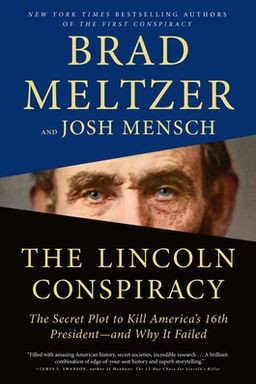
The Lincoln Conspiracy cover

The Lincoln Conspiracy

by Brad Meltzer and Josh Mensch

The Lincoln Conspiracy reveals the thrilling true story of the first conspiracy to assassinate Abraham Lincoln before he was sworn in as president. Private detective Allan Pinkerton and his team, including the first female detective, Kate Warne, unravel a dangerous plot, showcasing courage and strategy that changed the course of American history.

Conspiracy, Courage, and the Making of a Presidency

You live through the story of Abraham Lincoln’s perilous path to power—how political rhetoric hardened into plots, how reformers and detectives fought to preserve the Union’s continuity, and how courage became an act of logistics. This book traces the Baltimore Plot of 1861 and the broader context of sectional rage, secret societies, and intelligence innovation that shaped Lincoln’s journey from Springfield to Washington.

The fracture of a nation

By the late 1850s, America was a country breaking apart: congressional debates devolved into canings, militias formed in cities, and every territorial dispute became a question of slavery’s survival. Southern elites defended bondage as divinely sanctioned, while Northern reformers circulated abolitionist tracts and invoked the Declaration’s creed that all men are created equal. Violence was no longer exceptional—it was political language. The caning of Senator Charles Sumner and armed drilling in Baltimore forecast how ideological conflict would soon manifest in assassination plots and open war.

Lincoln’s rise and moral positioning

Against that backdrop stands Abraham Lincoln: a frontier-born autodidact whose public persona—the 'Rail Splitter'—embodied honesty and humble labor. His life of self-taught learning, moral introspection, and rhetorical precision becomes a symbol of stability amid chaos. His debates with Stephen Douglas in 1858 framed slavery as a national moral crisis. By 1860, his modest authenticity made him the Republican compromise candidate capable of uniting expanding factions. His cabinet—a calculated 'Team of Rivals'—embodied a deliberate bridging of regional divides, offering the political ballast necessary to face secession.

Threats and an atmosphere of conspiracy

Immediately after Lincoln’s election, letters and telegrams carried threats of hanging, shooting, and poisoning. In Washington, reformers like Dorothea Dix warned of plans to seize the Capitol. Congress responded with a 'Treason Committee' to probe subversive groups while Seward urged Lincoln to arrive discreetly. The risk was no longer abstract; it was stamped onto official correspondence. The country’s capital stood at the brink of compromise or capture.

The shadow defenders

The plot’s foil was Allan Pinkerton—the Scottish-born cooper turned detective—who transformed moral conviction into organized intelligence. Pinkerton and his female operative, Kate Warne, built a network capable of penetrating Baltimore’s secret lodges and loyalist circles. Their work, motivated by anti-slavery ethics and civic duty, exemplified a new professional model of espionage. You meet agents like Timothy Webster and Harry Davies masquerading as laborers or Southern aristocrats; they uncover conversations about coded telegrams and armed drills in Ferrandini’s barbershop—threads of a conspiracy designed to kill Lincoln during his train transfer through Baltimore.

A union preserved through secrecy

Through infiltration, coded telegrams, and midnight movement, Pinkerton and Warne orchestrate Lincoln’s escape. Their plan—cut telegraph wires, alter train schedules, and compartmentalize information—represents the birth of American counterintelligence. The Baltimore Plot, whether narrowly prevented or dramatically exaggerated, encapsulates a national truth: democratic institutions that thrive on openness must sometimes survive through secrecy. You see how ideals and pragmatism coexist uneasily when the Republic itself hangs in the balance.

Legacy and reflection

What follows—the bombardment of Fort Sumter, the outbreak of civil war, Pinkerton’s transformation into McClellan’s spymaster—expands the immediate crisis into a systemic revolution in intelligence and security. The enduring debate over Pinkerton’s motives and accuracy mirrors the tension between heroism and self-promotion that shapes history itself. Yet what remains undeniable is how collaboration, courage, and clandestine skill converged to safeguard a presidency that would soon fight to redefine freedom.

Central insight

Lincoln’s survival depended on a moral convergence of reformers, rail executives, and detectives—private intelligence acting where public institutions faltered. The Baltimore Plot reveals that saving democracy sometimes required operating in its shadows.


The Roots of Division

To grasp Lincoln’s peril, you must first understand the climate that made violence politically acceptable. The 1850s were years of polarization beyond ideology: armed confrontation replaced debate. From congressional assaults to militia organizing, the moral dispute over slavery became physical. Senator Charles Sumner’s caning in 1856 stands as an early indicator that democratic discourse was collapsing into vengeance.

Slavery and political absolutism

Southern elites viewed slavery not as an economic system but as a divine social order. Their defense fused theology, race, and property, insisting that bondage defined civilization itself. Northern abolitionists opposed through pamphlets, lectures, and narratives by former slaves. Each side fused morality with identity, leaving no room for compromise. Seward’s phrase 'irrepressible conflict' captured what everyone sensed: ideas alone would not suffice to decide the nation’s future.

From individual duels to institutional rage

Congressmen carried revolvers; social clubs trained militias. You can view this escalation as culture normalizing violence as persuasion. The Baltimore conspirators inherited that habit—the belief that killing a political adversary could sustain an ideology. When you track these developments, the Civil War no longer appears as a spontaneous eruption but as the logical endpoint of years of militant culture building.

Lesson

The Baltimore Plot did not arise in isolation; it sprouted from an already radicalized political ecosystem where violence had become a legitimate form of communication.


Lincoln’s Self-Made Identity

Lincoln’s story is inseparable from his self-crafted persona. Born into hardship, he learned by imitation and introspection. Every setback—his mother’s death, farm labor, isolation—sharpened his moral awareness and empathy for ordinary people. His eventual public image as the 'Rail Splitter' was both biography and political branding: a myth of virtue through work.

From frontier discipline to moral rhetoric

Self-taught from borrowed books, Lincoln fused legal reasoning with ethical clarity. His language borrowed heavily from Jefferson’s ideals, using the Declaration to frame the slavery debate as a question of human equality. In debates with Stephen Douglas he showed mastery of moral persuasion—plain words, moral stakes, and conviction more than eloquence.

An image that unified factions

At the Decatur convention, the 'Rail Candidate' tagline symbolized industry and honesty. Grace Bedell’s letter suggesting whiskers added humanity and visual charisma. Lincoln’s awkwardness became part of his trustworthiness. Political organizers amplified the persona to appeal across class and geography. His practical humility attracted rival factions, enabling his nomination as compromise candidate in Chicago and his creation of a balanced cabinet—the 'Team of Rivals'—as the Republic lurched toward dissolution.

Key understanding

Lincoln’s authenticity was strategic. His plainness marketed trust in an era of deceit. That trust would later enable him to accept covert protection without losing moral legitimacy.


Pinkerton and the Rise of Intelligence Work

Allan Pinkerton gives the story its operational core. Former cooper, union activist, and detective, he viewed investigation as civic service. In hiring women like Kate Warne, he created America’s first institutionalized intelligence team. When Samuel Felton sought help protecting rail lines and the inauguration, Pinkerton responded with clandestine discipline that shaped future espionage.

Craft and conscience

Pinkerton’s anti-slavery convictions fueled his courage. Having aided fugitives through the Underground Railroad, he approached Lincoln’s protection as moral duty. His agency’s credo 'We Never Sleep' reflected relentless vigilance. He stationed undercover operatives—Webster, Davies, Warne—within Baltimore’s social matrix to expose networks of militias and secret societies. They used false identities and cultivated trust among conspirators who boasted loosely in taverns and drawing rooms.

Warne’s strategic brilliance

Kate Warne proved indispensable. She infiltrated elite female circles, relayed messages through coded telegraphs, and later coordinated Lincoln’s covert rail passage. Her insistence on compartmentalization anticipated modern security doctrine. She merged charm and professionalism—proof that secrecy depends on empathy as much as deception.

Insight

Pinkerton transformed private investigation into public intelligence, showing that organized, ethical espionage could safeguard democracy in crises.


Baltimore’s Secret Societies

Baltimore becomes both stage and source of menace. Beneath its elegance lies a dense network of oath-bound organizations and paramilitary clubs: the Knights of the Golden Circle, National Volunteers, and Constitutional Guards. Cypriano Ferrandini’s barbershop serves as headquarters for armed Southern sentiment.

The architecture of secrecy

These societies mirror military discipline—signals, passwords, rituals. The Knights of the Golden Circle envisioned spreading slave power across hemispheres. Militia leaders turned ideology into drill. This secret structuring provided conspirators with communication speed and insider solidarity, enabling them to organize violence more efficiently than the Union’s bureaucratic defenses could react.

Ferrandini’s leadership

Pinkerton’s reports depict Ferrandini as charismatic fanatic, orchestrating assassination rituals where red ballots designated killers. He promised glory for any man who struck Lincoln. Plans included street riots, police inaction ensured by Marshal Kane, and escape by steamer. Whether inflated or accurate, these accounts expose how ideology mixed with theatrical oath-taking to create real operational intent.

Takeaway

Organized loyalty—reinforced by ritual—can convert belief into coordinated violence. Understanding the psychology of secret brotherhoods is essential for preventing modern extremism.


The Undercover Discovery

Pinkerton’s infiltration reads like early spycraft in motion. Operating under the alias John H. Hutcheson, he establishes office on South Street and recruits undercover agents. Each agent gathers fragments—telegraph ciphers, militia rosters, whispered threats—that collectively reveal the Baltimore Plot.

Collecting and connecting clues

Harry Davies befriends Otis Hillard, who brags of a telegraph code tracking Lincoln’s train. Pinkerton bribes Thomas Luckett to open secrets about arms purchases and Ferrandini’s cabal. Parallel interviews confirm names through repetition; cross-verification replaces conjecture with evidence. Intelligence emerges not as epiphany but as mosaic.

Human weakness as tool

Pinkerton exploits vanity and bravado—men who crave importance become informants. He demonstrates that conspiracies collapse through their own indiscretion. His careful layering of agents prevents exposure; no one operative knows the full plan. In doing so, he pioneers compartmentalization—the same principle guiding security systems today.

Essential idea

Actionable intelligence often arises from ordinary social vulnerability. Pinkerton’s success reveals how patience and incremental proof outweigh bravado.


The Midnight Escape

The climax merges espionage and logistics. Having confirmed threat intensity, Pinkerton orchestrates a covert reroute. On February 22–23, 1861, Lincoln leaves Harrisburg quietly, boards a secret train to Philadelphia, and travels overnight through Baltimore toward Washington while the telegraph lines fall silent.

Designing invisibility

Kate Warne purchases sleeper berths under aliases; Pinkerton ensures a sealed parcel delays train departure until Lincoln is aboard; Edward Sanford’s team cuts telegraph connections. At Baltimore, horsemen tow the car across town—the moment scheduled for assassination—yet dawn finds Lincoln already en route to the capital, his identity shielded beneath shawl and soft hat.

Security through silence

Pinkerton’s doctrine is clear: secrecy protects better than guards. The operation’s success stems from compartmentalized knowledge—only a handful understood timing. Lincoln’s reluctance to appear cowardly underscores leadership’s burden: safety must balance with dignity. The invisible journey preserved both his person and the Union’s legitimacy.

Meaning

Victory sometimes means escaping notice. The quiet passage through Baltimore is proof that discretion can be the highest form of courage.


Aftermath and Wartime Intelligence

Lincoln’s safe arrival only postponed the conflict. Within weeks Fort Sumter burned, the Civil War began, and Pinkerton’s skills migrated into military intelligence. His agents—Warne, Webster, Lawton—went undercover for General McClellan as 'McClellan’s Secret Service.' The Baltimore experience became the prototype for wartime espionage.

Continuity of method

Pinkerton applied the same undercover discipline to map Confederate movements. His alias Major E. J. Allen represented professional intelligence merging with military command. Tragedy struck when Timothy Webster was executed in Richmond, demonstrating the personal cost of espionage never recognized in formal reports.

Legacy's double edge

Postwar, the Pinkerton Agency evolved into corporate policing, ironically against labor—the very movement its founder once protected. Yet its early wartime role embedded intelligence as permanent state function. The Baltimore Plot thus seeded America’s future intelligence system and its moral contradictions.

Observation

Private initiative became national institution. The need to defend freedom birthed intelligence mechanisms that outlived war and altered civic trust itself.


Memory and Historical Debate

After the smoke cleared, memory became its own battlefield. Pinkerton claimed that careful planning prevented tragedy. Ward Hill Lamon disputed his account, calling him self-aggrandizing. Historians wrestle with whether the Baltimore Plot was imminent or inflamed by fear. What endures is the interplay of evidence and personality shaping historical truth.

Evidence versus ego

Contemporaneous dispatches, corroboration by Seward, Felton, and General Scott affirm Pinkerton’s findings. Multiple investigations converged on the same threat profile, suggesting credibility. Even if the risk was overstated, independent confirmation supports the narrative that violence was likely and prevention necessary.

The moral aftermath

Ferrandini lived quietly thereafter; Warne died obscurely; Webster was martyred; Pinkerton oscillated between hero and villain in public memory. This moral ambiguity defines intelligence history: heroism intertwined with secrecy’s unavoidable self-justification.

Enduring insight

The Baltimore Plot endures not merely as an event but as a mirror—reflecting how evidence, ambition, and fear coalesce to forge history’s moral texture.

Dig Deeper

Get personalized prompts to apply these lessons to your life and deepen your understanding.

Go Deeper

Get the Full Experience

Download Insight Books for AI-powered reflections, quizzes, and more.