
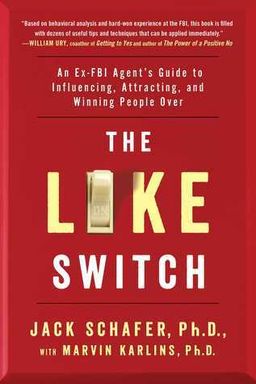
The Like Switch cover

The Like Switch

by Jack Schafer and Marvin Karlins

In ''The Like Switch,'' former FBI agent Jack Schafer reveals the secrets of nonverbal communication and social influence. Learn proven techniques to effortlessly make friends, win people over, and build lasting relationships. Whether navigating social settings or professional arenas, this guide provides actionable strategies to enhance your interpersonal skills and connect with others effectively.

The Power of the Like Switch: Turning Strangers into Allies

Have you ever wished you could make people like you instantly — get them to open up, trust you, or even cooperate with you when they have every reason not to? In The Like Switch: An Ex-FBI Agent’s Guide to Influencing, Attracting, and Winning People Over, former FBI Special Agent Jack Schafer and psychologist Marvin Karlins reveal a science-based roadmap for doing exactly that. Drawing from Schafer's decades of experience recruiting foreign spies, interrogating criminals, and reading people, the authors argue that likability isn’t an inherited talent — it’s a set of skills anyone can learn, practice, and master.

Schafer’s central claim is simple yet profound: whether you’re an intelligence officer trying to flip an enemy operative or just trying to get along better at work, friendship and influence follow the same predictable psychological laws. He introduces these as the Friendship Formula — proximity, frequency, duration, and intensity — which together determine how fast and deeply you connect with others. Once you understand these levers, you can deliberately turn casual interactions into meaningful relationships.

From Espionage to Everyday Life

The book opens with stories pulled straight from the shadowy world of counterintelligence. In one memorable case study, an FBI agent named Charles successfully recruits a foreign diplomat code-named “Seagull” to spy for the U.S. Rather than approaching him directly, Charles spends weeks simply placing himself in the man’s line of sight, using carefully timed nonverbal “friend signals” — a nod, a glance, a subtle smile. Only after Seagull’s curiosity overcomes his suspicion does Charles make direct contact. Months later, the diplomat is not only comfortable with him but volunteering secrets of his own. This slow, systematic process, Schafer explains, mirrors exactly how friendships form in everyday life. Whether you’re courting a business contact, a romantic partner, or a skeptical audience, the underlying psychology is the same.

Why Friendship Is a Formula, Not a Mystery

Schafer’s Friendship Formula explains why some bonds develop effortlessly while others never take root. Each factor — proximity (physical or virtual closeness), frequency (how often you interact), duration (how long those interactions last), and intensity (how emotionally engaging they are) — contributes to the “math” of rapport. Adjust any one, and you change the relationship’s trajectory. If a friendship feels distant, you can strengthen it by increasing frequency or deepening emotional intensity. Likewise, if you need to distance yourself tactfully, you can gradually reduce those elements until the relationship fades naturally.

This kind of methodical empathy may sound manipulative, but Schafer insists it’s simply intentional relationship-building. His point echoes Dale Carnegie’s timeless insight in How to Win Friends and Influence People: people will forget what you say and what you do, but never how you make them feel. Schafer’s innovation lies in translating that philosophy into actionable micro-behaviors drawn from behavioral science and FBI fieldwork.

Friend or Foe: The Nonverbal Code

Humans are constantly broadcasting subtle “friend” or “foe” signals through body language, facial expressions, and tone. Every first impression, Schafer argues, starts as a silent conversation between two brains scanning each other for threat or reward. Understanding these unconscious exchanges — eyebrow flashes, head tilts, genuine smiles, or defensive postures — allows you to influence how others read your intentions before you even speak. The book teaches how to replace accidental enemy signals (the “urban scowl” many city-dwellers wear without realizing it) with deliberate friend signals that invite trust and rapport.

Consider Schafer’s “firefly effect,” comparing people to insects flashing light to attract mates or signal safety. In social situations, our “light” is our demeanor: friendly signals make us visible and inviting, while threat signals switch our light off. Learn to control that light, Schafer suggests, and you can “turn on” almost anyone you meet.

Inside the Like Switch

Throughout the book, Schafer layers psychological principles — empathy, reciprocity, primacy effect, scarcity, and misattribution — onto practical communication tactics. Together they form what he calls the Like Switch: the ability to flip others’ emotional state from cautious or indifferent to warm and cooperative. He shows how to use empathy statements (“You look like you’ve had a long day”), nonverbal mirroring, and subtle reciprocity to make people feel seen and valued. In romantic or professional contexts alike, the Like Switch framework helps turn strangers into allies, skeptics into supporters.

By the end, The Like Switch becomes much more than a manual on persuasion. It’s a field guide to human connection — one that blends FBI tradecraft with timeless lessons in compassion. The book reminds us that friendship and influence aren’t mysterious forces; they’re predictable results of empathy, consistency, and intention. The very tactics that once lured foreign spies across enemy lines can just as easily help you win hearts across an office desk or dinner table.


The Friendship Formula

At the heart of Schafer’s system lies what he calls the Friendship Formula — a surprisingly simple but powerful equation that explains how relationships grow. It states: Friendship = Proximity + Frequency + Duration + Intensity. According to Schafer, you can increase or decrease any of these four variables to shape the trajectory of a relationship. The formula maps how rapport evolves whether between FBI agents and foreign operatives or two new coworkers finding common ground.

Proximity: The Power of Presence

Proximity means physical closeness — the distance and exposure between two people. When Schafer’s operative Charles shadowed Seagull on his weekly grocery trips without initiating contact, he wasn’t stalking — he was creating safe, predictable proximity. Simply being consistently visible, without intrusion or threat, helps the brain categorize someone as familiar rather than foreign. The same principle applies at work or in social networks: just showing up in the same spaces regularly primes affinity. (Social psychologist Leon Festinger found similar results in his “apartment friendship” study — neighbors close in physical space were far more likely to become friends.)

Frequency and Duration: Repetition Builds Trust

The second and third elements — frequency and duration — describe how often and how long interactions last. More frequent contact builds familiarity; longer interactions deepen influence. Schafer describes how Charles increased both by appearing repeatedly on Seagull’s route and later following him into the grocery store, spending more time in the same space. In everyday life, this might mean showing up consistently at your coworker’s coffee break or taking time for real conversations rather than shallow check-ins. As relationships mature, high frequency and duration (like between romantic partners or close colleagues) create stronger emotional bonds and greater mutual influence.

Intensity: Emotional Resonance

Intensity, the final factor, measures how strongly you meet another person’s emotional or psychological needs. This is where empathy, curiosity, and emotional attunement come into play. Charles sparked intensity by arousing Seagull’s curiosity — creating a puzzle he needed to solve. Similarly, you can build intensity by becoming emotionally memorable: showing genuine appreciation, using humor, sharing personal truths, or engaging in meaningful experiences. Schafer cautions that sudden or forced intensity can backfire; like Seagull, people need time to reinterpret curiosity as trust rather than threat.

Applying the Formula in Real Life

Once you understand the formula, you can consciously adjust it. If your marriage feels flat, increase intensity with new shared experiences. If you want to exit a toxic friendship, slowly reduce proximity, frequency, and duration until the connection fades naturally. Technology can supplement physical proximity — video calls or frequent texts maintain the illusion of closeness when distance intervenes. As Schafer notes, even foreign intelligence agencies use the same levers unconsciously; Chinese operatives, for example, would assign one translator per visiting scientist, spending long days touring and dining together to build rapport over time without overt recruiting.

Ultimately, the Friendship Formula turns the art of connection into a science. It redefines friendship not as fate or chemistry, but as a deliberate process you can steer. Relationships don’t just happen; they’re built, nurtured, and balanced through small, intentional exchanges that tell the other person, again and again: you are safe, you matter, and I see you.


First Impressions Without Words

Before you open your mouth, your body has already started talking. Schafer devotes an entire chapter to what he calls the pre-verbal phase of influence, where your nonverbal cues silently broadcast friend or foe signals. Much like fireflies flashing to attract mates, humans use micro-expressions — raised eyebrows, tilted heads, authentic smiles — to indicate trustworthiness and interest. Understanding these signals can help you send warmth consciously and avoid the defensive cues that shut people down.

The “Big Three” Friend Signals

The cornerstone gestures are the eyebrow flash, the head tilt, and the genuine smile. The eyebrow flash, a quick lift lasting a fraction of a second, signals recognition and safety. The head tilt exposes the vulnerable carotid artery — a subconscious way of saying, “I trust you.” The genuine smile, scientifically known as the Duchenne smile (crow’s feet and all), triggers endorphins and communicates happiness and welcome. Combined with eye contact lasting just under one second, these cues open the Like Switch before a single word is spoken.

Friend vs. Foe in Body Language

Schafer contrasts friend signals with the many ways we inadvertently signal “foe.” A scowl or tense jaw — the so-called “urban scowl” — tells others we’re unapproachable, a defensive trait learned in rough environments. Crossing arms, avoiding eye contact, or invading personal space also triggers the brain’s threat alarm. Even clothing can miscommunicate intent: a leather jacket and spiked collar might say “danger” in one context but friendship at a concert. The key, Schafer emphasizes, is situational awareness and congruence. You must send the right signals for the environment you’re in.

Mirroring, Touch, and the Inward Lean

Beyond facial expressions, nonverbal rapport depends on physical synchrony. Subtle mirroring (isopraxism) — matching a person’s posture, gestures, or tone — causes the brain to register similarity, a deep rapport builder. Likewise, gentle, socially appropriate touch (a handshake, a brief arm pat) creates a subconscious sense of trust when mirrored back. The “inward lean,” where your torso subtly angles toward the other person, is another nonverbal indicator of affinity that listeners interpret as interest and respect. These microbehaviors are small, but their cumulative impact is enormous; they flip the Like Switch effortlessly.

If body language communicates your intentions before speech, mastering it is like learning a second language — one that speaks directly to the primal brain. Schafer’s advice boils down to this: replace fear with warmth, motion with mirroring, and tension with trust. In a world where first impressions are often made in seconds, your “silent conversation” determines whether people let you in or shut you out.


The Golden Rule of Friendship

Schafer’s cardinal rule — derived from both psychology and field experience — is that people like those who make them feel good about themselves. He calls this the Golden Rule of Friendship: if you want people to like you, focus your attention on them, not on yourself. Ego is the arch-enemy of rapport. When you center the other person’s emotions, needs, and experiences, you trigger powerful psychological reciprocity — they associate you with positive feelings and seek to maintain that connection.

The Empathy Toolbox

Schafer offers practical tools for implementing this rule. Chief among them are empathic statements — reflections that show you’re attuned to someone’s feelings (“You look like you’ve had a long day” or “Sounds like work’s been hectic for you”). By mirroring their physical or verbal cues, you signal understanding without judgment. This encourages people to keep talking and feel valued. In his “Ben and Vicki” example, a man keeps conversation flowing effortlessly by using successive empathic statements that focus entirely on her experience, never on himself.

Flattery Done Right

Schafer distinguishes authentic compliments from manipulative flattery. Instead of handing out empty praise, he suggests triggering self-compliments: give people room to highlight their own achievements. For instance, telling a hard-working colleague, “That project must take a lot of discipline,” invites them to affirm, “Yes, it really does.” Self-generated pride feels genuine, and the good feeling they experience attaches to you. Likewise, third-party compliments — having someone else relay your praise — bypass suspicion and increase credibility, an FBI-proven technique also useful in office politics or dating.

Primacy and Perception

The rule extends to managing how others perceive you before they even meet you. Schafer describes the Primacy Effect: the first description someone hears about a person colors their lasting impression. If mutual acquaintances describe you as friendly and reliable, new contacts will unconsciously interpret your actions through that lens. In one interrogation story, Schafer primes a suspect to view his partner as an honest “human lie detector.” When the suspect sees the partner’s skeptical look, he interprets it as proof of extraordinary perception — and confesses. The same principle helps in business: let positive word-of-mouth precede you.

Reciprocity and the Ben Franklin Effect

Finally, Schafer reminds us that people like those they’ve helped. Known as the Ben Franklin Effect, this paradox means you can increase likability by asking small favors (“Could you watch my drink?”). Doing something for you makes others feel generous and competent, which in turn strengthens their affection. Combined with empathic communication, respectful curiosity, and sincere gratitude, these micro-moments of validation create a compounding loop of goodwill — the true engine of influence.

In practice, the Golden Rule is deceptively simple: stop trying to impress people, and start making them feel impressive. Every FBI recruiter knew this truth — spies didn’t betray their nations because they were pressured, but because someone made them feel understood, respected, and important.


The Laws of Attraction

Why are we drawn to certain people and indifferent to others? Schafer’s Laws of Attraction synthesize social psychology and real-world experience to explain how mutual liking develops and how to use that knowledge to strengthen any bond. These “laws” go far beyond physical attraction — they describe the hidden forces that guide trust, intimacy, and long-term rapport.

Similarity and Common Ground

People like people who are like themselves. Shared perspectives or experiences lower defenses and build instant rapport — which is why Schafer’s Chinese translator case worked so effectively. Recognizing common ground can mean identifying “contemporaneous experiences” (we both love baseball), “temporal ones” (we went to the same university years apart), or “vicarious experiences” (my dad worked in your field). Even subtle overlaps trigger a sense of kinship, fulfilling Aristotle’s wisdom that “we like those who resemble us.”

Curiosity and Misattribution

Curiosity hooks drive intensity. When you behave unpredictably — like bringing marbles to a bar, as one of Schafer’s students did — you spark intrigue. Likewise, the Law of Misattribution reveals that people may associate feelings of excitement, fear, or pleasure with whoever or whatever happens to be around. That’s why taking a date to a suspenseful movie or adventurous activity can increase attraction: the endorphins get “misattributed” to you. (This finding echoes psychologist Dutton and Aron’s famous “shaky bridge” study.)

Reciprocity and Scarcity

The Law of Reciprocity states that when someone gives you something — a smile, a favor, a compliment — you feel pressure to return it. This simple social contract fuels tipping behavior, gift-giving, and cooperation. The Law of Scarcity, by contrast, leverages desire through absence. People value what (or who) seems less available. Schafer demonstrates this power with his “Vladimir” case: because he constrained access to himself, the spy’s curiosity — and drive for connection — skyrocketed. In dating, the same principle explains why early overavailability dampens interest; measured restraint builds anticipation.

Self-Disclosure and the Rocky Road

Relationships deepen through exchange of self-disclosure — revealing vulnerabilities at a steady pace, like “bread crumbs” left along the path. Too much too soon smothers interest; too little stalls intimacy. Interestingly, even conflict can strengthen bonds, a principle Schafer calls the Law of the Rocky Road: when two people overcome initial friction, their relationship often becomes stronger than one that started smoothly. (Many romantic comedies illustrate this truth.)

Together, these laws explain both magnetic chemistry and everyday likability. They remind you that attraction is a process guided by consistency, empathy, and timing — not luck or looks. When you understand these forces, you stop chasing approval and start generating it naturally.


Speaking the Language of Friendship

After you’ve mastered nonverbal cues, Schafer turns to the power of verbal communication — what he calls “the language of friendship.” Once again, his FBI lessons apply surprisingly well to everyday life: the wrong words ignite defensiveness; the right words disarm and connect. Effective communication, he says, is less about what you know and more about how you listen, respond, and make others feel heard.

The Dangers of Ego-Centric Speech

In the parable of “Stacey and the Manager,” a young employee ruins her breakthrough idea by blurting, “You’ve been manufacturing this all wrong.” Her choice of words triggers her boss’s defensiveness — the “I’m right, you’re wrong” trap. Schafer dissects her mistakes: using adversarial pronouns (“you” vs. “I”), evoking cognitive dissonance, and bruising ego. The fix? Replace assertions with inclusion. Phrases like “I’d love your advice on…” invite collaboration, satisfying others’ need for both respect and self-worth.

Listening and Observing

Schafer reminds us that active listening is the foundation of empathy. It’s not silence while you wait to talk — it’s full attention, curiosity, and nonverbal affirmation (head nods, mirroring, eye contact). The FBI learned long ago that people reveal the truth only when they feel truly heard. Listening closes the “discourse cycle,” proving understanding. Observation goes hand in hand: watch for nonverbal changes — blinking, lip purses, leaning away — to sense disagreement or discomfort before it’s verbalized.

Elicitation: The Art of Drawing People Out

Asking direct questions often triggers resistance. Instead, Schafer used elicitation — gentle statements or presumptions that invite correction. A jewelry clerk, for example, reveals profit margins when she reflexively corrects the customer’s exaggerated guess. Variants like the “empathic presumptive” (“So you’re looking for something small for your apartment”) or quid-pro-quo disclosure make others volunteer more than they realize. The lesson is timeless: curiosity disguised as empathy disarms defenses better than interrogation.

Word Mines and Emotional Intelligence

Not all missteps are intentional. “Word mines” — terms that carry unexpected emotional meaning — can derail conversations if you don’t notice body language cues of distress. Empathic statements help defuse these triggers instantly. Schafer also explains telltale lip behaviors: purses indicate disagreement forming, bites signal suppressed thoughts, and compressions suggest withheld confessions. Spotting these subtleties lets you intervene before “no” becomes permanent.

Finally, Schafer offers a four-step acronym — LOVE: Listen, Observe, Vocalize, and Empathize — summarizing his entire communication approach. When you use it, you’re no longer just talking; you’re building trust molecule by molecule.


Building and Testing Rapport

Rapport, Schafer writes, is the invisible glue of every relationship. It’s a psychological bridge that turns interactions into alliances. Without rapport, even the most persuasive message falls flat; with it, influence flows almost effortlessly. The same cues that build rapport also serve to test it, revealing whether two people are in emotional sync.

Touch and Synchrony

Physical cues like touch act as rapport thermometers. A light arm tap or leaning closer signals comfort. In contrast, pulling away, crossing arms, or setting objects between you erect barriers. Schafer’s list of grooming behaviors — straightening a partner’s collar, brushing lint — often mark intimacy. He even solved a spy case when footage showed an agent touching a female contact on the small of her back, proving a sexual relationship and thus motive.

Mirroring and Leading

To test rapport, Schafer teaches the “lead-and-follow” technique. First, subtly mirror the other person’s posture. Once rapport is likely established, shift your position and see if they follow — a nonverbal signal of alignment. The same principle shows up in sales, classrooms, and therapy: when body rhythms synchronize, trust deepens. When movements fall out of sync, rapport falters.

Barriers, Eyes, and Cups

Objects often reveal emotions before words. A purse pulled into the lap, folded arms, or a coffee cup set between two people are defenses, while removing them signifies openness. One FBI trainee spotted a witness’s anxiety when she clutched a pillow during questioning; empathic acknowledgment (“You seem uneasy about describing him”) rebuilt trust until she relaxed — literally putting the pillow down. Conversely, increasing physical or conversational barriers signals cooling rapport.

Understanding these cues isn’t manipulation; it’s emotional radar. Whether you’re interviewing, negotiating, or dating, your ability to sense and adjust rapport determines both success and sincerity. You can’t fake genuine connection — but you can learn to notice when it exists and how to nurture it.


Caring and Conflict: Sustaining Long-Term Relationships

Once attraction and rapport are established, maintaining them requires something simpler yet rarer: genuine care. Schafer condenses long-term relationship success into an acronym — CARE: Compassion, Active Listening, Reinforcement, Empathy. Together, these traits sustain intimacy through life’s inevitable stress and conflict.

Compassion and Active Listening

Caring begins with concern. Schafer recalls meeting a kidnapping survivor years later who thanked him not for investigative skill but for kindness — daily listening sessions that helped restore her emotional stability. Compassion, he writes, isn’t grand gestures but steady, attentive presence. Active listening reinforces that compassion: it means noticing tone and nonverbal shifts, avoiding “hot-button” topics in fights, and letting your partner feel safe enough to speak freely. Over decades, listening builds trust; ignoring does the opposite.

Reinforcement Done Right

Like reinforcement training in psychology, relationships thrive on rewarded behaviors. Partners should spotlight positives rather than punish mistakes. Schafer classifies destructive patterns — the Negativist (“I only notice errors”), the Perfectionist (“Nothing’s ever good enough”), and the Sadist (“One mistake wipes out all the good”). Balancing feedback, celebrating milestones, and recognizing effort create emotional equity that sustains goodwill. Small recognitions — a thank-you card, a public compliment — become psychological deposits that buffer conflict.

Empathy and Anger Management

Inevitably, relationships encounter anger. Schafer’s FBI-tested anger cycle breaker offers a three-step fix: empathic statements to identify emotion, venting to release it, and presumptive statements to guide resolution (“You’re frustrated because… Let’s work on how to fix that.”). In one domestic example, he defuses his wife’s anger after long work absences by acknowledging her exhaustion and proposing a thoughtful solution — dinner out and childcare relief. Far from manipulation, it shows how empathy turns confrontation into cooperation.

Schafer closes with a touching metaphor: couples should write letters of appreciation early in love and save them “in case of divorce — break glass.” Those mementos, he suggests, can reignite compassion when tempers cool. Caring, he concludes, isn’t a feeling you have; it’s a practice you do daily, especially when it’s hardest.


Friendship in the Digital Age

In his final chapters, Schafer tackles the new frontier of relationships: our hyperconnected yet emotionally fragmented online world. Digital platforms make connection easier — and deception easier too. His FBI instincts offer a clear-eyed look at both the promise and perils of online friendship, from introverts finding community to unsuspecting victims of “catphish” scams.

Online Advantages

For many, especially introverts, the Internet provides a comfortable arena to build friendships. Without pressure for instant replies or physical presence, self-disclosure often comes easier. You can prequalify connections through shared interests — a digital form of common ground — and avoid the embarrassment of face-to-face rejection. Schafer sees this as the virtual extension of the Friendship Formula: proximity through screens, frequency through messages, and intensity through written vulnerability.

The Dangers of Immortality and Deception

Yet the digital realm never forgets. Every message or photo leaves a permanent cyber footprint. Schafer lists countless cases: professors duped into smuggling drugs, young athletes fooled by fabricated lovers, and scam artists “catphishing” victims by impersonating ideal partners. He outlines simple veracity tests — notice if someone answers direct yes/no questions with hesitation (“Well…”), deflects with unrelated details (the “Land of Is”), or sidesteps with persuasion rather than truth. Honest people convey facts; liars try to convince.

Competing Hypotheses and Visual Verification

To stay safe, Schafer recommends thinking like an investigator: develop competing hypotheses (“They’re genuine” vs. “They’re lying”) and gather evidence for both. Push for early face-to-face or video contact; evasiveness is a red flag. Assume deception until proven otherwise. Remember that the same psychological laws of attraction — reciprocity, misattribution, curiosity, and scarcity — also operate online, but without nonverbal checks and balances they intensify faster and riskier.

In the end, Schafer doesn’t demonize technology. Instead, he arms readers with awareness: online tools can extend empathy or exploit it, depending on how consciously they’re used. The Like Switch still works in cyberspace, but so do the danger lights. Shine yours wisely.

Dig Deeper

Get personalized prompts to apply these lessons to your life and deepen your understanding.

Go Deeper

Get the Full Experience

Download Insight Books for AI-powered reflections, quizzes, and more.