
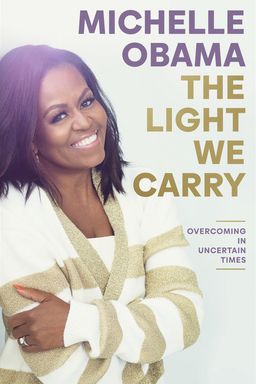
The Light We Carry cover

The Light We Carry

by Michelle Obama

In ''The Light We Carry,'' Michelle Obama shares her wisdom on finding strength and purpose amidst uncertainty. With warmth and honesty, she offers strategies to harness our inner light, build lasting connections, and create a hopeful, healing path forward.

The Light Within: Finding Strength in Uncertainty

Have you ever felt as if the world was wobbling beneath your feet—like life had stripped away all certainty, leaving you unsure how to balance? Michelle Obama’s The Light We Carry begins with that very question. After a global pandemic, political chaos, and a lifetime of public scrutiny, she asks: how do we keep standing upright when everything feels unstable? Her answer is both practical and profound: we each carry a light—an inner steadiness—that can guide us through uncertainty. The book is a meditation on resilience, community, identity, and courage, distilled from Obama’s own experiences as a daughter, mother, wife, leader, and citizen.

Obama argues that life will always be in flux—there are no fixed points, no formula for success, no immunity from fear or doubt. But what sustains us, she insists, are the tools we learn to use and the relationships we nurture. Her father’s cane, introduced in the opening story, becomes both metaphor and blueprint: we survive by finding the props that keep us steady. The book, therefore, is not a self-help manual, but a conversation—one in which Obama hands readers her own toolbox and invites them to recognize the light they already carry.

Strength Through Tools and Practice

The author’s guiding message is that tools—whether emotional habits, supportive relationships, or creative hobbies—help us manage chaos. From knitting as a form of meditation to laughter as family therapy, she shows how small actions can ground us in turbulent times. These tools, she says, are not inherited; they are learned through experience, failure, and persistence. Obama’s reflective, often conversational tone turns each chapter into a practical exploration of how to find one’s poise amid fear, how to cultivate kindness, and how to remain visible in a world that sometimes refuses to see you.

Embracing Difference and Vulnerability

In her account, being different—whether by race, gender, or circumstance—is not a deficit but a paradoxical source of strength. Drawing on her father’s life with multiple sclerosis and her own experiences as a Black woman in elite institutions, Obama argues that difference breeds both caution and boldness. This awareness, she says, allows people to make deliberate choices about how they use their energy, when to speak up, and when to hold boundaries. Her mantra isn't perfection or invincibility—it’s adaptability. In all circumstances, she reminds readers, courage coexists with fear.

Larger Themes and Purpose

Across its three major parts—personal empowerment, relationships, and social responsibility—The Light We Carry covers subjects like overcoming fear (“Decoding Fear”), cultivating kindness (“Starting Kind”), building supportive circles (“My Kitchen Table”), and owning your visibility (“Am I Seen?”). Later chapters examine professional integrity (“The Armor We Wear”) and moral courage (“Going High”). Each piece connects to the book’s central truth: we must practice steadiness both privately and publicly. Obama portrays self-knowledge as the seed of social compassion—individual brightness becomes communal light.

Obama’s Promise:

“One light feeds another. One strong family lends strength to more. One engaged community can ignite those around it.” In that sense, her light metaphor is not solitary—it's collective. We survive, she says, not alone but together, by reaching toward others even as we guard our own flame.

Ultimately, The Light We Carry is a handbook for navigating self-doubt and social division. It asks readers to stop waiting for equilibrium and start building it, one stitch, one act of kindness, one relationship at a time. In Obama’s view, hope is not mystical; it’s practical. The world may remain “both beautiful and broken,” but we can still carry our light forward—and in doing so, light the way for others.


The Power of Small

When global crises overwhelm us, Michelle Obama proposes a counterintuitive solution: go small. In the chapter “The Power of Small,” she unlocks the wisdom of modest, repetitive acts as antidotes to anxiety—like knitting, cooking, or simply taking a walk. For her, smallness doesn’t mean insignificance; it means manageability. It’s about doing what you can control when everything else feels uncontrollable.

Knitting as Mindful Therapy

During the pandemic’s darkest moments, Obama found solace in knitting—a family craft passed down from generations of women who once sewed to survive. As she loops yarn and turns stitches, she describes feeling calm return to her mind. “My hands were driving the car,” she writes, realizing that peaceful focus can start with physical movement. Just as her father’s cane symbolized balance, her knitting needles become a tool for emotional stability. It’s an ordinary act elevated into a ritual of healing.

Small Acts Create Large Shifts

For Obama, “small” actions—doing art, baking, repairing, even laughing—guard our mental health and replenish our energy. She compares this process to a Native American “three sisters” planting system of corn, beans, and squash: each element supports the others in mutual balance. Our lives, she argues, also require diversity in effort—combining tall ambitions with small grounding activities. Happiness is cultivated by tending to little victories, for “claiming a small victory is not evasion; it’s resilience.”

Balance and Mental Health

Obama engages with young women in Chicago who confess exhaustion and stress after years of loss, violence, and pandemic isolation. Through their stories—Deonna, Logan, Addison—she teaches that mental health often conflicts with high ambition: our minds slow down to protect us. The remedy is rest and repair, permission to recover without guilt. She connects this insight to psychology research showing that happiness strengthens activism (similar to studies cited by Barbara Fredrickson on positivity as fuel for social change).

Faith, Patience, and Progress

Knitting eventually becomes metaphorical for faith—each stitch laid in uncertainty until a pattern appears. “You just move your hands and follow the steps,” she says, echoing advice akin to Anne Lamott’s mantra from Bird by Bird: handle the small bird first. When we practice steadiness in miniature, we regain clarity to face what’s vast. Obama’s closing image—a finished sweater gifted to her family—celebrates the humble joy of completion in an unfinished world.

Her lesson: when life feels “too big to fix,” touch the small. The act itself becomes proof that hope can still be stitched from chaos.


Decoding Fear

Fear is universal—but Michelle Obama argues that we can learn to be “comfortably afraid.” In her chapter “Decoding Fear,” she transforms fear from an enemy into a teacher. Through stories of childhood terrors, her husband’s presidential bid, and her own public life, she explains how decoding fear means understanding its message rather than obeying its power.

From Childhood Monsters to Adult Risks

As a child on Chicago’s South Side, Obama was terrified of her brother’s ghost stories. Yet she later realizes that Craig’s calm was built on context—he could tell the difference between fantasy and reality. Learning to interpret fear is the first step to courage. A later episode with her Aunt Robbie’s Christmas play, when young Michelle feared a plush turtle on stage, taught her to “weigh fear against desire.” She wanted to dance more than she wanted to flee. That moment became her lifelong template for bravery through choice.

Fear of Newness

Obama reframes fear not as danger but as resistance to newness. From her decision to say yes to Barack’s presidential run—instead of retreating to comfort—she shows that anxiety signals transformation. Real growth, she writes, demands both “a spoonful of fear and a wagonful of competence.” Her father’s quiet example—walking unsteadily but never giving up—symbolized mastering fear through practice, not denial.

Fear, Race, and Trust

Through portraits of her grandfathers, Southside and Dandy, whose lives were confined by legitimate racial fear, Obama exposes how inherited fear limits possibility. They were competent but bound by mistrust. Her parents, she notes, broke that cycle, teaching their children to move outward in measured confidence. “Go forth with fear and return with competence,” her mother advised—the foundation of Obama’s philosophy of ease despite difference.

Fear as Rocket Fuel

Obama connects fear to creative energy, citing Lin-Manuel Miranda’s insight that nerves are “rocket fuel.” She recounts his trembling performance of early Hamilton verses at the White House, an instance of channeling fear into expression. Likewise, Barack’s presidential leap required converting anxiety into purpose. Fear is always present, she argues, but “doubt comes from within”—our own fearful mind rehearsing catastrophe. The antidote is recognition: “Oh, hello, it’s you again,” she tells her inner critic, disarming it with familiarity.

To decode fear is to treat it as data, not destiny. It warns, but it doesn’t rule. You lead your anxious mind instead of letting it drive. And that, Obama insists, is how true courage begins.


Starting Kind

If fear teaches courage, kindness teaches connection. In “Starting Kind,” Michelle Obama invites readers to begin each day with compassion—especially toward themselves. Drawing on lessons from friends and mentors, she shows how self-acceptance precedes empathy, asserting that gladness, not criticism, is the healthiest starting point.

Greeting Yourself First

Obama’s friend Ron opens each morning by smiling into the mirror and saying, “Heeey, Buddy!” His affectionate ritual, a simple hello to himself, becomes emblematic of what she calls a “kind start.” Instead of launching the day with self-critique, we begin with appreciation. In a culture wired for judgment—particularly of women’s appearances—this small act restores dignity. “Self-loathing isn’t a good starting block,” she writes. Kindness is not grand; it’s consistent.

Seeing Others with Gladness

Drawing on Toni Morrison’s insight—“When a child walks into the room, does your face light up?”—Obama explores how faces transmit value. Children interpret our expressions faster than our words; they thrive on gladness. Obama translates Morrison’s wisdom into universal practice: we must light up for people, recognizing their humanity first. In her White House interactions with children, this principle becomes policy—when she hugs a girl named Anaya after a compliment, dozens of other kids clamor for hugs. Gladness multiplies.

Reducing the Critical Face

Obama observes that adults often meet the world, and themselves, with “the critical face.” Whether parenting, teaching, or leading, we default to correction before compassion. Kindness repairs this imbalance, replacing scrutiny with presence. Scientific studies she cites show that when teachers greet students warmly at the door, classroom engagement rises by 20%. Kindness improves performance—it’s not softness but strategy.

Beginning from Enoughness

The chapter ends with practical simplicity: wake up and redirect your first negative thought. Replace “I look tired” with “I’m here. That’s a miracle.” This “second thought” technique is Obama’s mindful reprogramming tool, merging wisdom from compassionate psychology and daily habit. Her advice echoes positive psychologists like Kristin Neff, who emphasize self-compassion as prerequisite to resilience.

Starting kind is how we balance inner perfectionism with outer poise. When your face lights up for yourself, she says, it becomes easier to light up for the world.


Am I Seen?

Visibility, Michelle Obama declares, is a human need. “Am I seen?” is the question behind almost every ache for belonging. In this chapter, she traces her journey from feeling ‘the tall girl in the back row’ to claiming visibility as a source of pride. Her story expands to include broader lessons on race, gender, and the inherited narratives that define who gets seen and who doesn’t.

The Pain of Early Difference

As a child, Obama felt ostracized not for being Black but for being tall—the towering girl lined up last. Each formative moment taught her an unspoken hierarchy of value. Society praises smallness in girls, strength in boys. The awareness of “not fitting in” started young and evolved into her adult consciousness of racial and gender bias. That discomfort shaped her vigilance and empathy, teaching her to see others who were unseen.

Visibility and Representation

A key turning point occurs when Obama enters Princeton—a space dominated by white men. The absence of faces like hers deepened a sense of invisibility. She cites W.E.B. Du Bois’s “double consciousness”—seeing oneself through others’ eyes—as the exhausting reality of minority life. A personal mentor, Czerny Brasuell, helps Obama reconnect with her centered self, teaching that “no one can make you feel bad if you feel good about yourself.” Internal visibility precedes external recognition.

Breaking the Old Stories

Obama connects personal invisibility to national myths, noting that monuments and media overwhelmingly celebrate white men. In the Mellon Foundation’s audit, statues of mermaids outnumber female members of Congress. “It’s hard to dream about what’s not visible,” she writes. Rewriting the story of belonging becomes an act of rebellion against historical erasure—whether through activism, art, or simply self-love.

Transforming Not-Belonging into Purpose

Obama revisits painful memories—like a high school counselor dismissing her Princeton dream or a police officer accusing her brother of stealing his own bike—to show how shame becomes motivation. Similarly, Stacey Abrams’s story of being stopped at the governor’s mansion gate embodies the same “I don’t belong” wound turned into power. Those who are unseen persist, rewriting narratives through excellence. “Your limits aren’t mine,” Obama says, turning diminishment into fuel.

Seeing yourself fully—and helping others be seen—is not ego, but justice. Visibility, for Obama, is the foundation of freedom: when we rewrite the story of who matters, we expand the light for all.


My Kitchen Table: The Power of Friendship

Michelle Obama insists that no one can thrive alone. In “My Kitchen Table,” she explores friendship as both survival strategy and sanctuary—a circle of trust we build deliberately, one conversation at a time. Her ‘Kitchen Table’ becomes the metaphor for relationships that restore our oxygen in the storm.

Friendship as Structure

During her White House years, Obama orchestrated wellness weekends at Camp David with her closest girlfriends. What she jokingly called “Boot Camp” became ritualized space for strength, laughter, and rest. “Vigor is one of my love languages,” she says with humor. These friendships didn’t just entertain—they stabilized her amid pressure. Her faith in showing up for friends, and inviting them to show up for her, becomes a model of emotional economy: shared support lessens individual strain.

Friendship as Freedom

She also explores friendship’s role in marriage, noting that her partnership with Barack thrives because neither expects the other to meet all emotional needs. Like economist Esther Perel’s view of relational ecosystems, Obama advocates “distributing the load.” Friends absorb and reflect parts of one’s identity, allowing couples to breathe. Her circle includes older mentors like Valerie Jarrett and college confidantes like Angela—the ‘barnacles’ attached for life. Each friend represents a facet of home.

Facing Loneliness

Obama cites Surgeon General Vivek Murthy’s research showing rising loneliness across America before and after the pandemic. Technology, she warns, breeds ironic isolation: “Our phones shield us from serendipity.” Scrolling replaces talking; digital validation replaces community. For her, the remedy is physical presence—shared meals, hugs, laughter. Connection restores perspective more powerfully than content.

Choosing and Maintaining Your Table

Obama teaches deliberate friendship maintenance through “rituals of showing up”—calls, walks, and annual mother-daughter retreats. The right people, she asserts, help flatten life’s hills (drawing on University of Virginia research that friends literally make steep climbs seem shorter). To build your own table, she advises honesty, discernment, and appreciation of different strengths; some friends advise, others simply listen. “Don’t do life alone,” she urges—the simplest yet most urgent command in the book.

Her table, real or metaphorical, is the place where visible love becomes invisible strength. In friendship, we trade stories until fear feels smaller—and light feels shared.


The Armor We Wear

In “The Armor We Wear,” Michelle Obama examines how people protect themselves in professional and public life. Armor, she argues, is both necessary and dangerous—it shields you but can suffocate you. Using stories from her law career, the White House, and conversations with young women, she explores how preparation, adaptability, and authenticity form healthy protection.

Preparedness as Protection

Obama’s defining moment occurs during her 2008 Democratic National Convention speech when the teleprompter dies. Yet she delivers perfectly—from memory. That night, preparedness becomes her armor. “Preparedness is the hedge against panic,” she writes. Her brother’s childhood fire drills taught the same principle: knowing the routes keeps the family safe. For anyone in demanding situations, rehearsal builds stability. (Her view resonates with Angela Duckworth’s concept of ‘grit,’ where endurance stems from preparation.)

Navigating Boundaries

She connects armor to boundaries in workplaces that weren’t built for marginalized bodies. Code-switching—adjusting speech or mannerisms—becomes a social defense. Yet it’s also exhausting, she admits. This dual pressure, especially for people of color and women, demands a constant vigilance that drains creativity. “We’re deciding every day whether to hug the Queen,” a young editor tells her—symbolizing the daily negotiation between self-expression and conformity.

Armor vs. Authenticity

Obama reflects on watching pioneering women lawyers whose toughness became both virtue and burden. Their rigid professionalism opened doors but limited softness. She honors them for breaking barriers while acknowledging that each generation must shed some armor to make workplaces more humane. This echoes Brené Brown’s argument that vulnerability in leadership is strength, not weakness. True progress means being agile—strong yet permeable, guarded yet open.

Adapting with Awareness

At the White House, Obama practiced strategic adaptation: studying Laura Bush’s schedule before crafting her own role to ensure continuity while adding her authenticity. She saw the danger of being labeled “insolent” if she defied norms too quickly. Her approach—honor tradition, innovate within it—became her way to “stay armored without losing warmth.” For her, professionalism should protect dignity, not erase personality.

Obama’s rule for armor: wear it to survive, not to hide. Toughness is the starting line; authenticity is the finish.


Going High

Michelle Obama concludes her book with an idea that has become her signature phrase: “When they go low, we go high.” In this climactic chapter, she transforms a campaign slogan into a lifelong strategy for moral resilience. Going high, she explains, does not mean passive politeness—it means discipline, integrity, and creative response to injustice.

Integrity as an Action, Not an Emotion

Going high begins where rage meets reason. Obama clarifies that the phrase isn’t sentimental—it’s tactical. When anger threatens to derail judgment, she reframes emotion into action: “Emotions are not plans.” The discipline is to pause, reflect, and formulate a constructive path forward. Going high converts outrage into energy for lasting change—a process akin to Viktor Frankl’s idea of choice between stimulus and response.

Resisting the Trap of Cynicism

Even after enduring racism and misinformation, she argues that despair only repeats harm. While social media promotes instant reaction, true activism requires “doing the work”—voting, helping, teaching, repairing. She warns against mistaking clicks for change: “Complacency wears the mask of convenience.” In honoring John Lewis’s insight that freedom is continual effort, she defines going high as “a barbell we keep hoisting overhead.”

Faith and Fear in Leadership

Obama revisits the 2016 campaign—the shock of divisiveness, the pain of losing hope—and still insists on belief in democratic grace. Her commitment resembles Dr. Martin Luther King Jr.’s “not long” optimism: progress is slow but real. “You fall, you get up, you carry on,” her father’s credo, becomes the nation’s call. The light metaphor transforms again—each act of integrity keeps society luminous even in turbulence.

Sustaining Change

For Obama, going high is collective endurance. It asks us to combine personal steadiness with civic courage—protecting our energy while participating fully. She stresses boundaries (“keep the poison out and the power in”) and kindness as fuel. This moral stamina is necessary for leadership and everyday decency alike, echoing King’s and Lewis’s legacy of nonviolent strength.

Her final challenge: integrity only matters if embodied. Words don’t lift the barbell—actions do. Going high, she says, means “not forgetting to do the work.”

Dig Deeper

Get personalized prompts to apply these lessons to your life and deepen your understanding.

Go Deeper

Get the Full Experience

Download Insight Books for AI-powered reflections, quizzes, and more.