
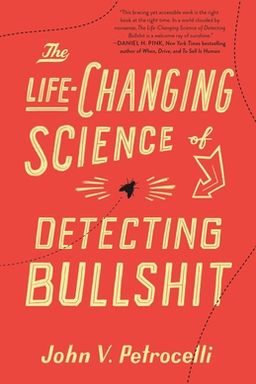
The Life-Changing Science of Detecting Bullshit cover

The Life-Changing Science of Detecting Bullshit

by John V Petrocelli

The Life-Changing Science of Detecting Bullshit equips you with critical thinking tools to navigate a world filled with misinformation. Learn to identify, resist, and challenge false information, enhancing your decision-making and promoting a truth-based culture.

The Science of Seeing Through Bullshit

Have you ever been caught between a persuasive claim and a nagging sense that something isn’t quite right? Maybe a celebrity's advice, a politician's speech, or a sales pitch sounds convincing but leaves you uneasy. In The Life-Changing Science of Detecting Bullshit, experimental social psychologist John V. Petrocelli invites you to step into the world of critical thinking and skepticism by understanding what he calls humanity’s growing epidemic—bullshit. His argument is simple but profound: bullshit thrives not because it’s hard to produce, but because most of us fail to detect it.

Petrocelli explores the psychological, social, and contextual forces that make bullshit flourish—from marketing hype and pseudoscience to political spin and self-deception. He contends that bullshit isn’t merely lying; it’s communication with no concern for truth. To lie, someone must know the truth and actively distort it. The bullshitter, however, doesn’t care whether what they’re saying is true or false—they just want to sound confident, persuasive, or impressive. This distinction, originally noted by philosopher Harry Frankfurt in On Bullshit, forms the backbone of Petrocelli’s scientific inquiry.

Why Bullshit Is So Dangerous

Bullshit, Petrocelli argues, is more insidious than lying because it erodes our ability to distinguish evidence-based truth from mere opinion. Lies provoke anger and are often punished, but bullshit slips by unnoticed, shaping beliefs and decisions in ways that cause harm—to our wallets, our politics, and our relationships. You might laugh at a wine review describing “fireplace smoke and edginess of cedar,” but the language of bullshit can persuade consumers to pay 10 times the price for a product that tastes identical. It’s seductive, pervasive, and socially tolerated, which makes its effects enduring.

A Framework for Understanding Bullshit

Petrocelli builds on Frankfurt’s philosophical foundation with empirical research on how and when bullshit arises. He introduces ideas like the Bullshit Flies Index, rating the severity of bullshit based on the harm it causes—from the harmless (one fly) to the dangerous (three flies). He studies real-world examples ranging from Kyrie Irving’s flat-Earth talk to Andrew Wakefield’s fraudulent vaccine-autism study and Donald Trump’s “alternative facts.” Each case reveals the same pattern: a speaker unconcerned with evidence, an audience lacking critical tools, and social conditions that reward confidence more than accuracy.

Why We Fall for It

According to Petrocelli, believing bullshit is easy because it aligns with human psychology. We prefer comfort over truth. We are cognitive misers who take shortcuts—trusting confidence, liking, authority, or intuition instead of reasoning. His concept of bullibility captures this cognitive laziness: accepting bullshit as fact simply because it feels right or everyone else believes it. In chapters on personality and emotion, he shows how agreeable people are more susceptible because they avoid conflict, how happy moods reduce skepticism, and how intuition often substitutes for analysis.

From Detection to Defense

The book’s second half shifts from diagnosis to empowerment. Petrocelli introduces the Bullshit Detection Wheelhouse, a toolkit for questioning claims and assessing evidence with skepticism. He walks readers through how scientists evaluate hypotheses: observing, testing, inviting criticism, and being willing to change conclusions when new data arrives. Whether you’re reading a headline claiming “wine fights cancer” or listening to a TED Talk on miraculous diets, he teaches you how to ask, How do you know that? instead of Why do you believe that? This small linguistic shift moves conversations from opinion to evidence.

Life Without Bullshit

Petrocelli’s ultimate goal is not cynicism but clarity. A world with less bullshit, he says, would be one that prizes curiosity, humility, and evidence-based reasoning. When people admit what they don’t know, question improbable claims, and are held accountable for misinformation, better decisions follow. He closes with a manifesto and rules for calling bullshit respectfully—attack the claim, not the person; admit your own errors; and make “calling bullshit” contagious by modeling thoughtful skepticism.

Throughout, his tone is witty and conversational, filled with relatable stories—from wine tastings to car dealerships and corporate jargon to pseudoscientific health fads. He merges social psychology, philosophy, and humor to arm readers against manipulation. Ultimately, Petrocelli argues that learning to detect bullshit isn’t just an academic skill—it’s a survival strategy in a world flooded with information and misinformation. If you’ve ever wished for sharper instincts in conversation, debate, or daily decision-making, this book reveals that those instincts are trainable—and essential.


Bullshitting vs. Lying

Petrocelli makes a crucial distinction that sits at the heart of his research: bullshitting is not lying. This may seem minor, but the difference has huge implications for how we interpret communication and trust others. Lying requires knowing the truth and intentionally distorting it. Bullshitting means not knowing—or caring—whether something is true at all. The bullshitter’s goal is persuasion, not accuracy.

The Used Car Dealer Test

Consider Petrocelli’s example of a used car salesman. When the dealer claims, “This car has never been in an accident,” knowing it’s false, he’s lying. But if the dealer says, “It had a small dent, no big deal,” without checking the Carfax report or inspecting the vehicle’s frame, he’s bullshitting. He’s indifferent to whether his claim is true. His focus is on closing the sale. Petrocelli calls this mindset playing “fast and loose with truth.”

Motives and Consequences

Why draw the line? Because our emotional reactions differ. Lies provoke anger and betrayal. Bullshit usually passes with eye-rolls or shrugs, making it socially tolerated. The danger is that bullshit accumulates—it infiltrates conversations, workplaces, political rhetoric, and media until we can’t tell truth from noise. Petrocelli warns that a culture numbed by bullshit risks turning “credibility” into a marketing strategy rather than a moral one.

Why We Let It Slide

Most people, he finds, don’t punish bullshit because it feels less malicious. But indifference is what allows it to thrive. Unlike liars, bullshitters often believe their own claims—they’ve talked themselves into confidence. When bluffing becomes a habit, self-deception follows. Petrocelli even jokes that bullshit can get you promoted to CEO—or elected president—because charisma often trumps truth. Understanding this distinction empowers you to calibrate your skepticism: not all falsehoods are equal, but all deserve scrutiny.


The Psychology of Bullibility

Why do smart people fall for obvious nonsense? Petrocelli’s concept of bullibility—a blend of gullibility and bullshit blindness—explains our universal weakness for persuasion over proof. He studies figures like Bernard Madoff and his investors, showing that intelligence is no shield against deception when desire outweighs diligence.

Madoff’s Million-Dollar Mirage

Madoff defrauded thousands through a decades-long Ponzi scheme promising 12% yearly returns. His victims included bankers, executives, and even a gullibility expert, psychologist Stephen Greenspan. Despite red flags—returns too consistent, markets too volatile, and missing audits—investors ignored the evidence because the narrative felt good. As Petrocelli notes, people are “relatively lazy thinkers” who mistake explanations for evidence. They believed because they wanted to.

Why We’re Wired for Bullibility

Petrocelli breaks bullibility down into five drivers: personality, context, cognition, emotion, and motivation. Agreeable personalities tend to trust others and avoid conflict; contexts full of uncertainty (like finance or health) invite quick judgments; intuitive thinking favors gut over data; emotions like happiness make us less skeptical; and motivations—such as wanting to belong—override truth. The cumulative result is a population ripe for manipulation.

Building Resistance

To fight bullibility, Petrocelli recommends slowing down thinking, asking “How do I know?” instead of “Why do I believe?”, and exposing yourself to disconfirming evidence. Critical thinking isn’t natural—it’s a skill. He contrasts intuitive Type 1 thinking (fast but shallow) with reflective Type 2 thinking (slow but accurate), echoing Daniel Kahneman’s Thinking, Fast and Slow. Awareness alone, he says, is half the cure. Once you see how your brain loves shortcuts, you’ll spot every persuasive exaggeration for what it is: a confidence trick.


The Cost of Bullshit in Everyday Life

Petrocelli opens with a deceptively simple question: are expensive wines actually better? His answer—supported by experiments—is a resounding no. Through examples like wine tasting, restaurant markups, and the Myers-Briggs personality test, he shows how bullshit costs us money and distort our decisions.

Premium Illusions

In Robert Hodgson’s wine study, expert judges rated the same wine inconsistently—even giving identical samples different scores. Frédéric Brochet’s experiment revealed critics couldn’t tell red from dyed-white wine. Yet, industry descriptions like “supple tannins” and “evolving finish” sell bottles for $200 while nearly identical wines cost $20. Petrocelli calls this the “Veblen effect”—we desire things because they’re expensive.

Bullshit Markups Everywhere

Restaurants mark up wine 400% and soda 1000%. Fortune tellers and “personality experts” sell pseudoscientific tests like the Myers-Briggs Indicator to corporations for millions, despite no predictive validity. These are what Petrocelli names bullshit markups: prices inflated beyond any rational basis. Psychological biases like confirmation, intuition, and trust make consumers complicit, paying not for value but for validation.

Emotional Economics

We buy stories more than products—narratives of luxury, uniqueness, or belonging. Petrocelli’s experiments show that repeated exposure makes falsehoods feel true (the “illusory truth effect”), and confidence from sellers reinforces belief. The fix? Demand data, embrace curiosity, and remember that skepticism saves money. Think like an investigator, not an admirer.


When and Why People Bullshit

Where bullshit thrives, certain psychological and social conditions are always present. Petrocelli identifies two main catalysts: feeling obligated to offer an opinion and sensing it’s easy to get away with bullshit. Using lab studies and real-world examples—from doctors misinterpreting medical results to media personalities misinforming their audiences—he shows how obligation and confidence multiply misinformation.

The Obligation Trap

In experiments, when participants felt required to explain something they didn’t understand, their level of bullshit doubled compared to those who weren’t obligated. Experts face similar pressure: physicians must deliver answers even when uncertain; politicians must appear knowledgeable on all topics. The result? Authoritative-sounding bullshit disguised as expertise. Petrocelli cites Gigerenzer’s study of gynecologists miscalculating breast cancer probabilities—errors that lead to unnecessary surgeries and anxiety.

Accountability and Passability

People bullshit more when they expect no accountability or when they think the audience can’t judge accuracy. When Petrocelli’s subjects believed experts would evaluate their explanations, bullshit plummeted. If they thought non-experts were judging, it soared. This principle explains why misinformation spreads faster among lay audiences online: everyone’s an “expert” on Facebook.

Social Pressures and Motivations

Bullshitters, from Andrew Wakefield to Dr. Oz, exploit expectations of omniscience and fear of admitting “I don’t know.” In medicine, marketing, and politics, pretending knowledge maintains authority. Petrocelli urges restoring intellectual humility—creating cultures that reward truth-seeking and penalize unfounded claims. Accountability isn’t punishment; it’s prevention.


Bullshit Artists and Their Tactics

Every era has its master manipulators—people who weaponize bullshit for fame or financial gain. Petrocelli profiles three: Douglas Biklen, Donald Trump, and Deepak Chopra. Their methods differ, but their strategies echo timeless psychological principles of persuasion.

Douglas Biklen and False Hope

Biklen’s “facilitated communication” claimed to help nonverbal autistic children type through hand guidance. Controlled tests proved facilitators, not children, authored the messages. Yet Biklen dismissed disconfirming evidence, blaming anxiety. His technique gave parents comfort but robbed science of credibility—earning three flies on Petrocelli’s index for direct harm.

Donald Trump and Narrative Control

Trump’s rhetoric exemplifies bullshit deployment at every level: harmless exaggerations (weather at his inauguration), bad distortions (crowd sizes), and dangerous misinformation (suggesting disinfectants for COVID). Each serves a distinct purpose—to project authority, deny contradiction, or manipulate perception. Petrocelli grades his examples across one, two, and three flies.

Deepak Chopra and Pseudo-Profundity

Chopra’s spiritual jargon—“hidden meaning transforms abstract beauty”—mimics science while meaning nothing. Petrocelli demonstrates, via Pennycook’s research, that people rate meaningless statements as profound when they sound complex. He calls this pseudo-profound bullshit. The antidote? Ask for clarification. If reversing a claim makes no difference (“revealed meaning” changes nothing), it’s bullshit. These artists remind us: charisma without evidence isn’t enlightenment—it’s manipulation.


Building a Bullshit Detection Wheelhouse

Petrocelli turns science into strategy. His bullshit detection wheelhouse acts as a mental toolkit for separating fact from fabrication. It combines skepticism, questioning, and evidence evaluation into everyday habits anyone can practice.

Ask Better Questions

Instead of “Why do you believe that?”, ask “How do you know that?” The former invites argument; the latter demands evidence. Petrocelli teaches question types for every stage: clarification, evaluation, devil’s advocate, and numerical reasoning. When someone cites “a study,” ask who conducted it, how data were gathered, and whether results were replicated. These are the scientist’s reflexes that anyone can learn.

Spot Red Flags

Certain phrases—“trust me,” “many people don’t know this,” “what if I told you”—signal a lack of concern for truth. Bullshit hides behind confidence and vagueness. Petrocelli’s linguistic analyses show bullshitters use more sense-related words (“see,” “feel”) and fewer causal ones (“because,” “therefore”). Listen for emotion over logic. If someone sounds profound but cannot explain their terms, it’s pseudo-profundity at work.

Numbers and Probabilities

Use simple math to challenge implausible claims. He applies Fermi estimation—back-of-the-envelope logic—to debunk false statistics like Fox News’s “$70 million food stamp fraud.” By comparing to program size, he shows the loss was less than one percent, exposing exaggeration. Visualization and contextual thinking make bullshit collapse under scrutiny. Skepticism, Petrocelli concludes, isn’t cynicism—it’s curiosity armed with math.


Expert Bullshit Detectors in Action

To demonstrate bullshit detection in practice, Petrocelli profiles three professionals—Curtis Baker the car buyer, Tim Terry the jeweler, and Christina Pryce the realtor. Each has mastered real-world critical thinking, turning experience into expertise.

Curtis Baker: Cars and BATNAs

Baker approaches purchases like negotiations. He researches models, checks Carfax reports, and calculates BATNA—best alternative to a negotiated agreement. He never buys emotionally. His secret: fall in love with multiple options so no dealer controls leverage. Asking tough questions and demanding inspections turns bullshit sales pitches into opportunities for savings.

Tim Terry: Diamonds and Deception

Jeweler Terry exposes the myth that diamonds are rare investments. Lab-grown stones are chemically identical to natural ones yet priced 30% lower. The illusion of scarcity—created by De Beers marketing—fuels billion-dollar markups. Terry’s honesty illustrates Petrocelli’s point: when you ask for data instead of stories, the sparkle fades but truth shines brighter.

Christina Pryce: Real Estate Rationality

Veteran realtor Pryce filters clients’ biases by using spreadsheets and weighted decision models. She refuses to amplify bullshit descriptors (“cozy,” “vintage”) that mask flaws and insists on evidence-based appraisals. Together, these experts model the Columbo mindset Petrocelli champions—ask one more question, dig one layer deeper, and let data—not drama—guide your judgment.


Life Without Bullshit

Petrocelli ends with hope and challenge. He imagines a society that values truth-seeking over impression management—a life without bullshit sustained by curiosity and accountability. He combines psychology and social science to outline how to build that world.

Rules for Calling Bullshit

Start by identifying bullshit accurately and respond respectfully. Attack the claim, not the person. Allow correction instead of humiliation. Admit your own bullshit when caught—it builds trust. Petrocelli warns that social tolerance enables contagion; once bullshit goes unchecked, it spreads normatively through peer pressure, groupthink, and conformity (similar to Cialdini’s social norms research).

From Individual to Cultural Change

To make bullshit detection contagious, he suggests modeling skepticism publicly—ask evidence-based questions, reward truth-telling, and make critical thinking social. Asch’s conformity studies show one voice of dissent can disrupt false consensus. Petrocelli calls for shifting calling bullshit from an injunctive norm (“you should”) to a descriptive norm (“everyone does”). When skepticism becomes standard, deception loses power.

The Virtue of Intellectual Humility

Being willing to say “I don’t know” prevents the obligation to bullshit. Intellectual humility—recognizing knowledge limits—is the antidote to arrogance. Petrocelli closes with a motto borrowed from the Royal Society: nullius in verba—take nobody’s word for it. In a world drowning in claims, curiosity and evidence are oxygen. His science of bullshit detection transforms everyday skepticism into a civic duty and a personal liberation.

Dig Deeper

Get personalized prompts to apply these lessons to your life and deepen your understanding.

Go Deeper

Get the Full Experience

Download Insight Books for AI-powered reflections, quizzes, and more.