
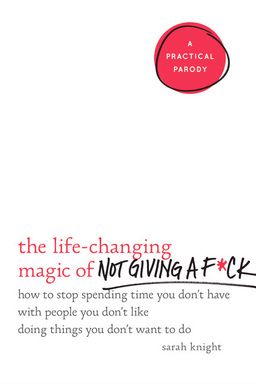
The Life-Changing Magic of Not Giving a Fck cover

The Life-Changing Magic of Not Giving a Fck

by Sarah Knight

The Life-Changing Magic of Not Giving a F*ck is your essential guide to reclaiming your time, energy, and happiness. Learn to politely disengage from obligations that don''t serve you, freeing yourself to focus on what truly brings you joy. With practical advice and the empowering Not Sorry Method, transform your life by caring less about what doesn''t matter.

The Life-Changing Magic of Choosing What Matters

Have you ever felt utterly drained by obligations, expectations, and endless attempts to please everyone? In The Life-Changing Magic of Not Giving a F*ck, Sarah Knight argues that most of us are suffocating under a pile of unnecessary concerns—not because our lives are truly that complicated, but because we haven’t learned to say no. Her hilarious yet practical manifesto invites you to declutter your mental space as thoroughly as Marie Kondo would declutter your sock drawer. Instead of asking what “sparks joy,” Knight asks: what truly deserves your time, energy, and money?

The book’s central premise is simple but radical: your capacity for caring—your “fucks,” in Knight’s unapologetically blunt vocabulary—is a finite resource. If you don’t protect that resource, you’ll end up exhausted, resentful, and broke (emotionally and maybe financially). The path to a lighter, freer life lies in managing your “fuck budget,” intentionally deciding which people, tasks, and ideas are worth your care, and unflinchingly eliminating the rest. In short, it’s about prioritizing joy over annoyance—and doing it without turning into an asshole.

Decluttering Your Mental Barn

Knight’s philosophy parallels Marie Kondo’s physical tidying method: just as you might clean out an overstuffed closet, you can also clear out your mental clutter. She describes the mind as a crowded barn full of obligations, expectations, and emotional junk. Each “f*ck” represents a demand on your time, energy, or money. Step one is to walk into that barn, discover what’s inside, and decide what’s essential. Step two is to stop spending resources on anything that doesn’t bring genuine satisfaction.

This process, called the NotSorry Method, consists of two practical steps: (1) deciding what you don’t give a f*ck about and (2) not giving a f*ck about those things. The idea is to make these decisions consciously, without guilt or apology—hence “NotSorry.” You’re free to refuse invitations, ignore trends, and say no to obligations that leave you depleted, as long as you do so honestly and politely.

Why This Matters

Knight contends that most of us give far too many “fucks” because we crave approval or fear disappointing others. But giving a f*ck about everything inevitably drains what she calls the “holy trinity” of resources—time, energy, and money. By reclaiming those resources, you become not only happier but also more efficient, creative, and kind. It’s not selfishness; it’s sanity.

The magic happens when you accept that you can’t please everyone—and that this is actually liberating. When you stop caring about things like office gossip, obligatory weddings, or other people’s parenting choices, you reclaim control over your own life. You start giving fewer but better fucks: the kind reserved for things that genuinely enrich your world—your health, creativity, relationships, and peace of mind.

What You’ll Learn

In this summary, you’ll explore how to stop worrying about what people think, how to establish personal policies that protect your peace, and how to navigate work, friendships, family, and social expectations without drowning in guilt. You’ll learn how to create a Fuck Budget to allocate your time wisely and how to communicate your boundaries with grace. Finally, Knight shows that the end goal isn’t apathy—it’s enlightenment: living intentionally, joyfully, and without apology.

“Not giving a f*ck doesn’t mean you don’t care. It means you stop caring about things that don’t matter so you can focus on the ones that do.”

Ultimately, Knight’s recipe for freedom combines humor with ruthless practicality. Like a life coach who swears like a sailor, she reminds you that there’s immense power in refusing to overextend yourself. By getting clear on what you value and fearlessly crossing out the rest, you unlock the true magic of choice—finally living your best life, on your own terms.


The NotSorry Method

The beating heart of Sarah Knight’s philosophy is her two-step NotSorry Method. Its genius lies in its simplicity: first decide what you don’t give a f*ck about, then stop giving a f*ck about it—without being an asshole. It’s a process designed to help you feel free, confident, and, well, not sorry.

Step One: Deciding What You Don’t Give a F*ck About

This first step is all about introspection. Imagine doing a full inventory of your mental barn to identify where your time, energy, and money currently go. The key is to separate what truly matters to you from what you’ve been doing out of guilt, obligation, or habit. Knight encourages readers to categorize their mental clutter into four groups: Things, Work, Friends (and acquaintances and strangers), and Family. Each category represents an area where fucks tend to accumulate unnecessarily.

By dividing your life into categories, you can systematically prune the drainers from your daily routines—everything from wearing makeup to the grocery store to attending that dreadful karaoke party for a coworker named Tim. This isn’t just a list-making exercise; it’s a way to identify joy versus annoyance. If something brings joy, it deserves your fucks. If it primarily annoys, it’s eviction time.

Step Two: Not Giving a F*ck About Those Things

Once you’ve identified what doesn’t deserve your attention, Step Two challenges you to actually stop investing time, energy, or money in those things. This can be trickier than it sounds, especially when other people’s expectations are involved. Knight insists that honesty and politeness are the dual armor you’ll need. Honesty ensures clarity; politeness maintains civility. Together, they let you assert your boundaries without turning into an overt jerk.

For example, if you hate karaoke but want to stay friendly with Tim, you might simply say, “Tim, thank you for inviting me, but long nights out aren’t really my thing. I hope it’s a blast!” Polite, honest, and completely NotSorry. This same balance applies whether you’re declining social invitations, saying no to volunteer projects, or skipping that family reunion in Pittsburgh.

“Honesty levels the playing field, and politeness keeps you from being an asshole.”

Avoiding the Asshole Trap

Knight repeatedly emphasizes that not giving a f*ck is not a license for cruelty or apathy. You still care about people’s feelings, just not their opinions. That means declining with tact, recognizing when honesty needs extra cushioning, and knowing when to fudge the truth (“I’m already booked that weekend”) to dodge unnecessary drama. Not giving a fuck doesn’t mean being rude; it means knowing when your politeness serves your peace and when it wastes your energy.

In short, the NotSorry Method transforms “saying no” into a moral act of self-preservation. Like mindfulness with swear words, it helps you reroute attention toward what matters. When practiced consistently, it becomes a form of emotional minimalism—tidy mind, happy life.


Stop Caring What People Think

For most readers, this is the hardest lesson of all. Knight argues that worrying about how others perceive us is the single greatest drain on our emotional energy. The paradox? You can’t control anyone’s thoughts. You can only control your actions. Therefore, it’s pointless—and exhausting—to spend your limited supply of fucks on other people’s opinions.

Feelings vs. Opinions

Knight draws a crucial distinction between feelings and opinions. Feelings deserve compassion; opinions do not necessarily deserve your compliance. In practice, this means you give a fuck about avoiding unnecessary cruelty but not about whether someone disapproves of your choices. You might care about your friend’s feelings if your decision disappoints them, but you don’t need to validate their judgment of your lifestyle.

For example, when a friend pressures you to buy her homemade organic peanut butter, you can decline politely without surrendering to her opinion that “natural” foods are morally superior. You’re allowed to prefer Jif and still be a good person. The same applies when family members critique your career choices, fitness habits, or decision not to procreate. Their feelings may matter; their opinions don’t control your behavior.

Learning the Language of Opinion

To navigate tricky conversations, Knight suggests using what she calls the “Language of Opinion.” Instead of arguing or apologizing, simply acknowledge that everyone’s entitled to see things differently. Phrases like “You may be right” or “Everyone has their own opinion” diffuse tension and allow you to bow out gracefully. It’s conversational aikido—the art of redirecting energy without confrontation.

Once you stop internalizing other people’s judgments, you experience what Knight calls “the exhilarating lightness of NotSorry.” It’s the mental equivalent of ditching a heavy coat you didn’t realize you were wearing. The less you care about external approval, the more time you have for genuine self-respect and peace.


Mastering the Art of the Fuck Budget

One of Knight’s most practical contributions is the concept of the Fuck Budget. It’s a metaphorical ledger that helps you manage your intangible resources of time, energy, and money with the same discipline you’d use to manage a financial budget. Every activity, obligation, or interaction costs you something. The question is: do you want to spend your precious fucks there?

Time, Energy, and Money

Knight identifies this triad as the “holy trinity” of human resources. When you overspend in one area, the others suffer. Going to a coworker’s karaoke party, for instance, drains your time (three hours), your energy (social fatigue), and possibly your money ($30 in bad margaritas). Choosing to stay home, on the other hand, replenishes all three and leaves you happier the next morning. The aim is not total withdrawal but conscious allocation.

She advises explicitly marking which activities return value in one or more categories. If skipping an event gains you time, energy, or funds that you can reinvest in something joyful—a book, a workout, or a nap—it’s a win. Your budget proves that “a fuck not given is something gained.”

Applying the Budget to Life Decisions

The Fuck Budget can clarify decisions at work, in relationships, or in financial obligations. Should you attend your cousin’s destination wedding or take that Caribbean vacation you’ve always dreamed of? Knight suggests calculating which option brings more joy and less annoyance. If your heart—or wallet—leans toward turquoise waters and fruity drinks, you know your choice. The power lies in realizing you’re entitled to spend your fucks however you wish.

By thinking in budgetary terms, you reduce guilt. Saying no becomes as rational as declining an unnecessary Netflix subscription: you simply can’t afford it. In this way, the Fuck Budget transforms abstract boundaries into measurable, defendable decisions. It’s personal finance—of the soul.


Different Fucks, Same Principle: Tackling Daily Life

Knight populates her book with examples of everyday situations where people waste their precious resources. These range from trivial trends to complex social obligations. Across all scenarios, the principle remains the same: decide whether the thing brings you joy or annoy, then act accordingly.

Category One: Things

This includes material possessions and cultural obsessions—the Kardashians, kombucha, napkin rings, whatever fills your mind or home without adding value. Knight’s “Ten Things I Personally Do Not Give a F*ck About” list includes morning people, basketball, and Taylor Swift. The message isn’t to imitate her dislikes but to inspire your own unapologetic discernment. You don’t have to care about kale or Icelandic travel photography if it doesn’t excite you.

Category Two: Work

Most of us, Knight says, hemorrhage fucks at the office—on pointless meetings, dress codes, gossip, and performance anxieties. The antidote? Care about doing your actual job well, and stop caring about the noise. Her advice to “fuck meetings” and “fuck conference calls” is both comic and pragmatic. By trimming performative labor, you protect your reputation and sanity simultaneously.

She also laughs at the “Likability Vortex”—the trap of caring more about being liked than being respected. You can't control whether coworkers like you, but you can definitely ensure they respect your competence. (A similar argument appears in Sheryl Sandberg’s Lean In, though Knight delivers it with far more tequila and profanity.)

Category Three: Friends and Strangers

With friends, boundaries are essential. Knight recommends personal policies—blanket rules that prevent emotional exhaustion, like “I don’t do poetry slams” or “I never lend money to friends.” These universal guidelines stop debates before they start. They’re firm yet impersonal, ideal for maintaining both peace and relationships.

Category Four: Family

Family presents the hardest frontier because guilt and obligation run deep. Knight’s advice: refuse to play the “shame game.” She illustrates with survey results showing that many readers secretly don’t care about extended family weddings, forced togetherness, or ancient grudges. The key is polite honesty—“I love you, but I can’t be there”—delivered with compassion and zero apology.

By practicing discernment in each domain, you become fluent in a new kind of emotional efficiency—one that preserves relationships without sacrificing your peace of mind.


Guilt, Obligation, and the Freedom to Say No

Knight treats guilt as the ultimate emotional parasite—the root cause of overgiving. We say yes not because we want to, but because we fear disappointing people or appearing selfish. To stop giving unnecessary fucks, you must neutralize guilt before it drains your energy.

Obligation vs. Choice

A cornerstone of Knight’s worldview is that you should choose joy over obligation. Doing something purely out of duty rarely benefits anyone in the long run. Instead, it fosters resentment. By reclaiming choice, you act more authentically—and ironically, you become more pleasant company because you actually want to be where you are.

Her wedding anecdotes illustrate this well. She recalls how refusing to labor over a complex seating chart saved her hours and stress while offending no one. People seated themselves just fine. The moral: obligation is often a mirage; the world doesn’t fall apart when you bow out.

The Guilt Detox

Knight’s “Guilt Detox” requires you to recognize that guilt is learned, not natural. Families, coworkers, and cultures condition you to equate saying no with being unkind. To combat that, she reframes saying no as an act of integrity—a clear message that preserves honesty on both sides. “Wouldn’t you rather have someone tell you no than show up resentfully?” she asks. Once you internalize that, guilt loses its grip.

Ultimately, learning to say no reclaims your agency. It forces you to live consciously rather than reactively. And in Knight’s irreverent vocabulary, that’s the essence of magic.


The Gains: Time, Energy, and Money

The reward for following the NotSorry Method isn’t emptiness—it’s abundance. Knight describes the payoff as a reclaimed trinity of resources: time, energy, and money. When you eliminate unworthy obligations, you gain all three in measurable quantities.

Time

Saying no to a neighbor’s vegan BBQ might free up an hour for self-care—a bath, a book, or an uninterrupted nap. These “found hours” add up. Imagine dozens of such micro-freedoms compounding each month. That’s an entire lifetime of relief.

Energy

Energy is renewed when you stop spreading yourself thin. Skipping an unnecessary evening party might leave you energized for a morning workout or personal project. Stress, in Knight’s view, is largely the product of misplaced fucks; alignment restores vitality. (Psychologically, this mirrors research by Kelly McGonigal and Brené Brown on self-authenticity fostering resilience.)

Money

Finally, not attending events or performing status-driven consumption saves actual cash. For Knight, declining a distant cousin’s wedding in Pittsburgh meant affording a Caribbean vacation instead. She reminds readers: there’s no such thing as “borrowed time,” but there is “bonus cash” for more meaningful pursuits. Every unwanted obligation you refuse strengthens your personal economy.

By visualizing these three currencies—time, energy, money—you experience motivation, not guilt. The direct link between fewer fucks and tangible rewards becomes impossible to ignore. It’s liberation disguised as efficiency.


Practicing Enlightened Selfishness

Knight champions what she calls enlightened selfishness: the art of taking care of yourself first, not at the expense of others, but for the benefit of everyone involved. Like putting on your airplane oxygen mask before helping others, it’s an act of survival and generosity in one.

Children, Assholes, and the Enlightened

She describes three types of non-fuck-givers: children, assholes, and the enlightened. Children don’t give a fuck because they don’t know better; assholes don’t give a fuck because they lack empathy. The enlightened, however, have found balance: they know when to care and when not to, without hurting anyone.

The secret to enlightenment is emotional maturity. It’s saying, “I love you, but I can’t attend your pyramid-scheme party,” with warmth instead of scorn. It’s being honest about your limits while staying polite—because peace shouldn’t come at the cost of cruelty.

From Self-Care to World Care

Ironically, Knight argues that self-focused boundaries improve the world. Happier, less burdened people contribute more meaningfully to work, relationships, and communities. By modeling clarity and restraint, you inspire others to protect their own well-being. The practice of not giving a fuck cascades outward, creating calmer, kinder societies—one polite “no” at a time.

In the end, enlightened selfishness isn’t about apathy; it’s about attention. It allows you to live deliberately rather than reactively—a state philosophers from Aristotle to Thich Nhat Hanh would recognize as true freedom.


The Magic of Enlightenment

By the end of Knight’s guide, the reader’s barn is tidy, the Fuck Budget balanced, and the guilt detox complete. The result? A lighter life filled with clarity and contentment. “Not giving a fuck,” she concludes, “isn’t about emptiness—it’s about space.”

Transformation Through Simplicity

Much like Marie Kondo promised that organized drawers would ripple into emotional harmony, Knight asserts that focusing only on what matters triggers spiritual transformation. You become, in her words, “the Santa of fucks,” distributing your precious caring only to those who truly deserve it. You lose anxiety, gain confidence, and start living by authentic choice.

Paying It Forward

Practitioners often inspire those around them. Knight recounts how friends, coworkers, and even her parents began adopting her approach after seeing her newfound calm. Helping others give fewer fucks, she admits, yields a secondhand joy. Happiness is contagious when it’s rooted in sanity.

Living Without Apology

The final stage of enlightenment is realizing that NotSorry doesn’t mean defiance—it means peace without remorse. You no longer apologize for sensible choices or shrink to appease others. Instead, you live with intention. As Knight jokes, her version of nirvana involves mojitos in the Dominican Republic rather than meditation in a cave, but the result is the same: freedom.

In the end, the magic Knight describes isn’t mystical at all. It’s practical psychology wrapped in profanity and humor—a modern Stoicism that empowers you to design a life you actually enjoy. Once you stop giving a fuck about the wrong things, you finally have room for everything right.

Dig Deeper

Get personalized prompts to apply these lessons to your life and deepen your understanding.

Go Deeper

Get the Full Experience

Download Insight Books for AI-powered reflections, quizzes, and more.