
Idea 1
The Shift to Radical Management
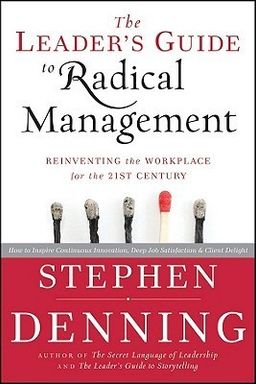
How can you turn work into a source of innovation, delight, and meaning instead of bureaucracy, burnout, and disengagement? In The Leader's Guide to Radical Management, Stephen Denning argues that modern organizations must replace the 20th-century model of control, efficiency, and shareholder primacy with a new management logic centered on delighting clients, empowering teams, and continuous learning. He contends that productivity, creativity, and satisfaction can rise together—if you change what management is for, whom it serves, and how it works.
This book weaves history, case studies, and practical frameworks into a cohesive vision: you start by redefining the goal of work (from outputs to client outcomes), restructure power into self-organizing teams, and replace linear plans with iterative feedback loops. You build transparency, communication, and improvement into daily routines, while leaders evolve from commanders to enablers of flow and learning. The result is an organization that is adaptive, humane, and client-centered.
Why traditional management fails
Denning traces today’s frustrations—bureaucracy, disengagement, and toxic short-termism—to a system designed for another era. Frederick Taylor’s scientific management and Henry Ford’s assembly line delivered massive productivity by decomposing tasks and controlling workers. But this model assumes stable conditions and predictable outputs. In the 21st century, where markets shift and value depends on innovation, those same assumptions crush agility and morale. Processes that once saved costs now slow adaptation. Layers of approval, siloed functions, and performance metrics based on volume over value create what Denning calls a “systemic disease” of management.
The replacement model: delight people, not produce things
Radical management begins with a simple but revolutionary question: Who is your work intended to delight? Instead of producing goods, reports, or transactions, your purpose is to create joy, surprise, and loyalty for clients. Everything—strategy, structure, and culture—flows from that. Denning draws on Fred Reichheld’s Net Promoter Score and Roger Martin’s “customer capitalism” to show how delight generates sustainable profits. In contrast, optimizing for short-term efficiency leads to “bad profits”—returns earned at the expense of trust and satisfaction. Companies like Apple, Toyota, and Enterprise Rent-A-Car thrive because they orient daily work toward client happiness and measure it rigorously.
The human and organizational shift
Focusing on delight reshapes the workplace itself. You can’t deliver real innovation or responsiveness from the top down. Instead, you need self-organizing teams—people with autonomy, diversity, and a shared purpose, capable of solving mysteries rather than just puzzles. Denning cites Jeff Sutherland’s work on Scrum, Takeuchi and Nonaka’s studies at Honda and Toyota, and historical precursors like Henry FitzEmpress’s 12th-century juries to illustrate how granting real responsibility produces legitimacy, creativity, and flow. When teams have direct visibility into client reactions, work regains meaning and energy.
Iteration and transparency as operational habits
Radical management replaces linear planning with rapid experimentation. You deliver value in short, client-driven iterations—weeks rather than quarters—each producing something usable or demonstrable. This iterative rhythm, borrowed from Agile and Lean, links teams to real clients and protects them from “phantom work jams” caused by excessive work-in-process. Transparency amplifies learning: daily stand-ups, visible boards, and open retrospectives ensure that obstacles surface fast and are removed by management, which shifts from enforcing compliance to enabling improvement. Denning likens transparency to Toyota’s “andon” cord—the act of stopping the line when problems appear not to punish but to learn.
Communication, story, and culture of respect
Processes alone can’t sustain transformation. Radical management depends on interactive communication—storytelling, honest dialogue, and listening. People align through shared narratives, not PowerPoint charts. Denning calls these “springboard stories,” which inspire action by showing possibility through example. They turn management from transmission of orders to exchange of meaning. Likewise, “respect for people,” one of Toyota’s twin pillars, ensures workers can raise problems without fear. Denning’s cases—from the World Bank to Total Attorneys and OpenView Venture Partners—show that culture evolves through these constant, authentic conversations.
How change spreads
Denning closes with realistic tactics for transforming your organization. Change doesn’t come from decrees but through organic propagation—small wins, visible successes, and narrative contagion. A strong nucleus of believers demonstrates results in a beachhead project, creating evidence and enthusiasm that inspire replication. Each success reshapes norms until radical management becomes the default system. Denning urges patience: you’re not adding new techniques to an old logic; you’re replacing the logic itself. That means reorienting metrics, power, and identity around client delight and continuous learning.
Core insight
Radical management is a human system for unpredictable work: start with delight, organize through teams, iterate transparently, communicate through stories, and evolve continuously. Do that, and productivity, innovation, and meaning reinforce each other instead of competing for attention.