
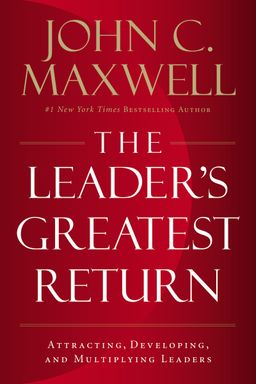
The Leader’s Greatest Return cover

The Leader’s Greatest Return

by John C Maxwell

The Leader’s Greatest Return offers a comprehensive guide to developing leadership potential within your organization. Drawing on over 25 years of experience, John C. Maxwell provides insights into fostering a culture of continuous leadership development, ensuring your organization thrives with a strong network of capable leaders.

The Leader’s Greatest Return: How to Multiply Your Leadership Impact

What if your greatest legacy as a leader isn’t what you build, but who you build? In The Leader’s Greatest Return, John C. Maxwell argues that the ultimate measure of leadership success is not personal achievement, but the ability to attract, develop, and multiply other leaders. He contends that while great leaders can achieve impressive goals, those who multiply leaders achieve exponential impact that extends far beyond their own reach. The true return on leadership, Maxwell insists, comes not from directing followers—but from developing other leaders who, in turn, create more leaders.

Maxwell builds on decades of experience as a global leadership teacher to outline a ten-step methodology that helps leaders identify, attract, understand, motivate, equip, empower, and position emerging leaders. He then shows how to mentor, reproduce, and compound those leaders for long-term growth. The philosophy is simple: when you grow leaders, everyone wins—your organization, your mission, and the world around you.

From Followers to Multipliers

Most leaders settle for leading followers, because followers are easier to manage. But followers replicate dependency, while leaders replicate growth. Maxwell draws a vivid distinction: followers add; leaders multiply. By developing leaders instead of followers, you create a self-sustaining cycle of influence that compounds over time—much like compound interest in finance. It’s the difference between temporary success and enduring legacy.

His argument mirrors the Pareto Principle, introduced in his final chapter: a small proportion of well-developed leaders—the top 20%—produce the majority of results, influence, and innovation. Investing in those few key people yields disproportionate returns across the organization. This is the “leader’s greatest return” in action.

Leadership as a Lifelong Process

Maxwell insists that leadership development is both difficult and endless. There is no finish line; true leaders remain students forever. Drawing on Gayle Beebe’s idea of “progressive formation,” he compares leadership growth to building a wall over generations—the vision and legacy expand with each brick laid.

He also stresses that leadership is hard work—there are no two consecutive easy days for a leader. But like exercising an uphill climb, every step of developing others strengthens the organization’s muscles for growth. With humility and perseverance, leaders compound their influence over decades, not days.

The Ten-Step System of Multiplying Leaders

Maxwell structures the book around ten progressive steps:

  • Identifying leaders (discovering potential)
  • Attracting leaders (inviting them to the leadership table)
  • Understanding leaders (building connection)
  • Motivating leaders (sparking inner drive)
  • Equipping leaders (providing training and tools)
  • Empowering leaders (releasing authority)
  • Positioning leaders (building synergistic teams)
  • Mentoring leaders (coaching to mastery)
  • Reproducing leaders (teaching them to teach others)
  • Compounding leaders (realizing exponential returns)

These steps form a leadership ladder where every level builds on the previous one. To climb that ladder successfully, leaders must balance character with competence, relationships with results, and conviction with teachability. You can’t multiply what you don’t model.

Why This Matters Now

Maxwell frames his book as a response to what he calls the global “leadership deficit.” In governments, corporations, and families alike, there’s a shortage of leaders who act with integrity, vision, and empathy. Yet the good news, he reminds us, is that leaders aren’t born—they’re developed. Anyone with willingness, humility, and discipline can grow into a leader. And anyone already leading can choose to multiply their influence by developing others.

“Everything rises and falls on leadership.”

— John C. Maxwell’s lifelong conviction

By the book’s conclusion, Maxwell challenges you to move from addition to multiplication, from personal success to leadership legacy. If you can attract and develop other capable leaders, you don’t just improve your team—you change the trajectory of your organization and magnify your positive impact on the world.


Finding Leaders: The Art of Identification

How do you find potential leaders in a world overflowing with talent but short on trustworthiness? Maxwell argues that identifying true leadership potential requires discernment beyond resumes or charisma. He introduces the Six A’s of Identification: Assessment of Needs, Assets on Hand, Assets Not on Hand, Attitude, Ability, and Accomplishments. These serve as filters to locate individuals who can grow into genuine leaders.

Assessment of Needs: Start with Vision

You can’t identify the right leaders unless you know where you’re going. Maxwell urges leaders to clarify their mission before recruiting anyone. Like hiring a squirrel instead of trying to train a horse to climb, you must match potential to purpose. Chick‑fil‑A’s leadership expert Mark Miller (author of Leaders Made Here) advises to define the target clearly—people must know what they are trying to accomplish.

Assets on Hand: Look Inside First

Your best potential leaders are often already on your team. Internal candidates understand culture, share values, and have established influence. Maxwell stresses influence as the true measure of leadership—if someone can inspire action without authority, they’re already leading. He references Andrew Carnegie’s famous metaphor: when mining for gold, you move tons of dirt, but you look for gold, not dirt. The task of a wise leader is to look for gold in the people you already have.

Attitude and Ability: The Heart and Head of Leadership

Hiring talent without attitude causes long‑term damage. Delta Airlines CEO Ed Bastian tells Maxwell, “We hire for attitude and train for aptitude.” Skills can be taught; character cannot. The right candidates have enthusiasm like Warren Buffett, who says he “tap dances to work,” and persistence like Tommy Lasorda, who loved managing even on losing days. Such people are willing learners; character steadies their growth.

At the same time, ability matters. Leadership without competence breeds frustration. Maxwell teaches leaders to seek those who demonstrate four markers of talent: excellence in execution, attraction of others, natural fulfillment in their work, and expanding opportunities because of it. As Aleksandr Solzhenitsyn observed, “Talent is conscious of its abundance and doesn’t mind sharing.” Leadership ability works the same way: talented leaders lift everyone around them.

Accomplishments and Builders: Producers Who Create Results

Past performance predicts future leadership. Maxwell distinguishes “builders”—people who love results, learn from uncertainty, stay impatient for progress, and spread contagious passion. Builders are rare, but they’re the foundation of great organizations. A builder lives by Maxwell’s “Law of the Rubber Band”: growth stops when you lose tension between where you are and where you could be.

He illustrates the principle through Bob Taylor of Taylor Guitars, who sought a successor capable of out‑creating him. Taylor’s prayer‑like list of impossible traits eventually led him to Andy Powers—a self‑taught guitar maker from San Diego who exceeded every expectation. Taylor’s success story reinforces a core truth: you find great leaders by knowing exactly what you’re looking for.

“Know it, and you’ll see it.”

—John C. Maxwell, on identifying potential leaders

By applying these six lenses—vision alignment, presence of internal assets, positive attitude, proven ability, and real‑world results—you move beyond guesswork into intentional leadership identification. The goal isn’t to find followers who do tasks but prospective leaders who build futures.


Building the Leadership Table: Attracting and Engaging Leaders

Once you’ve identified potential leaders, how do you draw them in? Maxwell’s metaphor for attraction is the leadership table—a place where emerging leaders gather to learn, share ideas, and experience growth. Unlike exclusive boardrooms, the leadership table is open—but meaningful. It’s where people feel seen, challenged, and invited to contribute beyond their job description.

Creating a Leadership Culture

Maxwell argues that culture is the invisible wind that determines whether your leadership efforts sail smoothly or stall. Teams with a leadership culture—where leadership is taught, modeled, and expected—produce future leaders naturally. Chick‑fil‑A, for example, doesn’t just train employees in customer service; it equips them in leadership values such as servanthood and integrity, creating 250+ applicants for every store position. Culture, Maxwell writes, is “caught” before it’s taught—people do what people see.

Practicing Roundtable Dynamics

To help you establish your own version of the leadership table, Maxwell suggests using roundtables—small group discussions where everyone participates, applies lessons, and holds one another accountable. Unlike lectures, roundtables emphasize application over information. Leaders ask good questions, listen intentionally, and challenge others to ACT: apply, change, and teach.

This hands‑on model (developed through Maxwell’s EQUIP foundation and used to train millions globally) turns leadership learning into a movement. People grow because they experience both freedom and accountability—a dynamic few corporate seminars achieve.

Proximity and “Who Luck”

Leadership, Maxwell reminds us, is more caught than taught. Growth accelerates when leaders share proximity with other leaders, gaining modeling and feedback beyond classroom theory. He cites Jim Collins’s term “who luck”—the good fortune of meeting the right people who stretch your potential. To create who luck for your team, expose them to quality relationships, connect them with mentors, and encourage them to ask, “Who do you know that I should know?”

Everyone Gets to Lead

Maxwell warns against the elitism of “high‑potential pools.” Drawing from Rajeev Peshawaria’s Too Many Bosses, Too Few Leaders, he argues that everyone deserves a chance to lead—because leadership capacity often blooms later or in unexpected people. By welcoming many, the best will rise. Leadership tables democratize opportunity but hold firm to accountability; they invite broadly but develop selectively.

When you create environments where learning becomes culture, proximity fuels growth, and contribution feels valued, leaders aren’t just attracted—they’re retained and multiplied. As Maxwell summarizes through the story of his mentee John Vereecken in Latin America, one good leadership table can ripple out to transform thousands of communities and lives.


Understanding and Connecting Before Leading

Leadership is a people business first. Maxwell’s Law of Connection—“Leaders touch a heart before they ask for a hand”—anchors this chapter. Before guiding anyone, you must understand their stories, motivations, and perspectives. The case of Neville Isdell rescuing Coca‑Cola’s culture in 2004 illustrates what it means to connect before leading.

The Coca-Cola Example: Listening Before Acting

When Coke called Isdell out of retirement to fix its declining business, he didn’t start with restructuring or marketing. Instead, he embarked on a global listening tour to understand his people, bottlers, and partners. He suspended judgment, asked questions, and rebuilt badly damaged trust. His humility created buy‑in: rather than announcing new strategy, he involved employees in creating it. Within three years, Coke regained growth and morale—proof that empathy precedes effectiveness.

Perspective Taking and Question Asking

Maxwell explains that true connection begins when leaders see through others’ eyes. This requires what psychologist Steffan Surdek calls “perspective thinking”—understanding how life experiences shape perception. To accomplish this, Maxwell teaches three levels:

  • Learn perspective thinking—recognize that most people want to feel special, understood, and hopeful.
  • Practice perspective seeking—invite others to share their viewpoint after meetings or decisions.
  • Engage in perspective coordinating—synthesize everyone’s views into collective understanding.

By doing so, you build shared ownership rather than forced compliance.

Becoming a Better Listener

Maxwell highlights listening as leadership’s most underrated skill. Quoting psychiatrist David D. Burns, he writes that being understood motivates people more than being told what to do. Good listeners, like Billy Graham or John Wooden, earn lifelong loyalty because they make others feel heard. At the John Maxwell Company, new hires spend their first two weeks simply meeting colleagues and listening to their stories—before doing any work—because understanding precedes impact.

To connect effectively, you must trade control for curiosity. Ask questions that invite reflection; listen not to reply, but to learn. As Maxwell notes, “Leaders who sweat with their people can handle the heat.” The more you grow in empathy and connection, the more influence you gain—and the easier everything else in leadership becomes.


Motivating Leaders: Cultivating Inner Drive

Can you truly motivate someone else? Maxwell answers: not sustainably. Real motivation comes from within. While you can’t inject drive into others, you can help them discover and amplify their inner motivations. He identifies seven internal motivators that fuel leaders: purpose, autonomy, relationships, progress, mastery, recognition, and money.

Purpose: The Greatest Catalyst

Purpose turns a “have to” into a “want to.” Leaders who link their work to a higher cause gain stamina through struggle. Maxwell quotes Clare Boothe Luce’s idea that each great person is defined by “one sentence.” For Kennedy it was “He inspired a nation to explore space.” For Maxwell, his sentence is: “I add value to leaders who multiply value to others.” Helping your people find their sentence—what they were created to do—unlocks enduring motivation.

Autonomy and Relationships

Freedom to make meaningful decisions—autonomy—was a core finding of Daniel Pink’s Drive. Maxwell confirms this: people who own results engage more deeply. He cites Delta Airlines’ approach to empowerment and early U.S. history at Jamestown, where productivity increased tenfold when settlers were given personal land. Relationships add another dimension—purpose shared with beloved teammates feels richer. “Individual competition makes us faster,” writes Maxwell’s colleague Erin Miller, “but intentional collaboration makes us better.”

Progress, Mastery, and Recognition

People find energy in measurable growth. Whether learning a craft, leading a team, or refining a skill, visible improvement builds momentum. Pat Riley captured it best: “Excellence is the gradual result of always striving to do better.” Leaders turn this into mastery by setting small goals that lead to big wins. Recognition multiplies this effect—psychologist Henry Goddard proved that praise physically increases energy levels. A sincere “thank you” can recharge a tired leader more than a bonus check.

Money: A Misunderstood Motivator

Money, Maxwell admits, is a valid motivator—but only up to security. Beyond that, giving becomes the new source of joy. Like Fred Allen’s joke, “Everything more important than money costs money,” finance frees you to pursue significance, not survival. The mature leader transitions from earning more to giving more.

The ultimate goal, Maxwell concludes, is turning motivation into habit. Motivation sprints; habits run marathons. His acronym BEST—Believe in them, Encourage them, Show them, Train them—builds momentum until doing right becomes instinctual. The story of Traci Morrow, a Beachbody coach turned leadership powerhouse, demonstrates this process: aligning purpose, relationships, and mastery turned her daily habits into a global impact system.

By helping leaders awaken their intrinsic motivations rather than relying on carrots and sticks, you nurture self-driven excellence. People don’t need to be pushed when they’re pulled by purpose.


Equipping and Empowering: Turning Potential into Impact

After motivation comes the heavy lift: equipping and empowering others to succeed without you. Maxwell teaches that leaders who fail to equip will forever carry the load alone. True equippers multiply competence; true empowerers multiply confidence. His model combines both into sustainable growth.

Equipping through Proximity and Process

Maxwell’s five-stage model—“I do it; I do it and you’re with me; you do it and I’m with you; you do it; you do it and someone else is with you”—captures the journey from instruction to multiplication. It echoes apprenticeship models of old where skills were absorbed through close contact. He calls proximity the key: learning travels fastest through watching, doing, and reflecting together. EQUIP, his global nonprofit, has trained over five million leaders using this cascading model.

The Essentials for Equipping

Maxwell outlines six practices: model the way, gather people near you, ask the right questions, let them learn by doing, set clear goals, and remove barriers. Each builds belief and competence. He warns leaders not to delegate before equipping—otherwise you replicate frustration, not performance. Just as a mountaineer prepares others before the ascent, you must assess readiness, teach the terrain, and match tools to tasks.

Empowering through Trust and Release

Once equipped, leaders must be released. Maxwell’s “10–80–10 Rule” illustrates balanced empowerment: begin by guiding the first 10% (vision and preparation), release your people for the middle 80% (execution and innovation), then reengage in the last 10% (evaluation and celebration). This gives ownership without abandonment. Secure leaders share power instead of hoarding it; insecure leaders become bottlenecks. As Maxwell says, “Only secure leaders give power to others.”

Creating Empowering Environments

Empowerment requires atmosphere. Maxwell outlines seven traits of empowering environments: belief in people’s potential, freedom to act, collaboration, accountability, ownership, service, and reward for results. Nordstrom’s legendary rule—“Use your best judgment”—exemplifies this mindset. Under leaders who grant trust, teams self‑organize, innovate, and grow. Glenn Jackson of Jackson Spalding calls these “3‑2 count” moments—leaders step up only when stakes are high, not to micromanage.

Equipping gives people what they need to start; empowering gives them permission to soar. Together, they transform dependency into destiny and potential into perpetual growth.


Mentoring and Reproducing Leaders

Developing leaders one by one is rewarding; reproducing leaders who reproduce others is legacy. Mentorship, Maxwell argues, is not a hobby but a responsibility. He distinguishes between coaching (skill-centered) and mentoring (life-centered). A coach sharpens competence; a mentor shapes character and conviction. The combination produces transformation.

Mentorship in Action: The Sheri Riley Example

Maxwell shares Sheri Riley’s story—a music executive who mentored both her assistants and the teenage artist Usher. She promised to care more about his life than his brand, offering truth, accountability, and wisdom. Decades later, Usher credited her authenticity as a guiding force. That is mentoring at its best: seeing the whole person, not just the performer.

How Great Mentorship Works

  • Select your mentees intentionally. Like Jesus choosing his twelve disciples, good mentors choose discipline and teachability, not popularity.
  • Set mutual expectations—mentoring must yield ROI for both parties: progress for the mentee, purpose for the mentor.
  • Personalize guidance—treat growth as tailoring, not mass production.
  • Have crucial conversations early—truth told in love accelerates maturity.

Maxwell shares how he mentors Traci Morrow, offering candid feedback and hard truths that “draw out her tenacious leader rather than shut her down.” Such moments, he says, separate coaches from leaders and mentors from managers.

Reproducing Generations of Leaders

Reproduction occurs when leaders train those who can train others. Maxwell references Paul’s instruction to Timothy: “Entrust what I have taught you to reliable people who will teach others.” He envisions at least four generations of leadership transfer—Paul (1), Timothy (2), faithful people (3), others (4). Organizations that embed this mindset become self-propagating ecosystems of growth. Chick‑fil‑A calls this “Leaders Made Here.”

Mentorship transitions influence from addition to multiplication. Each person you pour into becomes an extension of your legacy—and when they do the same, your leadership outlives you.


The Compounding Effect: Achieving the Leader’s Greatest Return

Maxwell concludes with a profound financial metaphor: leadership development compounds like interest. Small, consistent investments in the right people multiply exponentially across time. Applying the Pareto Principle (20% of people create 80% of results) and James Clear’s “1% Advantage Rule” (Atomic Habits), he argues that slightly better leaders create dramatically better outcomes when growth is sustained over decades.

From Addition to Exponential Multiplication

When you develop one leader, you add capacity. When that leader develops leaders, capacity multiplies. Over time, the impact compounds. Maxwell’s nonprofit EQUIP trained 5 million leaders in every nation on earth by starting with 400 volunteers who each trained others—proof that consistent systems outlast charismatic starts. The compounding engine depends on time, intentionality, and focus: right choices + consistency + time = ridiculously significant returns.

Seven Returns from Developing Leaders

  • Developed leaders share the leadership load, freeing you to work in your strengths.
  • They multiply resources—time, ideas, loyalty, and people.
  • They generate momentum, turning small wins into sustained energy.
  • They expand your influence exponentially, reaching people you’ll never meet.
  • They keep you sharp—growing leaders forces you to keep learning.
  • They secure your organization’s future by creating a bench of successors.
  • They multiply your legacy far beyond your lifetime.

Case Study: Kevin Myers and 12Stone Church

Maxwell’s long mentorship of pastor Kevin Myers demonstrates compounding success. Through decades of coaching, Myers grew his leadership capacity, developed others, and multiplied his influence. Today, his organization continually trains hundreds of resident leaders and mentors other pastors, generating waves of leadership growth across generations. Maxwell calls this the ultimate ROI of mentorship: when your protégés become multipliers themselves.

“Developing leaders is the most rewarding thing you can do as a leader.”

—John C. Maxwell

Maxwell leaves readers with both a challenge and a promise: start small, start today, but never stop multiplying leaders. The compounding rewards—growth, freedom, and legacy—belong to those who keep investing in others long after their own achievements are secured. This, he concludes, is the leader’s greatest return.

Dig Deeper

Get personalized prompts to apply these lessons to your life and deepen your understanding.

Go Deeper

Get the Full Experience

Download Insight Books for AI-powered reflections, quizzes, and more.