
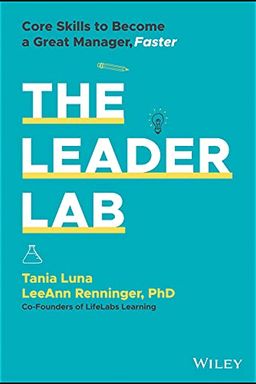
The Leader Lab cover

The Leader Lab

by Tania Luna and LeeAnn Renninger

The Leader Lab is your go-to guide for mastering essential management skills quickly. Authors Tania Luna and LeeAnn Renninger share research-driven insights and practical techniques, empowering you to become an outstanding manager. From impactful coaching to effective feedback, transform your leadership style and boost team performance with these accessible strategies.

Becoming a Great Manager, Faster

What if mastering leadership didn’t take decades—but could be achieved faster, with deliberate practice of just a handful of core habits? That’s the challenge Tania Luna and LeeAnn Renninger tackle in their book The Leader Lab: Core Skills to Become a Great Manager, Faster. They argue that great management isn’t born from charisma or intuition; it’s built through small, high-impact behaviors called Behavioral Units (BUs), practiced repeatedly until they become second nature. These BUs, combined with eight essential skills—or “tipping point skills”—form the backbone of rapid managerial mastery.

The Science Behind Better Management

Luna and Renninger draw on their research at LifeLabs Learning, a leadership development company that has trained employees from Google, Warby Parker, TED, and thousands of others. They discovered that great managers can be identified not by their personality but by small, consistent behaviors that drive engagement, alignment, and performance. The authors liken these habits to the ‘black box’ of aviation—hidden yet measurable actions that determine success or failure. By opening that box—observing managers in real meetings and one-on-ones—they isolated the precise micro-behaviors that distinguish merely good managers from great ones.

Their findings reveal that it’s never the grand speeches or charismatic flair that matter most—it’s the subtle gestures, phrasing, and choices: asking more questions, replaying what others say for clarity, deblurring vague terms, validating feelings, and linking actions to purpose. Much like learning a musical instrument, mastery depends on deliberate, consistent practice. Each behavior seems simple, but together they compound into powerful leadership ability.

Why Manager Skills Matter More Than Ever

The authors note that poor management exacts a global cost of over $7 trillion a year through inefficiency and disengagement. Only 20% of employees feel motivated by how they’re managed, while many admit they’re “relieved when their manager is out sick.” Yet great management, they argue, doesn’t just boost retention or output—it changes lives. Managers who validate, coach, and connect help people become better collaborators, parents, and citizens. Managing today’s teams—diverse, distributed, and innovation-driven—requires leaders who catalyze thinking, not control behavior. Managers must help others think better and faster, not merely oversee tasks.

As such, modern managers are also leaders. The old distinction between the two—leaders as visionaries and managers as taskmasters—no longer holds. In today’s environment of constant change, everyone who manages people must learn to lead: to influence without authority, drive inclusion, and adapt swiftly to uncertainty.

The Core of the “Leader Lab”

The book’s structure mirrors a scientific lab: theory meets experimentation. Readers are invited to treat their workplace as a “Leader Lab”—a testing ground where every meeting, conflict, and coaching moment is a micro-experiment. Like a scientist, the manager observes, reflects, tests, and adapts. This is the crucial difference between managers who grow slowly through experience and those who grow rapidly through reflection.

Part I introduces the seven Core Behavioral Units (BUs)—minute yet mighty behaviors that define everyday leadership mastery:

  • Q‐step – asking at least one thoughtful question before telling.
  • Playback – paraphrasing others to ensure clarity and trust.
  • Deblur – clarifying vague or subjective language to align meaning.
  • Validate – explicitly showing empathy and care.
  • Linkup – connecting actions to their “why.”
  • Pause – slowing down to think, breathe, and decide deliberately.
  • Extract – reflecting on experiences to harvest lessons and make them explicit.

Part II then moves from micro to macro—introducing eight Core Skills built from these BUs. These include coaching (catalyzing insight), feedback (sharing and receiving information well), productivity (using time intentionally), effective one-on-ones (building engagement), strategic thinking (aligning short-term actions with long-term value), meeting mastery (driving collaboration), leading change (guiding transitions), and people development (helping others grow).

Through vivid storytelling—especially the recurring character Mia the Manager—Luna and Renninger illustrate each lesson. Mia, a new manager equipped with a magical “Do-Over Button,” replays key managerial mistakes and corrects them using each BU. Her journey mirrors that of most readers: from overworked problem-solver to empowered leader who builds capability in others. By the final chapters, Mia’s team thrives, not because she gained innate charisma, but because she practiced small, consistent, science-backed habits.

Why These Ideas Matter

The Leader Lab stands out because it redefines what leadership development can be: fast, evidence-based, and human. It offers a roadmap for transforming management from a reactive scramble into a deliberate craft. Its message echoes modern behavioral psychology—tiny actions compound into outsized outcomes (a philosophy shared with authors like James Clear in Atomic Habits). By turning every day into a lab experiment, Luna and Renninger make mastery accessible to anyone willing to practice.

Ultimately, the book argues that being a great manager isn’t harder—it’s smarter. When you shift from trying to have all the answers to asking better questions, when you clarify and validate instead of assuming, and when you pause to extract learning from each experience, you accelerate your own growth and your team’s. As the authors remind us, “Great managers aren’t born—they’re built, one small behavior at a time.”


The Seven Core Behavioral Units (BUs)

At the heart of The Leader Lab are seven deceptively simple management micro-skills called Behavioral Units (BUs). These aren’t abstract leadership traits—they’re repeatable actions you can spot, measure, and practice in nearly every conversation. Like elements on the periodic table, they combine in different ways to create complex leadership outcomes. Let’s explore each BU and why it matters.

1. Q-Step: Ask Before You Tell

Great managers ask five times more questions than average managers. The Q-step means pausing to ask at least one question before offering advice or direction. This single habit helps you diagnose problems faster, develop others’ skills, and drive commitment rather than compliance. Mia learns this when she realizes that giving advice too quickly shuts down others’ creativity. By asking Luca “How are you feeling about it?” instead of defending her role, she opens dialogue and rebuilds trust.

2. Playback: Show You Understand

A Playback is a paraphrase of what someone said. It builds clarity, prevents misunderstanding, and signals care. Saying “It sounds like two things are on your mind…” or “So, you’re feeling overlooked?” helps people feel heard and minimizes costly miscommunication. Like “measuring twice before cutting once,” Playbacks ensure shared understanding before action.

3. Deblur: Clarify Ambiguity

A blur word—like “soon,” “better,” or “professional”—means different things to different people. Deblurring turns fuzziness into precision. By asking questions like “What does ‘better’ mean to you?” or “How would you measure that?” managers align expectations and eliminate bias. When Mia asks Luca what “culture fit” means, she prevents unconscious bias from derailing a hiring decision.

4. Validate: Make Care Explicit

Even precise communication can feel robotic without empathy. Validation acknowledges emotion: “That makes sense,” “I appreciate you sharing that,” or “It sounds hard.” It answers the question “How does this person feel about me?” By showing warmth and respect, managers reduce stress, build trust, and retain talent. (Gallup research supports this: employees who feel cared for are more likely to stay engaged.)

5. Linkup: Connect Tasks to Purpose

Linkup is the antidote to mindless work. Every task should connect to a “why.” When you delegate, lead meetings, or give feedback, explicitly state the link: “We’re doing this to save time,” or “This helps us deliver faster to clients.” Research shows people comply—and commit—more when they understand purpose (“because” boosts agreement rates from 60% to 93%). Mia learns that asking “What does this link up to?” turns vague enthusiasm into shared alignment.

6. Pause: Slow Down to Speed Up

Pausing seems counterproductive in our productivity-obsessed culture, yet it increases clarity, creativity, and conflict resolution speed. Great managers oscillate between focus and rest—micro, meso, and macro pauses that recharge thinking. Mia discovers that breathing or delaying a reaction prevents “amygdala hijacking”—those defensive spirals that destroy relationships. Pausing out loud also normalizes reflection in team culture.

7. Extract: Learn From Every Experience

Finally, Extract transforms everyday work into continuous learning. Like fighter pilots’ post-flight debriefs, managers who extract ask: “What went well? What didn’t? What can we do next time?” Reflection accelerates skill-building even faster than repetition. Mia develops this practice after each one-on-one, turning missteps into mastery.

Core idea:

These seven BUs are the “Swiss Army knife” of leadership. Once you master them, nearly every management challenge—a tough feedback talk, a stalled project, a disengaged employee—becomes solvable through intentional behavior rather than guesswork.

They’re simple to learn, hard to master, and transformative in impact. Every other leadership skill in the book—coaching, feedback, meetings, strategy—draws on some combination of these seven core actions.


Coaching: Catalyzing Insight, Not Giving Advice

Instead of solving problems, great managers help others solve their own. Coaching is more than support—it’s leadership through inquiry. Luna and Renninger found that exceptional managers coach frequently, turning daily conundrums and complaints into growth opportunities. It’s not about having answers; it’s about asking the right questions to spark ownership and ability.

Recognizing “4C” Coaching Moments

Managers should watch for four triggers: Conundrums (problems needing thinking), Complaints, Confidence issues (self-doubt), and Completions (milestones). Each is a cue to ask questions, not give directives. For example, when Olivia complains about a coworker, Mia resists advice and instead explores: “What does success look like in your partnership?” turning frustration into reflection.

The SOON Funnel: A Map for Coaching Conversations

The “SOON Funnel” structures conversations into four stages: Success (“What would great look like?”), Obstacles (What’s in the way?), Options (What could you try?), and Next steps (What will you do?). This sequence taps motivation and avoids rambling. A single SOON conversation can turn vague dissatisfaction into an actionable plan, and by letting employees voice their reasoning, managers ensure stronger follow-through.

Building a Coaching Mindset

Most managers overvalue quick fixes—“management by answers.” But that only creates dependency. Coaching builds scalable capability. The book’s advice mirrors Daniel Goleman’s emotional intelligence models and Sir John Whitmore’s GROW framework (Goal, Reality, Options, Will). Like those, the authors emphasize curiosity over control. You don’t need a magical “Do-Over Button”—just a Q-step habit and patience with people’s learning curves.

When Mia learns to ask, “What do you think would help?” she stops acting as fixer-in-chief and becomes a true multiplier. The best coaches measure success not by how needed they are—but by how unnecessary they become.


Feedback: Turning Conversations into Learning Loops

Feedback is the nervous system of any healthy team—it helps you sense impact and correct course. Yet most managers dread it. Luna and Renninger demystify feedback with one simple acronym: Q-BIQ (Question, Behavior, Impact, Question). This model reframes feedback as a two-way learning cycle rather than a one-way critique.

1. Start and End with Questions

Always begin with a Micro-Yes like “Can I share some thoughts?” This primes readiness. End with curiosity: “What do you think?” It signals partnership and keeps amygdala-defenses low. Asking permission and checking understanding makes feedback safe and productive.

2. Describe Observable Behavior

Skip judgments like “You were rude.” Instead say, “When you interrupted Olivia mid-sentence...” Feedback should be “camera-visible.” Deblur vague labels (“unprofessional,” “hardworking”) into facts. This prevents defensiveness and helps people see what to repeat or adjust.

3. Link to Impact

Explain why the behavior matters—how it affects the team, client, or goals. Tailor the impact to what the listener values: personal growth, team harmony, or customer success. For instance: “By adding context in meetings, you help others make faster decisions.” Connecting cause and effect produces buy-in and meaning.

4. Keep It Continuous

Instead of annual evaluations, great managers normalize small, frequent feedback—praise as much as critique. They “pull” for feedback, asking their teams “What’s one thing I can improve by 10%?” This levels hierarchy and creates a feedback culture. Research supports this habit: leaders who ask for critical input are rated more effective (Ashford & Tsui, 2017). Mia learns that modeling vulnerability invites honesty in return.

“Great feedback isn’t advice—it’s information.” Luna & Renninger show that the real growth happens when both people leave a feedback talk feeling heard, understood, and motivated to act.

When practiced alongside Playbacks and Validations, Q-BIQ conversations become moments of trust, not tension—a core ingredient of any learning organization.


Productivity: Managing Time, Energy, and Focus

Productivity, in The Leader Lab, isn’t about doing more. It’s about doing what matters most with intention. Luna and Renninger identify four common productivity bottlenecks: time awareness, prioritization, organization, and focus. By diagnosing which one is broken, you can fix the right thing instead of adding more hacks.

Time Awareness: Respect the Clock

Great managers use precise time language (“Let’s take five minutes,” not “a sec”) and start and stop meetings on time. They encourage time audits to reveal how hours are actually spent, reducing illusions of busyness. As the authors quip, “What gets scheduled gets real.”

Prioritization: Focus on What Counts

People drown in urgent but unimportant work. The authors revive Eisenhower’s Urgent/Important Quadrant—focusing first on high-impact, non-urgent ‘investment’ tasks that prevent fires later. To decide quickly, managers can ask team members their MITs (Most Important Things) each week. A shorter to-do list and a longer not-to-do list are signs of maturity.

Organization: Close Open Loops

Adopt a Consistent Capture System (one reliable place for tasks, notes, and deadlines). Teams should create a “Closed Loop Culture”—clear owners, deadlines, and follow-ups—so nothing gets lost in limbo. As memory researcher Bluma Zeigarnik found, unfinished tasks clutter the brain’s bandwidth until completed or recorded.

Focus: Guard Attention

In a world of constant pings, managers must defend deep work. The authors recommend if-then rules (“If I start a meeting, then I’ll silence notifications”), Pomodoros (25-minute sprints with 5-minute breaks), and Kanban boards to track tasks visually. Helping teams manage focus isn’t micromanagement—it’s respect for their minds.

Productivity in this book goes beyond efficiency; it’s about sustainability. A well-run day balances execution with rest. As Luna and Renninger note, “Doing nothing well is a skill.”


One-on-Ones: The Manager’s Most Powerful Tool

If there’s one meeting never to cancel, it’s the one-on-one. These consistent weekly conversations account for the biggest difference between average and high-performing teams. The Leader Lab reframes one-on-ones as engagement engines driven by five brain cravings: Certainty, Autonomy, Meaning, Progress, and Social Inclusion—collectively called the CAMPS model.

Certainty: Clarity Reduces Stress

Regular rhythms, predictable agendas, and transparent goals prevent anxiety. Even when answers are unknown, communicating confidence (“We’ll update every Friday, even if nothing’s changed”) builds psychological safety.

Autonomy: Give Voice and Choice

Let employees own part of the meeting and choose the setting or timing. Balance guidance with freedom—too little autonomy breeds dependence; too much causes drift. Mia helps Kofi re-engage by asking what decisions he’d like more say in.

Meaning and Progress

Meaning fuels motivation; progress fuels dopamine. Managers should help people see the impact of their work (“Here’s how your project helped 300 customers”) and celebrate small wins weekly. Even reflection on lessons learned counts as progress.

Social Inclusion

Humans need to belong and stand out simultaneously (“optimal distinctiveness”). Small talk, genuine curiosity, and visible support for individuality strengthen connection. Leaders who care personally outperform those who only manage performance (similar to Kim Scott’s Radical Candor).

Ultimately, a great one-on-one fulfills all five cravings. When done right, they transform disengaged employees into trusted collaborators—and stressed managers into grounded leaders.


Strategic Thinking: Seeing the Forest and the Trees

Strategic thinking may be the most coveted yet misunderstood management skill. For Luna and Renninger, it means acting in the present with awareness of the future and the system as a whole. Great managers think beyond tasks—they prevent problems, align purpose, and anticipate unintended consequences.

Five Habits of Strategic Thinkers

  • Gap Analysis: Define where you are, where you want to be, and measure the space between. Vague goals like “improve client satisfaction” become clear goals like “raise survey scores from 75% to 90% by Q4.”
  • Linkup: Constantly connect actions to goals. Ask, “What does this link up to?” before approving any task.
  • The 3 Lenses Model: See problems through three filters—personal (their behavior), interpersonal (my contribution), and organizational (systemic context). This expands understanding beyond blame.
  • UC Check: Consider Unintended Consequences before acting. Every decision has side effects—ask, “Who could be negatively impacted?”
  • Inclusive Planning: Involve the right stakeholders early, assign clear roles (Driver, Approver, Consultants, Informed), and visualize collaboration throughout the process.

Through these lenses, you no longer just react to problems; you architect systems. Strategic managers are anticipatory thinkers who prevent fires instead of constantly putting them out.

As one executive in the book put it, “Strategic thinkers change conversations from what-to-do to why-it-matters.”


Managing Meetings, Leading Change, and Developing People

The last three tipping point skills—meeting mastery, change leadership, and people development—turn managers from effective operators into organizational catalysts.

Meeting Mastery: Stop Wasting Lives in Circles

Since meetings consume up to 40% of work time, Luna and Renninger propose the 4P Opener (Purpose, Product, Personal benefit, Process) to start with energy and clarity. They distinguish meeting types—Inform, Explore, Narrow—and match tools to each: Q-storms for exploration, round-robins for inclusion, Impact/Feasibility maps for decision-making. Course correction follows one formula: Behavior observation + Impact statement + Process suggestion. Simplicity is power.

Leading Change: Stay Slushy

Building on Kurt Lewin’s Unfreeze–Change–Refreeze model, the authors add a twist: Stay Slushy. Change never ends, so teams must remain adaptable. Effective leaders conduct CAMPS listening tours to understand stakeholders’ needs, craft a Vision Statement that engages both head and heart, simplify plans, and celebrate early wins. Overcommunicate, embed behavioral cues (like checklists or reminders), and treat change as a series of experiments, not one final transformation.

People Development: Growing Capacity, Not Dependency

Finally, great managers multiply growth through others. They map capability gaps (where skills are missing), hold “Zoom Out” conversations to uncover career desires, and find the Venn Zone where business and individual goals overlap. Through Individual Development Plans (IDPs) and the 3E model (Education, Experience, Exposure), managers turn aspirations into action plans. Development isn’t an annual review—it’s a rhythm of reflection, feedback, and progress.

Mia learns this in her final chapters: by shifting from doing work herself to developing others, she scales her team’s success. The result: higher retention, stronger performance, and a culture that learns by experimenting. Leaders who grow people grow everything.

Together, these final skills illustrate Luna and Renninger’s core philosophy: the best managers don’t add pressure—they add clarity, purpose, and learning loops.


The Meta-Skill: Turning Work into a Leadership Lab

Throughout The Leader Lab, Luna and Renninger remind you that leadership isn’t a destination—it’s a practice. The real meta-skill isn’t any single BU or tool but the attitude of experimentation. Great managers treat every task, success, and mistake as data. They continually ask, “What can I extract and test next?”

Work as a Lab, Manager as Scientist

This experimental mindset democratizes growth. You don’t need a corporate budget or certification—just curiosity. Every feedback exchange becomes a micro-experiment in communication; every team meeting, a trial in inclusion. The authors call this the Leader Lab philosophy: transforming work from performance to practice.

The Ripple Effect of Great Managers

Managers ripple influence far beyond their teams. Leaders like “Marta,” who helped her employees bring their authentic selves to work, or “Bernardo,” who guided a company out of near extinction, show that effective management uplifts entire systems. Great managers don’t just hit metrics—they change how people experience work and life. The authors found that 90% of managers who applied these skills sustained improvements after one year, boosting both engagement and wellbeing.

Becoming a Lifelong Experimenter

The final chapters challenge you to embrace reflection as your ongoing feedback loop. Review your “Lab Reports,” re-test your skills, and keep gathering data. As with any lab, progress happens through iteration, not perfection. This mindset makes learning self-sustaining—you become your own leadership coach.

Ultimately, The Leader Lab is both manual and manifesto. It urges you to see leadership as learnable and improvable—one question, playback, and reflection at a time. By practicing these micro-behaviors daily, you don’t just become a better manager faster; you help create the kind of workplaces the world needs now.

Dig Deeper

Get personalized prompts to apply these lessons to your life and deepen your understanding.

Go Deeper

Get the Full Experience

Download Insight Books for AI-powered reflections, quizzes, and more.