
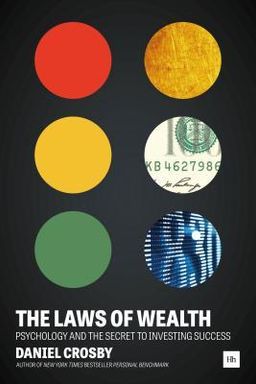
The Laws of Wealth cover

The Laws of Wealth

by Daniel Crosby

The Laws of Wealth reveals how psychological biases can undermine investment success. Daniel Crosby offers practical strategies to overcome these pitfalls, enabling investors to make rational decisions and achieve financial goals. Embrace a systematic approach to investing and turn behavioral insights into financial triumphs.

The Psychology of Wealth: Why Investing Success Starts with You

Have you ever wondered why, despite all the information and tools available today, so many investors still make poor decisions? In The Laws of Wealth, psychologist and behavioral finance expert Dr. Daniel Crosby argues that true investing success begins not with strategy or data, but with understanding human behavior. He contends that financial outcomes are shaped far more by mindset than by markets, and that your emotions—not economic forecasts—are the single most important determinant of your wealth.

Crosby’s central thesis is simple but profound: you must invest in risky assets to survive financially, but you are psychologically ill-equipped to do so. Investors live in a world where what feels right emotionally is often wrong financially. To solve this paradox, Crosby introduces a two-part framework: first, he outlines ten behavioral rules to manage yourself; second, he presents “Rule-Based Behavioral Investing (RBI),” a system to build disciplined, psychologically resilient portfolios.

The Two-Part Battle: Self vs. System

Part One of the book focuses on behavioral self-management—the psychological principles that prevent investors from acting on fear and greed. Crosby opens with compelling stories, from the biblical tale of Naaman’s “River Jordan Problem” to the eradication of Guinea worm disease in Africa, to show how simple but painful behavioral changes can solve complex problems. The takeaway? You can’t control the markets, but you can control your reactions. From accepting that “you are your own worst enemy” to learning that “if you’re excited, it’s probably a bad idea,” these rules act as mental armor against the emotional rollercoaster of investing.

In Part Two, Crosby turns to process, introducing Rule-Based Behavioral Investing (RBI)—a disciplined, data-grounded way to manage money that complements behavioral insight. RBI rests on four “Cs”: Consistency, Clarity, Courageousness, and Conviction. By creating systems that automate sound decisions and neutralize human error, you tilt probability in your favor. You stop trying to predict the future and instead control the only variable that matters—your behavior.

Understanding Wall Street Bizarro World

Early in the book, Crosby defines what he calls “Wall Street Bizarro World”—a mental landscape where everything works in reverse of real life. In the markets, doing less often beats doing more, the future is paradoxically more predictable than the present, and the wisdom of crowds leads to irrationality instead of safety. It’s a world where patience is profitable, fear is opportunity, and excitement is a red flag. The challenge is not simply to acquire financial knowledge but to apply simple behavioral principles with unwavering discipline.

Science Meets Common Sense

Drawing on decades of psychological research and classical market studies, Crosby bridges the gap between mind and money. He cites studies showing that the average investor underperforms the market by more than four percent each year due to emotion-driven timing. He references Daniel Kahneman’s work on cognitive biases, Warren Buffett’s behavioral wisdom, and modern data from firms like Vanguard and Morningstar demonstrating that investors coached in behavior—not stock picking—achieve better results. His message aligns with thinkers like Richard Thaler (Misbehaving) and Jason Zweig (Your Money and Your Brain): the investor’s real edge is psychological, not informational.

Why These Laws Matter

Crosby’s approach matters because it reframes investing as a human discipline rather than a technical one. You can no longer rely on “expert” forecasts or complex models (as Nate Silver observed, most are no better than coin flips). Instead, your wealth depends on mastering emotion, accepting impermanence, and practicing boring consistency. Whether you’re managing your own portfolio or working with an advisor, the goal is the same: build behavioral systems that override impulsive human tendencies. In other words, prosperity depends less on beating the market and more on beating yourself.

By the end of The Laws of Wealth, you’ll understand not just how money works, but how you work—and how your psychology shapes every financial decision. You’ll learn that risk isn’t volatility, forecasting is futile, and diversification is humility in practice. Above all, you’ll see that sustainable wealth requires treating investing not as a game of intelligence, but as a test of character.


The Ten Laws of Behavioral Self-Management

Dr. Crosby structures the first half of his book around ten “laws of wealth,” each one a principle for mastering your own mind before mastering money. These rules blend psychology, philosophy, and behavioral finance, turning decades of cognitive research into practical investing wisdom you can apply daily.

1. You Control What Matters Most

This law states that your behavior, not the market, is the main driver of returns. Citing DALBAR’s long-term data, Crosby shows that investors lose around 6% annually to bad timing—selling in panic and buying in euphoria. The cure? Automate contributions, ignore the noise, and anchor your strategy to process instead of emotion.

2. You Cannot Do This Alone

Vanguard’s “Advisor’s Alpha” study found that financial advisors add about 3% annually not via stock picking but by behavioral coaching. Crosby’s takeaway: find a sounding board who can save you from your worst instincts. An advisor’s real value is emotional restraint and perspective, especially when the market feels chaotic.

3. Trouble Is Opportunity

Bear markets are guaranteed—roughly once every three years—and they represent opportunity, not disaster. Citing Sir John Templeton and Warren Buffett, Crosby urges you to buy amid fear. He frames downturns as “the psychological price of strong returns,” a mindset proven by investors who profit from mean reversion (the rebound of undervalued assets).

4. If You’re Excited, It’s a Bad Idea

Emotion sabotages logic. Studies by psychologist Jennifer Lerner and Dan Ariely show that sadness or excitement distort perceived value, leading to overpaying and impulsive trading. Crosby’s antidote: if you feel euphoric about a stock, pause. Great investing is boring. “Emotion makes you a stranger to common sense,” he warns.

5. You Are Not Special

Overconfidence bias, Crosby says, is the disease of investors who believe rules don’t apply to them. He reminds readers through Roman history that even victorious generals had slaves whisper “remember you are mortal.” Admit mediocrity to achieve mastery—otherwise ego risk will lead you to ignore probability and reality.

6. Your Life Is the Best Benchmark

Benchmarking against indexes fuels envy and poor choices. Instead, align portfolios with personal benchmarks—your goals, values, and timelines. Using Brinker Capital’s “Personal Benchmark” model, Crosby shows that investors with goals-based strategies are less likely to sell during downturns and more likely to stay invested long-term.

7. Forecasting Is for Weathermen

Financial forecasts are nearly useless. Studies by Philip Tetlock and David Dreman reveal “expert” predictions barely beat random chance. Crosby urges you to avoid gurus and focus on behaviors that endure—systematic investing, diversification, and humility. “This person has no clue,” should be your mantra while watching CNBC.

8. Excess Is Never Permanent

Echoing Horace’s ancient wisdom—“many shall fall who are in honor”—Crosby dissects mean reversion. Just as sports or stock-manias revert to average, financial excess always normalizes. Investors must prepare for famine during feast and feast during famine, managing expectations through cyclical humility.

9. Diversification Means Always Having to Say You’re Sorry

True diversification ensures something in your portfolio is always underperforming—it’s the psychological cost of safety. Crosby quotes Ben Carlson: it minimizes regrets. No one knows which asset class will win, but spreading bets and rebalancing regularly is the best hedge against arrogance and catastrophe.

10. Risk Is Not a Squiggly Line

Volatility is not risk—permanent loss is. Howard Marks and Buffett agree that fear of swings misleads investors into buying “safe” assets that underperform inflation. Real risk is failing to achieve your goals, not seeing price fluctuations. Embracing volatility with discipline means accepting short-term pain for long-term gain.

Together, these ten laws form a behavioral code—a way to invest courageously and calmly in a world that thrives on chaos.


The Four Cs: A Behavioral System for Investing

After laying the groundwork for self-management, Crosby introduces the four Cs of Rule-Based Behavioral Investing (RBI): Consistency, Clarity, Courageousness, and Conviction. Together, they create a simple framework for managing money free from ego, emotion, and information overload. Think of the four Cs as the behavioral equivalent of seat belts—they don’t make driving safer, they make you safer.

Consistency: Systems Beat Genius

Consistency means replacing intuition with automation. Research cited from Joel Greenblatt and Lewis Goldberg shows that systematic formulas outperform human judgment in over 94% of domains—including investing, medicine, and law. Crosby notes that even Value Line’s managers underperformed their own model when they tried to use discretion. Consistency requires humility—the courage to accept that simple models are better than you.

Clarity: Simplicity Over Complexity

Financial complexity, Crosby argues, is Wall Street’s favorite sales tactic. In a world drowning in data, clarity amplifies wisdom. Quoting physicist Nassim Taleb’s quip about the wheel existing 6,000 years before the rolling suitcase, Crosby reminds us that the best innovations—and investment strategies—are elegantly simple. The key is focusing on 3–7 meaningful variables and ignoring the rest. More data doesn’t mean better insight; it means more distraction.

Courageousness: Staying Different and Staying Invested

Courage in investing means taking non-consensus views and resisting the urge to bail out. Howard Marks puts it bluntly: superior results require thinking differently and being right. Dr. Crosby illustrates courage through “active share” research showing that fund managers with portfolios most different from indexes outperform by over 2% annually. Courage also means staying invested during volatility—because time in the market beats timing the market, even though sitting still feels terrifying.

Conviction: Diversify Wisely, Not Widely

Conviction balances focus and humility. Most investors either hold too few stocks (ego risk) or too many (fear disguised as diversification). Research by Evans and Archer found that 20–30 stocks deliver nearly all the benefits of diversification. Beyond that, returns weaken. Crosby’s “Goldilocks Diversification” philosophy calls for owning enough stocks to manage risk but few enough to matter—around 25 to 30.

When applied together, the four Cs form a behavioral safeguard that allows you to act with logic in an illogical world.


The Five Ps of Equity Investing

Crosby’s second major model—the Five Ps of Equity Investing—translates behavioral insight into specific stock-selection criteria. Price, Properties, Pitfalls, People, and Push form a rule-based process for choosing assets that exploit recurring human biases while managing risk. Each ‘P’ targets a different aspect of behavioral failure in the market.

Price: Never Overpay

The first rule is Buffett’s favorite—buy cheap. Humans irrationally equate high price with high quality. Studies on wine tasting (Baba Shiv, Stanford) prove that perceived price alters perceived pleasure. In markets, that bias causes investors to overpay for glamour stocks and shun value stocks. Crosby compiles decades of data (Fama-French, O’Shaughnessy, Lakonishok-Vishny-Shleifer) showing cheap stocks outperform rich ones by 5–6% annually, often with less volatility. Value investing works precisely because it feels bad to do.

Properties: Buy Quality

Low price isn’t enough; you must buy good businesses. Drawing on Joseph Piotroski’s “F-score” and Joel Greenblatt’s “Magic Formula,” Crosby shows how quality metrics like return on capital and positive cash flow separate “cheap good companies” from “cheap bad ones.” Examples include Buffett’s shift from Benjamin Graham’s “cigar butt” approach to Munger’s philosophy: “better a wonderful company at a fair price than a fair company at a wonderful price.”

Pitfalls: Consider Risk, Not Return

Pitfalls target fraud, mismanagement, and overoptimism. Tools like James Montier’s “C-score” detect cooked books, while Edward Altman’s “Z-score” predicts bankruptcy. Crosby warns that the invisible nature of risk means investors ignore it until it explodes. He encourages “inversion”—asking “why might I be wrong?”—and using checklists to spot behavioral red flags. Like a Devil’s Advocate in a portfolio meeting, skepticism saves capital.

People: Follow the Leaders

Instead of trying to read CEO charisma, Crosby studies behavior. Insider buying and share repurchases reliably predict positive outcomes because “patients may lie, but symptoms don’t.” When management buys its own stock, it signals confidence. Buffett agrees, calling buybacks “the most certain investment of capital.” Studies show insider trades outperform markets by 6% yearly, proving that actions—not words—reveal true belief.

Push: Go with the Flow

The last piece, “Push,” captures momentum—the tendency for recent winners to keep winning. Psychology explains it: investors anchor on first impressions and underreact to change. Since David Ricardo’s 19th-century trading rules, momentum has delivered strong returns across centuries and continents. Yet Crosby merges it with value, following Cliff Asness’s insight that cheap stocks gaining momentum (low price, high push) produce the best long-term results.

By combining timeless behavioral truths with empirical data, the Five Ps turn market paradoxes into lasting advantages.


Behavioral Risk: The Hidden Enemy of Investors

Crosby categorizes the failures of investor psychology into five behavioral risks: Ego, Emotion, Information, Attention, and Conservation. These are the invisible biases that sabotage portfolios from within, explaining why even intelligent investors make irrational decisions. Each dimension reflects a universal flaw in human cognition and behavior.

Ego Risk

Ego risk stems from overconfidence and the need to feel competent—manifesting as concentrated bets, leverage, and resistance to criticism. Crosby lists biases like confirmation bias, the illusion of control, and false consensus, reminding investors that arrogance is expensive. The antidote is diversification and humility about what you don’t know.

Emotion Risk

Emotion bias appears when feelings override logic—optimism during bubbles or panic during crashes. The “ostrich effect” makes investors ignore risk until it’s too late. Crosby recommends checklists and calm routines to govern decisions under pressure, echoing Stoic wisdom and Daniel Kahneman’s insights on hot and cold emotional states.

Information and Attention Risk

Information risk is the tendency to confuse more data with better decisions, while attention risk pushes investors toward salient headlines instead of probable outcomes. Nate Silver’s “signal vs. noise” principle applies perfectly—simplify your inputs. Focus on a few meaningful signals; ignore the “big data” hype.

Conservation Risk

Finally, conservation risk arises from loss aversion and status quo bias. Because we hate losses twice as much as we love gains, we hold losers too long and sell winners too soon. Crosby calls it “the disposition effect.” Managing it means accepting impermanence and designing processes that trade emotion for discipline.

The five behavioral risks explain why rational strategies often fail when humans enter the equation—and why rule-based systems are the surest cure.


A New Way to Measure Risk and Reward

In the closing chapters, Crosby dismantles traditional notions of risk and introduces a psychologically realistic alternative. Wall Street defines risk as volatility, but Crosby argues risk is the possibility of permanent loss or failure to meet life goals. He redefines safety as the courage to endure short-term discomfort for long-term reward.

Volatility Isn’t Danger

Proof comes from history: since 1871, the market has risen or fallen more than 20% nearly half the time, yet long-term investors who held steady rarely lost money. Greg Davies shows that checking portfolios daily produces 41% perceived losses, while annual or decadal check-ins reveal consistent growth. Volatility is noise, not risk—fear is the real enemy.

Defining Real Risk

Howard Marks and Jeremy Siegel back Crosby’s redefinition: the true risk is failing to preserve purchasing power. Bonds and cash may feel safe, but they lose value after inflation. Equities are risky only in the short term; over 30 years, they drastically outperform. The irony? Avoiding stocks guarantees poverty in retirement.

Managing Risk Psychologically

Risk management, Crosby explains, begins with controlling the controllable—your decisions, not market events. He quotes Peter Bernstein’s wisdom: maximize control over outcomes you can influence, minimize exposure to what you can’t. That means focusing on valuation, quality, and diversification—fundamental factors tied to human behavior rather than abstract volatility metrics.

Ultimately, The Laws of Wealth teaches that understanding risk requires understanding yourself. It’s not about beating the market; it’s about building peace of mind amid its madness.

Dig Deeper

Get personalized prompts to apply these lessons to your life and deepen your understanding.

Go Deeper

Get the Full Experience

Download Insight Books for AI-powered reflections, quizzes, and more.