
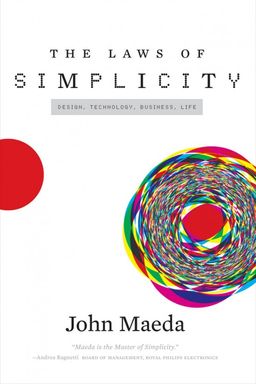
Idea 1
The Art and Logic of Simplicity
When was the last time you felt overwhelmed—by emails, errands, or the endless notifications that fill your day? In The Laws of Simplicity, MIT professor and designer John Maeda argues that in an age saturated with technology and information, simplicity isn’t just a luxury—it’s a necessity. But simplicity, he reminds us, isn’t about making things dumb or plain. It’s about subtracting the obvious and adding the meaningful.
Maeda’s vision of simplicity is born from the intersection of design, technology, business, and human life. He invites you to rethink the way you design products, organize your environment, and even live your life. He sees simplicity not as a rejection of complexity but as its companion—a force that organizes, clarifies, and reveals what truly matters. In fact, simplicity and complexity need each other, just as stillness defines movement and silence defines sound.
Why Simplicity Matters Now
As Maeda points out in his opening chapter, “Simplicity = Sanity.” Technology has made our lives fuller yet left many of us feeling burdened rather than liberated. The constant barrage of updates, services, and tools leads to what he calls digital overload. Through his research at MIT’s Media Lab and his collaboration with major corporations, Maeda set out to rediscover how simplicity could be a design principle, a business strategy, and a way of life.
The world rewards efficiency, and yet simplicity can appear inefficient. Reducing features may seem like taking value away, but Maeda flips that logic: when carefully designed, fewer options yield greater clarity, beauty, and usability. This paradox—less is truly more—lies at the heart of the book’s argument. (Compare this with Barry Schwartz’s The Paradox of Choice, which shows how more options make us less happy.)
The Ten Laws and Three Keys
Maeda distills his philosophy into ten laws of simplicity and three guiding keys. Each law builds upon a design philosophy that can also be applied to management and everyday life. The first three laws—Reduce, Organize, and Time—address basic ways to make systems and decisions simpler through thoughtful elimination, structure, and efficient use of time. The next set—Learn, Differences, and Context—dives deeper into how knowledge, contrast, and environment shape our sense of simplicity. Finally, the last trio—Emotion, Trust, and Failure—confronts the human dimensions: how emotion and imperfection create authentic simplicity rather than sterile minimalism. The book culminates in Law 10: The One—“Simplicity is about subtracting the obvious and adding the meaningful.”
Complementing these are the Three Keys for the future of technology—Away, Open, and Power: moving complexity out of view (as in cloud computing), opening systems to collaboration (as in open-source development), and reducing energy use to maximize value. Together, these insights form a design manifesto rooted in both technology and empathy.
Simplicity as a Human Art
What makes Maeda’s approach unique is how human it feels. While his background is steeped in technology, he constantly brings us back to ordinary experience—the feel of writing a letter, waiting at the airport, enjoying sushi. He reminds us that design isn’t only about shaping products but about shaping relationships—with objects, systems, and other people. For example, in Law 8: Trust, he reflects on the comfort of leaning back into water when learning to swim—a metaphor for trusting the systems that support us.
This thread of humanity runs through the book: simplicity isn’t sterile perfection but a balance of efficiency, empathy, and intention. Maeda compares a clean Apple product design to his mother’s colorful home decor. Both are valid expressions—because more emotions are better than less. Simplicity, he argues, must make room for joy, warmth, even chaos.
A Philosophy for the Mind and Marketplace
Maeda connects the aesthetic of simplicity to its strategic and economic power. “Simplicity sells,” he notes, pointing to the success of Apple and Google, whose minimalist designs hide immense complexity underneath. Just as in technology or business, clarity persuades, and ease builds loyalty. Through stories from his experiences advising companies like Philips, he shows how simplicity can shape entire organizations, not just objects.
Ultimately, simplicity is both an ideal and a practice. You don’t just declutter your room once—you cultivate simplicity daily through choices about what to keep, what to remove, and what to highlight. The book is a meditation on how making those choices mindfully can restore the equilibrium between human needs and technological ambition.
Key Principle
“Simplicity is about subtracting the obvious, and adding the meaningful.”––John Maeda
If you’ve ever longed for a saner, cleaner, more graceful interaction with the world, Maeda’s The Laws of Simplicity offers not just design guidance but a philosophy of living—one that balances the beautiful tension between minimal form and maximal humanity.