
Idea 1
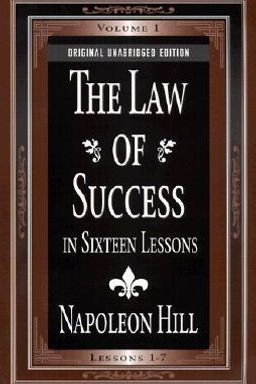
The Law of Success: Organizing Mind into Power
How can you deliberately bring success under your control? In The Law of Success, Napoleon Hill argues that prosperity obeys definite principles — mental, social and ethical laws that anyone can learn. Through his research with some of the most influential people of his era — Andrew Carnegie, Thomas Edison, Henry Ford, and hundreds of business leaders — Hill concluded that success is not luck but organized thought harmonized with cooperative action.
Hill’s central claim is that thought is power. When properly focused through definite purpose, imagination, autosuggestion, and persistence, thought transforms into organized results. The book treats the mind not as abstract “spirit” but as a real engine: it emits vibrations, attracts matching conditions, and shapes circumstances through sustained concentration and cooperation. The fifteen laws he describes form a practical blueprint that raises the frequency of your mental effort until it converts potential into achievement.
The structure and underlying logic
Each law builds upon the one before. Desire initiates motion; Definite Chief Aim directs it; Self‑Confidence fuels persistence; Initiative and Leadership convert decision into momentum; and the Master Mind multiplies power through harmony. Later laws refine control: Habit, Accurate Thought, Concentration, Tolerance and Self‑Control prevent leakage, while Saving, Enthusiasm, Cooperation and the Golden Rule make success ethical and sustainable. You begin as an individual shaping your inner world and end as a leader transforming communities.
Mind as energy and imagination as bridge
Hill unites early twentieth‑century science and psychology. Thought, he says, vibrates as real energy. The brain is both transmitter and receiver; through imagination and autosuggestion you tune it to exact frequencies of your desire. This explains why intuition often brings coincidences, solutions or people that push you forward. Imagination is not fantasy — it is constructive visualization that impresses your subconscious, the part of the mind that acts automatically once properly instructed.
The cooperative dimension
Personal will power alone rarely creates enduring success. Hill’s concept of the Master Mind — the blending of several minds in perfect harmony around a shared goal — introduces the social structure of achievement. Carnegie’s steel empire, Ford’s manufacturing revolution and Edison’s creative partnerships all operated as networks of organized intelligence. In such alliances, individual egos subside and collective insight multiplies. A team united by friendship and definite purpose generates an electromagnetic-like field of ideas and confidence that far exceeds any single contribution.
Moral and emotional control
Hill constantly warns that the same mental power which builds fortunes can destroy character if misused. Enthusiasm must be balanced by self‑control; confidence must rest on tolerance; leadership must rule through cooperation, not coercion. The Golden Rule — to treat others as you wish to be treated — acts as both moral compass and energetic governor: every thought and deed returns multiplied. Success without ethics, Hill says, leaves spiritual bankruptcy just as debt leaves financial ruin.
A philosophy of action and habit
Practicality defines Hill’s method. He urges you to convert every idea into daily routine — writing a clear chief aim, repeating affirmations aloud, taking one initiative each day, saving habitually, controlling emotions and forming alliances. His motto could be summarized as “faith organized through persistent action.” The laws integrate psychology, business discipline and ethics into one system where belief, initiative, and cooperation yield measurable progress.
(Parenthetical note: modern readers recognize Hill’s ideas as precursors to contemporary self‑help and performance psychology — from cognitive conditioning and visualization studies to leadership training and organizational strategy. His genius lies not in mystical speculation but in translating intangible forces of thought, emotion and morality into applied technique.)