
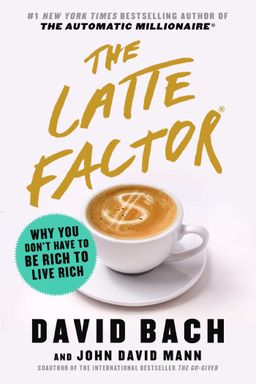
The Latte Factor cover

The Latte Factor

by David Bach, John David Mann

The Latte Factor tells the inspiring journey of Zoey, a young woman who learns that financial freedom is within reach with small, consistent actions. Guided by a wise mentor, she uncovers simple secrets to transform her financial life and live richly now and in the future.

You Don’t Have to Be Rich to Live Rich

What if achieving financial freedom and living your dream life started not with some massive inheritance, lottery win, or Silicon Valley IPO—but with a single cup of coffee? In The Latte Factor, bestselling author David Bach (with coauthor John David Mann) argues that you don’t need to be rich to live rich. Instead, you only need to change how you see money—and how you see yourself. Through the story of Zoey Daniels, a 27-year-old underpaid, overworked editor in New York City, Bach shows that small choices made consistently over time can completely transform your financial and personal life.

Bach introduces a simple but powerful metaphor: the Latte Factor—that is, the trivial daily expenses we tell ourselves are harmless, whether it’s a latte, a muffin, or an impulse buy. These small ‘latte-sized’ leaks, when redirected into savings and investments, can snowball into significant wealth through the power of compound interest. Behind this idea lies a broader psychological truth: most of us sabotage our chance for freedom not because we don’t earn enough, but because we don’t manage what we already have. By reframing everyday spending decisions, you can align your financial behavior with your true values and dreams.

A Story-Based Approach to Financial Freedom

Unlike traditional financial guides loaded with jargon and spreadsheets, The Latte Factor reads like a fable. Through Zoey’s conversations with an old barista named Henry, a retired architect and quiet millionaire, Bach delivers timeless lessons in the language of daily life. Each morning coffee run becomes a classroom where Henry unveils the “Three Secrets to Financial Freedom”: (1) Pay yourself first, (2) Don’t budget—make it automatic, and (3) Live rich now. Zoey’s awakening from financial anxiety to empowerment mirrors the journey Bach invites every reader to take.

Through vivid scenes—New York subways, the World Trade Center’s Freedom Tower, a quiet Brooklyn café—readers see how financial insight connects to meaning and purpose. The story’s emotional weight deepens when Zoey’s mother falls fatally ill, reminding us that wealth isn’t about numbers on a balance sheet but the freedom to live a full, regret-free life. Bach’s message resonates far beyond dollars and cents: managing money well is truly about managing life well.

The Philosophy Behind the Latte Factor

Bach’s philosophy challenges a widespread myth: that money is the key to happiness, and happiness will arrive once we ‘make it.’ Instead, he asserts that true wealth begins with awareness—recognizing that every small choice either builds your future or steals from it. The Latte Factor is a symbol of personal agency. The moment you say, “I can’t afford it,” you surrender your power. As Henry teaches Zoey, it’s never really about the latte—it’s about looking closely at where your time, attention, and energy are leaking away, and reclaiming it for what truly matters.

Financial freedom, Bach explains, doesn’t require complexity or extraordinary effort—it requires simplicity and consistency. By starting small, automating savings, and letting compound interest do the heavy lifting, anyone can achieve independence and peace of mind. The story ultimately threads financial advice with a spiritual and emotional journey: the courage to say “yes” to life, just as Henry said “yes” to the photograph titled “Yes” —a symbol of embracing purpose over paycheck.

Why It Matters

Bach’s argument could not be timelier in an era of instant gratification and financial anxiety. Millions struggle under debt, consumer pressure, and the myth of “not enough.” The Latte Factor reframes financial control as a daily act of mindfulness and self-respect. It demonstrates that the true barrier isn’t external—it’s internal: our lack of clarity, our ingrained habits, and our willingness to postpone living our dreams. Bach’s call to “Live Rich Now” is a rallying cry for anyone who believes freedom must wait until retirement.

“You are richer than you think,” Henry reminds Zoey. This single line captures the entire spirit of the book—a reminder that abundance begins not with income, but with insight and intention.

By blending practical finance, personal growth, and storytelling, Bach crafts a guide that empowers you to take small, decisive steps toward a life of purpose and joy. The Latte Factor isn’t just about money—it’s about waking up to the extraordinary possibilities hidden in the ordinary moments of your day.


Pay Yourself First

The first and most transformative of Henry’s lessons to Zoey is deceptively simple: Pay Yourself First. At first, this sounds like an obvious platitude—something everyone has heard but few understand. Through an intimate conversation over coffee, Henry reframes the idea entirely. Paying yourself first means the first person who receives a portion of your earnings should be you—your future self—not your landlord, your credit cards, or Uncle Sam.

Zoey, like many of us, assumes she’ll save once she “earns more.” But Henry dismantles that logic: if you don’t save while you earn a little, you won’t save when you earn a lot. As your income rises, so do your expenses—unless you decide to change the pattern. Bach backs up this message with striking statistics about how most Americans live paycheck to paycheck, not due to low income but due to lifestyle inflation.

The Mathematics of Freedom

Henry uses a tangible example: saving $5 or $10 a day—about the price of Zoey’s daily coffee habit. With compound interest at 10%, that small daily choice grows into nearly $1 million over forty years. The math is symbolically simple but emotionally profound. It shows how consistent small efforts, not dramatic windfalls, build real freedom.

“Why would you work all day and not keep even an hour’s pay for yourself?” Henry asks Zoey. This reframing changes saving from deprivation into self-respect.

Henry suggests starting with “one hour of your daily income” as a baseline. For Zoey, this equals about $25 per day, producing over $3 million in forty years. The numbers are symbolic, but the principle is actionable: you can achieve wealth by carving out your first slice before anyone else takes theirs.

The Psychological Shift

Paying yourself first is ultimately a mental and emotional reorientation. It challenges the self-sacrificing belief that “good people think of others first.” Henry’s metaphor of the airplane oxygen mask—put your own mask on first—captures the lesson perfectly. Unless your own financial oxygen is secure, you can’t help others, pursue your dreams, or live meaningfully. This aligns closely with ideas from books like Your Money or Your Life (Vicki Robin) and The Psychology of Money (Morgan Housel): that financial independence is as much about awareness and self-prioritization as it is about math.

In the end, Zoey learns that “pay yourself first” isn’t a budgeting trick—it’s a philosophy of self-worth. It’s a declaration that your dreams deserve to be funded before your distractions. That mindset shift marks the beginning of her transformation from stressed editor to empowered creator of her own freedom.


Don’t Budget—Make It Automatic

The second secret Henry teaches Zoey demolishes one of the most entrenched personal finance myths: that successful money management requires strict budgeting. In reality, Bach argues, most people hate budgets and almost no one sticks to them. Instead of relying on willpower, the solution is to remove willpower from the equation entirely.

Henry and his friend Baron (a reformed oil executive) explain that even the government learned this trick. Taxes are automatically deducted from paychecks because, if people had to manually send in money every month, almost no one would remember—or have the discipline—to do it. Bach’s insight is that you can apply the same principle to your own wealth creation.

Automation: The Lazy Person’s Discipline

Henry teaches Zoey to set up automatic withdrawals into savings and investment accounts that occur the same day her paycheck is deposited. She doesn’t even “see” the money, and therefore doesn’t miss it. This is the genius behind Bach’s earlier bestseller The Automatic Millionaire: lasting financial success doesn’t depend on discipline; it depends on systems. Once you automate savings into a 401(k), IRA, or an automatic transfer to a separate “freedom” account, you simply let time and interest handle the rest.

“You can’t spend what isn’t in your account,” Henry says. “Automation turns good intentions into guaranteed actions.”

Bach shows how this method beats traditional budgeting because it requires zero ongoing effort. Budgets, like diets, often fail—they fight human nature. By automating savings before you even have a chance to spend, you align your system with human behavior instead of fighting it.

Tax-Deferred Growth and Compounding

Zoey also learns the powerful difference between post-tax and pre-tax investing. In a standard account, your funds are taxed every year as they grow. In a tax-deferred account like a 401(k), your money compounds untouched—nearly tripling over time. Henry illustrates this with clear back-of-the-napkin math: investing $100,000 at a 10% return grows to about $661,000 in a taxable account, but to more than $1.7 million in a tax-deferred one. This vivid visualization helps Zoey see the power of compounding not just as math, but as momentum.

By automating her saving and harnessing pretax growth, Zoey begins to see her future not as a source of fear, but of quiet inevitability. Freedom isn’t something she’ll fight for daily—it becomes something she designs once and enjoys for decades.


The Latte Factor Explained

At last, Henry reveals the idea that gives the book its title—The Latte Factor. When Zoey worries she can’t afford to save, Henry sets down a five-dollar bill and points to her latte. That single, trivial expense symbolizes the unconscious habits draining people’s wealth and potential every day.

The Latte Factor isn’t literally about coffee—it’s a metaphor for the small, automatic expenses that keep you stuck. Henry helps Zoey total her daily costs: her morning latte and muffin, $7; her organic juice, $7; lunch in the cafeteria, $14; bottled water, $1.50—a total of nearly $30 a day. Redirected into investments, those daily dollars could grow into millions through compound interest. Zoey is stunned when she calculates her total: over $4 million in forty years, even at modest interest rates.

Why the Latte Factor Works

This concept succeeds because it targets mindset, not math. We constantly tell ourselves, “It’s just a few bucks.” But repeated daily spending is powerful—just like daily saving. By identifying our “latte factors,” we expose the hidden ways we trade long-term freedom for short-term convenience. Henry emphasizes that it’s not about deprivation—it’s about choice. You can still enjoy luxuries, as long as you consciously decide where your money goes after you’ve paid yourself first.

“The latte factor isn’t about being a penny-pincher,” Henry tells Zoey. “It’s about getting clear on what matters.”

From Wasted Money to Empowerment

Once Zoey lists her “latte factors,” she realizes she’s been draining not only her money but her energy. Brew coffee at home, bring lunch three days a week, skip unused subscriptions—these changes add up to opportunity, not sacrifice. Bach makes the point universal: anyone, from students to CEOs, can uncover thousands of dollars a year just by noticing their habits.

By reframing daily spending as a choice between consumption and creation, The Latte Factor elevates financial awareness into personal empowerment. The latte becomes a lens through which we learn to say “yes” to what truly matters—freedom, security, and self-respect.


Rethinking Wealth: Renters vs. Owners

When Zoey doubts Henry’s authority—after all, isn’t he just an old barista?—he surprises her with his backstory. Henry owns the coffee shop and several nearby buildings. He explains the deeper philosophy behind financial independence: everyone builds wealth, but the question is for whom.

Each day, your spending decisions make you either a renter or an owner. Renters let life happen to them; owners take a hand in shaping it. Henry illustrates this by describing how, while other local cafés protested Starbucks’ arrival, he bought Starbucks stock. Now when customers buy a latte at either his shop or Starbucks, Henry earns something. Ownership creates leverage—and leverage creates freedom.

This moment shifts Zoey’s understanding of wealth from consumption to participation. Owning assets—whether real estate, stock, or your own business—means turning your money into something that works for you rather than the other way around.

The Choice of Ownership

You can choose to rent your lifestyle or own your future. When you rent—whether it’s your apartment, your job, or your time—you’re paying for short-term convenience at the cost of long-term autonomy. Ownership changes that equation. As Bach argues, the key decision isn’t between risk and safety but between temporary comfort and lasting security.

By replacing passive consumption with active ownership, Zoey begins to shift her mindset from dependency to design. She learns that financial independence is less about income level and more about structure: about setting up systems that make her an owner in her own life story.


Myths of Money

One of the most practical sections in The Latte Factor comes when Zoey’s boss, Barbara, delivers a crash course in what she calls “The Myths of Money.” These myths keep otherwise capable people trapped in financial stress. Bach uses Barbara’s voice to unpack three core misconceptions that mirror modern culture’s financial neuroses.

Myth #1: More Money Will Make You Rich

Most people believe that income is the solution to their financial problems. But Barbara dismantles this myth: you don’t have an income problem; you have a spending problem. Earning more without changing your habits only amplifies dysfunction. As she bluntly puts it, “You just take whatever money problems you have and make those bigger too.” (Note: This insight parallels Charles Duhigg’s ideas in The Power of Habit about changing systems, not outcomes.)

Myth #2: It Takes Money to Make Money

Barbara shows Zoey that wealth-building isn’t exclusive to those who already have capital. Compounding begins with as little as $5 a day. Saying “I’ll invest when I have extra” guarantees you never will. Financial independence starts with action, not windfall. This myth keeps people waiting for luck rather than leveraging the time they already have.

Myth #3: Someone Else Will Take Care of You

The most emotionally charged myth addresses dependence—the belief that a spouse, employer, or government will protect you. Barbara emphasizes that financial security is self-created. No knight in shining armor is coming. Women, especially, are vulnerable to this delusion; statistically, most will outlive their partners yet earn less and save less due to systemic inequality. Bach uses Barbara’s sober realism to drive home responsibility as empowerment: wealth, like health, doesn’t maintain itself. You must be your own caretaker.

Bust these myths, Barbara insists, and the entire financial landscape opens. Freedom isn’t dependent on outside circumstances; it’s built through daily self-honesty and small, consistent choices.


Live Rich Now

The final and most inspiring of Henry’s three secrets completes the circle: Live Rich Now. After absorbing practical lessons on saving and automation, Zoey learns that financial freedom is meaningless if you postpone happiness until retirement. Living rich now means aligning your daily life with your core values—not waiting until your 60s to start living.

When Henry asks Zoey what gives her “flat-out, unbridled joy,” she recalls childhood moments on a boat off the coast of Maine: the sense of freedom, adventure, and beauty. He helps her see that these aren’t luxuries—they’re her values. The true purpose of money is to fund those values, not to replace them. This realization reframes wealth from accumulation to alignment.

“Without the third secret,” Henry says, “the first two won’t work—because you won’t do them.”

Living rich now doesn’t mean reckless spending; it means consciously directing your money toward experiences and growth that make life richer today. For Zoey, this means taking photography lessons, traveling, and eventually negotiating time off to explore the world. By acting on her values, she stops using money as an excuse and starts using it as a tool.

Ultimately, Bach’s message is healthy and holistic: Financial freedom isn’t an end state—it’s a practice of living intentionally now. Just as Henry’s photograph “Yes” captured a sunrise filled with golden light, Zoey learns to say yes to a life illuminated by purpose, not fear. This is the true essence of The Latte Factor: wealth isn’t about having more; it’s about being more, today.

Dig Deeper

Get personalized prompts to apply these lessons to your life and deepen your understanding.

Go Deeper

Get the Full Experience

Download Insight Books for AI-powered reflections, quizzes, and more.