
Idea 1
Earl Weaver and Baseball’s Systems Revolution
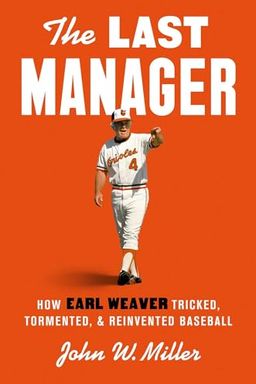
A manager who turned charisma into a system
How do you win in a game where chance, personalities, and tradition collide? In this book, the author argues that Earl Weaver solved that riddle by turning a manager’s job from ringmastering into systems design. He bridged eras: from the mid‑century myth of the all‑powerful field boss to the late‑century rise of front offices, analytics, and player autonomy. You watch a showman who loved theatrics and hot‑mics become, paradoxically, the architect of a repeatable machine—the Oriole Way—built on scouting, development, probabilistic thinking, and codified rules for pitching, defense, and offense by chunks.
Weaver looks like a contradiction: he smokes in the dugout and pantomimes ejecting umpires, yet he also counts pitches, archives matchups, and treats out management like a calculus problem. That paradox is the point. He is both the last great celebrity manager (think the 1982 curtain call at Memorial Stadium and a 1983 Playboy profile) and the first to manage like a data‑age operator. His three‑pronged mantra—pitching, defense, and three‑run homers—becomes a decision framework, not a slogan.
What changes under Weaver
The book shows you how Weaver, drawing on mentors (George Kissell, Andy Cohen), minor‑league crucibles (Elmira with Jack Crandall’s box‑score compilations), and even St. Louis’s gambling culture via Uncle Bud, evolves into a probabilistic thinker. He values on‑base percentage before it’s fashionable, protects the twenty‑seven outs like a hoarder of rare currency, and manages rosters to maximize expected value over 162 games. He makes defense a practiced weapon (Mark Belanger, Brooks Robinson, Paul Blair), pairs it with strike‑throwing, speed‑changing pitchers (Jim Palmer, Mike Cuellar, Dave McNally, Pat Dobson), and treats matchups as everyday engineering—the bench becomes a substitution machine that creates a platoon edge in 64% of plate appearances in 1977.
Crucially, Weaver builds inside an organization that already thinks systematically. The Orioles—via Paul Richards, Jim McLaughlin, and Harry Dalton—industrialize scouting and development at Thomasville’s Bird’s Nest: standardized drills, cross‑checks, daily grading, and swift cuts. That pipeline produces durable stars who fit the manager’s framework (Eddie Murray, then Cal Ripken Jr.). What fans call "Orioles Magic" rests on deliberate process design.
Low‑tech analytics before the data deluge
Weaver doesn’t wait for computers. He deploys small tools that matter: Danny Litwhiler’s early radar gun to read fatigue; Charley Bree charting velocities; Bob Brown’s printed matchup sheets; Pat Santarone’s groundskeeping tweaks to favor Baltimore’s profile; and JUGS curveball machines to simulate spin in 1975. He runs micro‑experiments—corked‑bat tests for batting practice, velocity differentials for changeups—and tosses fads that measurement fails to validate. You learn a usable lesson: measure the few signals that predict outcomes, then change behavior right away.
Core credo
"Your most precious possession on offense are your twenty‑seven outs." Everything else—no‑bunt bias, play‑for‑the‑big‑inning, and platoon usage—flows from that line (a gambler’s expected‑value instinct).
Theater that serves performance
You also meet Weaver the performer. The 96 ejections, the famous 1977 Don Denkinger pantomime, the hot‑mic showdown with Bill Haller in 1980—these aren’t random outbursts. They are ritual, a way to concentrate pressure on the manager, protect players, and electrify Memorial Stadium. Inside the clubhouse, the "Kangaroo Court" turns mistakes into humor and accountability. The risk is reputational blowback when spectacle outruns substance (as with a 1972 spit at a reporter), but for years the results protected him.
Arc, limits, and legacy
By 1982, as free agency shifts power to players and analytics to front offices, Weaver retires at a high, then returns in 1985 for money and loyalty, only to find the fit and energy gone. The collapse of 1986 is instructive: good ideas need timing, aligned structures, and a willing operator. Yet the legacy endures—he coauthors the simulation Earl Weaver Baseball (1987) with Trip Hawkins, Don Daglow, and Eddie Dombrower, encoding his matchup rules, park effects, and substitution logic. That game becomes a gateway to analytic thinking for a new generation (Nate Silver later praises its depth).
Take the book as a field manual for managing under uncertainty. You build a system (the Oriole Way), prioritize the right variables (outs, run prevention, chunk scoring), use low‑cost measurement (radar, charts), and lead with theater calibrated to human psychology. Then, when roles change historically, you translate craft into code so principles survive your tenure. (Note: This arc echoes Moneyball’s thesis, but predates it, placing Weaver as a practical progenitor rather than a theorist.)