
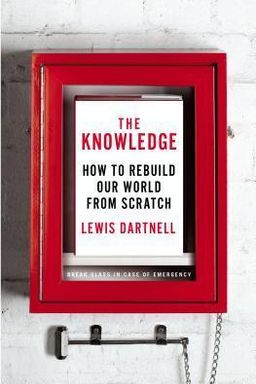
The Knowledge cover

The Knowledge

by Lewis Dartnell

The Knowledge offers a comprehensive guide to surviving and thriving in a post-apocalyptic world. From securing basic needs like shelter and food to advancing industrial capabilities, Lewis Dartnell provides the essential tools and knowledge to rebuild civilization from the ground up. Embrace resilience and innovation in the face of disaster.

The Blueprint for Rebooting Civilization

When the world collapses, what remains? Lewis Dartnell’s The Knowledge: How to Rebuild Our World from Scratch begins with one critical question: how can you restart civilization if all infrastructure, industry, and expertise vanish? Dartnell’s argument is deceptively simple but profound—you don’t preserve every detail of modern science; you preserve the fundamental principles and practical pathways that allow survivors to re‑create it.

Principles Over Encyclopedias

Instead of printing the entirety of Wikipedia or a world library, Dartnell advocates for a condensation of high‑leverage concepts. He borrows from Richard Feynman’s atomic hypothesis—“All things are made of atoms”—as proof that one kernel can unpack whole domains of knowledge. The goal is a seed of civilization, not an archive. That seed includes core scientific principles (atoms, germs, electricity), step‑by‑step practices that make them actionable, and simple experiments that lead to rediscovery.

You should think of this manual not as a static compendium but as a roadmap—showing what to prioritize first (food, water, shelter), and then how to rebuild technological capabilities layer by layer. Dartnell frames it as a realistic survival guide rather than science fiction: a plan for practical rebirth.

From Grace Period to Sustainable Systems

The starting point is the grace period—a brief window when scavenged food, medicine, and fuel from pre‑collapse cities remain usable. Your first challenge is strategic scavenging: preserve seeds from supermarkets and gene banks, reclaim essential tools, and then retreat from unlivable cities to rural farms. Dartnell warns that urban decay, pestilence, and disorder will follow swiftly; sustainability requires rural, self‑contained settlements near clean water and arable land.

Examples from history reinforce the lesson. Survivors during the Bosnian siege built floating hydropower rigs using car alternators; Cubans kept vehicles alive for decades by improvising parts from junkyard stock. These cases illustrate Dartnell’s recurring idea: creativity plus scavenging bridges the gap to independence.

Rebuilding the Foundations

Civilization rests on agriculture, chemistry, metallurgy, and power. Dartnell teaches how to make soap from ash and fat, lime from heated limestone, and charcoal by pyrolysis—all low‑tech processes that unlock sanitation, construction, and chemical synthesis. He reconnects readers to the stepwise technologies—seed drills, plows, waterwheels—that once drove industrial revolutions. You learn how soil fertility depends on legumes and crop rotation; how nitrogen fixation (via the Haber‑Bosch process) can free agriculture from dependence on fallow cycles or guano; and how soda (sodium carbonate) sustains glassmaking and paper.

Power generation evolves similarly: from mechanical waterwheels and windmills to steam turbines and electricity grids. Overshot waterwheels, Pelton turbines, and scavenged car alternators provide practical means for early electricity. The crucial leap comes with alternating current and transformers, enabling long‑distance energy distribution—an engineering insight that separates village survival from national recovery.

The Scientific and Social Rebirth

Once agriculture feeds people and energy powers tools, you can respark science itself. Dartnell emphasizes microscopy and germ theory to reignite medicine: seeing microbes explains disease prevention and antibiotic discovery. Glassmaking supports lenses for telescopes, microscopes, and photographic plates, restoring observation and record‑keeping. Printing presses—born again through alkaline paper pulping, iron‑gall ink, and movable type—allow knowledge to spread reliably. Telegraphs, radios, and clocks synchronize people across space and time, reweaving the social fabric.

At its heart the book isn’t just technical—it’s philosophical. Dartnell insists on the scientific habit: measure, test, iterate. Civilization doesn’t depend on memorizing facts but on fostering curiosity and method. From sundials to sextants, from soap recipes to power grids, each technology embodies human inquiry. Recovering that mindset means civilization is never truly lost—it can always be rebooted.

Core takeaway

You cannot save every book. But you can save the knowledge that creates books—the chain of experiment and discovery that rebuilds civilization from mud and fire to microchips and radio waves.

Through chemistry, engineering, agriculture, and science, Dartnell’s vision is not nostalgia but empowerment. With the right knowledge seed, even a shattered world holds the code to regenerate itself.


Survival, Scavenging, and Strategic Relocation

Your immediate goal after a collapse is survival. Dartnell calls this the “grace period,” the time when remnants of modern society—food, fuel, antibiotics, and machinery—can be salvaged before they decay. He likens cities to transient treasure vaults: supermarkets provide calories for years, pharmacies yield medicines and antiseptics, and libraries hold repair manuals and scientific texts.

How to Use the Grace Period

You must prioritize scavenging sensibly: consume perishables first, secure durable rations (rice, grains, canned food), and extract usable fuels. Gasoline and diesel degrade quickly, so use them while establishing renewable sources. Batteries and alternators can be extracted from cars to create improvised power generators—Bosnians during the Goražde siege demonstrated that salvaged car parts can produce reliable hydroelectric systems without a national grid.

Leaving the City Behind

Urban centers become hostile once sanitation fails. Dartnell advises relocating to old rural buildings with chimneys, fertile land, and clean groundwater. Think of cities as salvage cores: survivors occupy rings around decaying urban centers, venturing within only to recover materials. Hygiene becomes paramount—handle human waste with composting and biogas digesters to reclaim energy safely while destroying pathogens.

Early priorities

Identify food, medicine, clothing, and fire-starting tools. Scavenge metals and batteries for power setups. Establish clean water—and sanitation systems—before urban decay sets in.

(Historical parallels: post-Hurricane Katrina New Orleans showed how order collapses in days without governance. Dartnell’s strategy—graceful scavenging, moving outward, then building rural resilience—is a structured antidote to chaos.)


Agriculture and Soil Renewal

After survival, food security defines civilization. Dartnell lays out a concise agricultural reboot: recover seeds, cultivate fertile soil, and maintain nutrients through rotation and waste recycling.

Seeds and Varieties

Modern hybrid seeds don’t breed true, so prioritize open-pollinated heirloom varieties. Locate institutional seed banks such as the Svalbard Global Seed Vault or national repositories to recover viability. Dry, cool storage extends lifespan exponentially, making these caches crucial for multi-generational farming.

Understanding and Restoring Soil

Soil health depends on texture and organic cycling. Dartnell advises practical testing—a jar sediment test reveals proportions of sand, silt, and clay. Loam gives ideal balance. Fertility comes from recycling waste: legumes fix nitrogen; composted manure restores minerals; and rotations prevent depletion. His model—Norfolk four-course rotation—integrates legumes, cereals, roots, and fodder crops to sustain productivity indefinitely.

Improving and Storing Yields

Simple tools—seed drills, hoes, sickles—enable mechanization at village scale. Grain drying and sealed storage prevent fungal spoilage. Integrating livestock closes nutrient loops and allows advanced uses such as biogas recovery from waste. Experienced farmers soon produce enough surplus to free others for craft and study—the foundation of specialized labor.

Key agricultural insight

Stable food systems precede all technological recovery. Feed people first, and civilization follows.

(Note: Dartnell matches historical transitions—from medieval fallow systems to Enlightenment rotations—demonstrating how small innovations compound into sustained productivity.)


Chemistry for Daily Life

Civilization rises on chemistry. Dartnell highlights a handful of key substances that unlock sanitation, construction, and craftsmanship: lime, soap, potash, charcoal, and distilled compounds.

Lime and Alkalis

Calcining limestone (>900°C) releases quicklime; adding water forms slaked lime—an essential for plaster, mortar, and disinfection. Combine slaked lime with wood-ash potash to create lye, a strong alkali vital for soap production. Soap from ash and fat transforms public health: it prevents infection, enabling sustained communities.

Pyrolysis and Distillation

Burning wood in absent oxygen yields charcoal and volatile chemicals—acetic acid, methanol, creosote—substances crucial for preservative and fuel use. Distillation, the art of separating fluids by boiling point, becomes universal: purify alcohol for disinfecting and fuel, refine tar for solvents, and later split crude oil into usable fractions. Mastering distillation teaches process control—the stepping stone to industrial chemistry.

Industrial-Scale Chemistry

Scaling up leads to two pivotal processes: Solvay’s soda production (turning salt and limestone into sodium carbonate using recycled ammonia) and Haber-Bosch nitrogen fixation (converting atmospheric nitrogen into ammonia). These industrial syntheses break geographic limitations: they fuel agriculture and glassmaking, and provide fertilizers and explosives. Learning them marks humanity’s escape from scarcity chemistry to abundance chemistry.

Essential lesson

Rebuild chemistry in stages—from soap and lime to industrial syntheses—and you transform mud and ash into medicine, metal, and modern life.

(Comparatively, this mirrors Vaclav Smil’s historical account of energy and chemistry transitions—the same chain that created modern prosperity.)


Power and Engineering

Energy underwrites every technology. Dartnell divides power into three intertwined forms: mechanical, thermal, and electrical. Each stage builds capacity to convert available resources into motion and light.

Mechanical Foundations

Waterwheels and windmills harness natural forces reliably. Overshot wheels maximize hydraulic efficiency, while geared windmills generate rotational motion for milling and pressing. These simple machines set the template for later turbines and electric generators.

Steam and Heat

Charcoal supplies concentrated heat for smelting and for driving steam engines. Dartnell recaps how primitive steam devices paved the way for industrial power—external combustion engines that can run on any fuel. Today’s combined heat-and-power systems, like Denmark’s biomass plants, exemplify high-efficiency adaptation (waste heat warms homes while generating electricity).

Electricity and Distribution

Salvage alternators and batteries first, but aim for local renewable generation: micro-hydro (Pelton or cross-flow turbines), wind, or solar. The crucial advance is alternating current with transformers—transmitting power at high voltage and low current drastically reduces losses and enables regional grids. Understanding this principle means you can restore electrical civilization even at village scale.

Engineering takeaway

Match the technology to your resources: simple turbines before steam plants, local DC circuits before national AC grids. Robustness beats complexity in a fragile reboot.

(Historical note: Charles Francis Brush’s 1887 wind generator exemplifies how modest mechanical systems can electrify homes—small scale precedes large networks.)


Metallurgy, Fabrication, and Glass

Metals and glass form civilization’s skeleton. Dartnell explains not only how to smelt and shape materials but why these crafts multiply technological capability.

Iron and Steel

Smelt iron ore with charcoal and limestone in a bloomery to yield wrought iron; advance to blast furnaces and Bessemer converters for steel. Each step demands higher heat control and airflow engineering. Once you have steel tools, you can build everything else—the defining feedback loop of progress.

Workshops and Machinists

For fabricating parts, start with a bucket foundry and sand molds; progress to forges and lathes. A lathe is civilization’s multiplier—it can make parts for itself and other machines. This recursive tooling capability sparks industrial self-replication.

Glass and Optics

Glassmaking—melting silica with soda and lime—enables laboratory vessels and optics. Lenses empower microscopes, telescopes, and cameras, expanding knowledge beyond naked perception. Without glass, you can’t see microbes, measure starlight, or transmit data—the essence of science depends on transparency.

Core message

Mastering metal and glass is mastering civilization’s instruments—tools, lenses, and machines amplify human ability far more than any store of scavenged goods.

(Parallels with James Burke’s Connections: each technological material—iron, glass—links chains of innovation across centuries.)


Medicine and the Microbial Revolution

When lives are fragile, knowledge of germs saves more than heroics. Dartnell walks you through rebuilding public health from first principles: sanitation, clean water, and basic microbiology.

Preventive Medicine

Handwashing and soap cut infection rates drastically. Treat diarrhea with oral rehydration: water, sugar, and salt—a formula that saves millions even today. Use boiling, filtration, or solar disinfection for clean water. These low-tech actions produce enormous survival gains.

Seeing Disease

Recreate microscopes with ball lenses and agar from seaweed to culture microbes. Observation reveals pathogens and allows crude antibiotic rediscovery. Fleming’s penicillin story becomes a model for citizen science under collapse—observe inhibition zones and extract active compounds.

Surgery and Diagnostics

Asepsis, anesthetics (ether, nitrous oxide), and sterilization allow safe operations. Simple instruments—stethoscopes, thermometers, cuffs—enable diagnostic accuracy. When electricity and glass return, X-rays expand medical vision. Medicine advances from hygiene to science through incremental reconstruction.

Health insight

You don’t need hospitals to save lives; you need hygiene, observation, and persistence—the triad that reinvented medicine once and will again.

(Context: before antibiotics, sanitation alone halved mortality—proof that science begins at the sink, not the laboratory.)


Fuel, Transport, and Mobility

Mobility determines trade and agriculture reach. Dartnell summarizes how to make and adapt fuels when petroleum runs dry.

Liquid Fuels

Gasoline and diesel require fractional distillation and cracking—feasible but limited by crude supply. Bioethanol (via fermentation) and biodiesel (transesterifying oils or fats using alcohol and lye) are viable replacements. Methanol from wood pyrolysis provides the necessary alcohol reagent, closing loops within basic chemistry.

Gaseous Alternatives

Wood gasifiers produce combustible mixtures—common in WWII vehicles. Though bulky, they allow emergency transport using biomass instead of oil. Compressed gas storage, while advanced, can be improvised with textile gas bags.

Engines and Materials

Internal combustion engines follow two modes: spark ignition (gasoline/ethanol) and compression ignition (diesel/biodiesel). Understanding crankshafts, valves, and gears lets you repair existing engines or rebuild simpler versions. Rubber shortages can halt transport—cultivate guayule shrubs as temperate substitutes for Hevea rubber (a WWII solution). When mechanization falters, oxen and horses resume their role as low-energy tractors.

Transport insight

Fuel flexibility equals resilience. Relearning biofuels and mechanical basics keeps trade routes open even when oilfields vanish.

(Parallels: wartime gasifiers and Brazil’s ethanol program prove that preindustrial chemistry supports modern mobility.)


Communication, Time, and Measurement

Information flow rebinds societies. Dartnell describes rebooting telegraphy, radio, and timekeeping—the tools that synchronize civilization.

Telegraph and Radio

Telegraph networks use electromagnets and Morse code for text communication. Radio evolves this into wireless signals using antennas and crystal detectors (galena cat’s‑whisker diodes). Modulation transmits voice by imprinting sound waves onto carriers. Vacuum tubes amplify and stabilize signals, culminating in broadcast and two‑way communication—the dawn of modern media.

Time and Navigation

Rebuilding clocks and sextants restores coordination. Sundials mark local noon; pendulum clocks regulate seconds; sextants and chronometers calculate position. Longitude equals a time difference—the Earth spins 15° per hour. These instruments enable synchronized agriculture, trade, and exploration.

Scientific Habit

More than devices, Dartnell teaches mindset: record, test, refine. Even when tools are crude, disciplined measurement resurrects precision. Observing stars like Barnard’s sets your calendar; repeating experiments recovers lost standards.

Core communication insight

Recreating messaging, timing, and navigation restores cooperation—the invisible web that transforms scattered survivors into society.

(Notes: In WWII POW camps, prisoners built radios from scrap—proof that ingenuity and minimal parts can regain global reach.)


Knowledge Preservation and Cultural Continuity

For all the science, Dartnell ends with culture: preserving knowledge through writing and printing. Civilization depends on memory externalized to paper and ink.

Paper and Ink

Make paper by breaking down cellulose fibers with alkali (slaked lime or potash), rinsing, and pressing into sheets. Produce iron-gall ink from oak galls and iron sulfate—historically resistant to fading. These are simple yet enduring materials; medieval records written this way survive centuries.

Printing and Replication

Gutenberg’s movable type revolution remains achievable: cast letters in sand molds, use oil-based lampblack inks, and repurpose wine presses into printing presses. Printing manuals, crop guides, and scientific diagrams spreads expertise faster than oral teaching. Once print returns, education multiplies exponentially.

Cultural message

Printing is civilization’s self-replication. When you can record and share ideas, science cannot die—it can only restart.

(Note: Dartnell’s finale echoes H. G. Wells’ dream of a “world brain”—a network of shared practical knowledge that ensures continuity across ages.)

Dig Deeper

Get personalized prompts to apply these lessons to your life and deepen your understanding.

Go Deeper

Get the Full Experience

Download Insight Books for AI-powered reflections, quizzes, and more.