
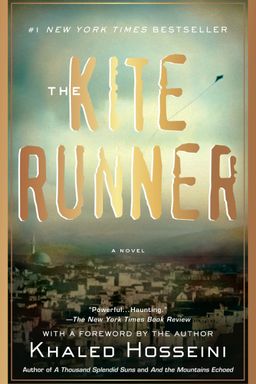
The Kite Runner cover

The Kite Runner

by Khaled Hosseini

The Kite Runner, a best-seller by Khaled Hosseini, delves into the complexities of friendship, betrayal, and the search for redemption. Narrated by Amir, an Afghan in the US, it recounts his childhood in Kabul and a life-changing event. This poignant novel examines the universal themes of guilt, courage, and forgiveness within a rich cultural backdrop.

When Civilization Meets the Primitive: The Horror of History and the Darkness Within

What happens when the ghosts of history, both personal and cultural, refuse to stay buried? Christopher Buehlman’s Those Across the River dives headlong into this question, blending Southern Gothic atmosphere with historical trauma and supernatural terror. Set in the sweltering Georgia summer of 1935, the novel explores not only the collapse of a small town under monstrous forces but also the psychological unraveling of its civilized narrator, Orville Francis Nichols—a war veteran, failed academic, and man haunted by the sins of both family and history.

Buehlman’s story becomes an allegory for how America reckons—or fails to reckon—with its own buried violence. The book probes the boundary between reason and barbarism, the modern and the primal, showing that what lies “across the river” isn’t just monstrous flesh—it’s the human past, festering beneath our genteel veneers.

A Nation of Ghosts: Themes of History and Guilt

At its surface, Those Across the River tells a story about a Northern couple moving South during the Great Depression to make a fresh start. Frank Nichols, disgraced history professor, and his spirited lover Eudora flee scandal and poverty to claim Frank’s inheritance: a crumbling Georgia house linked to his infamous great-grandfather, Lucien Savoyard—a Confederate general and plantation master known for enslaving, torturing, and killing his laborers. Frank intends to write a history of this ancestor, ironically titled The Last Plantation. His decision to move onto this cursed soil sets the entire tragedy in motion, intertwining historical memory with literal horror.

The town of Whitbrow is steeped in inherited dread. For decades, locals have performed a bizarre monthly ritual—the “Chase”—in which pigs are herded across the river and sacrificed to placate what lives in the woods. When Frank and Eudora, modern outsiders armed with Northern liberal rationality, join the community, their skepticism leads the town to discontinue the ritual. It’s a “civilized” decision that unleashes the uncanny—the past asserting itself violently upon the present.

The Civilized Versus the Primal

Much of the book’s tension comes from this clash between Enlightenment rationality and something older, darker, and more elemental. Frank prides himself on being a man of letters, an atheist historian, confident that science and education can make sense of all things. Yet the world he enters operates by superstitions, pagan survival rituals, and racial memory. Like William Faulkner’s Absalom, Absalom! or Flannery O’Connor’s Southern grotesques, the novel’s landscape feels eternal—beautiful yet fetid, alive with both divine and blasphemous energy.

As Frank investigates his ancestor’s plantation ruins, he uncovers not only physical evidence of atrocities but a shadow of himself in Savoyard—the capacity for cruelty that all men inherit. The river that separates the town from the woods becomes a potent metaphor: it divides the living from the dead, reason from madness, and history from amnesia. The true horror is not the creatures who emerge from the darkness but the recognition that “those across the river” are kin: enslaved victims turned revenants, monstrous forms of the guilt and blood debt the modern South tries to forget.

War, Trauma, and the Persistence of Violence

Frank’s own postwar trauma mirrors the psychic wounds of the nation. His flashbacks from the trenches of World War I—gas attacks, mutilations, mangled friendships—are just as disturbing as any supernatural scene. The war broke his faith in reason and progress, leaving him neither fully alive nor dead. In Whitbrow, he finds another battlefield: a Southern microcosm where the past keeps re-enacting its carnage. The woods’ horrors externalize his PTSD—the mutilated soldiers become the mutilated revenants who haunt the forest.

Eudora, his lively and outspoken companion, becomes another casualty of civilization’s descent. Barren, romantic, and morally skeptical, she represents modern womanhood stepping into a mythic trap. When she’s bitten in the novel’s climax, she transforms not only into a physical monster but into a symbol of the modern world succumbing to its ancient instincts—a reversal of enlightenment into primal appetite. Buehlman refuses tidy heroism: both love and intellect prove powerless against inherited evil.

Why It Matters: Horror as Historical Reckoning

Ultimately, Those Across the River is less a creature feature than an historical exorcism. Its werewolf mythology replaces Hollywood tropes with Southern guilt and racial vengeance: the monsters are the literalized descendants of enslaved people and their abuser, locked together forever in violence. The story insists that what we bury—wars, slavery, family sins—never remains buried. You can build houses, write books, or perform Sunday rituals, but the dead will come tearing through the paper walls of civilization. The novel dares you to ask yourself: what rivers of your own history, personal or cultural, have you chosen not to cross—and what waits on the other side?


The South’s Haunted Geography

In Buehlman’s haunting vision, the American South is not just a location—it’s a living organism that devours memory. The fictional town of Whitbrow, Georgia, exists at the edge of wilderness, where nature continually reclaims what men build. The novel’s landscape blends decay and beauty: kudzu-choked ruins, steaming swamps, and ghostly plantations. The physical environment mirrors the moral and spiritual corruption born of slavery and denial.

Whitbrow: Civilization on Borrowed Time

Whitbrow is a microcosm of Depression-era America. Its people cling to fading gentility and fading crops. The town’s only stability comes from ritual—the “Chase” that sends two pigs each month across the river as offerings. When Frank and Eudora persist in stopping this tradition, the community’s fragile barrier between what’s civil and what’s savage collapses. The ensuing chaos symbolizes what happens when repressed histories and unacknowledged debts return to the world of the living.

This choice parallels historical modernizations that destroyed older ways of “keeping peace with ghosts.” Progress, the novel implies, can be dangerous when it erases the memory of evil instead of reconciling with it. (The same dynamic animates Faulkner’s Yoknapatawpha County, where time circles rather than moves forward.)

La Boudeuse: A Monument to Evil

At the heart of Whitbrow’s geography lies La Boudeuse, the Savoyard plantation—a decaying fortress built atop the bones of enslaved people. When Frank explores its ruins, the irony is thick: his goal as a historian is to “excavate the truth,” but the truth here is alive, ravenous, and ready to consume him. The plantation represents legacy as curse: an architecture designed to imprison others, now holding the descendants of its builder in its spiritual basement.

The River as Border and Symbol

The river that divides Whitbrow from the dark woods functions on multiple levels. It’s a geographic boundary, a psychological threshold, and a moral frontier. Each crossing—literal or symbolic—blurs distinctions between human and monster, past and present. Frank crossing it to investigate the old plantation mirrors America crossing into its own dark history, unwillingly yet inevitably. When the woods’ inhabitants finally cross that river back to attack the town, the past invades the present—an historical reckoning in monstrous form.

“Every place is haunted,” the book suggests. Geography itself stores memory—the blood, sweat, and cruelty of generations soil the land, mutating it into sacred and cursed ground.

By the time Whitbrow burns, it feels less like the destruction of a physical town than the inevitable collapse of denial. The landscape reclaims what men built from greed and cruelty. The South, never fully purged of its original sin, remains haunted geography—no matter how pretty the magnolias bloom.


Monsters as Historical Memory

Buehlman enriches his horror with allegory: the werewolves in Those Across the River are not merely beasts—they’re physical embodiments of generational guilt. The infection that transforms humans into blood-drinking creatures is less a biophysical curse and more an ancestral disease passed down through history.

Born of Slavery, Cursed by Legacy

Lucien Savoyard’s atrocities in the mid-nineteenth century—mutilating and hunting enslaved people—set in motion the book’s horrors. The Blacksmith Hector, forced to serve Savoyard, becomes infected while killing him with a silvered spear. This act of righteous vengeance ironically passes on the oppressor’s curse. The wolves are thus born out of rebellion, yet damned to repeat the cycle of consuming flesh. They are metaphors for historical retribution twisted by time. In one horrifying irony, the abused inherit the abuser’s monstrous appetite. Trauma reproduces itself.

Vampires, Werewolves, and the Gothic Economy of Guilt

Buehlman revitalizes the Southern Gothic in the mode of Cormac McCarthy or Toni Morrison’s Beloved: he uses the supernatural to materialize history’s unhealed wounds. Werewolves, unlike vampires, represent contamination and rage rather than seduction; they tear rather than tempt. The book’s infection motif—bite as inheritance—recasts racial and familial guilt as a bloodborne condition. No amount of rationalism, religious ritual, or “northern” education can cure it. The descendants of violence are doomed to keep transforming with each full moon of history.

Eudora’s Transformation and the Tragic Symmetry

Eudora’s infection and slow metamorphosis complete the novel’s cruel symmetry. After her bite, her body begins healing too quickly, then craving raw meat, then yearning for the night. She becomes the mirror image of Hector—the living synthesis of North and South, woman and monster, victim and participant. Her transformation literalizes the cost of contact with America’s buried violence: intimacy with it changes you irrevocably. Despite Frank’s desperate care, love cannot serve as redemption; the disease of brutality is more transmissible than affection.

The Horror of Memory Itself

If Hector and his pack are sins made flesh, Frank’s survival forces the ultimate horror: remembrance. He becomes a ruined chronicler, alive to bear witness, physically scarred like the landscape itself. In his old-age narration, we learn that decades later, Eudora still haunts him—literally and figuratively—proving that no act of exorcism, historical or personal, can truly dispel the ghosts of the past. Horror here becomes the cost of consciousness: to remember is to continue the haunting.


Love and Decay in the Time of Despair

At the heart of Those Across the River lies a doomed love story. Frank and Eudora’s romance, at once intellectually vibrant and morally shaky, anchors the novel’s human drama amid its gothic chaos. Their love, born in betrayal and sustained by fantasy, confronts not just supernatural evil but the slow decay of trust and meaning in a world collapsing from within.

The New Adam and Eve—and Their Fall

Frank and Eudora leave civilization believing they can start anew—a secular Adam and Eve moving into an earthly Eden still scarred by slavery and war. But their inheritance is tainted; the house Frank’s aunt warns him against becomes their snake’s nest. Eudora, witty and sexually liberated for 1935, stands against southern propriety. Yet her independence, once alluring, isolates her within Whitbrow’s repressive order. Like many gothic heroines—from Charlotte Brontë’s Jane to Daphne du Maurier’s unnamed Rebecca narrator—Eudora’s rebellion meets ruin because the world she enters will not forgive her intelligence or sensuality.

Desire, Sin, and the Feminine Double

Dora’s eventual transformation plays on the gothic trope of female monstrosity, where women’s desires manifest as literal beasts. Her predatory hunger becomes both sexual and moral metaphor—what happens when passion is severed from conscience. Buehlman’s writing renders her metamorphosis more tragic than terrifying; she is victim and vector, much like the South itself—possessed by a history that devours its daughters. (Compare this to Shirley Jackson’s women haunted by the houses that contain them.)

Frank’s Moral Erosion

Through his love for Dora, Frank’s façade of civility erodes. His descent from urbane academic to feral survivor mirrors her physical change. By the time he is “just trying to save her,” his humanity is as compromised as hers. When he ultimately fails to kill her, it isn’t mercy but complicity. Their doomed intimacy reveals one of Buehlman’s deepest points: love cannot redeem inherited sins—it can only reproduce them.


Trauma, Rationalism, and the Limits of Knowing

Frank Nichols’s voice—part historian, part confessional—drives the novel’s unnerving realism. His meticulous, even academic, narration of horrific events highlights a key tension: the futility of knowledge when faced with primal chaos. Buehlman uses Frank’s rationalism to explore how the modern mind fails before trauma and superstition.

The Historian as Unreliable Witness

Frank wants to write the definitive book on Lucien Savoyard, believing documentation can atone for ancestral sin. But his historical detachment proves meaningless in Whitbrow’s nightmare. “Research” turns to nightmare when the dead history he studies begins devouring the living. His obsession resembles Captain Ahab’s or Faulkner’s Quentin Compson—men who try to analyze the abyss instead of confronting their own reflection in it. Making sense of horror, the novel suggests, becomes another form of denial.

The War Within

Frank’s PTSD looms over everything. He carries the Somme’s mud inside his body; even his missing finger becomes a grotesque emblem of incompleteness. When the town erupts into violence, his soldier’s instincts resurface—violence, he realizes, is his native tongue. The horror genre here fuses with war literature, suggesting that civilization’s traumas—whether World War I or slavery—never end. They simply change uniforms.

The Scholar of the Irrational

Buehlman’s cruel genius is in showing that knowledge doesn’t protect—it beckons. Every rational question Frank asks (“What is really across the river?”) leads him deeper into nightmare. The historian ends as a mad prophet, a man who has seen too much. In the closing chapters, as an aged alcoholic recounting his life’s ruin, Frank embodies modernity’s price: intellect without peace, memory without meaning, progress without salvation.


The Return of Myth and Moral Reckoning

By the novel’s end, Buehlman closes his Southern Gothic loop: myth consumes modernity, and history finishes its feast. Whitbrow’s doomed citizens reenact ancient rituals disguised as Southern Christianity, proving that belief always finds a way to survive—even if it wears monstrous shapes.

Religion, Ritual, and Rot

Pastor Lyndon’s pious sermons and the town’s pig sacrifices reflect Christianity’s uneasy marriage with pagan instinct. When the townspeople stop the offerings, God does not intervene—the old gods do. “The Chase,” while barbaric, had kept balance. The moral order collapses when they stop feeding the old hunger. The novel’s theology is apocalyptic but fair: divine justice has a long memory, and the dead collect their debts in flesh.

Fire, Silver, and Final Judgment

Frank’s final vengeance—mustard gas, silver bullets, and flame—echoes biblical destruction mixed with modern warfare. The apocalypse comes not from angels but from veterans with chemical weapons, returning modern sins to primitive soil. His act of annihilation completes the South’s circle of retribution: the monsters are burned, but so is any chance at redemption. Progress becomes just another instrument of damnation. (This parallels T.S. Eliot’s “The Hollow Men,” where modern civilization ends with a whisper, not wisdom.)

The Persistence of the Haunting

The closing “Coda,” decades later, reasserts eternal recurrence. Frank, now an old, broken man, sees Eudora and the boy in 1950s Chicago—undead, unaged, walking among modern crowds. History migrates north, the sins of the South infecting the cities that denied their complicity. The river has long been crossed. In this way, Those Across the River becomes not only a ghost story but a prophecy: when you refuse to atone for the past, it follows you home—and it never dies.

Dig Deeper

Get personalized prompts to apply these lessons to your life and deepen your understanding.

Go Deeper

Get the Full Experience

Download Insight Books for AI-powered reflections, quizzes, and more.