
Idea 1
Faith, Power, and the Crisis of Allegiance
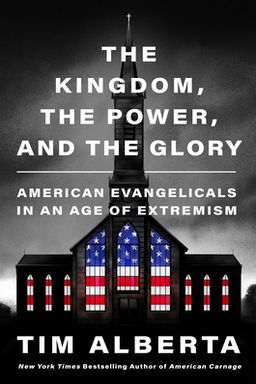
What happens when the Church confuses its mission with a quest for national dominance? In The Kingdom, the Power, and the Glory, journalist Tim Alberta explores how American evangelicalism, once defined by a transcendent faith, became entangled in politics, conspiracy, and power-seeking. Alberta writes as both insider and investigator: the son of a Michigan pastor who watched his own congregation fracture under political strain. His central claim is sharp—evangelicalism’s crisis is not primarily political but theological. Its members have traded allegiance to the heavenly kingdom for loyalty to an earthly one.
The two kingdoms in tension
For Alberta, the story begins with Jesus’ distinction: “My kingdom is not of this world.” Yet many believers have reversed that order, treating America as the promised land rather than their mission field. You see this shift embodied in local churches like Cornerstone, FloodGate, and Goodwill—places where patriotic displays and political rhetoric replaced Gospel teaching. Pastors who warned against nationalism, such as Chris Winans and John Torres, faced backlash or exile. Those who embraced politics as ministry, like Bill Bolin at FloodGate, drew huge crowds but blurred the line between pastor and campaigner. Alberta calls that reversal the defining theological error of modern evangelicalism.
From revival to political machine
Tracing the movement’s history, Alberta revisits Jerry Falwell Sr.’s Moral Majority and the creation of Liberty University. Falwell and his allies—Howard Phillips, Richard Viguerie, and Paul Weyrich—built an empire that merged religion with Republican strategy. Falwell’s “I Love America” concerts and Liberty’s patriotic branding normalized the fusion of faith and politics. What began as tactical resistance to social change became a full-fledged identity movement. By the 2010s, figures like Ralph Reed, Paula White, and Robert Jeffress turned political rallies into spiritual revivals where partisanship sounded like prayer.
Alberta captures the transactional evolution: the Moral Majority’s vote-for-judges logic gave way to tribal belonging. Many now treat political loyalty as proof of faith. The shift from theological to partisan identity, he argues, explains the anger, fear, and conspiratorial thinking now common in evangelical spaces.
Institutions and the market of fear
From the Falwells’ Liberty empire to Clay Clark’s ReAwaken America tour, Alberta shows how evangelical institutions became enterprises of influence. Liberty’s growth brought money and control but also scandals—sexual misconduct, self-dealing, and political cynicism under Jerry Falwell Jr. At the same time, a commercial economy emerged around fear. Charisma Media, WallBuilders, and ReAwaken America monetize anxiety through books, supplements, and “prophetic” conferences. Churches become distribution centers for grievance and certainty. Alberta calls it an “economy of outrage” that rewards certainty and punishes nuance.
(Parenthetical note: Alberta’s critique parallels C.S. Lewis’s warning about “the inner ring”—the desire for influence that corrodes virtue.)
Pastors under siege and the discipleship deficit
Pastors are both victims and participants in this story. Many entered ministry to cultivate spiritual depth but found themselves refereeing mask wars, racial disputes, and election denial. Thousands have burned out or resigned. Alberta calls this the “discipleship deficit”—a generation steeped in political media but shallow in Scripture. Theologians like Vincent Bacote, Ed Stetzer, and John Dickson underscore that evangelical breadth has come at the cost of formation; without catechesis, believers become easy prey for nationalism.
The backlash and the reformers
The book’s second half highlights resistance. Figures such as Russell Moore, Cal Thomas, and David French represent theological pushback—what Alberta calls “deconstructing political religion.” Their aim is not to destroy faith but to reclaim it from idolatry. Miroslav Volf and Cyril Hovorun connect America’s drift to international patterns—how religion sacralizes state power, as seen in Putin’s Russia. These thinkers urge a reordering: power must serve witness, not the reverse.
Journalists and survivors like Julie Roys and Rachael Denhollander embody this reform ethic from another angle: they demand accountability in institutions like the Southern Baptist Convention. Their investigations forced denominations to confront scandals of sexual abuse and cover-up—the moral collapse that accompanies unchecked authority. The Anaheim convention becomes Alberta’s symbol of hope: a moment when ordinary believers choose truth-telling over tribal defense.
Rebuilding what was lost
In closing chapters, Alberta profiles Russell Moore and Curtis Chang’s twin projects—the “air war” of coordination and the “ground war” of pastoral rehabilitation. Their initiative, The After Party, offers biblical study on how to engage politics and culture without losing civility or faith. Pastoral networks, small-group curricula, and lay empowerment become the counter-strategy to performative outrage. Alberta concludes with Pastor Chris Winans’s metaphor of the “infinite game”: the Church’s purpose is not victory but faithfulness. You win not by conquering rivals but by enduring in love and truth.
Guiding insight
Alberta’s book is both diagnosis and hope. It warns that allegiance misplaced in the nation destroys spiritual integrity, but it also reveals a path to renewal through humility, accountability, and re-centered discipleship.
Through pastors, theologians, and ordinary believers, Alberta shows that the crisis of American evangelicalism is self-inflicted—but repentance, reform, and reformation remain possible if believers have the courage to disentangle faith from fear and politics from the gospel.