
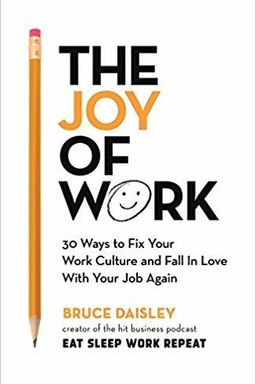
The Joy of Work cover

The Joy of Work

by Bruce Daisley

The Joy of Work by Bruce Daisley reveals 30 actionable strategies to transform your work environment. Learn how to boost productivity, foster creativity, and create a harmonious workplace through simple changes like walking meetings, social breaks, and focused work sessions. Rediscover the joy in your job and enhance your overall well-being.

Rediscovering the Joy of Work

When was the last time you ended a workday genuinely energized instead of exhausted? In The Joy of Work: 30 Ways to Fix Your Work Culture and Fall in Love with Your Job Again, author Bruce Daisley—former European Vice President at Twitter—invites us to rethink how we experience our jobs. Far from another empty ‘work-hard-play-hard’ manifesto, it’s a science-backed, human-centered guide to reclaiming meaning, connection, and energy in the modern workplace.

Daisley’s argument is straightforward but profound: modern work has lost its joy because our cultures are broken. Endless meetings, digital overload, isolation, and performative busyness have turned workplaces into stress factories. But it doesn’t have to be this way. Drawing on behavioral science, organizational psychology, and real-life stories, Daisley lays out thirty simple, evidence-based changes—grouped under three themes: Recharge (to restore your energy), Sync (to strengthen team connection), and Buzz (to build energized, creative workplaces).

Why Work Feels Worse Today

Daisley begins by asking: if technological advances have given us such freedom, why does work feel more suffocating than ever? As our devices tether us to our emails, the line between office and home has dissolved. The result is “hurry sickness”—a world where we never stop rushing, checking, and striving. Constant connectivity and performance anxiety have made stress the default mode of modern workers. Daisley illustrates this with research by psychologist Alexandra Michel, who studied investment bankers and found that extreme hours led to burnout, depression, and even physical illness. Today, even outside high finance, many of us live the same pattern—always connected, perpetually depleted.

The pandemic-level burnout of professionals, he warns, isn’t just an individual failing. It’s a systemic one. Organizations celebrate 130-hour workweeks (as Marissa Mayer once did at Google) and mistake exhaustion for dedication. But evidence from Stanford researcher John Pencavel shows that productivity actually collapses after about 50 hours per week. In fact, those working 70 hours accomplish no more than those working 55—a sobering reality that Daisley urges us to heed.

The Joy Equation: Recharge + Sync + Buzz

Through three connected parts, Daisley provides a blueprint for reversing this fatigue spiral. First comes Recharge—the performance-enhancing habits that re-energize you. Ideas like Monk Mode Mornings, walking meetings, digital sabbaths, and reclaiming lunch breaks help you escape distraction and rediscover focus. You learn how quiet time, proper rest, and managing your energy cycles can spark creativity and clarity. Neuroscientists such as Cal Newport (author of Deep Work) back this up: uninterrupted focus is where your best thinking happens.

Next, Daisley explores what he calls Sync—how teams build trust and connection. Using insights from MIT’s Alex “Sandy” Pentland and sociometric research from Ben Waber’s Humanyze project, he shows that gossip, laughter, and informal chat aren’t distractions—they’re productivity engines. Sync grows from psychological safety (Amy Edmondson’s concept), shared rituals, and moments of genuine human connection: a tea break, laughter at work, or even where the office kettle is placed. Without Sync, no team can thrive.

Finally, Buzz takes this one step further. When individuals feel recharged and teams are in sync, workplaces can reach a state of collective creative flow—what Daisley calls “Buzz.” Here, psychological safety meets positive affect (as studied by Alice Isen and Barbara Fredrickson). Buzz happens when people feel trusted, inspired, and open to sharing ideas without fear. Pixar’s famed “Braintrust” meetings, for instance, embody this spirit: candid feedback without ego, delivered in a climate of optimism.

Why This Matters Now

Daisley’s book arrives in a work culture teetering under stress. Gallup’s global engagement studies show that fewer than one in ten UK employees feel engaged at work. Yet studies also reveal that belonging, not bonuses, drives commitment. As Daisley reminds us, “We don’t need more perks; we need more purpose.” Drawing on historical examples—from Ford Motor’s eight-hour day to Sweden’s six-hour experiment—he argues that restoring joy isn’t about idealism. It’s about science and sanity.

What sets this book apart is its practicality. It doesn’t demand revolutions from CEOs (though it hopes they’re listening). It empowers you—the employee, teammate, or manager—to make small, evidence-backed changes. From defending your lunch breaks to gently disrupting meeting madness, Daisley shows how microactions can foster macro happiness.

The core insight: Joy at work isn’t a luxury; it’s a productivity multiplier. When your work culture supports focus, connection, and creativity, both wellbeing and performance rise together. Daisley isn’t promising utopia—just a more human way to do great work.


Recharge: Reclaiming Energy and Focus

If you’ve ever felt that your workday never truly ends, you’re not alone. In Part One: Recharge, Daisley argues that most of us are running on depleted batteries. The modern office has become a cognitive obstacle course—open-plan distractions, ceaseless emails, and back-to-back meetings erode deep thinking. But by restoring rest, routine, and rhythm, you can reclaim your focus and energy.

Monk Mode Mornings

Inspired by productivity scholar Cal Newport, Daisley’s “Monk Mode Morning” is an evidence-based daily ritual. The idea is simple: dedicate the first few hours of each day to deep work—no meetings, emails, or Slack messages. MIT research shows that attention residue (the mental drag from task-switching) slashes your cognitive power. One 2018 study found that people interrupted every three minutes took eight minutes to refocus; for complex tasks, up to 20. By protecting focus, Monk Mode Mornings transform productivity and boost job satisfaction.

Walking Meetings and Dopamine Thinking

Drawing from Stanford psychologist Marily Oppezzo, Daisley shows how walking elevates creativity by 60 percent. The science? Aerobic activity increases dopamine and “divergent thinking,” the brain’s mode for generating new ideas. He references Charles Dickens, who wrote intensively for five hours and then walked up to twelve miles. Friedrich Nietzsche’s line says it best: “All truly great thoughts are conceived while walking.” In the workplace, walking meetings or “walk-and-talks” can ease tension, unlock creative thinking, and—even comically—keep conversations confidential. (He cites Mafia boss Joseph Massino, who insisted walking was safest for secret discussions.)

Ending Hurry Sickness

Daisley encourages us to slow down. The constant “ASAP” culture, he writes, isn’t a badge of honor; it’s a productivity killer. Quoting Basecamp’s founders—“ASAP is inflationary”—he reveals how urgency addiction clouds judgment and amplifies stress hormones like cortisol. Neuroscientist Sandi Mann refers to boredom as “a cognitive superpower”: when our minds wander, creativity often strikes. Try waiting quietly for an elevator without touching your phone—an act of rebellion against hurry sickness that gives your Default Mode Network space to connect new ideas.

The Science of Rest and Rhythm

Rejecting the cult of overwork, Daisley draws from historical and modern examples proving that less is more. Ford Motor Company’s 1914 switch to the eight-hour day doubled profits. A century later, Stanford’s John Pencavel found that output drops sharply past 50 hours per week. At the consultancy McKinsey, a partner who worked six days (instead of seven) outperformed his peers. These findings echo Tony Schwartz’s “energy project” research: the human brain works best in 90-minute bursts, followed by renewal. As Daisley quips, “Stop celebrating exhaustion. Start managing your energy.”

Recharging your personal battery isn’t indulgent—it’s essential. Sleep well (Matthew Walker, author of Why We Sleep, agrees), take digital Sabbaths, and reclaim your lunch break. As one case study, Museum of London’s Laura Archer described how skipping lunch derailed her health and mood until she rediscovered the power of “going for lunch.” In her words, “You get a second wind.”

Recharge takeaway: Treat your mind like an athlete treats their body: cycles of focus, rest, and renewal make peak performance sustainable.


Sync: Building Belonging and Trust

If “Recharge” is about individual energy, “Sync” is about collective rhythm. Teams perform best when people connect, trust, and care about one another. Daisley reveals that friendship at work isn’t a nice-to-have—it’s a superpower. Drawing from MIT’s Alex Pentland and Wharton’s Sigal Barsade, he shows that love, laughter, and tea breaks could be the missing links in corporate performance.

Moving the Kettle

MIT’s social-physics research found that casual face-to-face collisions are the lifeblood of ideas. Simply relocating the office kettle or coffee machine can amplify collaboration by 40%. Pentland’s sociometric badges—devices tracking real interactions—proved that spontaneous chats drive productivity far more than emails or meetings do. As Daisley puts it: “Your coffee break could be worth half your quarterly results.”

Tea Breaks and Shared Rituals

Inspired by Scandinavian fika, Daisley champions shared breaks as vital pauses for reflection and bonding. In a Bank of America call center, synchronizing team coffee breaks raised productivity by 23% and cut stress by nearly 20%. By laughing, venting, and problem-solving together, employees self-coached and supported one another. Social rituals like Twitter’s “Tea Time” or Y&R London’s “Crisp Thursdays” help teams breathe together—literally syncing their rhythms.

Rethinking Meetings and Boss Behavior

To strengthen Sync, Daisley warns against meeting overload. Drawing on PayPal’s David Sacks, he notes that halving your meetings can double your energy. He also quotes Harvard professor Amy Edmondson’s research on psychological safety—the shared belief that speaking up won’t get you punished. In hospitals, she found that high-performing teams reported more mistakes—not because they performed worse, but because they felt safe enough to admit them. This trust, not surveillance or slogans, is the foundation of high-performing cultures.

The Power of Laughter

Laughter, Daisley argues, is human glue. Anthropologist Robin Dunbar’s research shows that shared laughter releases endorphins, increases closeness, and raises pain tolerance. Soldiers, firefighters, and hospital medics who find humor in hardship cope better and collaborate more effectively. James Comey once noted that great leaders—like Presidents Obama and Bush—used humor to create trust. “Groups that laugh together,” Daisley writes, “are safer, stronger, and smarter.”

Sync takeaway: Connection is the invisible infrastructure of great work. Move the kettle, share a laugh, and trust will follow.


Buzz: The State of Energized Teams

When personal energy meets team connection, something extraordinary happens—Buzz. Daisley defines Buzz as the magical state when psychological safety (from Amy Edmondson) meets positive affect (from Alice Isen). It’s the mood of creative flow when teams feel safe, valued, and excited to contribute. Pixar movies, Danish design houses, vibrant tech startups—all achieve a form of Buzz. But it’s not luck. It’s built deliberately.

Positive Affect: The Science of Good Moods

When we’re in a good mood, research shows, we’re more generous, flexible, and creative. Alice Isen’s famous “bag-of-candy” experiment found that doctors who received small gifts made faster and more accurate diagnoses. Positive affect broadens our thinking and boosts dopamine in the brain’s prefrontal cortex. Daisley argues that workplaces can prime this mindset through appreciation, small wins, and kindness—boosting innovation more than any strategy memo ever could.

Psychological Safety: The Freedom to Speak

Buzz can’t thrive without psychological safety—the freedom to question, admit errors, and challenge authority. Edmondson’s hospital studies and Martin Bromiley’s tragic story of his wife’s surgery gone wrong both prove that silence, not incompetence, kills performance. In psychologically safe teams, failure becomes learning. Leaders can nurture this by opening meetings with phrases like “I might be missing something” or “I need your help.”

The Buzz Formula

Positive Affect + Psychological Safety = Buzz. Daisley visualizes this as a simple grid. Low on both equals “survival mode”—a fear-driven office. High safety but low positivity equals “grind.” High positivity but low safety triggers isolation and performative cheer. Only when both align do teams reach Buzz—alive, candid, and creative. He points to Pixar’s Braintrust sessions, where filmmakers share early cuts for candid (but kind) critique. The rule? No orders, no egos, only observations. It’s candor without cruelty.

Buzz, then, is less about fun perks and more about emotional climate. As Daisley writes, “A team buzzing with energy doesn’t need slogans; it needs trust, laughter, and a little optimism.”

Buzz takeaway: Create emotional safety and positivity, and innovation naturally follows.


Courageous Leadership Without Fear

“The mark of a great leader,” Daisley reminds us, “is humility wrapped in confidence.” Too often, bad bosses kill team energy through fear or micro-management. In the Sync section’s later chapters, he dissects what makes a toxic boss tick and how great leaders build trust by stepping aside—not by shouting louder.

Stop Being the Mill Owner

Daisley borrows from Dan Kieran’s metaphor of the “inner eighteenth-century mill owner”—the boss who equates productivity with presenteeism. Whether glaring at late arrivals or frowning at someone working remotely, this mindset sees control as commitment. But trust, not control, drives creativity. The Results Only Work Environment (ROWE) model, first adopted by Gap and Best Buy, rewards outcomes, not hours. Employees set goals, then choose when and where to deliver them. It’s autonomy with accountability—the balance every innovative workplace needs.

Banishing Notifications, Not People

Good leadership protects its teams from stress triggers. Daisley references studies by Loughborough’s Tom Jackson revealing that the average worker faces 96 email interruptions per day. These spikes in cortisol mimic “cat fear” in Jaak Panksepp’s experiments on rats: when stressed, we stop exploring and stop being creative. Slack is not culture. Turning off notifications, or setting “do not disturb” office-wide blocks, is small-scale leadership with huge creative payoffs.

Empathy and Expertise

Daisley cites Amanda Goodall’s research that the best leaders have deep expertise in their craft, not just MBAs in management. “You can’t coach what you don’t understand.” Great bosses combine technical empathy with emotional empathy—they know the work and care about the worker. At companies like Slack and McDonald’s, executives spend days on the front lines to stay grounded. As Daisley puts it, “Do no harm” may be the most radical management philosophy of all.

Leadership takeaway: The best leaders don’t demand energy—they protect it. Trust people, remove distractions, and let output—not optics—speak.


Diversity and Creative Flow

Homogeneity feels comfortable—but it kills creativity. In Buzz 7: Champion Diversity, Daisley makes a pragmatic case for inclusion: diverse teams simply make better decisions. Drawing on Sam Sommers’ social psychology research, he explains that groups with differing perspectives challenge assumptions, process information longer, and reach more accurate conclusions—even if it feels uncomfortable while they do it.

The Frat House Experiment

In a clever experiment, U.S. fraternity members solved a murder mystery either with fellow brothers or with an outsider added to the group. Although the homogeneous group felt more confident and enjoyed the process, they solved the problem correctly only 29% of the time. The mixed teams, while less comfortable, were twice as successful. The lesson: comfort is the enemy of quality thinking.

Progress Through Difference

Daisley echoes John Stuart Mill: progress depends on exposure to people “dissimilar to ourselves.” Diversity—of background, gender, ethnicity, thought—breaks groupthink and drives innovation. McKinsey’s global data confirm it: companies in the top quartile for ethnic diversity are 35% more likely to outperform financially. Gender-diverse firms perform 15% better. The best teams question, debate, and stretch one another’s logic. They replace consensus with curiosity.

Diversity takeaway: The best teams aren’t the most harmonious—they’re the most curious. Difference drives performance because it drives better thinking.


Making Culture Human Again

Behind Daisley’s humor and data lies a moral vision: work should feel human again. Modern organizations, he laments, confuse culture with marketing. They hang “values” on walls while discouraging real conversation. Yet belonging isn’t built by slogans; it’s built by simple human warmth and recognition.

Beyond Perks and Ping-Pong Tables

Workplace engagement, Daisley argues, isn’t about free breakfast or beanbags—it’s about companionate love. Borrowing from Wharton professor Sigal Barsade, he describes this as the empathy, kindness, and warmth among colleagues that predict job satisfaction and loyalty. In study after study, “love-heavy” workplaces outperform “efficiency-heavy” ones in both morale and profit. The lesson: culture isn’t something you declare; it’s something you feel.

Belonging as a Basic Need

Revisiting Maslow’s hierarchy, Daisley argues, echoing psychologists Roy Baumeister and Mark Leary, that belonging isn’t a luxury after food and shelter—it’s as essential as both. In every field, isolation depletes health and creativity. Firefighters, nurses, and medics thrive because they feel part of a trusted collective. As Daisley concludes, “If Frederick II’s infants died of neglect, modern employees are withering from isolation.”

Through each story—from a team knitting a blanket for a sick colleague to weekly pizza meetings at BBC Radio 1—Daisley shows that the true joy of work lies in human connection, courage, and purpose. When people laugh, care, and collaborate, results follow naturally.

Final takeaway: The best workplaces aren’t those with the boldest slogans—they’re the ones where people feel seen, safe, and supported. Joy isn’t a luxury; it’s the lifeblood of meaningful work.

Dig Deeper

Get personalized prompts to apply these lessons to your life and deepen your understanding.

Go Deeper

Get the Full Experience

Download Insight Books for AI-powered reflections, quizzes, and more.