
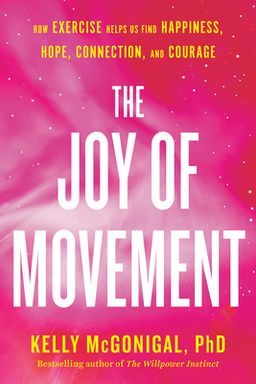
The Joy of Movement cover

The Joy of Movement

by Kelly McGonigal

In ''The Joy of Movement,'' Kelly McGonigal explores how exercise transcends physical health, offering profound mental benefits. Drawing on science and real-life stories, this book illustrates how movement fosters happiness, connection, and resilience, empowering everyone to harness its positive effects.

The Joy of Movement: How Motion Unlocks Happiness, Hope, and Connection

Have you ever noticed how a walk, a workout, or a dance can shift your mood from darkness to light? In The Joy of Movement, psychologist and Stanford lecturer Kelly McGonigal explores a radical idea: movement is not merely a way to stay fit—it’s a biological celebration of what makes us human. Drawing on neuroscience, anthropology, psychology, and captivating personal stories, McGonigal argues that movement is the body’s built-in mechanism for happiness, resilience, and social connection. It’s not just exercise; it’s how we were designed to thrive.

McGonigal weaves together scientific findings about the runner’s high, group fitness classes, endurance sports, and even gardening to demonstrate how moving our bodies changes our brains and bonds us to others. She invites readers to rediscover movement not as punishment or performance but as one of life’s most fundamental joys—a source of meaning, hope, and belonging.

Movement as a Built-In Happiness System

At the book’s core is the claim that our physiology is designed to reward movement. When we move, our bodies release powerful neurochemicals—endorphins, dopamine, and endocannabinoids—that generate joy, reduce anxiety, and increase connection. These biological rewards aren’t accidents; they evolved to encourage behaviors that helped our ancestors survive. Movement once meant chasing food, exploring new territories, or protecting the tribe. Today it can mean running a marathon or dancing in your living room, but either way, your brain still interprets it as engagement with life itself.

Through compelling science, McGonigal shows that moving remodels the brain to make us more receptive to joy. Muscles even release what she calls “hope molecules,” chemicals that act like natural antidepressants. The simple act of contracting your muscles sends signals to your brain saying, “You can do hard things.” This literally builds the neurobiology of resilience. The takeaway is profound: hope might start in your muscles before it reaches your mind.

From Solitary Effort to Collective Joy

While some moments of happiness come from personal triumph—a run, a yoga pose, a hike—the greatest joy, McGonigal argues, comes from moving together. The book celebrates the communal ecstasy of synchronized movement, from rowing crews and dance classes to charity runs and religious rituals. Drawing on French sociologist Émile Durkheim’s concept of collective effervescence, she explores how rhythm and synchrony dissolve the boundaries between self and others. Endorphins released during collective movement strengthen trust and cooperation, turning strangers into teammates and exercise groups into families.

McGonigal shares stories like that of the GoodGym volunteers who run together to help isolated seniors, or the Ottawa women’s rowing team whose synchronized strokes evoke bliss and oneness. Such experiences prove that movement is a tool for belonging. It’s not just about endurance or calories; it’s about participation in something larger—a biological reminder that we’re made to move with each other.

Movement as Medicine for the Mind and Spirit

Beyond pleasure, movement heals. McGonigal details how exercise combats depression, anxiety, trauma, and even grief. She recounts stories of people like Jody Bender, who relearned to run after a stroke; Susan Heard, who found refuge from sorrow through outdoor runs after her son’s death; and Parkinson’s patients who rediscovered joy through dance. Each reveals how physically engaging with life reawakens hope, confidence, and courage. The rhythm of breath and motion can restore our sense of agency when words or will alone cannot.

Even the natural world contributes. Walking, hiking, or gardening—what researchers call green exercise—taps into ancient instincts for exploration and awe, quieting negative self-talk and reconnecting us with the living world. McGonigal compares this sense of peace to the effects of meditation or even entheogens: a feeling of oneness, transcendence, and belonging to something greater than the self.

Persistence, Courage, and Hope

Movement also teaches endurance—not just physical but emotional and spiritual. Through tales of Tough Mudder participants facing their fears or ultramarathoners pushing through despair, McGonigal reveals how perseverance through motion reshapes identity. The brain rewards effort with euphoria, but more importantly, it integrates struggle into a story of strength. Moving your body trains your mind to keep going when life gets hard.

By the end, The Joy of Movement becomes less a self-help book and more a manifesto on what it means to be human. Movement connects us to ourselves, to others, and to the world. It taps our instincts for play, persistence, and cooperation. McGonigal’s compassionate storytelling and scientific rigor combine to create one sweeping insight: joy is not merely an effect of movement—it is its purpose.


The Biology of Joy

Kelly McGonigal begins by dismantling the myth that exercise’s happiness boost comes just from endorphins. The real story is far richer. Movement activates a symphony of biological rewards—dopamine, serotonin, endocannabinoids, and stress-reducing proteins secreted by muscles. These chemicals not only make you feel euphoric but also build emotional resilience. They synchronize your brain’s reward and social circuits, making you more open to joy and connection.

Hope Molecules: Muscles That Heal the Mind

Among McGonigal’s most memorable ideas is the notion of “hope molecules.” When you contract your muscles—whether lifting a kettlebell or walking uphill—they release myokines, tiny proteins that travel to your brain to reduce inflammation and stimulate growth. One such myokine, irisin, enhances learning, motivation, and protection against depression. Scientists call these chemicals a natural antidepressant system. This means every squat, stretch, or step is a molecular message from your muscles: “Keep going. You can adapt.”

In extreme endurance athletes, McGonigal notes, blood tests show astonishing levels of irisin—proof that movement literally makes the mind more resilient. Yet you don’t need to run through the Arctic to get the benefit: even moderate exertion floods your bloodstream with hope. Movement becomes internal medicine brewed by your own biology.

Endocannabinoids: Nature’s Social Glue

McGonigal devotes much attention to the brain chemical endocannabinoids, naturally produced substances similar to the active compounds in cannabis. These molecules produce calm contentment and ease social bonding. When you feel “high” after a good run or workout, you’re experiencing this internal chemistry. She cites research showing that exercise, social connection, and even laughter all elevate endocannabinoids—meaning the runner’s high isn’t just about feeling good; it’s about feeling connected.

This “don’t worry, be happy” chemistry explains why group exercise builds trust so quickly. Shared effort amplifies pleasure, bonding participants into what anthropologists call a tribe of effort. If you’ve ever hugged sweaty teammates at the finish line, you’ve felt biology’s quiet miracle: motion turning stress into fellowship.


The Persistence High

Rather than viewing the runner’s high as a mysterious accident, McGonigal reframes it as an evolutionary reward for persistence. Our early ancestors depended on long-distance movement—running, scavenging, migration—to survive. Those whose brains made endurance feel rewarding passed on that trait. The chemicals that flood your brain after sustained effort—particularly endocannabinoids—were nature’s way of saying, “Keep going.”

Evolution’s Gift for Endurance

Biologists Dennis Bramble and Daniel Lieberman argue that humans evolved as endurance athletes. Features like long legs, stable ankles, and sweat glands gave us unmatched stamina. But what kept us moving wasn’t just anatomy—it was emotion. McGonigal recounts David Raichlen’s experiments showing that moderate exertion, not sprinting or strolling, produces the biggest spike in endocannabinoids. The result? A “persistence high” that emerged to help us chase prey and explore new lands. Today, that same neurochemical cocktail rewards anyone who keeps moving—be it walking the dog, cycling, or climbing stairs.

Modern Lives, Ancient Bodies

Anthropologist Herman Pontzer’s research on Tanzania’s Hadza people, who walk and run for hours daily, shows what humans were designed for. Unlike sedentary Westerners, the Hadza are active into old age and exhibit almost no depression or heart disease. Pontzer couldn’t help noticing their evident joy. McGonigal points out that while our modern world rewards sitting, our physiology still expects movement. When we fail to meet that need, we grow anxious, tired, and disconnected—a kind of modern mismatch disease.

Courage Through Motion

McGonigal tells stories like that of Jody Bender, a stroke survivor who relearned to run by sheer persistence. She discovered that each difficult mile reinforced her self-image as strong and capable. “Sometimes I cry when I run,” she says, “I’m just proud I can.” This emotional alchemy—fear into pride, struggle into strength—is the persistence high at work. The body’s chemistry doesn’t just reward movement; it transforms your understanding of who you are. Once you’ve experienced that, you carry endurance into every challenge life throws at you.


Getting Hooked: Loving the Habit

Why do some people need their daily run like others need coffee? McGonigal shows that the brain can learn to love exercise through the same neural mechanisms that underlie addiction—but with opposite outcomes. Regular movement sensitizes, rather than numbs, the brain’s reward circuits. Over time, you don’t need caffeine or narcotics to feel alive; your own body becomes its own stimulant.

Exercise as the Good Addiction

Research dating back to the 1970s revealed that people deprived of exercise showed withdrawal symptoms—irritability, restlessness, even sadness. But unlike addictive drugs that hijack and dull the reward system, regular exercise enhances it. It raises baseline dopamine levels and increases dopamine receptors, making you more sensitive to everyday pleasures. As McGonigal writes, physical activity is a form of “do-it-yourself deep brain stimulation.”

Case studies like Nora Haefele, a 62-year-old marathon walker who calls racing her “drug of choice,” illustrate how movement becomes a spiritual ritual. Her races are both “a church service and a rave.” Far from escapism, this devotion is a joyful bond—what McGonigal calls “the brain’s capacity for commitment.”

The Pleasure Gloss

The pleasures of movement deepen over time. Familiar cues—the smell of chlorine at a pool, the sound of a yoga mat unrolling—become triggers for anticipation and joy. McGonigal calls this phenomenon the “pleasure gloss.” Just as Pavlov’s bell made dogs salivate, a dancer’s favorite song or a runner’s favorite shoes elicit happiness even before the moving starts. Many exercisers report goosebumps or excitement just preparing for their activity. Their environments literally shine with meaning.

Born to Move

Some of us are genetically wired to find motion more rewarding. Studies suggest that up to 50 percent of physical activity tendencies are heritable. McGonigal and her twin sister Jane share this predisposition and even discovered genetic variations related to exercise’s antidepressant effects. Yet genes aren’t destiny; habit is. If exercise is love, it’s a love learned through repetition. The more you move, the more your brain rewires to crave the movement. Get hooked, she says, in the healthiest way possible.


Collective Joy and the Power of Togetherness

Few sensations rival the joy of moving in sync with others. McGonigal explores this ancient human ecstasy—what sociologist Émile Durkheim called collective effervescence. When you dance, row, or sing in unison, your brain’s endorphins flood you with warmth and connection. Synchrony blurs boundaries, turning ‘me’ into ‘we.’

Synchrony as a Social Superpower

Experiments by psychologist Bronwyn Tarr show that synchronized dancers not only feel closer to each other but also tolerate more pain—proof of raised endorphins. Even simple rhythmic gestures like walking in step or yoga breathing together create trust. McGonigal describes rowing crews, military marchers, and Zumba classes as modern rituals of belonging. Moving to the same rhythm releases a feel-good cocktail that strengthens communities as effectively as friendship or family.

The Science of Connection

When you perceive someone moving as you do, your mirror neurons wire their actions into your sense of self. This fuses bodies into a single unit—a collective body. The experience doesn’t just feel emotional; it’s neurological. Participants often describe feeling their personal outlines dissolve. Kimberly Sogge’s rowing team spoke of becoming “one living entity” with the river beneath them.

Community as Survival Strategy

From CrossFit “boxes” that function like churches to Nia dance classes used as healing ceremonies, McGonigal demonstrates that movement communities fulfill our social DNA. They provide what psychologist William McNeill called muscular bonding: shared rhythm that turns exertion into solidarity. In dark times—from natural disasters to grief—collective joy becomes medicine. When Houston survivors of Hurricane Harvey gathered for an outdoor Zumba class, McGonigal saw what she calls “resilience in motion.” Even disaster could not silence our need to dance.


Movement as Metaphor: Overcoming Obstacles

In perhaps her most inspiring section, McGonigal shows how movement becomes a physical metaphor for courage and growth. When we tackle literal obstacles—jumping into cold water, lifting a weight, learning to balance—we rehearse the emotional skills of persistence and self-belief. Every push-up or climb is a story the body tells about our ability to endure life’s hardships.

Transforming Fear into Strength

McGonigal recounts Cathy Merrifield’s Tough Mudder experience: standing atop a 12-foot platform, terrified of jumping into muddy water. The first time she’d faced this fear—at age eight—an instructor had forced her off a diving board. Decades later, she jumped by choice and emerged exhilarated. The difference between terror and triumph, McGonigal writes, is agency. Our nervous system reads voluntary challenge as empowerment, converting fear into confidence.

The Wall of Greatness

At DPI Adaptive Fitness, a gym for people with disabilities, clients mark their victories on the “Wall of Greatness.” Stroke survivors, amputees, and veterans record feats like 1,000 squats or hundreds of punches in 30 seconds. These acts are tests of hope: tangible proof that progress is possible. As founder Devon Palermo says, “We’ll set you something very challenging; if you destroy it, you’re on the Wall.” Each milestone rewrites the story from limitation to possibility.

Agency Through Action

Experiments with both humans and animals support this truth. When rats shocked in a lab were given any way to control their environment—even spinning a wheel—they resisted helplessness. Likewise, real-life athletes who choose challenge emerge braver. Movement teaches us the most transferable life lesson: fear means act, not freeze. Every small step becomes an argument against despair.


Embracing Life Through Nature

When you move outdoors, you don’t just exercise—you reconnect with a primordial source of well-being. McGonigal presents green exercise as nature’s antidepressant. Whether hiking, gardening, or simply walking among trees, physical activity in nature induces wonder, slows time, and reawakens presence. It restores what stress and screens erode: our connection to the living world.

Nature as Psychological Reset

Studies show even five minutes of outdoor movement transforms mood. Brain scans reveal that walking in natural surroundings reduces activity in the default mode network—the brain system tied to rumination and self-criticism. This is the same target as advanced antidepressant therapies. As one study found, forest walks outperformed cognitive therapy for treating depression. Nature triggers what McGonigal calls soft fascination: full sensory awareness that quiets inner storms.

Biophilia and Belonging to the Earth

Citing biologist E.O. Wilson, McGonigal describes biophilia—our innate love for life—as a core human instinct. People who feel connected to nature report greater purpose and happiness than those who don’t. She tells of astronaut Don Pettit cultivating a zucchini aboard the Space Station: even there, humans crave contact with living things. Soil bacteria themselves have antidepressant effects, illustrating that our relationship with the earth is literally biochemical.

Hope Takes Root

Green Gym projects in the UK, where volunteers garden, restore parks, and plant trees, exemplify what McGonigal calls “physical activity with a purpose.” These programs improve not only fitness but hope. Planting trees that may outlive you affirms belonging to a future beyond your lifetime. Nature teaches endurance through seasons of death and renewal. To embrace life, she concludes, is to move within it.


How We Endure: Motion as a Teacher of Resilience

McGonigal ends with movement’s highest lesson: endurance. Through stories of ultramarathons, mountaineering, and spiritual practices, she explores how motion reveals the human capacity to suffer well. Pain and euphoria coexist in what runners call ‘the space beyond exhaustion.’ Move long enough, and you discover who you are.

The Science of Suffering Well

Endurance athletes like Shawn Bearden or adventure racer Terri Schneider learn that every step through pain activates resilience circuits. Their muscles release hope molecules; their minds learn patience and faith. Depression and despair slow time and isolate, but endurance teaches the opposite: each moment of suffering can pass. As ultrarunner Christina Torres puts it, “The hill will finish.”

Resilience Through Relationship

Despite the mythology of solitary heroism, enduring hardship often depends on connection. The iconic story of British runner Derek Redmond being helped across the Olympic finish line by his father encapsulates this truth: we endure with, not against, others. Ultra-athletes form deep kinship through shared pain; it bonds them more powerfully than victory. Communities that sweat together learn empathy in motion.

Motion as Meaning

From Japan’s Marathon Monks to everyday exercisers, movement becomes ritual—proof that life continues through effort and grace. When McGonigal herself conquers her own fear of heights while rock climbing, she realizes courage can be collective. Joy, fear, and support coexist. Movement reminds us: we are physically built to persevere and psychologically wired to keep hope alive. In the act of moving, we rediscover what it means to live.

Dig Deeper

Get personalized prompts to apply these lessons to your life and deepen your understanding.

Go Deeper

Get the Full Experience

Download Insight Books for AI-powered reflections, quizzes, and more.