
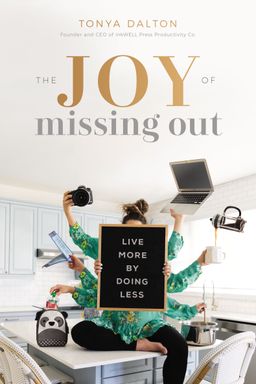
The Joy of Missing Out cover

The Joy of Missing Out

by Tanya Dalton

The Joy of Missing Out by Tanya Dalton helps you eliminate stress and boost productivity by focusing on priorities. Discover actionable strategies for simplifying your life, setting purposeful goals, and embracing the joy of doing less.

The Joy of Missing Out: Live More by Doing Less

When was the last time you slowed down long enough to truly savor your day? In The Joy of Missing Out: Live More by Doing Less, productivity expert Tonya Dalton reframes how we think about busyness, balance, and success. She argues that most of us are trapped in a cycle of overwhelm—believing that being busy is the same as being productive—when in truth, it’s the polar opposite. Her message is radical in its simplicity: joy isn’t found in doing more, but in doing what truly matters.

Dalton contends that our obsession with doing “all the things” has left us exhausted, distracted, and dissatisfied. To reclaim meaning, she proposes a mindset shift—from hustle to harmony. Instead of chasing balance, which she says is impossible and even counterproductive, we should design lives centered around our priorities. Her philosophy forms the backbone of what she calls the liveWELL Method: a four-step system that guides you through discovering your purpose, clarifying what matters most, simplifying your systems, and harmonizing all areas of your life.

A Cultural Antidote to Busyness

We live in a world that applauds hustle and glorifies productivity at the expense of peace. Dalton’s first challenge to readers is to stop equating worth with busyness. Through her own story—sitting on her kitchen floor overwhelmed by guilt and exhaustion—she shows how easily women, especially, confuse doing everything for others with living a meaningful life. Overwhelm, she declares, isn’t about having too much to do; it’s about not knowing where to start.

The book speaks directly to those who feel pulled in every direction, acting out of obligation rather than intention. Her antidote is JOMO—the Joy of Missing Out—the liberating realization that saying no to what doesn’t matter is saying yes to a more fulfilling life. Dalton encourages you to define your own version of success, one anchored by values and priorities rather than comparison or guilt.

The Four Steps of the liveWELL Method

At the heart of Dalton’s framework is an invitation to live intentionally. She organizes her method into four progressive phases:

  • Discover – Understand your true priorities, uncover your North Star (your guiding purpose), and let go of limiting stories.
  • Clarify – Redefine productivity as effectiveness, not efficiency. Learn to manage your focus, time, and energy according to your priorities.
  • Simplify – Create systems and routines that automate daily life so you can “take the thinking out of it” and free energy for meaningful work.
  • Harmonize – Integrate all areas of life—work, home, and personal—so that your week feels aligned with your purpose rather than divided by obligation.

This four-part process mirrors the arc of transformation Dalton experienced herself. After years of overworking and people-pleasing, she redesigned her business and daily systems to prioritize her family, health, and creativity. Now, as an entrepreneur and coach, she teaches others to do the same by working smarter, not more.

From Overwhelm to Ownership

Dalton insists that transformation begins with choice. Borrowing psychological insights about “locus of control,” she explains that people who feel agency over their lives—those with a strong internal locus—experience less stress, greater satisfaction, and more freedom. The trouble is, many of us surrender our choices to others’ expectations—and then wonder why we feel powerless.

Her “Squirrel Strategy” offers a playful reminder that resourcefulness beats rigidity. Just as a squirrel tries endless routes to reach a feeder, so must you creatively approach obstacles. Instead of believing “I can’t,” ask, “What else is possible?” The shift from victimhood to ownership is foundational for embracing JOMO.

Why Missing Out Creates Meaning

Far from being a call to laziness, Dalton’s philosophy is about intentional absence. Choosing to miss out isn’t withdrawal; it’s a commitment to what truly matters. She dismantles cultural myths around balance, multitasking, and perfectionism, showing how chasing all the things actually prevents us from doing what counts. Harmony, not balance, is her watchword—an ongoing calibration where priorities shift over time but always align with your core values.

Throughout the book, Dalton shares moving anecdotes—from teaching her children independence through family “team meetings” to helping clients like Rhonda reclaim morning yoga time by questioning beliefs about motherhood. Her storytelling brings abstract ideas down to earth, making each strategy doable in everyday life.

A Framework for Sustainable Joy

Ultimately, The Joy of Missing Out teaches that sustainable joy grows from alignment, not achievement. Through the liveWELL Method, Dalton empowers you to redefine productivity as living with purpose, clarity, and space to breathe. You’ll learn to pursue focus over frenzy, design supportive systems, and create intentional whitespace—the unhurried time necessary for creativity and connection. Missing out, paradoxically, becomes the richest way to live fully.


Discovering Your North Star

Dalton believes that most of us drift through life reacting to others’ priorities instead of steering toward our own. To change course, you must define your North Star—a personal compass that merges your mission, vision, and core values. This clarity transforms vague busyness into direction. As Dalton writes, “When we don’t define our North Star, we allow others to define it for us.”

Mission, Vision, and Values

Your mission answers what you do and why. Your vision reveals where you’re going. Your core values shape how you’ll get there. Dalton guides readers to write clear, concise statements instead of lofty wishes. For example, her own mission—“to use my passion and expertise in productivity to inspire others to achieve their goals”—anchors every business decision she makes. It acts as a filter for saying yes or no.

Readers see inspiring examples: Alfred Nobel redefined his legacy after reading his premature obituary, and a homeschooling mother named Amanda distilled her multitasking life into one statement—“I use my humor and problem-solving skills to improve the lives of my family and community.” Through such clarity, Dalton shows that identity is self-authored, not assigned.

Practical Self-Discovery Tools

Dalton offers down-to-earth exercises like the “ABC Brain Dump” (listing A–Z words tied to your passions) or a “Vision Board” of images representing your desired future. These visual and linguistic tools turn abstract introspection into tangible insight. She also promotes revisiting your North Star regularly since, as psychologist Daniel Gilbert observes, “humans are works in progress who mistakenly think they’re finished.”

Core Values in Action

To live by values, Dalton urges you to name and define no more than six that genuinely reflect you—such as Family, Grace, or Adventure—then test them against real dilemmas. If a choice violates one, the answer should be no. She advises asking, “Would I sacrifice for this value?” For one woman, declaring “Outdoor Adventure” as a value sparked a lifestyle of hiking excursions that rekindled her joy.

(Comparable approaches appear in Stephen Covey’s The 7 Habits of Highly Effective People, but Dalton’s take feels more personal and emotionally grounded.) Your North Star, she concludes, is not a fixed point but a living guide—helping you navigate shifting seasons without losing your sense of self.


Rethinking Productivity and Time

The core of Dalton’s philosophy is that productivity isn’t about doing more—it’s about doing what matters. She challenges the worship of efficiency, the glorification of multitasking, and the myth of balance. Echoing thinkers like Cal Newport (Deep Work) and Laura Vanderkam (I Know How She Does It), she insists that focus—not frenzy—creates fulfillment.

Efficiency vs. Effectiveness

Dalton draws a sharp line between efficiency (speed) and effectiveness (impact). A dishwasher can be efficient, she says, but only humans can be effective. Constant motion may impress others but rarely produces meaningful results. The true question is not “How can I do more?” but “Why am I doing this at all?”

Three Myths of Productivity

  • Myth 1: Multitasking makes us faster. Research shows it drains up to 40% of productivity. Dalton humorously notes that multitasking doesn’t make you efficient—it makes you bad at everything at once.
  • Myth 2: Breaks are indulgent. Biological rhythms prove otherwise: our brains work in 90-minute focus cycles. Like breathing, rest (the “in-breath”) is essential for creativity and performance.
  • Myth 3: Technology fixes everything. Handwriting, Dalton explains, engages the brain’s reticular activating system, embedding memories more deeply than digital note-taking.

Time as a Finite Resource

Using metaphors like “time is a bowl of ice cream,” she shows that work expands to fill the container you give it (Parkinson’s Law). Instead of stretching deadlines endlessly, shrink them to create focus. Prioritize your top 20% of efforts—the ones that generate 80% of results (the Pareto Principle).

Time isn’t found; it’s made. Dalton dismantles the illusion that we lack time, reminding readers that after accounting for sleep and work, we still have seventy-two waking hours weekly to choose how we live. The issue isn’t scarcity—it’s choice.


Clarifying Energy and Focus

In a culture addicted to to-do lists, Dalton reveals how our obsession with checking boxes drains energy and fuels false accomplishment. She calls this “dopamine busy”—doing small, unimportant tasks for the quick high of crossing them off, while bigger priorities languish. Her solution is a Priority List and the CLEAR Framework.

From To-Do to Priority

Dalton divides tasks into three categories: Escalate (important and urgent), Cultivate (important but not urgent), and Accommodate (urgent but unimportant). The magic lives in the middle—cultivating tasks that advance long-term goals instead of reacting to emergencies. Her point: if you prioritize the important, you’ll have fewer emergencies to begin with.

The CLEAR Framework

  • C – Is it Connected to my North Star?
  • L – Is it Linked to a goal?
  • E – Is it Essential (must it be done by me)?
  • A – Is it Advantageous—does it offer lasting returns or satisfaction?
  • R – Is it Reality-based, or just a story I’m telling myself?

By rating tasks through CLEAR, you see what truly deserves your energy. For instance, returning a $15 shirt to Target isn’t “important”—it’s merely urgent. Dalton’s example of a Silicon Valley CEO who donates such items instead of wasting time returning them cleverly reframes how we value our minutes.

(This echoes Stephen Covey’s quadrant model but feels more compassionate and intuitive.) The point is not to do everything well, but to do the right things with intention and energy.


Simplifying Systems and Habits

Dalton admits she’s “terrible at running” and uses that as a metaphor: we’re often in love with the idea of perfect systems, not the systems themselves. The key to reducing overwhelm, she insists, isn’t rigid discipline—it’s automating what doesn’t matter. Simplicity, not strictness, keeps life running smoothly.

Eat the Elephant

Borrowing from the proverb “How do you eat an elephant? One bite at a time,” Dalton encourages breaking large goals into small, sequential tasks. Each small win fuels momentum. Physical scientist Lorne Whitehead’s domino analogy illustrates this perfectly: a 2-inch domino can knock over one 50% larger, showing how small habits compound exponentially.

Take the Thinking Out of It

Your brain, Dalton explains, consumes 20% of your daily calories. Every decision depletes energy, leading to decision fatigue. Her fix: minimize trivial decisions by creating automations—recurring systems that “just happen.” For instance, she uses “Laundry Tuesdays” so the family knows exactly when laundry happens. This reduces mental clutter and empowers her children’s independence.

Harnessing Habits

Drawing from Charles Duhigg and Gretchen Rubin, Dalton outlines four steps: articulate the habit (why it matters), identify cues (triggers), define behavior, and make a plan with the “three Rs”—record, reward, and redirect. Habit loops, once formed, save cognitive energy and make good behavior easy. She humorously recounts her battle with the “ping” of her inbox and how turning off notifications changed her life.

Dalton’s insight mirrors James Clear’s idea in Atomic Habits: design your environment, not your willpower. Systems set you free.


Creating Routines and Structure

Routines, Dalton says, aren’t restrictive—they’re freedom disguised as structure. She demonstrates how habits chained together create momentum, like dominoes falling. For example, her morning routine—beginning at 4:30 a.m. with prayer, water, and stretching—sets the rhythm for creativity. She calls the quiet connection with her husband “Million Dollar Minutes,” those small but invaluable moments of intimacy before the day begins.

Automations and Rituals

Dalton distinguishes routines (daily) from automations (recurring tasks that happen automatically). She applies automations to chores, from cleaning filters to deep-cleaning the fridge quarterly. These recurring tasks prevent small fires from becoming crises. In workplace settings, automations include calendar reminders, batching emails, or scheduling regular reviews.

By teaching her kids to handle their own laundry through incremental steps, Dalton shows how systems foster independence and reduce maternal burnout. Her message: when you set automations, you actually gift yourself future peace.

The 5 Ps Planning System

Dalton’s 5 Ps of planning—Purge, Process, Prioritize, Protect, Propel—create weekly and daily structure. “Purging” clears mental clutter by listing everything. “Processing” each day allows flexibility. “Prioritizing” uses her CLEAR framework; “Protecting” preserves your focused time by time-blocking; and “Propelling” (like Hemingway’s advice to “leave water in the well”) ensures each day sets up the next. Her “Daily Download,” a five-minute reflection of wins, gratitude, and next steps, doubles productivity through self-awareness.

Dalton’s approach recalls Ryder Carroll’s Bullet Journal Method—both fuse mindfulness and planning—but hers threads emotion and family focus through every page.


Harmonizing Whitespace and Saying Yes Intentionally

As the book culminates, Dalton turns to the emotional core of productivity: presence. In our nonstop culture, she argues, we must reclaim whitespace—open, unstructured time that fuels creativity, rest, and reflection. Without it, our minds stay cluttered and our hearts detached from what matters.

Creating Space and Boundaries

Whitespace isn’t idleness—it’s the psychological equivalent of air. Dalton’s “shark” metaphor illustrates the danger of constant motion. Like sharks, we believe we must move to survive, yet even great whites rest by floating in currents. Humans can—and must—do the same. Disconnecting from technology, as she did during a five-day device-free family trip, restored connection and laughter among all participants.

Through stories like Kelly, the single mother who struggled with self-care guilt, Dalton reminds readers that “self-care isn’t selfish.” Taking time to read or rest is an investment in everyone’s well-being. She quotes John Maxwell: “You cannot give what you do not have.”

Saying No to Say Yes

In a later chapter, Dalton introduces “Finding Your Yes.” Every yes, she notes, is also a no—to something else. The key isn’t rejecting everything, but committing deliberately. She teaches the Sandwich Strategy for polite refusal: gratitude, a clear no, and kindness again. Real-world scripts make boundary-setting less intimidating.

Harmony, Not Balance

True harmony, Dalton says, happens over a 168-hour week, not a single day. Stop expecting daily perfection; look at the bigger rhythm. Her “Quarterly Crusades” help readers focus deeply on one priority at a time—a career project, a relationship, a health goal—while maintaining motion in other areas through systems. The goal isn’t flat equilibrium but dynamic integration.

By embracing whitespace, setting boundaries, and honoring your “yeses” with intention, Dalton concludes, you transform productivity into presence. The joy of missing out is, ultimately, the joy of fully showing up—for yourself, for others, and for life.

Dig Deeper

Get personalized prompts to apply these lessons to your life and deepen your understanding.

Go Deeper

Get the Full Experience

Download Insight Books for AI-powered reflections, quizzes, and more.