
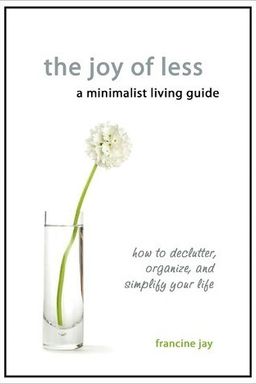
The Joy of Less cover

The Joy of Less

by Francine Jay

The Joy of Less guides you to embrace minimalism and simplify your life. With easy steps and the STREAMLINE method, transform your home into a serene space while focusing on what truly matters. Discover how to reduce stress, save money, and enhance your quality of life by decluttering your environment and mind.

The Joy of Living with Less

What if having less stuff could actually make you happier? In The Joy of Less, Francine Jay argues that our possessions often weigh us down physically, mentally, and emotionally. Despite the constant cultural messages that buying more will make us beautiful, successful, and satisfied, Jay flips this assumption: true happiness and freedom come from owning less, not more. She contends that a cluttered life leads to stress, while simplicity opens space—both literally and figuratively—for peace, creativity, and joy.

A Fresh Take on Minimalism

Jay begins by redefining minimalism. She rejects the cold, sterile aesthetic often associated with high-end minimalist design—white walls and three pieces of furniture—and reframes it as a warm, accessible philosophy for everyday people with kids, pets, laundry, and lives. Minimalism isn’t about deprivation, she explains; it’s about liberation. It’s the freedom that comes when our homes stop controlling us. The word “empty,” she notes, shouldn’t feel sad—it means space: space to think, play, create, and breathe. In this sense, a home is most valuable when it’s not overflowing, but when it offers openness and potential.

From Mindset to Method

Before diving into the practical side of decluttering, Jay insists on cultivating a minimalist mindset. Like dieting, decluttering won’t work as a quick fix if our thinking doesn’t change. A person can throw away half their stuff overnight, only to fill the space again in six months. Instead, Jay begins with philosophy—helping us rethink our relationship with possessions. She walks readers through ideas like seeing our stuff for what it truly is, remembering that we are not what we own, understanding how excess equals anxiety, and recognizing that fewer things mean more freedom. These ten philosophical ideas form the foundation for her STREAMLINE method, a hands-on roadmap for simplifying any space.

The STREAMLINE System

The heart of Jay’s approach is the STREAMLINE method, ten steps for decluttering that cover both theory and practice. Each letter—Start over, Trash/Treasure/Transfer, Reason for each item, Everything in its place, All surfaces clear, Modules, Limits, If one comes in, one goes out, Narrow it down, and Everyday maintenance—builds toward sustainable simplicity. The process doesn’t depend on buying expensive containers or organizing systems; in fact, Jay humorously contrasts her method with organizing books that merely rearrange clutter instead of eliminating it. Her focus is not on storage but on reduction: the art of getting rid of what doesn’t serve you.

Minimalism Beyond the Home

Jay extends minimalism beyond physical spaces. Once your house is clear, she explains, your schedule and mind will follow. Minimalism isn’t just decluttering; it’s a lifestyle shift that transforms how you use your time, attention, and energy. She encourages streamlining obligations, setting boundaries with the word “no,” and setting priorities that align with your personal joy. Moreover, Jay pushes minimalism toward an ethical dimension: living simply so others may simply live. She emphasizes that every unnecessary purchase consumes resources that could serve someone else. Minimalism becomes not only personal liberation but also an act of social and environmental kindness.

Why It Matters

Minimalism, in Jay’s vision, isn’t austere—it’s hopeful. She argues that when we declutter our homes, we declutter our minds, our calendars, and even our carbon footprints. The book is both personal and global in scale: it’s about reclaiming life from clutter, but also about reclaiming the planet from overconsumption. Her message echoes broader movements found in works like Marie Kondo’s The Life-Changing Magic of Tidying Up and Joshua Becker’s The More of Less, but Jay’s tone is conversational and warm, like a friend cheering you through each cabinet and drawer. By the end of The Joy of Less, the reader sees minimalism not as a restriction, but as a gateway—to freedom, creativity, ethical living, and joy. Jay’s promise is simple but transformative: when you own less, you don’t lose; you gain space, peace, and the joy of enough.


See Your Stuff for What It Is

Jay begins by helping you confront the reality of your possessions. Take a look around, she says—the objects filling your vision each came with cost and effort. Seeing your stuff clearly means stripping away the emotional fog that clouds judgment. She divides possessions into three categories: useful stuff, beautiful stuff, and emotional stuff. This triad allows you to analyze items rationally rather than sentimentally.

Useful, Beautiful, and Emotional

Useful things earn their place because you use them—beds, computers, tea kettles, screwdrivers. However, Jay insists you ask: do I actually use it? Owning tools or gadgets doesn’t automatically make them useful. Beautiful things feed your spirit—the artwork or object that makes you feel joy when you see it. Emotional items remind you of people, places, or moments—but only those that bring happiness should stay. A dusty heirloom kept out of guilt doesn’t serve you; it just weighs you down.

Having Conversations with Your Stuff

Jay playfully suggests talking to your possessions: “What are you and what do you do?” “Would I replace you if lost?” “Am I keeping you out of obligation?” This exercise unveils truths about hidden attachments. The process echoes Marie Kondo’s method of thanking objects before letting them go, yet Jay emphasizes practicality over ritual. If an item can’t answer these questions positively, it’s not adding value to your life.

The Subcategories of Clutter

She identifies two hilarious forms of clutter: other stuff’s stuff—like accessories, manuals, or packaging—and other people’s stuff. The latter may linger from your spouse, roommate, or relatives, requiring diplomacy rather than authority. Begin with your own things and hope your attitude becomes contagious. In short, Jay teaches you to see clearly: clutter isn’t neutral; it’s excess energy and space hijacked by forgotten, unloved, or unnecessary items.


You Are Not What You Own

One of Jay’s most liberating lessons is detaching identity from possessions. Society tells us our cars, clothes, and homes reflect our worth. But, she declares, you are not what you own; things are just things. This insight hits deep because so many of us chase self-image through brands and purchases, trying to buy status, success, or self-esteem.

Aspirational Stuff and Fantasy Selves

Jay introduces the idea of “aspirational stuff”—objects bought to impress others or express our fantasy selves. Maybe you bought hiking gear imagining weekend adventures that never happen, or cocktail dresses for imaginary parties. Such items represent who we wish we were, not who we actually are. Their presence pulls focus away from living authentically in the present.

Liberation Through Detachment

Owning expensive designer goods or sentimental relics doesn’t define you; your actions and relationships do. Jay reminds readers that letting go of old achievements or unfulfilled ambitions—like trophies or graduation gowns—creates space for new experiences. She contrasts consumer promise versus reality: a luxury car doesn’t make you more valuable; it anchors you to debt and obligation. Minimalism breaks those chains.

“We are what we do, think, and love—not what we buy.” This mantra encapsulates Jay’s theme of self-worth independent from possessions.

Compared with thinkers like Erich Fromm (To Have or to Be?) or Joshua Becker (The More of Less), Jay’s tone is gentle, but her message radical: possessions shouldn’t be surrogates for experience. Freed from attachment, you can focus on becoming rather than accumulating.


Less Stuff, Less Stress

Imagine calculating all the energy spent on just one possession—earning money to buy it, cleaning, maintaining, and worrying about its potential damage. Multiply that by everything you own, and you have a full-time job taking care of your stuff. Jay argues that our possessions often own us more than we own them.

How Stuff Creates Stress

She walks readers through the cycle: first, stress from wanting things; then stress from buying them; and finally stress from maintaining them. We obsess over scratches on our car, stains on our silk blouse, or repairs for gadgets. Jay connects this to broader anxieties—debt, time scarcity, and emotional exhaustion. The culprit isn’t just money—it’s mental clutter.

The Joy of Less Equals Peace of Mind

Jay’s antidote is cutting possessions in half—literally imagining life with 50% fewer things. The relief is palpable: less debt, fewer chores, more weekends free. She reminds readers that college dorm life or vacations often felt joyful precisely because we had so little. There’s a connection between simplicity and serenity: fewer ownership worries, more time for experiences. (Psychologist Barry Schwartz’s Paradox of Choice supports this idea that fewer options can reduce anxiety.)

Minimalism is thus emotional self-care. When we relieve ourselves from consumer burdens, we reclaim energy for relationships and creativity instead of maintenance. Jay’s mantra here could easily summarize the entire philosophy: less stuff equals less stress.


Less Stuff, More Freedom

Jay likens clutter to chains. Imagine being offered a dream job across the country—would your excitement be dampened by the thought of packing your entire house? In this vivid analogy, possessions are anchors that keep you from moving, traveling, or taking opportunities. “Things can be anchors,” she warns; they hold you in place physically and emotionally.

Freedom Through Mobility

To explain the liberation of minimalism, Jay uses travel imagery. Owning too much is like lugging three suitcases on vacation; traveling light transforms the journey into adventure. With fewer belongings, we’re nimble and spontaneous—ready to embrace life’s possibilities instead of guarding our stuff. This metaphor recurs throughout minimalist literature (Colin Wright’s nomadic philosophy, for instance, echoes Jay’s call for mobility).

Freedom from Debt and Obligation

Beyond physical mobility, owning less frees us financially. Debt enslaves, she says, forcing people into jobs they hate to pay for unnecessary purchases. The minimalist alternative restores power over time and income. Jay encourages readers to picture what could be done with resources saved: new studies, travel, volunteering, or creative projects—all impossible while chained to bills and clutter.

Living Lightly and Connecting Deeply

Minimalist freedom isn’t isolation but connection. Without the barrier of stuff, we engage more deeply with others and the world. Experiences replace possessions as our measure of success. By dismantling the “prison of possessions,” Jay makes freedom not abstract but tangible—you feel it in a clean room, a light backpack, and an unburdened mind.


The STREAMLINE Method

After crafting a minimalist mindset, Jay arms you with a concrete system: the ten-step STREAMLINE method. It offers structured yet flexible steps for decluttering every space. Unlike fad systems based on endless sorting containers, STREAMLINE emphasizes decision-making and sustainable simplicity.

S - Start Over

Remove everything from a space and imagine moving in anew. Empty rooms inspire clarity—a curator selecting treasures instead of a hoarder defending clutter. This reframing changes decluttering from disposal to curation, making it joyful rather than punitive.

T - Trash, Treasure, or Transfer

Sort every item into three piles: what’s garbage, what’s worth keeping (Treasure), and what should move on (Transfer). Jay even suggests a “Temporarily Undecided” box dated for future review. The distinction makes decision-making concrete, reducing paralysis.

R through N - Reason, Place, and Limits

Each subsequent step deepens organization: Reason for each item ensures purpose; Everything in its place and All surfaces clear prevent backsliding; Modules and Limits contain categories and quantities; If one comes in, one goes out balances flow; Narrow it down pushes continuous refinement; Everyday maintenance sustains the habit. Together, these principles make minimalism permanent, not episodic.

STREAMLINE is a philosophy disguised as a cleaning method—its real aim is transforming decision-making about ownership itself.

Jay’s STREAMLINE echoes the clarity of David Allen’s Getting Things Done process—systematic yet humane. Once mastered, clutter retreats and mindfulness grows. Every item left becomes intentional.


Decluttering Room by Room

Jay ensures practicality by going space by space—from living rooms to wardrobes, kitchens to bathrooms, even sentimental items. This section of the book translates philosophy into practice with personality and humor.

Living Room: Flex Space for Living

The living room should be a stage for life, not storage. Jay compares cluttered homes to museums of unused furniture. She guides you through evaluating each piece’s purpose and encourages flex space—areas empty and ready for different activities. Surfaces, she insists, are not for storage.

Bedroom: Sanctuary of Serenity

The bedroom must restore, not exhaust. Jay’s rules: clear the floor, keep only peaceful décor, and limit furniture to essentials. The daily act of making the bed becomes ritual of mindfulness. Serenity requires simplicity.

Wardrobe and Kitchen Wisdom

Her wardrobe advice rivals the capsule wardrobe movement: keep only flattering, functional pieces, define your style, and embrace “one of each.” In kitchen and dining spaces, she preaches elegant utility—limit tableware to family size, ditch gadgets, and keep countertops clear. Function creates beauty.

Storage and Sentiment

Basements and attics, she jokes, are clutter’s final frontier. Her rule: if you haven’t used something in a year, it’s gone. For sentimental items, she offers compassion—choose one symbolic piece or digitize memories. The goal isn’t to erase nostalgia but to prevent it from consuming space.

These room-by-room practices make minimalism tactile and achievable. Readers find transformation in every drawer and shelf—where philosophy meets everyday life.


Minimalism as Lifestyle and Ethics

In the final section, Jay broadens her argument: minimalism isn’t just about neat homes—it’s about better living and a better world. She invites readers to streamline not only space but schedules and values. This expansion makes The Joy of Less more than self-help; it’s social philosophy.

Decluttering Time and Mind

Jay prescribes “ten techniques to simplify your days.” Say no to obligations that drain energy. Eliminate excess activities. Prioritize what truly matters. Consolidate tasks, standardize routines, delegate responsibilities, and most importantly, embrace “good enough” instead of perfection. Her reminder to just “be”—to pause, breathe, and appreciate stillness—links simplicity to mindfulness traditions (similar to Thich Nhat Hanh’s teachings on presence).

Living Simply So Others May Simply Live

Jay’s ethical vision rests on Gandhi’s maxim: live simply so others may simply live. Every nonessential purchase consumes shared global resources. She introduces the concept of the minsumer, a mindful consumer who minimizes consumption’s impact on people and planet. Rather than endless recycling after thoughtless buying, the minsumer reduces and reuses first. Jay celebrates buying locally, sharing resources, and choosing sustainable materials—a small philosophy with global consequences.

The Butterfly Effect of Minimalism

Jay concludes with a beautiful metaphor: the bull of overconsumption versus the butterfly of gentle living. Minimalists, she suggests, are butterflies—light, graceful, and restorative. Living lightly protects the planet and clears space for compassion and creativity. She envisions nations of butterflies replacing nations of bulls, where joy derives from relationships and purpose, not possessions.

In this way, The Joy of Less transcends its tidy premise. It’s about redefining abundance—not as accumulation, but as gratitude. Living with enough becomes an act of kindness to oneself, others, and the Earth.

Dig Deeper

Get personalized prompts to apply these lessons to your life and deepen your understanding.

Go Deeper

Get the Full Experience

Download Insight Books for AI-powered reflections, quizzes, and more.