
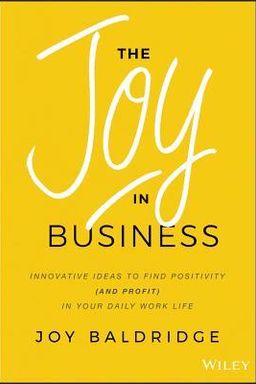
The Joy in Business cover

The Joy in Business

by Joy J D Baldridge

The Joy in Business offers essential tools and techniques for enhancing happiness and success in personal and professional life. Joy J D Baldridge draws from her extensive experience to provide readers with actionable insights on cultivating a positive mindset, effective communication, and healthy habits.

Finding Joy and Meaning in Everyday Work Life

Have you ever felt that your work life is missing a spark of joy — that your daily routine has become a grind rather than a source of meaning? In The Joy in Business, Joy Baldridge asks exactly that question and responds with an energetic roadmap for turning ordinary work experiences into extraordinary ones. She argues that joy isn’t a luxury or a perk; it’s a strategy. Baldridge, drawing on years of speaking, coaching, and corporate consulting, contends that cultivating positivity isn’t just about smiles and slogans — it’s about developing concrete habits that increase productivity, profitability, and personal satisfaction at the same time.

At the heart of Baldridge’s message is the belief that joy results from flexibility, adaptability, awareness, and consistent self-care. She describes a series of mental models, quirky metaphors, and memorable acronyms — such as AFA: Always Flexible and Adaptable, R.E.N.T.: Rest, Exercise, Nutrition, Thoughts, and PAR: Prevent, Acknowledge, Release — to help readers reframe stress and use small, intentional actions to reclaim control of their work lives. Through practical stories, humorous anecdotes, and motivational quotes, she makes the pursuit of joy feel achievable even on the busiest days.

Why Joy Matters in Business

Baldridge challenges traditional views of productivity that equate success with long hours and constant pressure. She reminds you that fatigue and frustration can drain creativity, communication, and compassion — the very elements that sustain great leadership. Drawing on cognitive psychology and business insights (similar to Shawn Achor's The Happiness Advantage), she shows that happiness directly boosts performance by sharpening focus, increasing resilience, and reinforcing teamwork. In her vision of business, feeling good isn’t separate from doing well; it’s the fuel that drives both.

Turning Positivity into Tangible Practices

The book’s unique structure reads like a series of compact, energetic conversations — each one introducing a tangible concept called a “Golden Nugget” that can be instantly applied at work or at home. You learn why taking short “Purple Breaks” to rest your eyes can revive your energy, how the “House of Glad” metaphor helps manage emotions, and why paying your R.E.N.T. daily keeps your mental and physical foundation strong. Baldridge’s style is conversational but highly actionable, encouraging you to try each idea right away rather than simply reflect on it. Her mantra, “Now is perfect,” captures this spirit of immediacy and mindfulness.

Stories That Spark Transformation

Throughout the book, Baldridge uses vivid examples — from calling the White House at age nineteen to auditioning for “America’s Got Talent” with her teenage daughter — to illustrate courage, adaptability, and the power of seizing opportunities. Each story embodies her belief that even wild or embarrassing experiences carry lessons about flexibility, resilience, and joy. Her father’s “Salt the Hay” motto reminds readers to think creatively when facing obstacles, while the “Bee Stinger Out” story teaches how to let go of lingering regret. These stories make abstract principles feel lively and human.

The Habit of One Thing

A recurring theme throughout Baldridge’s framework is consistency. She encourages readers to ask each day: “What’s the one thing I can do to further my success for tomorrow?” This mindset mirrors the incremental improvement philosophy of books like Gary Keller’s The One Thing — a reminder that sustainable progress comes from small, focused moves enacted regularly. Baldridge’s mix of humor, optimism, and structure turns that daily question into a kind of joyful ritual for re-centering purpose.

Why Joy Is a Strategic Advantage

Ultimately, Baldridge’s premise is simple but radical: joy is a skill that can be learned and practiced. It is the single most underrated driver of organizational excellence. When you embody AFA, pay your R.E.N.T., acknowledge and release negativity through PAR, monitor your “ogive” curve of emotions, and speak the Language of the Lands to relate to different personality types, you’re not just becoming happier — you’re becoming more effective. As Baldridge repeatedly says, “Those on the top of the mountain didn’t fall there.” Joy is earned through disciplined optimism and mindful action. And whether you’re a CEO, student, entrepreneur, or parent, her message is clear: the path to productivity and profit begins with joy.


AFA All the Way: Always Flexible and Adaptable

Baldridge begins her toolkit for joyful living with what she calls the AFA mindset — Always Flexible and Adaptable. This concept, inspired by her father’s teaching and symbolized by a little yellow stress doll named BOB, captures her belief that modern success depends on resilience. According to a Fortune magazine article, the two traits required for employment in the new millennium are flexibility and adaptability; rigidity simply doesn’t work anymore. Being AFA means bending without breaking when circumstances shift and adjusting smoothly when plans crumble.

Meet BOB: The Mascot of Resilience

BOB — short for “Build On Bounce” — is a small, stretchy yellow figure that Joy gives to audience members at her talks. When stretched, BOB always snaps back quickly, embodying the idea of instantly recovering from pressure. Baldridge uses BOB to ask: how fast do you bounce back from adversity? In one corporate seminar, participants used BOB as a stress-relief reminder that resilience is visible and playful. Even kids found inspiration in him — one client’s son going through a tough divorce told his mother, “I’m going to be flexible and adaptable like BOB.” BOB became a symbol of emotional endurance for families, employees, and leaders alike.

Flexibility Starts with “It’s OK”

The AFA mindset begins with the phrase “It’s OK.” Whether you’re stuck in traffic, late for a deadline, or facing an unexpected setback, saying “It’s OK, because I’m flexible and adaptable” helps you shift from reactive panic to proactive adjustment. This aligns with mindfulness techniques found in psychological research: verbal self-assurance reduces stress by signaling acceptance. Baldridge illustrates this through a real-life example — when her daughter’s asthma attack forced her to cancel an important meeting, her colleague replied simply with “AFA.” That one word immediately released her guilt and anxiety, proving that flexible people help others stay flexible too.

From Stress to Flow

Practicing AFA changes how you relate to tension. Instead of resisting challenges, you learn to flow through them. Baldridge encourages readers to use AFA as a code at work — texting “AFA” when plans change or conversations stall. Just a three-letter message transforms workplace culture into one of empathy and ease. Teams using the AFA code experience less conflict and more trust because its meaning — we’re flexible, we’ll adjust — reinforces cooperation instead of blame.

AFA as Daily Discipline

For Baldridge, flexibility isn’t optional self-help; it’s a professional discipline. She compares it to yoga for the mind: the practice of stretching your emotional muscles so you can bounce back fast. Being AFA allows you to maintain perspective no matter what happens. The payoff, she says, is huge — you stop feeling like things are happening “to you” and start feeling empowered to adapt to them. You become the calm center in a storm of deadlines, change, and uncertainty, and as Joy likes to remind her readers, “Situations may not be OK, but you’re OK.”


Pay Your R.E.N.T. Every Day

You may have heard of paying rent as a financial obligation, but Joy Baldridge redefines it as a personal investment in well-being: Rest, Exercise, Nutrition, and Thoughts. To live in what she calls the House of Glad — a mental space of calm energy and gratitude — you must pay your R.E.N.T. every day. Each component is essential for emotional, mental, and physical stability, forming a foundation to your long-term success.

Rest: Recharge and Reset

Baldridge’s father created the “Purple Break,” a practice of closing your eyes and restoring visual purple (rhodopsin) — the molecule that regenerates in total darkness. You simply cover your eyes, breathe, and count backward from fifteen. It takes about a minute. This micro-rest restores alertness, focus, and creative energy. She jokes that doing a public Purple Break may confuse colleagues, but done discreetly, it’s a powerful performance hack. Short intentional pauses, like her 4–4–6 breathing, achieve the same purpose: resetting your rhythm for better decisions.

Exercise: Move or Lose Momentum

Exercise doesn’t have to mean marathon training. Baldridge’s father’s first run was just to the neighbor’s mailbox — a small step that later led him to attempt a real marathon. Tiny actions, she explains, compound into big results. Whether it’s taking the stairs, stretching between Zoom calls, or even raising your arms in the air with coworkers, movement breaks guilt and builds energy. Her motto: “Don’t just sit there — do something!” echoes James Clear’s Atomic Habits in advocating micro-steps for macro-change.

Nutrition: Choose Fuel Wisely

Nutritionist Joann Flynn’s advice anchors this section: broccoli is good, sugar is evil. Baldridge recounts giving up sugar for Lent, a struggle that exposed how addictive it was, but also how powerful discipline can be. She describes sugar as more addictive than nicotine or heroin, contributing to emotional instability and chronic disease. Her takeaway? Simple, balanced foods and mindful eating sustain both energy and optimism. The metaphor of protein as “logs on a fire” and carbs as “kindling” turns nutrition into a story of endurance versus quick burnout.

Thoughts: Fuel the Mind

Perhaps the most powerful part of the formula, Baldridge insists, is the “T.” She recounts advice from Dr. Jonas McAlarney, a physician who told her, “Your thoughts drive everything.” Positive thoughts dictate whether you rest, exercise, and eat well. Negative self-talk, in contrast, acts like missed rent payments — eviction from the House of Glad into the House of Mad, Sad, or Scared. By practicing positive affirmation flooding (“Every day in every way, I’m getting better and better”), you reprogram the subconscious to expect progress. Just like Émile Coué’s autosuggestion technique, repetition makes optimism habitual.

The R.E.N.T. Habit

Baldridge urges you to treat paying R.E.N.T. like brushing your teeth — small daily maintenance that prevents a major breakdown. Missing rent leads to emotional clutter and burnout, while paying it keeps you centered in gratitude. She even recommends finding a “R.E.N.T. buddy” to hold you accountable, turning self-care into shared care. As Dr. McAlarney reminds readers, “Your thoughts drive everything,” and in Baldridge’s world, that makes positive thinking the richest currency around.


Speak the Language of the Lands

Ever wondered why you click with some people and clash with others? According to Baldridge, communication feels broken not because people are difficult, but because they’re different. Her model of the “Language of the Lands” defines four personality types — Social, Factual, Helpful, and Driven — each with its own linguistic currency. Mastering their languages makes relationships smoother, teams stronger, and sales more successful.

The Four Lands and Their Hot Buttons

  • Socials live to be amazing. Their key words: “amazing,” “great,” “fabulous.” They crave recognition.
  • Factuals live to be right. They value precision and dislike vagueness.
  • Helpfuls live to help. They thrive on appreciation and emotional warmth.
  • Drivens live to win. They seek efficiency and results, not chatter.

Baldridge shows how just one word can unlock trust. Tell a Social someone’s work is “amazing” and you’ll have their attention. Tell a Factual their method is “exactly right” and they’ll glow. Compliment a Helpful by saying “I couldn’t have done it without you,” and they’ll beam. Drivens, meanwhile, respond to concise results: “You win.”

Fluency Builds Bridges

Baldridge urges practicing these languages deliberately, much like learning French or Spanish. Try “speaking Factual” with technical colleagues or “speaking Helpful” with a teammate who values cooperation. She recounts how discovering her husband’s Factual nature saved their marriage — he didn’t respond to “amazing” compliments, but lit up when she praised his precision. Once she learned the right words, communication transformed. It’s empathy through language: adjusting vocabulary to make others feel seen.

Compliment Translation and Connection

If someone misses your preferred language, Baldridge suggests doing a “compliment translation.” When her Factual husband told her she was “right,” she mentally translated it to “amazing.” The emotional benefit was the same. Language, she insists, shapes reality. Avoid assuming your language is universal; adapt your words intentionally. This echoes Stephen Covey’s insight (“Seek first to understand, then to be understood”) from The 7 Habits of Highly Effective People.

Empathy Through Language

In business, speaking multiple lands’ languages turns diversity into synergy. A sales rep fluent in “Driven” and “Factual” can persuade executives; a leader fluent in “Helpful” and “Social” can nurture morale. Baldridge’s concept bridges personalities by replacing judgment with curiosity. As Abraham Lincoln said, “I don’t like that man. I must get to know him better.” For Baldridge, the translation of that quote is simple: learn his language, and you’ll both speak the same joy.


Prevent, Acknowledge, and Release (PAR)

Negativity creeps into every workplace — worry, anxiety, fear. Baldridge calls them WAFs and introduces a three-step cure: Prevent, Acknowledge, and Release. PAR helps you deal with problems before they grow toxic by facing them instead of suppressing them. It’s a mindfulness tool disguised as a stress-management formula.

Prevent What You Can

Being proactive means thinking ahead and avoiding procrastination — what Albert Einstein would call “genius.” Baldridge echoes productivity wisdom from David Allen’s Getting Things Done: preparation minimizes panic. Create checklists, visualize outcomes, and act early. You can’t stop every storm, but you can carry an umbrella.

Acknowledge Without Judgment

When things do go wrong, denial intensifies pain. Baldridge teaches the power of acknowledging emotions out loud: “This is frustrating!” Naming what you feel activates what psychologists call “affect labeling,” reducing emotional charge and releasing tension. By admitting irritation, you paradoxically calm it. She writes that when you face negativity head-on, it loses strength and becomes manageable.

Release and Reset

Release comes naturally once acknowledgment occurs. This automatic release resets your mind to focus on the solution instead of the problem. Baldridge calls it “auto-release,” a system of emotional homeostasis. Pair it with her breathing exercises or affirmations to accelerate recovery. The mantra “Intellectuals solve problems; geniuses prevent them” (from Einstein) captures PAR’s preventive spirit.

Her advice: when WAFs arise, don’t run or repress. Pause, say how you feel, breathe, and let go. With time, PAR becomes self-conditioning — proof that the best answers, as she says, “lie within.”


Listening Equals Integrity

Baldridge elevates listening from a courtesy to a core leadership skill. Few people, she claims, ever master it. Listening, she writes, involves hearing and waiting “in suspense.” That means resisting the urge to reply, advise, or interrupt while others are speaking. Listening equals integrity because it demonstrates respect — and respect builds trust.

Why Listening Fails

Most people think faster than they speak. With mental speeds over 1,000 words per minute and speech speeds at 150, our minds drift. Baldridge’s listening quiz exposes how often we tune out, judge, or rush to respond. Scoring low isn’t shameful; it’s normal. Improving begins by choosing one bad habit to change into a good one, like replacing “interrupting” with “biting your tongue.”

Ten Techniques to Listen Better

  • Be 100% responsible for communication.
  • Use the Mirror Method (“So, just to clarify…”).
  • Bite your tongue (literally) to stop talking.
  • Drink heavily — water, not wine — to pause and think.
  • Cover your mouth when tempted to interrupt.
  • Jot notes instead of butting in.
  • Use the 4–4–6 breath to stay in the present.
  • Press your toes (Toe Press) to ground yourself.
  • Do a Purple Break before meetings for clarity.
  • Repeat key names five times to remember them.

Listening as Respect

Baldridge quotes Bryant McGill: “One of the sincerest forms of respect is actually listening to what another has to say.” Active listening helps organizations thrive, reduces miscommunication, and strengthens morale. She closes with humor from John Mayer’s “My Stupid Mouth” lyric — a playful reminder to “think before speaking.” In her world, that’s how respect sounds in practice.


Seize the Day: Carpe Diem Opportunities

Baldridge believes coincidences are opportunities in disguise. Her chapter on Carpe Diem challenges readers to notice serendipity and act on it. She tells stories that show how awareness and courage turn chance encounters into success.

Connecting Through Coincidences

A private banker reading The New York Times noticed that a corporate chairman moving offices happened to be from the same small island he grew up on. He reached out, mentioned their shared roots, and turned coincidence into a multimillion-dollar client relationship. The lesson: never underestimate small connections.

The Beverage Story

On a flight from Milwaukee to Nashville, two strangers laughed when a Coke exploded. That shared humor revealed they both worked in the beverage industry — and led to a business deal. Baldridge calls this “planetary alignment”: when laughter or empathy opens a door. If you’re paying attention, the universe often cues you to act.

Practicing Carpe Diem

To seize opportunities, you must be prepared, curious, and willing to ask questions. Baldridge encourages exchanging contact information and following up — that’s where magic happens. As Clive Davis said, “You’ve got to seize opportunity if it is presented to you.” Everyday coincidences may be intentional intersections waiting for courageous responses.

Her reminder from Will Rogers — “Even if you’re on the right track, you’ll get run over if you just sit there” — captures the spirit perfectly. In Joy’s world, paying attention and taking action isn’t luck; it’s leadership.

Dig Deeper

Get personalized prompts to apply these lessons to your life and deepen your understanding.

Go Deeper

Get the Full Experience

Download Insight Books for AI-powered reflections, quizzes, and more.