
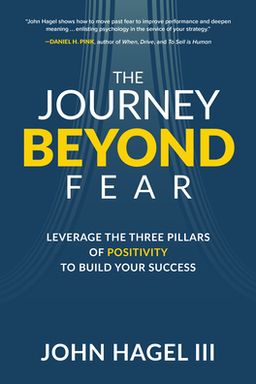
The Journey Beyond Fear cover

The Journey Beyond Fear

by John Hagel III

In ''The Journey Beyond Fear,'' John Hagel III reveals how to conquer fear and unlock potential using three key tools: inspiring narratives, passion alignment, and collaborative learning. Discover how these strategies open doors to personal and professional growth.

The Journey Beyond Fear: Transforming Pressure into Passion

What if the fear that holds you back from fulfilling your potential could become the fuel that propels you forward? In The Journey Beyond Fear, John Hagel III invites you into a radical rethinking of how individuals, organizations, and societies respond to accelerating change. Hagel argues that fear—the most pervasive emotion in modern life—has become a silent epidemic, undermining creativity, trust, and innovation just as global pressures mount. But he contends that the antidote to fear isn’t naïve optimism; it is cultivating three pillars of positivity: meaningful narratives, the passion of the explorer, and learning platforms that connect people to achieve exponentially greater impact.

Hagel’s premise is simple but profound: We live in an age of unprecedented possibility, yet also unprecedented pressure. The same digital systems that connect the world have intensified global competition, shortened product lifecycles, and disrupted traditional institutions. In such conditions, people instinctively retreat into protective fear-based mindsets, which magnify risk, shorten perspective, and diminish trust. The challenge, Hagel says, is to transform that fear-driven pressure into excitement and growth.

The Context: Fear in a World of Acceleration

Drawing from his global experience—from Silicon Valley to the World Economic Forum—Hagel paints a world in flux. Technology’s exponential growth has made us simultaneously empowered and insecure. He offers personal reflections, describing how his childhood in a turbulent household full of emotional pressure shaped his understanding of fear’s corrosive effects. Now working within the fast-paced digital economy, he sees similar patterns magnified across industries. The performance pressure feels relentless: you compete globally not only with millions of people, but with machines capable of doing your job better and faster. The billboard Hagel saw in Silicon Valley—“How does it feel to know a million people can do your job?”—symbolizes the collective anxiety of modern professionals.

Hagel’s research at Deloitte’s Center for the Edge found that corporate performance has been declining for decades. Despite innovations, U.S. public companies’ return on assets fell 75% from 1965 to 2019—a staggering long-term erosion. The takeaway? Our institutions, built around scalable efficiency, are no longer fit for a world that demands scalable learning. This misalignment feeds fear rather than excitement, driving people into reactive survival modes instead of hopeful exploration.

The Antidote: The Three Pillars of Positivity

The heart of Hagel’s message revolves around three interconnected principles:

  • Narratives – These are not stories with tidy endings, but open-ended calls to action that inspire collective movement toward future opportunities. They define a journey rather than describe a completed outcome.
  • The Passion of the Explorer – A mindset oriented toward discovery, excitement, and continuous learning, distinct from obsessive ambition or fear-driven competition.
  • Learning Platforms – Environments, digital or human, that enable small groups to learn through action together, creating “creation spaces” where impact compounds exponentially.

These pillars interlock to support what Hagel calls the “journey beyond fear.” Narratives supply meaning and direction; passion provides emotional fuel; and learning platforms connect people to accelerate growth. When aligned, they create a system of positive emotion and compounding collaboration. The outcome is not just personal transformation—though that’s crucial—but the revitalization of our institutions and societies.

Why This Journey Matters

Hagel’s vision reaches beyond individual psychology to organizational and social structures. He warns that isolation, both emotional and institutional, is the enemy of progress. Fear drives isolation; hope fosters connection. In a digitally connected but emotionally fragmented world, the ability to build trust-based relationships is the key differentiator of the future. Those willing to move from fear to excitement—guided by opportunity narratives, fueled by passion, and amplified through collective learning—will thrive amid change.

The book’s metaphors make the journey vivid: life as a voyage on uncertain seas, requiring narrative as a compass, passion as wind, and platforms as the crew that enables you to sail forward. Hagel invites readers to become explorers rather than survivors—people willing to venture toward the edges where the greatest learning happens. Like his own career transitions—from management consulting to startup founder to thought leader—growth only occurs at the edge of comfort, where fear becomes excitement.

A Call to Action: From Fear to Opportunity

Ultimately, Hagel’s book isn’t just a reflection on fear—it’s an actionable framework. He challenges you to examine how fear shapes your personal narrative and whether you’ve framed your future around threats or opportunities. He urges institutions to move from inward efficiency to outward learning; leaders to replace control with trust; and individuals to view pressure as an invitation to explore. As philosopher Dee Hock (Visa’s founder) told Hagel, “It’s not about risk and reward—it’s about fear and hope.”

“Our ultimate opportunity,” Hagel writes, “is to develop our own, our organization’s, and all of humanity’s potential in the fullest possible way.”

By the end of The Journey Beyond Fear, you realize that moving past fear isn’t a psychological exercise—it’s a lifelong transformation. The real journey is toward collective possibility. Whether you’re an executive overwhelmed by change or an entrepreneur navigating uncertainty, Hagel insists the same truth: Fear is inevitable, but it need not be the dominant force. Given the proper narrative, passion, and platform, fear can be transmuted—into curiosity, connection, and creativity that redefines success for the 21st century.


The Power of Narrative: Crafting Future-Focused Stories

John Hagel distinguishes between a story and a narrative—an essential difference that reshapes how you lead, learn, and connect. Stories, he explains, are enclosed worlds. They have beginnings, middles, and ends. Narratives, in contrast, are open-ended calls to action that cast you as an active participant in shaping an unresolved future. This distinction turns communication into movement and storytelling into mobilization.

Stories vs. Narratives

Stories conclude; narratives continue. A story might inspire you emotionally, but it leaves you as an observer. A narrative demands that you respond. For example, when Martin Luther King Jr. declared, “I have a dream,” he didn’t simply recount history—he called millions to act toward a vision still unrealized. That’s the essence of a true opportunity-based narrative: it lives in the future and depends on collective action.

Hagel contrasts this with “threat-based” narratives common in politics and media—those that tell us the enemy is at the gate and we must fight back. These feed fear and urgency but constrict creativity. Opportunity-based narratives, by contrast, expand imagination. They help people see challenges as springboards, not obstacles. Where fear shrinks time horizons, opportunity expands them.

Opportunity-Based Narratives and Their Levels

Hagel identifies four levels of narrative: personal, institutional, geographical, and movement-based. Each can influence the others. A personal narrative shapes how you engage with your own life; institutional narratives define how companies connect with customers; geographical narratives energize cities or nations; and movement narratives mobilize societies toward transformative change.

For example, Apple’s “Think Different” campaign embodies a powerful institutional narrative. The company wasn’t telling its own story—it was inviting you to join the adventure of creative individuality. “Belong Anywhere” by Airbnb is another narrative, challenging isolation and promising connection. These slogans are shorthand for vast opportunities that live beyond the brand itself.

Why Narratives Overcome Fear

Fear thrives in uncertainty and isolation; narratives counter it by providing clarity and connection. They shift focus from threats to possibilities, from “Who will win?” to “How can we win together?” Opportunity narratives create positive-sum worlds, where collaboration expands resources rather than divides them. By inviting participation, they build trust—a force that fear undermines.

Narratives also serve as psychological anchors. In turbulent times, people crave meaning and direction. Hagel compares narrative to a North Star: a guiding light amid change. It stabilizes identity without limiting discovery. Where institutions often cling to rigid rulebooks, a good narrative keeps you moving toward something larger than yourself, aligning personal motivation with a shared cause.

Crafting a Powerful Narrative

According to Hagel, the most effective narratives share eight features:

  • They align with broader forces shaping the world (like technological transformation).
  • They invite open-ended participation, giving room for creativity.
  • They define opportunities with enough detail to be credible, but enough space to be flexible.
  • They appeal to emotion as much as reason, sparking excitement and hope.
  • They are realistic about challenges, yet focus on achievable progress.

Critically, a narrative isn’t written—it’s lived. It grows from sustained action. Hagel emphasizes that people believe what they see, not what they’re told: “If you’re not acting within your narrative, no amount of marketing will make it credible.” Thus, a narrative begins as an intention but matures through motion and accountability.

“Narratives are not words on a page. They emerge through action—and they evolve through learning.”

For leaders, communicators, or anyone seeking to inspire change, Hagel’s framework transforms messaging into mission. Instead of broadcasting information, you extend an invitation: a call to help fulfill an exciting, unfinished story. As narratives cascade across levels—from your personal quest to institutional or geographic movements—they replace isolation with alignment. In that alignment lies the power to transcend fear and turn complexity into opportunity.


Personal Narratives: Overcoming Isolation and Fear

If narratives are calls to collective action, your personal narrative is the call you issue to yourself and those closest to you. It’s how you frame your life’s purpose and invite others to join you in shaping it. John Hagel reveals that for most people, this narrative is unconsciously shaped by fear—especially in the early phases of life. Reframing that narrative is the first step toward reclaiming agency.

From Threat-Based to Opportunity-Based Living

Understanding your personal narrative begins by asking: Is your future defined more by threats or opportunities? Hagel’s own story offers a vivid case study. His childhood, marked by parental conflict and emotional volatility, taught him that love had to be earned through achievement. He internalized a threat-based narrative—“Our world is full of challenges; tell me your problems, and I’ll help you solve them.” This narrative drove him toward excellence but confined him to transactional relationships built on performance, not passion.

Professionally, this mindset led Hagel to management consulting at McKinsey and later Deloitte. His early success was real but unfulfilling. Helping others analytically (while avoiding emotion) became his survival mechanism. Only years later, after personal crises—including two failed marriages—did he realize his narrative had limited him. His turning point came when he reframed his story from “helping others solve problems” to “helping others and himself explore the edges of what’s possible.”

Crafting Your Personal Narrative

Hagel proposes a reflective practice to make your personal narrative explicit and opportunity-based:

  • Identify whether your current narrative is driven by fear or excitement. What dominates your thinking about the future—risk or possibility?
  • Determine the call to action you issue to others. Are you inviting collaboration or encouraging dependence?
  • Ask who your narrative empowers. Does it motivate others to help you, or does it attract those who amplify your capacity to contribute?

Through these questions you begin transforming your threat narrative into an opportunity narrative—one that celebrates exploration, creativity, and shared growth. Hagel’s client stories illustrate this transformation. One physician initially pursued medicine to avoid financial insecurity, inheriting her parents’ anxiety. After reflection, she reframed her work around the opportunity to help patients maintain wellness rather than merely treat illness. By doing so, she founded a new collaborative clinic focused on holistic well-being, connecting nutritionists, coaches, and meditation teachers. Her fear turned into fuel for innovation.

Leverage Through Relationships

A powerful personal narrative does more than define purpose—it attracts allies. Hagel reminds readers that impact scales through relationships. Fear-based narratives isolate; opportunity-based ones connect. When your narrative includes a call to action for others to co-create change, it builds trust and shared excitement. Instead of transactional exchanges, you develop transformational partnerships.

Long-term, trust-based relationships multiply your learning potential. (Business theorists like Peter Senge in The Fifth Discipline echo this emphasis on shared learning.) The people who respond to your call amplify your purpose, just as Hagel’s collaborations at Deloitte’s Center for the Edge and Singularity University magnified his own exploration of institutional innovation.

Key Lesson: Examine Your Narrative Lens

Every strategic choice, career path, or emotional pattern flows from an underlying narrative about who you are and what kind of world you live in. The process of articulating and evolving that narrative is not a one-time act but an ongoing dialogue between identity and action. Hagel concludes: “We take the first step on our new journey when we recognize the extent to which fear has shaped our narrative—and the ways our narrative is reinforcing our fear.”

Moving beyond fear means reframing the meaning of success. Instead of security and control, seek challenge and collective learning. Your personal narrative becomes not a protective shell but a dynamic compass—one that points toward your edges, where life and growth truly occur.


Institutional Narratives: Rehumanizing Organizations

Organizations, Hagel argues, suffer from an identity crisis. Their implicit narratives are self-centered: “Buy our product,” “Trust our brand,” “Watch us succeed.” These pseudo-narratives feed institutional fear—fear of disruption, fear of irrelevance, fear of transparency. But when institutions craft opportunity-based narratives that focus not on themselves but on their customers’ aspirations, they can transform performance and trust from the inside out.

From Marketing Message to Movement

Hagel offers striking case studies. Apple’s “Think Different” wasn’t about Apple—it was about you. It invited individuals to reclaim creativity and break from conformity. Similarly, Nike’s “Just Do It” framed the opportunity for inner victory and reconnection with physical self, while Airbnb’s “Belong Anywhere” urged travelers to overcome isolation. Each narrative extended an open invitation to action, not just consumption. These companies understood what Hagel calls institutional leverage—mobilizing ecosystems of users and partners that expand impact exponentially.

Institutions become powerful when their narratives resonate with what customers already yearn to achieve. A healthcare company that frames wellness as empowerment rather than disease prevention can attract customers and collaborators aligned with that positive mission. The key, Hagel says, is moving from “inside-out” thinking (“Here’s what we sell”) to “outside-in” understanding (“Here’s what you hope to accomplish”).

Narratives vs. Purpose

Today’s business culture prizes “purpose statements.” Yet Hagel draws an important distinction: purpose motivates internal stakeholders, while narratives mobilize external ones. A purpose might read, “We aim to produce sustainable energy,” but a narrative says, “Join us in a global movement to unlock clean energy for all.” The latter sparks co-creation rather than compliance. Institutions should nest their purpose within a broader opportunity narrative—one that aligns their goals with the needs and dreams of others.

Benefits of Institutional Narratives

  • Exponential leverage: By framing opportunity beyond the organization, companies mobilize entire ecosystems. Apple’s app developers created far more value than Apple could on its own.
  • Accelerated learning: Narratives generate experimentation. When users and partners pursue the same opportunity, their actions produce shared learning that evolves the system.
  • Enduring trust: Narratives that invite collective creation show vulnerability (“We can’t do this alone”). That honesty builds emotional loyalty far deeper than brand marketing.

Challenges to Creating Institutional Narratives

Hagel outlines several barriers: leadership fear, over-delegation to PR teams, and limited time horizons. Executives often cling to quarterly results and view deep narrative development as risky or frou-frou. Yet he reminds them that fear is already undermining performance. Without opportunity narratives, the immune system of scalable efficiency suffocates innovation. Crafting a narrative must begin at the top—leaders living their stories, not outsourcing them.

“Institutional leaders must live their narratives,” Hagel warns. “If they don’t, external stakeholders will dismiss them as marketing ploys.”

The shift from threat-based defensiveness (“We’re losing market share—innovate faster!”) to opportunity-based expansion (“Let’s redefine what success means together”) transforms cultures. Institutions that rehumanize themselves through narrative don’t just sell; they serve. They evolve from transactional engines to platforms for shared growth—and in doing so, they overcome fear just as individuals do.


The Passion of the Explorer: Reframing Motivation

In an era that glorifies hustle, Hagel redefines passion—not as obsession or ambition, but as boundless curiosity and collaboration. The passion of the explorer is the second pillar of positivity that fuels creativity, risk-taking, and resilience. It’s what moves you from fear-driven survival toward excitement-driven discovery.

Passion vs. Obsession: The Social Divide

Hagel carefully differentiates passion from obsession. Obsession consumes; passion creates. Obsessive people narrow their focus, seeking escape from inadequacy by merging identity with an object—whether a celebrity or career title. Passionate explorers, however, expand identity through creation and connection. Their sense of self deepens as they help others learn and grow. Passion builds relationships; obsession isolates them. This insight mirrors psychologist Mihaly Csikszentmihalyi’s concept of “flow”—an energized engagement that blends self-loss and mastery, but always with purpose.

Passion vs. Ambition

Unlike ambition, which seeks external success—titles, money, recognition—passion is sustained by intrinsic fulfillment. Hagel points to entrepreneurs like Elon Musk and Jeff Bezos, whose exploratory drive kept them learning long after material comfort. Where ambition aims for control, passion seeks contribution. Passionate explorers value progress more than perfection.

A Taxonomy of Passion

Hagel offers a four-part taxonomy that traces how passion matures over time:

  • Passion of the Fan: The entry level—driven by curiosity and learning rather than contribution.
  • Passion of the Player: A short-term engagement that seeks to create but often lacks persistence.
  • Passion of the True Believer: A long-term commitment focused on an ideal path, sometimes rigid against questioning.
  • Passion of the Explorer: A long-term, evolving curiosity—thriving at the edges, seeking challenges, and building connections for impact.

The Explorer’s Three Traits

What distinguishes explorers are three dispositions:

  • Commitment to a domain: Explorers make long-term investments in areas where they can make a growing impact.
  • Questing disposition: They see obstacles as opportunities to expand capability, rather than threats to security.
  • Connecting disposition: They seek collaborators to accelerate learning, extending trust through shared vulnerability.

Why Passion Beats Fear

Passion, Hagel explains, transforms pressure into purpose. Where fear shrinks horizons and reinforces isolation, passion expands perspective and fosters learning. Organizations built on scalable efficiency tend to suppress this form of emotion, seeing it as unpredictable. Yet passion enables the rapid, adaptive creativity modern institutions need. When combined with reason—the structure that channels energy—it becomes unstoppable. As Benjamin Franklin wrote, “If passion drives you, let reason hold the reins.”

“Passion provides energy and freedom; reason provides structure and focus. We need both to achieve our full potential.”

To cultivate this passion, Hagel emphasizes exploration: look for experiences that excite you, not validate you. Seek challenges that stretch capability. And most importantly, connect with others who share your curiosity. Because passion thrives not in isolation but in conversation—it is the emotional fuel of collaboration, innovation, and fearlessness.


Finding and Integrating Your Passion into Work

Discovering your passion of the explorer isn’t about waiting for inspiration—it’s about deliberate reflection and courageous experimentation. Hagel insists that passion lives within everyone, even if it’s buried beneath institutional conditioning. Schools, workplaces, and cultural norms often suppress emotional exploration, teaching us to conform instead of to create. To rediscover passion, you must rebel against this conditioning by looking outside and within.

Rediscovering Passion

Hagel begins with an observation: every child shows passion naturally. Watch a six-year-old at play—they explore, connect, and learn with joy. Somewhere between playgrounds and boardrooms, adults lose that spark. Schools reward memorization, not curiosity. Employers value predictability, not exploration. The first step, therefore, is acknowledging that your loss of passion isn’t personal failure; it’s systemic suppression. The way out is curiosity—searching for experiences that excite you without fear of outcome.

Looking Outside

Venture into new domains. Hagel recalls how his youthful fascination with bulldozers and construction sites evolved into a lifelong passion for creating platforms where people collaborate to build something bigger—literally in projects, figuratively through digital ecosystems. External exploration helps surface recurring patterns of excitement, which reveal your deeper threads of interest.

Looking Within

Equally vital is introspection. Identify past experiences that generated joy or curiosity—books, projects, or mentors that captivated you. Across your memory, look for common elements. Hagel’s own reflection linked his love for architecture, strategy, and technology through a unifying theme: creating platforms that bring people together. By tracing such patterns, he uncovered his foundational passion of the explorer.

Integrating Passion and Profession

Finding passion is only half the challenge; integrating it with your professional life is where transformation happens. Many people work in environments hostile to exploration. At Deloitte, Hagel found only 14% of workers experienced the passion of the explorer—a stunning statistic. Institutions designed for scalability and efficiency often suppress passion because they fear unpredictability. Yet, small steps can build bridges: look for tasks that excite you, propose projects aligned with your curiosity, or connect with colleagues who share similar energy. Form what Hagel calls “impact groups”—small teams that learn through action and mutual accountability.

Some individuals, Hagel shows, make bold leaps. One senior university administrator left academia to become a handyman—a career aligned with his childhood love of fixing things. His income dropped, but his joy soared, eventually scaling into a successful business. Passion can be a compass, not a cage: when followed authentically, it guides you toward the work that makes fear irrelevant.

Driving Institutional Change

For those staying within existing organizations, Hagel advocates transforming institutions from the edges. Start small—experiment with new ways of learning, collaboration, and risk-taking that demonstrate positive results. These “edge initiatives” can attract senior allies and gradually reshape core structures. The new model should be one of scalable learning, not scalable efficiency. Instead of controlling workers, inspire exploration. Toyota’s assembly line experiment, where workers were rewarded for problem-solving rather than repetition, exemplifies this transformation.

“With the right effort,” Hagel writes, “we can turn our institutions from prisons into powerful learning platforms.”

Whether you leave or lead from within, integrating passion and profession requires courage and patience. It’s not an escape from pressure—it’s a way of transforming pressure into creative potential. When passion guides your work, fear becomes irrelevant because every obstacle turns into an opportunity to learn. The explorer’s reward, ultimately, isn’t wealth or security—it’s fulfillment through contribution.


Learning Platforms: Achieving More Together

The third pillar of Hagel’s framework—learning platforms—brings narratives and passion into collective motion. These platforms are environments where people come together to learn through action rather than instruction. Their purpose is not merely information exchange but exponential growth through collaboration. In a world of constant change, learning platforms transform isolated expertise into accelerating networks of improvement.

From Scalable Efficiency to Scalable Learning

Traditional institutions operate on scalable efficiency: replicate tasks, minimize deviation, and control outcomes. This model worked in stable times but suffocates innovation. Learning platforms invert the logic—decentralizing experimentation and amplifying discovery. They embody what Hagel calls the “power of pull”: drawing out potential, attracting unexpected collaborators, and accessing insights that lie beyond individual reach.

Four Types of Platforms

Hagel categorizes platforms into four types, each with distinct functions:

  • Aggregation platforms like Amazon or eBay connect users to resources, enabling transactions.
  • Social platforms like Facebook and Twitter build relationships and facilitate communication.
  • Mobilization platforms like Wikipedia or open-source software coordinate collective action toward shared goals.
  • Learning platforms integrate all of these to accelerate performance improvement through shared reflection and experimentation.

Learning platforms employ what Hagel calls “creation spaces”—shared networks of small, trusted groups engaged in iterative problem-solving. Examples range from extreme sports communities to SAP’s developer network, where coders globally solved problems and shared discoveries in real time. The design principle is simple: people learn fastest in small groups that act, reflect, and connect.

Designing a Learning Platform

Effective learning platforms possess key features:

  • Shared workspaces where members collaborate in small impact groups.
  • Feedback loops and metrics that track performance improvement.
  • Moderation and coaching functions that convert discussion into action and reflection.
  • Challenges staged at increasing levels of difficulty to foster collective mastery.

Crucially, learning must be fueled by passion and guided by narrative. Without emotional motivation, platforms become information warehouses rather than engines of progress. Together, these pillars create exponential learning cycles—more participants lead to more diversity of perspective, which leads to faster collective advancement.

The Future: Activation Centers

In closing, Hagel envisions activation centers—next-generation learning platforms designed to help people make the journey beyond fear. They combine workshops, coaching, and collaborative action spaces where participants discover their passion, evolve their narratives, and join movements to transform institutions and societies. The goal is nothing less than global exponential learning.

“Learning platforms help us shift from a world of diminishing returns to one of exponential opportunity.”

In Hagel’s vision, learning becomes a shared adventure—a way of being rather than a task. By connecting narratives that inspire and passions that energize, learning platforms make it possible to turn fear-driven pressure into collective excitement. The future belongs to networks that learn faster than the problems they face, and learning platforms are their sails.

Dig Deeper

Get personalized prompts to apply these lessons to your life and deepen your understanding.

Go Deeper

Get the Full Experience

Download Insight Books for AI-powered reflections, quizzes, and more.