
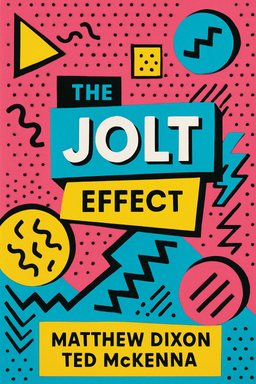
The JOLT Effect cover

The JOLT Effect

by Matthew Dixon and Ted McKenna

The JOLT Effect unveils a revolutionary sales approach grounded in extensive research, revealing how addressing customer indecision is the true key to success. This guide offers innovative techniques to improve win rates and build stronger relationships.

Winning the Battle Against Customer Indecision

Have you ever had a prospect say, “We’re excited about your solution, but we just need to think about it”? Every salesperson has experienced this maddening moment—the deal that looks certain, the buyer who seems completely on board, only for everything to stall. In The JOLT Effect, Matthew Dixon and Ted McKenna argue that this dead zone of inaction isn’t caused by poor selling or lack of urgency—it’s caused by something much more insidious: customer indecision.

Drawing on a massive study of more than 2.5 million sales conversations, the authors reveal that while salespeople have long been taught to defeat the customer’s status quo—the tendency to prefer sticking with what they know—that’s only half the battle. The bigger enemy isn’t resistance to change, but fear of making a mistake. The uncomfortable truth is that modern buyers aren’t stopping because they don’t see the value in moving forward. They’re stopping because they’re terrified of choosing wrong, missing something, or being held accountable for a failed decision.

The Real Opponent: Indecision, Not Inertia

Dixon and McKenna show that 40–60 percent of deals today end in “no decision,” meaning the customer simply never signs. Contrary to the conventional sales playbook, only 44 percent of these cases stem from status quo bias—the customer’s comfort with the current situation. The remaining 56 percent come from something far trickier: indecision driven by fear, uncertainty, and doubt. And this tendency is only getting worse as customers face more choices, more information, and more complex buying group dynamics than ever before.

Human nature plays a starring role here. Behavioral scientists Daniel Kahneman and Amos Tversky labeled it loss aversion—the principle that we feel the pain of loss twice as strongly as the pleasure of gain. Buyers are far more afraid of messing up than of missing out. The same psychological forces that make us hesitant about changing jobs, buying a house, or choosing investments are the ones that kill deals in the sales pipeline. The paradox: the more options and data you give a customer to boost confidence, the more anxious they often become.

Why Fear of Messing Up Beats Fear of Missing Out

At the heart of buyer indecision lies something psychologists call the omission bias—people would rather suffer from inaction than risk regret from action. From a seller’s perspective, that means buyers aren’t lazy or forgetful; they’re protecting themselves. Avoiding a bad decision feels safer than making a good one that might backfire. Buyers worry about picking the wrong option among many (valuation problems); they worry they haven’t done enough homework (lack of information); and they worry they won’t get the results promised (outcome uncertainty).

Each fear manifests in predictable ways—customers asking for endless references, demanding more demos, or wanting to “run the numbers again.” Most salespeople interpret these stalls as signs that they haven’t yet sold the value. They double down on data, urgency, and pressure tactics. The authors show, with overwhelming evidence, that this traditional playbook doesn’t just fail—it backfires, making customers even more indecisive.

“You don’t need to dial up the fear of not buying—you need to dial down the fear of buying.”

This insight overturns decades of sales doctrine. Where traditional methods focus on ‘beating the status quo,’ the JOLT approach helps sellers beat buyer anxiety. It shifts selling from persuasion to reassurance.

The JOLT Method: Four Steps to Move Buyers Forward

High performers, the authors found, intuitively follow a new playbook built around four behaviors that spell out the acronym JOLT:

  • J – Judge the Indecision: Top sellers assess a buyer’s ability to make decisions, not just their ability to buy. They spot the emotional triggers and environmental factors that predict paralysis, and they’re not afraid to disqualify a hopeless opportunity early.
  • O – Offer Your Recommendation: Instead of bombarding customers with options, great sellers narrow choices and confidently say, “Here’s what I’d do if I were you.” This moment of leadership breaks the paralysis of too much choice.
  • L – Limit the Exploration: When buyers ask for more demos, data, and validation, average reps comply. JOLT sellers control the flow of information, guiding customers through what truly matters and challenging unnecessary inquiries.
  • T – Take Risk Off the Table: Buyers fear failure more than loss. Top sellers minimize downside risks—offering guarantees, pilot plans, smaller starts, or flexible terms that boost confidence and move deals forward.

Why This Matters Now

The authors’ research, largely enabled by millions of virtual sales calls recorded during the pandemic, revealed that indecision is the universal obstacle across all industries—from SaaS to construction and financial services. As digital meetings made customer conversations easier to observe, Dixon and McKenna saw that nearly 87 percent of deals contain moderate to high levels of indecision. Understanding how to navigate that fear, rather than bulldozing it, is the new frontier in sales excellence.

Ultimately, The JOLT Effect reframes what modern selling is about. The best sellers aren’t talkers, closers, or charmers—they’re guides who replace pressure with partnership. They don’t just sell solutions; they sell confidence. In a marketplace overflowing with choices and anxiety, that might be the most valuable product of all.


The Psychology of Inaction

When a deal dies in silence, most salespeople assume it’s due to the customer’s bias for the status quo—the comfortable inertia of keeping things as they are. But Dixon and McKenna’s research shows that the main reason isn’t comfort—it’s fear of regret. Understanding the psychology behind why buyers don’t move is crucial to overcoming it.

Status Quo Bias vs. Omission Bias

The status quo bias makes people prefer their current setup simply because change requires effort. Yet, as the authors show, even when better options exist at low risk, most still stay put. It’s not laziness—it’s energy conservation and uncertainty avoidance hardwired into the human brain. But beneath that is something even more powerful: the omission bias, or the preference for inaction to avoid blame.

Psychology experiments by researchers like Kahneman, Tversky, and later Ilana Ritov and Jonathan Baron proved that people regret actions that go wrong far more than inactions that miss opportunities. Translating to sales, a buyer would rather keep a mediocre system than risk introducing a better one that could fail and reflect poorly on them. As Dixon phrases it, “Customers are less worried about missing out than about messing up.”

The Three Fears of Indecision

From decades of behavioral science and their own data set of 2.5 million calls, Dixon and McKenna identify three predictable sources of indecision:

  • Valuation Problems: Customers can’t decide which option is best. Competing offers seem equally good or various package configurations overwhelm them.
  • Lack of Information: Buyers feel they haven’t done enough homework. They ask for more demos, reference calls, and whitepapers, hoping more input will remove their anxiety.
  • Outcome Uncertainty: Even when they’ve chosen, customers fear they won’t get the results promised, recalling past failures with similar purchases.

Each of these fears can derail progress—and none are solved by the traditional sales response of pushing harder on urgency or value. Sellers who “dial up the fear” by stressing the cost of inaction make things worse because they’re amplifying the exact emotion blocking the sale: fear of failure.

The Silent Killer: Undetected Fear

The authors call indecision a “silent killer” because it’s hard to see. Unlike objections, customers rarely admit they’re afraid of failure; they speak the language of logic—“We need to think about this” or “We’re still evaluating options.” Most aren’t even aware that fear’s driving their hesitation. Using AI to analyze sales call transcripts, Dixon and McKenna identified tone markers—hesitation, confusion, anxiety—that correlate powerfully with stalled deals. When these markers appear frequently, win rates drop from 45–50 percent to under 5 percent.

Understanding these psychological triggers helps sellers pivot from persuasion to protection—from trying to prove gain to proving safety. As the authors remind us, “The opposite of fear isn’t excitement—it’s confidence.” That’s the mindset shift every seller needs to pull buyers out of the inaction trap.


Judging the Indecision

The first step of the JOLT method is about diagnosis, not persuasion. In Judge the Indecision, the authors reveal that top salespeople qualify deals based not only on customers’ ability to buy but also on their ability to decide. They know that time spent on an immovable buyer is time wasted, no matter how perfect the product fit seems.

Spotting Decision-Dysfunction Early

High performers look beyond surface enthusiasm. They listen for signals—hesitation patterns, contradictory statements, endless research loops. The goal isn’t to push anxiety aside but to determine if it’s manageable or intractable. As one medical device rep in the book put it: “There’s a difference between a buyer who can’t decide and a buyer who won’t.”

To make that assessment, Dixon and McKenna outline a practical four-step framework. Sellers analyze how the customer (1) gathers information, (2) evaluates alternatives, (3) defines ‘good enough,’ and (4) handles delays. A buyer who constantly adds new decision-makers or reopens exploration after each call might be showing chronic indecisiveness—a signal to step back.

Key Psychological Markers

Drawing on psychology, the authors relate indecision to measurable traits: ambiguity intolerance, perfectionism (“maximizers” seeking the perfect option), and decision avoidance (procrastination masquerading as diligence). These markers show up not in what buyers say but in how they behave—moving backward after apparent progress or endlessly rechecking their reasoning.

Top sellers even use a scorecard to rate indecision levels across these dimensions. More than 22 points? It’s time to disqualify or deprioritize. They also weigh external amplifiers like time pressure and deal importance, both of which can exacerbate buyer anxiety. For instance, as stakes rise or deadlines loom, even naturally decisive buyers may hesitate.

Cutting Losses Wisely

What separates world-class performers isn’t optimism—it’s realism. They know when to walk. As one sales leader said, “In our business, it can take years to close a big deal. Spending that much time with an indecisive customer who never closes can end a salesperson’s career.” Disqualifying a poor-fit opportunity frees time for prospects who can be guided to action.

The message is clear: Treat indecision like a qualifier, not a surprise. High performers don’t wait for deals to stall—they predict which ones will. By judging indecision early, they conserve their most limited resource: time.


Guiding the Buyer: Offer Your Recommendation

Choice feels like freedom, but as psychologist Barry Schwartz showed in The Paradox of Choice, it often leads to paralysis. Dixon and McKenna found the same dynamic in sales: when buyers face too many options, satisfaction drops and indecision spikes. Top sellers counter this by taking on the role of guide rather than waiter. They don’t ask, “What do you want?” They say, “Here’s what works best for you.”

Breaking the Burden of Choice

As options multiply, buyers worry about making mistakes and second-guessing their selections. The Vanguard study cited in the book illustrates this perfectly: for every ten additional retirement funds offered, participation rates fell by 2 percent. Too much freedom kills action. In B2B contexts, this often plays out as endless deliberations over feature tiers, contract terms, or add-ons.

Proactive Guidance and Advocacy

Two behaviors define high performers here: proactive guidance and advocacy. Proactive guidance means anticipating indecision and narrowing the path before confusion sets in—“Most of our clients your size start with this tier.” Advocacy goes further, adding a personal touch: “If I were in your shoes, I’d choose this option.” Both double or triple win rates compared to sellers who simply ask more diagnostic questions.

When guidance and advocacy are combined, win rates soar to nearly 48 percent, compared to an average of 26 percent. Numbers aside, the emotional shift is profound. The buyer feels supported, not sold. Someone is willing to share the risk of the decision. Recommendations transform fear into clarity.

What Not to Do

Average sellers default to what they’ve been taught—open-ended diagnosis. They ask, “What matters most to you?” or “What does success look like?” hoping the buyer will decide for themselves. But when customers are already overwhelmed, questions amplify anxiety. The data shows that this approach drops close rates to 14 percent. Buyers don’t want endless empathy—they want confident leadership.

The lesson: leadership beats choice. The best sellers act more like doctors than order takers, guiding patients toward the right prescription. You don’t overcome indecision by offering freedom; you overcome it by providing confidence.


Limiting the Exploration

If the second fear of indecision is “I haven’t done enough homework,” this chapter reveals how high performers help customers let go of their obsession with perfect information. Borrowing from General Colin Powell’s “P = 40 to 70 rule,” Dixon and McKenna remind us: if you have between 40 and 70 percent of the information, it’s time to decide. More than that, and you’re not researching—you’re stalling.

Owning the Flow of Information

Top sellers position themselves as experts who control what information enters the conversation. They don’t bombard customers with data or overuse technical specialists. Instead, they become the customer’s guide through complexity. As one rep said, “The moment I hand the call to a product engineer, I lose my authority.” Owning information also means recommending outside resources judiciously—credible third-party analyses, not endless marketing content.

Anticipating Needs and Objections

Great sellers anticipate objections before they’re voiced. When customers hesitate—“I think so,” instead of “Got it”—they stop and ask, “You seem uncertain. What concerns you?” This builds trust and prevents problems from festering beneath the surface. Their data shows that proactively addressing objections yields win rates 40 percent higher than letting them slide.

The Power of Radical Candor

Borrowing from Kim Scott’s framework, Dixon and McKenna introduce radical candor—telling customers the truth because you care about their success. Radical candor isn’t harsh; it’s honest. It means saying, “Another demo won’t help,” or “This data won’t change the outcome—let’s focus on your biggest concern instead.” High performers do this while showing empathy. Their goal is to help buyers get unstuck, not shut them down.

For example, one rep told a hesitant client: “You don’t need another case study. You need to know whether your team can manage this integration. Let’s unpack that instead.” That conversation closed the deal in days, not months.

By limiting exploration, reps protect customers from drowning in data. They replace information overload with focused expertise. The paradox? Giving buyers less information often makes them feel more confident to decide.


Taking Risk Off the Table

Fear of failing after purchase—what Dixon and McKenna call outcome uncertainty—is the most toxic form of indecision. Average reps respond with scare tactics like “act now or lose out,” also known as FUD (fear, uncertainty, and doubt). But fear doesn’t conquer fear. The best performers do the opposite: they de-risk the decision.

Common FUD Pitfalls

Four types of FUD tactics dominate sales: urgency (“The price goes up Friday”), scarcity (“Only two seats left”), wallowing (“Remember how painful your old system is”), and isolation (“Your competitors are moving ahead”). All are meant to pressure buyers out of hesitation. The data shows they reduce buying likelihood by as much as 84 percent because they intensify anxiety instead of resolving it.

How Top Sellers De-Risk Decisions

JOLT sellers use three key strategies instead:

  • Set Realistic Expectations: They manage optimism. Instead of hyping outrageous ROI, they promise achievable outcomes. Underpromise, overdeliver. This alone can double win rates.
  • Offer Downside Protection: They provide safety nets—opt-out clauses, refund windows, or pilot programs. Even when no formal policy exists, they find creative ways to mimic security (like detailed onboarding plans or temporary carve-outs).
  • Start Smaller: They recommend phased starts instead of grand rollouts. “Let’s launch this in one department first, then expand.” Ironically, they sell more by selling less.

The authors share stories of sellers who recovered million-dollar deals this way. In one, a nervous customer balked at a five-year contract. The rep suggested carving out one division for a shorter term with an opt-out clause. That simple act of reassurance saved the deal and led to long-term growth later.

Removing fear beats amplifying urgency. The core skill isn’t aggression—it’s empathy combined with structure. As Dixon and McKenna write, “Buyers don’t fear spending money. They fear looking stupid for spending it wrong.” The job of a great seller is to make sure they never have to.


Becoming the Buyer’s Agent

The book’s most human insight is that great sellers act more like buyer’s agents than sellers. Drawing a parallel to the comeback of travel advisors, Dixon and McKenna explain that in a world of overwhelming choice, people crave trusted guides, not transactions. The JOLT seller is that guide.

From Seller to Delegate

Once buyers decide they can’t easily decide, they subconsciously delegate the decision-making process to someone they trust. The best sellers accept that role, effectively “buying on behalf of the buyer.” They stop pushing and start simplifying, serving as their guide through uncertainty. This mental shift—from persuasion to protection—is revolutionary.

Solving the Agency Dilemma

But trust doesn’t come automatically. The authors borrow from economics’ principal-agent problem—the idea that an agent (the seller) might act in their own interest over the principal’s (the buyer). Buyers often assume the salesperson is hiding something or exaggerating value. To rebuild trust, top sellers:

  • Recommend cheaper solutions or smaller packages when appropriate.
  • Give honest praise to competitor products when they’re a better fit.
  • Freely admit product limitations or personal uncertainty.

This honesty paradoxically increases credibility. Buyers interpret transparency as proof that the rep has nothing to hide. As one client told a seller who recommended a smaller plan, “You had me at ‘spend less.’”

Making “Yes” the Default

When trust is established, sellers can confidently ask for commitment. Behavioral economists Richard Thaler and Cass Sunstein call this creating a default option—the easy, automatic choice. By phrasing a close as the path of least resistance (“Let’s go ahead and set your start date”), top sellers help customers move from reflection to instinct. Saying yes feels natural, not pressured.

In the end, JOLT sellers don’t win by persuading—they win by partnering. They embody empathy, predict risk, and make complex decisions feel simple. As the authors put it, “The modern salesperson doesn’t sell; they shepherd.”


Beyond the Close: How JOLT Builds Loyalty

While JOLT delivers huge gains in win rates, its impact goes further—it builds enduring customer loyalty. Dixon and McKenna argue that closing deals isn’t the final victory; sustaining trust post-sale is the new sales frontier.

The Effort-Loyalty Connection

Drawing on their earlier research from The Effortless Experience, the authors show that loyalty blooms when the customer experience feels easy. They identify two key dimensions: the stickiness of the product and the level of effort it takes to use or maintain it. Low-effort experiences translate to higher renewals, more referrals, and fewer complaints.

Avoiding Post-Decision Dysfunction

Even after signing, many indecisive buyers suffer “post-decision dysfunction”—they second-guess, worry, and sometimes reverse course. These habits—worrying, checking, and decision instability—mirror the indecision that plagued the sale. The cure? The same JOLT behaviors that built confidence before purchase. By setting realistic expectations, offering continued reassurance, and limiting post-sale complexity, sellers minimize buyer’s remorse and protect long-term relationships.

Why JOLT Reduces Effort

The data is clear: JOLT behaviors dramatically reduce perceived effort across the customer journey. Buyers who feel guided rather than pressured continue trusting their seller and brand. Conversely, when sellers relitigate the status quo or rely on FUD, effort spikes and loyalty plummets. The authors’ Effort Index analysis shows that low-effort sales interactions correspond to win rates between 40 and 90 percent, while high-effort ones rarely exceed 10 percent.

The takeaway is elegant: when you make buying easy, customers don’t just say yes—they stay. The best sales methodology doesn’t just close transactions; it opens durable, trusting partnerships.

Dig Deeper

Get personalized prompts to apply these lessons to your life and deepen your understanding.

Go Deeper

Get the Full Experience

Download Insight Books for AI-powered reflections, quizzes, and more.