
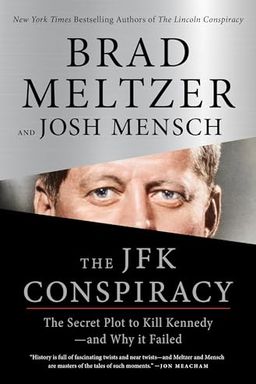
The Jfk Conspiracy cover

The Jfk Conspiracy

by Brad Meltzer And Josh Mensch

The authors of “The Nazi Conspiracy” and “The Lincoln Conspiracy” tell the story of a retired postal worker who might have changed the course of history.

How a Forgotten Plot Explains Modern America

What if a single, almost-random moment of hesitation had changed everything you know about American history? In The JFK Conspiracy, Brad Meltzer and Josh Mensch argue that a little-remembered, near-successful attempt to assassinate President‑elect John F. Kennedy in December 1960 is a Rosetta stone for understanding the modern presidency, political polarization, security in an age of spectacle, and the stories that shape national memory. They contend that history doesn’t only turn on grand conspiracies or shadowy cabals; sometimes it pivots on a lonely man in a Buick, an alert postmaster, a handful of young Secret Service agents improvising in real time, and a wife who will one day define an era with a single word: Camelot.

The Book’s Core Argument

Meltzer and Mensch’s central claim is that the “first conspiracy” against JFK—the nearly forgotten plot by retired postal worker Richard Pavlick to blow up Kennedy with a car bomb outside the family’s Palm Beach compound—reveals how personal bigotry, media-saturated celebrity politics, and the growing pains of the Secret Service collided in the hinge months between election and inauguration. The plot failed, the authors show, not because the system worked flawlessly but because luck, timing, and ordinary people—most notably small‑town postmaster Thomas Murphy—intervened. That near-miss becomes a lens on themes you live with today: the mainstreaming of extremist rhetoric, the challenge of protecting leaders in public-facing democracies, and the way myth can overtake messy facts.

What You’ll Learn in This Summary

First, you’ll meet Pavlick, a seventy‑three‑year‑old New Englander whose anti‑Catholic nativism was stoked by respectable pulpits (Rev. Norman Vincent Peale) and back‑channel operatives (Rev. Billy Graham), and who stalked Kennedy from Hyannis Port to Georgetown to Palm Beach with seven sticks of dynamite wired to a switch under his front seat. You’ll see how a happenstance goodbye from Jackie and little Caroline at the front gate made him balk for a few seconds—and likely saved JFK’s life.

Next, you’ll track the transformation of the Secret Service from the rigor of Eisenhower’s military‑style schedule to the unruly charisma of Kennedy’s celebrity politics. Through agents Clint Hill and Jerry Blaine, you’ll experience the transition’s improvisation—turning a garage roof into an observation post, re‑routing streets, teaching a president‑elect who loves crowds to accept protective constraints, and even inventing a workaround for Jackie’s mail to outpace security screening.

You’ll also step into the 1960 campaign’s religious fault line: pamphlets, whisper campaigns, and Klan endorsements on one side; Kennedy’s Houston speech on absolute church‑state separation on the other. The authors place Peale and Graham’s quiet orchestration of anti‑Catholic talking points alongside a longer American story—how the Klan’s 1920s wave broadened its animus from Black Americans to Jews and Catholics, and how those currents resurfaced in 1960 (a continuity many overlook).

Then comes Jackie: a shy, erudite former reporter who craved privacy and became, overnight, the most photographed woman in the world. You’ll watch her emergency C‑section, the christening of John Jr., a bruising first tour of the White House under an imperious Mamie Eisenhower (and a mysteriously missing wheelchair), and the unlikely bond she forges with Clint Hill—before she later reframes a nation’s grief with Theodore White’s “Camelot” interview. The book shows how narrative power—paired with Kennedy’s earlier story of valor on PT‑109—can transmute pain into meaning (compare the authors’ attention to legend here with Robert Dallek’s balance of image and record).

Why These Ideas Matter Now

If you sense today’s currents of conspiracism and hate roiling beneath mainstream politics, this story feels eerily present. The 1960 plot wasn’t a baroque inside job; it was a one‑man “human bomb,” validated by public rhetoric that made a Catholic president sound like a Vatican puppet. The Secret Service’s scramble—after eight quiet years with Eisenhower—mirrors how institutions are forced to evolve when norms shatter. The authors suggest that your safety, like the republic’s, rides as much on civic vigilance (a Murphy with a gut feeling) as on formal protocols.

Finally, you’ll reconsider how you remember Kennedy. This isn’t hagiography. The portrait includes the magnetic campaigner, the war hero, the reformer—and also the flawed husband whose infidelities wounded Jackie and whose mystique sometimes outran his legislative record. Yet by tracing the narrow escapes that precede Dallas—Pavlick’s bomb, then three years later Dealey Plaza—the book argues that contingency and narrative sit at history’s core. The lesson for you: pay close attention to the small hinges—who watches a license plate, who writes a letter, who refuses to normalize bigotry, who crafts a unifying story after trauma.

Big takeaway

The “first conspiracy” against JFK shows how extremism moves from the margins into action, how security adapts in the glare of televised politics, and how a single family—through courage, error, luck, and storytelling—can reframe a nation’s self‑understanding.

In the sections ahead, you’ll walk through the plot’s minute‑by‑minute anatomy, the Service’s reinvention, the 1960 religion wars, Jackie’s dual role as shield and storyteller, and the power—and peril—of the myths we choose. That path offers you a practical lens for reading today’s headlines with sharper eyes.


The Human Bomb That Almost Worked

The book’s dramatic spine is simple enough to retell to a friend over coffee: a seventy‑three‑year‑old retired postal worker, Richard Pavlick, drives 1,500 miles with seven sticks of dynamite wired to a switch under his car seat to kill the President‑elect. What makes it unforgettable is how the plot comes together—and then falls apart—through a string of ordinary decisions, a single glance at a child, and civic muscle memory you can still use.

From Grievance to Target

Pavlick isn’t a cinematic mastermind. He’s a local crank from Belmont, New Hampshire—a “chronic complainer,” perpetually writing letters about flag etiquette, water chemicals, and his dream of a Protestants‑only veterans’ group. What he does have is a combustible worldview: Catholics are agents of Rome, immigrants are subverting America, and the Kennedy patriarch is buying the presidency. The anti‑Catholic thunder from pulpits (Rev. Norman Vincent Peale’s press conference) and quiet strategist meetings (Rev. Billy Graham’s Montreux gathering) validate his bile. You’ve seen this pattern before: lonely grievance supercharged by elite signals (compare the dynamic to how fringe conspiracies found mainstream megaphones in later eras).

Scouting the Victim

After Election Day, Pavlick drives to Hyannis Port, studies the compound, and ends up at Barnstable Municipal Airport—close enough to watch JFK climb the steps, wave, and disappear into the plane’s doorway. He follows the Kennedys to Georgetown, sends a note to Belmont’s Postmaster Thomas Murphy to forward mail to Washington (a red flag Murphy won’t forget), and then aims south to Palm Beach, where the family plans to ride out the transition.

Meanwhile, agents in Palm Beach are building a security plan from scratch: turning a two‑car garage into a command post, stationing Coast Guard boats offshore, converting a street by the gate (Monterey Road) to one‑way to thwart a ramming attack. These are good moves—but they can’t stop a car parked across the intersection, wired to explode on impact.

Seconds That Save a President‑elect

On Sunday, December 11, 1960, at 9:50 a.m., JFK steps out for Mass at St. Edward Catholic Church. Pavlick sits in his faded green 1950 Buick, engine idling, trigger in reach. The gate opens. Kennedy appears, tanned and smiling. And then—Jackie, exhausted from a traumatic emergency C‑section and a turbulent flight the night before, and little Caroline, step near the gate to wave goodbye. That tiny tableau freezes Pavlick. He later admits he didn’t want to kill “the wife or the children,” so he waits, then follows to church instead.

Inside St. Edward’s, the Service’s Jerry Blaine notices a disheveled older man who doesn’t fit the Sunday‑best crowd. Blaine shadows him, gently guides him back toward the door like an usher, and memorizes his plate—BI 606—before the man drives off. Three days later, when Secret Service headquarters calls with a nationwide BOLO on a New Hampshire Buick suspected of carrying explosives, that number clicks: it’s the same car Blaine saw in the narthex.

A Postmaster’s Hunch Triggers a Net

Back in Belmont, Thomas Murphy has been puzzling over Pavlick’s letters. Why would an anti‑Kennedy crank ask to forward mail to Washington, then send a second card from Aiken, South Carolina, requesting mail at “Palm Springs”—almost surely a malapropism for Palm Beach? He calls his superiors. The warning climbs quickly: U.S. Attorney’s offices, Secret Service field teams, and local police in Palm Beach coordinate. On December 15, Officer Lester Free spots the Buick on Royal Poinciana Bridge, pulls it over for erratic driving, and—within moments—ten officers converge.

At first, Pavlick is blandly cooperative: he likes flowers, knows the Boston mayor from long ago (wrong “Fitzgerald”), and buried the dynamite in his yard. But a search finds seven sticks—Atlas Giant Gelatin 40% and Farmex ditching sticks—in the trunk and pants leg, plus caps, wire, a six‑volt battery, and a drilled channel to a knife‑switch under the seat. Confronted with a typed “posthumous” letter calling himself a catalyst for a better America, he acknowledges the plan. Had he not balked at the gate, he tells agents, he intended to die as a “human bomb” and “get rid of Kennedy.”

What You Can Use

Three practical lessons stand out. First, rhetoric matters: when respectable figures launder animus, isolated people feel licensed to act. Second, civic instincts save lives: Murphy’s “that smells wrong” call set off a chain that outpaced bureaucracy. Third, small security frictions compound: one‑way streets, Coast Guard patrols, and agents with the humility to memorize a plate number can turn chance into resilience. The story is humbling too: for all the planning, it was a child’s wave that bought the Service the week they needed to connect the dots. (Secret Service chief U. E. Baughman later called Pavlick’s Sunday plan “one of the closest calls any President ever had.”)

You finish this chapter alert to the line between grievance and action—and to your own role in noticing, reporting, and not normalizing the kinds of talk that make a bomb feel justified.


Inside a Service Learning in Real Time

If you’ve ever stepped into a new job and found the playbook didn’t fit the moment, you’ll recognize the Secret Service of late 1960. The agency spent eight years with Dwight Eisenhower, a punctual five‑star general who waved from distance and kept to schedule. Overnight, they inherited John F. Kennedy—forty‑three, television‑primed, thrilled by crowds, cosmically informal. Meltzer and Mensch use two young agents, Jerry Blaine and Clint Hill, to show you how protection evolved on the fly—and how small process hacks can be the difference between order and disaster.

From Augusta Fairways to Woody’s Motel

Two days after Election Night, Blaine and Hill are called off Eisenhower’s golf course in Augusta. Blaine is told to get to Palm Beach and build a protective bubble around a private family compound that backs onto open beach and unfettered ocean. Hill is told to report to Secret Service chief U. E. Baughman in D.C. and learns—much to his dismay—that he’s being assigned to protect the First Lady, not the President. He worries it’s a career cul‑de‑sac of “fashion shows and teas.” He’s wrong. Within weeks, he will be at Jackie Kennedy’s bedside, on Georgetown’s hospital floors, and crafting the quiet practices that let a shy woman move through a ravenous press safely.

Palm Beach: Improvising a Perimeter

Blaine’s team turns a stucco garage into a command post, posts men with submachine guns disguised as caddies on nearby fairways, coordinates Coast Guard patrols to push boats off the lawn’s line of sight, and convinces Palm Beach Police to flip Monterey Road to one‑way to blunt vehicle rammings. They also learn their protectee. JFK bounds off his plane, jogs to shake hands, ignores Agent Floyd Boring’s polite “Let’s get in the car, sir,” and later notices an agent cooking in a wool suit in Florida sun and personally delivers short‑sleeve shirts to the detail. Beneath the charm is a pattern that scares protectors: unpredictability.

The Quiet Complexity of Protecting Jackie

Hill finds a different challenge: guarding someone who doesn’t want a guard. Jackie is eight months pregnant, craves privacy for Caroline and the new baby, and dreads becoming an exhibit. Hill offers to be invisible and competent. He devises a “C & O Canal” walking route where she can breathe, and a mail workaround—friends address packages to “Clint Hill” so they aren’t delayed by explosive screening. He also learns the culture of the household: the Kennedys often carry no cash and borrow from whoever’s near; reimbursements come later via staff. It sounds trivial. It isn’t. Logistics you solve early don’t become security risks in a crowd later.

Crisis as Classroom

The Service’s steepest learning curves are the emergencies: the 2 a.m. call that Jackie is hemorrhaging; the split‑second triage between alerting the President‑elect and racing behind an ambulance; the ad‑hoc perimeter on a hospital floor that doubles as a nursery and press magnet; the christening inside a chapel ringed by fifty police and agents. Even the outgoing administration becomes a workshop: Eisenhower shows Kennedy how a coded phrase—“Opal Drill Three”—drops a Marine helicopter on the South Lawn in seconds. That’s how institutions transmit muscle memory.

What Changed—and What Didn’t

By the time Pavlick is arrested, the Service has woven a fast network with U.S. Attorneys, postal inspectors, and local cops. They’ve started screening all family mail and created back‑channel delivery for the First Lady. They’ve converted streets, layered water and land patrols, and learned to shadow a president who treats crowds like oxygen. Yet the book is honest: even with all that, Kennedy’s openness leaves structural vulnerabilities. Three years later in Dallas, Hill will sprint from the follow‑up car’s running board to the presidential limo, shield Jackie with his body, and help deliver a mortally wounded president to Parkland. Training and courage matter—but so do choices about exposure in open cars and routings through canyons of glass. (For a complementary institutional autopsy, see Vincent Bugliosi’s Reclaiming History; for agent‑level texture, Gerald Blaine’s The Kennedy Detail and Hill’s Mrs. Kennedy and Me are essential—both heavily cited here.)

If you lead teams, the Service’s transition teaches a practical playbook: experiment visibly, over‑communicate locally, plan for water as well as land, and expect your customer to behave like himself, not like your last client. Most of all, design for the moment you don’t control—a Buick idling across the street.


Faith, Nativism, and the 1960 Culture War

You can’t understand Pavlick without understanding 1960’s religious politics. The book threads a line from the Ku Klux Klan’s 1920s campaign against Catholics and Jews to the refined anti‑Catholic attacks amplified by national pastors during Kennedy’s run. It also shows how Kennedy met that moment head‑on—and why his Houston speech still offers you a vocabulary for pluralism today.

From Hoods to Headlines

The second coming of the Klan in the 1920s, led by Hiram Wesley Evans, married white supremacy to a Protestant‑nativist project—“America First” chants, newspapers like The Fiery Cross, and political clout across the Midwest. In their telling, Catholics were foot soldiers of Rome; Jews were cosmopolitan saboteurs; Black Americans a threat to white rule. Those tropes didn’t vanish. In 1960 they resurfaced—with better suits and TV microphones. The Reverend Norman Vincent Peale convened 150 ministers to warn that “our culture is at stake” if a Catholic sits in the Oval Office; the Reverend Billy Graham quietly orchestrated strategy from Switzerland while distancing his name in public. Pamphlets whispered about nuns teaching in public schools and the Pope breaching the “wall of separation.” The Klan’s Florida “Grand Dragon” even endorsed Richard Nixon, who publicly disavowed it while his campaign tacitly coordinated with fundamentalist networks (as documented by Shaun Casey).

Kennedy Answers in Houston

On September 12, 1960, Kennedy walked into the Greater Houston Ministerial Association—hostile room, cameras rolling—and reframed American religion in a handful of sentences. “I believe in an America where the separation of church and state is absolute,” he said, where no official “accepts instructions on public policy from the Pope” and where an act against one faith is “an act against all.” Then he flipped the script: as a Navy veteran and a brother who had buried another son of a Catholic family killed in the war, how dare anyone question that family’s patriotism? The applause line wasn’t about theology; it was about citizenship.

The speech worked because it didn’t beg tolerance. It demanded reciprocity: if a Quaker (Nixon), a Baptist, a Jew, or a Catholic can all be full citizens, then clerical litmus tests are un‑American. That’s an argument you can still use—in workplaces, schools, and local politics—when identity becomes a wedge.

The Countercurrent: Youth and TV

Even as anti‑Catholicism surged, cultural winds were shifting. A new class of “teenagers,” educated and activist, marched for civil rights, integrated lunch counters, and threw their weight behind a candidate who spoke of a “New Frontier.” Television amplified the contrast. In the first televised debates, Kennedy looked like the future—tanned, crisp, camera‑confident—while Nixon appeared pasty and tense (Mary Ann Watson’s work details the medium’s power). In Spanish Harlem, Jackie spoke flawless Spanish—“Viva Kennedy!”—and the campaign built the first modern Latino outreach (Ignacio García’s Viva Kennedy chronicles how Mexican American, Puerto Rican, and Cuban American communities responded).

Why This Chapter Matters to You

When religious identity becomes a proxy for loyalty, democratic trust frays. The book’s juxtaposition—Peale’s podium and Pavlick’s trunk—shows how rhetoric that seems polite can license violence one or two steps down the chain. The answer isn’t censorship; it’s strong counter‑speech, clear institutional norms, and citizens confident enough to defend someone else’s full belonging. Kennedy’s Houston frame offers a template: you don’t request permission to be included; you assert the constitutional ground you share. If you’re building coalitions today, that frame is gold.

The irony is that the slur—“a Catholic can’t be President”—backfired. It crystallized a generational choice between fear and a forward‑leaning pluralism. The authors leave you with a sobering addendum: stigmas mutate, but the operating manual is the same. Learn to hear them—and answer them—before someone builds a bomb.


Jackie Kennedy: Shield, Prism, Storyteller

If Kennedy’s rise is a study in charisma and television, Jackie’s arc is a study in paradox: a private, scholarly former reporter who becomes the world’s most public woman—and then, in grief, the author of the story that fixes a presidency in memory. The book’s great strength is letting you see her through three lenses at once: human, protected, and myth‑maker.

Human: A Brutal November

The timeline is punishing. Thanksgiving Eve: JFK flies to Washington; Jackie, nine months pregnant, meets him at their Georgetown row house. Early Thanksgiving morning: contractions, ambulance, emergency C‑section; a premature baby boy—John Jr.—is whisked to an incubator. The press races to the hospital; flowers and microphones pile up. The next day, she sees her son for the first time through nursery glass. Within a week, the christening happens in a hospital chapel surrounded by fifty police officers and Secret Service agents. The day after that, she’s discharged into a waiting White House tour she cannot physically manage, overseen by an exacting Mamie Eisenhower who refuses to be seen wheeling her successor. (J. B. West, the chief usher, quietly stashes a wheelchair behind a closet door; Jackie later confides she was “too scared of Mrs. Eisenhower to ask.”)

Protected: The Hill Bond

Clint Hill, the North Dakota kid who thought First Lady detail meant “afternoon teas,” becomes her constant shadow—drafting discrete walking routes along the C & O Canal, fending off press scrums, and checking every bouquet and box for explosives. He learns her rhythms (she wants her children to live “as normal a life as possible”) and her mind (she quizzes him on White House history and logistics, filling yellow legal pads). With Caroline, he is tender; with household quirks, he is practical (agents learn to carry cash because neither JFK nor Jackie does). The day the family flies to Palm Beach in a storm, he notes her pallor and exhaustion; that night she collapses in tears for two days. Protection is logistics and empathy.

Storyteller: A Myth to Hold the Grief

Three years later, after Dallas, Jackie calls historian-journalist Theodore White to Hyannis Port. For hours, she walks him through the blood, the ring she slipped on Jack’s finger, the nurse peeling off gloves stiff with her husband’s blood. Then she insists on the line that will outlive them both: Jack loved the last song from Lerner and Loewe’s Camelot—“for one brief shining moment.” She wants the nation to remember the round table, not the autopsy. White files from the house; Life holds the presses. Whether you bristle at the myth or need it, you can’t deny its force. Jackie took the shards of a public trauma and gave them a shape people could carry. (The authors’ treatment balances empathy with candor about JFK’s infidelities and Jackie’s private hurt, echoing the careful work of Barbara Leaming and Robert Dallek.)

Maker of Space, Curator of Meaning

Don’t miss her constructive power, either. As First Lady, she refuses the word “redecorate” and launches a “restoration” of the White House as a living museum—founding the Fine Arts Committee and the White House Historical Association, hunting Presidential artifacts, authoring a guidebook, and turning state dinners into salons for scientists, artists, and poets. The media fixates on clothes, but her deepest work is context. If you lead teams or families through transition, that curation—making a place tell a truer story—is a leadership act.

Jackie’s through‑line is coherence: children safe, privacy negotiated, house restored, myth forged. The book invites you to see her not as icon but as a strategist of meaning—one who paid a steep human price and still delivered a language the country could use.


Luck, Courage, and the Stories We Keep

Meltzer and Mensch close the loop by putting three stories side by side: PT‑109, Pavlick’s near‑miss, and Dallas. The juxtaposition forces you to wrestle with contingency—how luck and choices braid—and with narrative—how we metabolize what happens.

PT‑109: The Origin Story

Before the politics, there’s a young naval officer in the Solomon Islands whose patrol boat is cut in two by a Japanese destroyer at night. Two men die. With an injured back, Jack swims three miles, towing a badly burned machinist by a life‑jacket strap clamped in his teeth, hauls men onto a bare island, then swims alone into Ferguson Passage to flag a rescue that never comes. He carves a message on a coconut and entrusts it to island scouts. Days later, everyone is saved. The Navy awards him the Navy and Marine Corps Medal; future voters award him a presumption of courage. You can quibble about myth‑building (as William Manchester noted decades ago), but the core is true: he saved lives when it counted.

Palm Beach: The Luck We Don’t Like to Admit

The Pavlick chapter dislodges a comforting illusion—that the system is a force field. In truth, the system is people. A postmaster who pays attention. An agent who memorizes a plate. A patrolman who makes a lawful stop. A U.S. Attorney who thinks to call 37 hardware stores until one coughs up a receipt. And a man with a bomb who looks at a child and blinks. That fragility isn’t a counsel of despair; it’s a call to vigilance. You are part of the net—or the hole.

Dallas: Courage Amid Catastrophe

Three years later, Dealey Plaza erases illusions of invulnerability. You ride with the motorcade through packed canyons of windows. On Halfback’s running board, Clint Hill hears the first shot, sees the President grab his throat, sprints toward the limo as a second shot hits Governor Connally, and is climbing onto the trunk when the fatal third round “sounds like a melon shattering.” Jackie crawls across the trunk, reaching for a piece of her husband’s head. Hill shoves her back into the seat, arches his body over hers as a human shield, and yells, “Get us to a hospital!” In Parkland’s hallway, he takes the call from Bobby Kennedy—“How bad is it?”—and says, “It’s as bad as it gets.” You can’t read this and not feel the body cost of courage.

Which Story Do We Keep?

The authors neither flatten Kennedy into sainthood nor reduce him to flaw. They argue, instead, that a democracy needs truthful myths—accounts that inspire without lying. PT‑109 reminds you that capability under duress matters. Pavlick reminds you that vigilance and decency matter even more than procedures. Dallas reminds you that exposure decisions, and the people who run toward danger, matter most when everything else fails. If you need a single sentence to carry away, it might be this: history is contingent, and the stories we tell about it are moral choices.

Practically, that means you can do three things now. Guard your tongue and listen for others’—don’t launder bigotry as a “question.” Practice small civic acts—call the office, write the report, learn the license plate. And when grief comes, choose a story sturdy enough to hold people together without denying the pain. That’s the narrow path the book traces—from a beach in the Solomons to a gate in Palm Beach to a trunk in Dallas—and it’s a path you can still walk.

Dig Deeper

Get personalized prompts to apply these lessons to your life and deepen your understanding.

Go Deeper

Get the Full Experience

Download Insight Books for AI-powered reflections, quizzes, and more.