
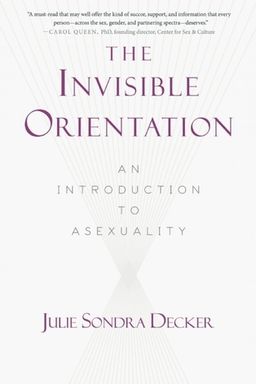
The Invisible Orientation cover

The Invisible Orientation

by Julie Sondra Decker

The Invisible Orientation by Julie Sondra Decker demystifies asexuality, offering a thorough exploration of what it means to identify as asexual. Discover the challenges faced by asexual individuals, the misconceptions surrounding this orientation, and how society can foster better understanding and support.

Seeing the Invisible: Understanding Asexuality as a Legitimate Orientation

Have you ever felt as though a part of the human experience was being left out of everyday conversation—something so fundamental that most people assume it applies to everyone? In The Invisible Orientation, Julie Sondra Decker argues that one such gap exists in how our culture understands sexuality. Specifically, she reveals that asexuality—the experience of not feeling sexual attraction toward anyone—is both real and far more common than most of us imagine.

Decker contends that the invisibility of asexuality stems from two interwoven forces: a cultural obsession with sex and the pervasive myth that everyone experiences sexual desire. By telling her own story, starting from her teenage years when others said she was a 'late bloomer,' Decker helps readers see how this gap in understanding leads people to be misdiagnosed, dismissed, or pressured into conformity. Her book serves as both a primer on the orientation itself and a compassionate invitation to reconsider how we define attraction, intimacy, and identity.

Challenging Assumptions About Sexuality

Decker opens with a striking insight: our culture treats sexual attraction as a universal human constant. Films, advertisements, and even casual conversations assume that sex drives choice, happiness, and maturity. When someone defies that assumption, the response she often receives isn't curiosity but disbelief—statements like, “You just haven’t met the right person,” or “You need to get your hormones checked.” Decker’s personal narrative underscores that lack of sexual interest isn’t a defect to fix but a legitimate identity that exists on the same continuum as other sexual orientations.

She outlines key principles that ground the entire book: asexuality is not celibacy or abstinence; it’s not a religious or moral stance, a symptom of trauma, or a result of failure in dating. It is a natural orientation defined by the absence of sexual attraction—no more, no less.

From Personal Story to Social Visibility

The author’s journey—from being labeled “Miss Non-Hormone” by a frustrated boyfriend to discovering the Asexual Visibility and Education Network (AVEN)—becomes a lens for understanding how awareness changes lives. When David Jay founded AVEN, it created a community that gave thousands of people language for experiences they’d never been able to name. For readers who may not be asexual but care about inclusivity, these stories reveal how cultural representation can reshape self-worth. Decker argues that knowledge of asexuality helps not only the roughly one percent of people who identify that way but also those who wish to build more compassionate relationships across the sexual spectrum.

The book is structured like a roadmap: first defining asexuality as a legitimate orientation; then exploring the diversity of experiences among ace individuals—romantic, aromantic, graysexual, demisexual, and others—followed by surveys of misconceptions and myths. Later sections provide guidance for newly self-identified asexual people on coming out, handling criticism, and navigating relationships; and for non-asexual loved ones seeking understanding. Finally, Decker offers extensive resources, from community networks to research collectives.

Why Visibility Matters

Decker emphasizes that invisibility is a form of discrimination. If society equates adulthood and health with sexual attraction, those who don’t experience it are deemed broken or immature. She describes the psychological toll that comes from internalizing these messages—particularly for young people who realize they’re different during puberty but lack vocabulary or representation. Many end up forcing themselves into uncomfortable situations to “fix” what isn’t broken.

By placing asexuality on the map of legitimate sexual orientations, Decker asks readers to reframe what “normal” means. Just as understanding homosexuality broadened the concept of love, acknowledging asexuality expands our view of connection and autonomy. In doing so, she addresses several layers of misunderstanding, from conflating sexual behavior with sexual attraction to assuming sex is synonymous with intimacy.

Relevance Beyond Identity

Ultimately, The Invisible Orientation isn’t just about asexuality; it’s about how societies normalize certain desires while erasing others. Decker calls for greater empathy and education so that those who identify as asexual aren’t forced into defensive positions where they must 'prove' their orientation. This book offers a foundation for anyone—ace or not—to understand that human connection doesn’t require sexual attraction, and that there are countless ways to love, bond, and live fully.


Redefining Sexual Orientation

Decker reframes sexual orientation as a spectrum that includes people who are attracted to no one. In her words, asexuality is not the absence of humanity but an additional category within the continuum of desire. She compares defining asexuality to filling out a multiple-choice question: even if your answer is “none of the above,” it’s still an answer—an intentional space that represents a real orientation.

Asexuality Is Not 'Nothing'

This section of the book dismantles the idea that identifying as asexual means lacking an orientation. Decker explains that orientation isn’t defined by whether someone engages in sexual behavior but by their experience of attraction. People who aren’t sexually attracted to anyone have as consistent and valid an orientation as any gay or straight person. She references research by psychologist Anthony Bogaert showing that about one percent of adults report never feeling sexual attraction, a statistic that translates into millions of people globally.

A Mature, Healthy State

Asexuality, Decker stresses, is not a childish stage or a lack of maturity. Many asexual people are told they’ll “grow out of it,” but Decker argues that maturity should never be measured by sexual experience. She quotes a thirty-nine-year-old ace woman who says she has heard for decades she’ll “blossom eventually,” yet remains happily unaffected. Asexual people form rich relationships and adult lives without needing sexual activity to define their adulthood or success.

Health Without Sexuality

A central myth Decker challenges is that sex is essential for physical and emotional health. She methodically debunks medicalized explanations—hormone imbalances, trauma, or low libido—showing that studies find no correlation between asexual identity and illness. In fact, pushing someone into therapy to “fix” asexuality can do more harm by reinforcing shame. Having no sexual interest doesn’t mean lacking intimacy; many asexual people enjoy closeness, romance, or sensual connection outside of sex.

(In contrast, psychologists like Lori Brotto and Morag Yule have provided empirical data supporting Decker’s view that asexuality is a sexual orientation, not a dysfunction.)

Why Recognition Matters

Decker frames recognition as both personal validation and social necessity. To respect asexual people is to expand our collective understanding of human diversity. In a world that prizes sexual fulfillment, saying “none of the above” can feel like shouting into silence—but Decker’s argument makes clear that there’s nothing missing in these experiences. They simply occupy another place on the map of human sexuality, a place that deserves to be seen.


The Spectrum of Asexual Experiences

If you’ve ever thought “asexual” meant just one kind of person, Decker’s chapter on ace experiences will surprise you. She reveals a wide array of identities within the asexual spectrum—from romantic to aromantic, graysexual to demisexual. This diversity challenges stereotypes and shows how varied human connection can be, even when sexual attraction isn’t part of the equation.

Romantic vs. Sexual Attraction

Many asexual people feel romantic love without sexual desire. A romantic asexual person might crave emotional closeness, while an aromantic person might prefer deep friendships or queerplatonic partnerships—intimate but non-romantic commitments. Decker highlights how these relationships are often dismissed as “less real,” but they can involve just as much loyalty and emotional depth as marriages.

To describe these variations, community language has evolved: heteroromantic, homoromantic, biromantic, panromantic. Each term differentiates who an ace person might be romantically drawn to, even when sexual attraction isn’t present. For example, a panromantic asexual person could fall romantically in love with people of any gender yet never desire sex with them.

Gray and Demi Identities

Some ace individuals occasionally experience weak or situational sexual attraction—people Decker calls “graysexual.” Demisexual people, conversely, only develop sexual attraction after forming a strong emotional bond. These distinctions enrich our understanding of how attraction operates. They also help people who once felt confused about inconsistent feelings find vocabulary that fits.

Beyond Sexual Scripts

Through powerful examples—a married ace woman negotiating sex for her partner’s happiness, or aromantic individuals crafting lifelong friendships—Decker illustrates how asexual and non-asexual relationships demand creativity. They redefine intimacy beyond conventional sexual scripts. Partnerships might center around conversation, shared projects, or affection without sexual obligation. In this way, Decker expands society’s imagination of love itself.


Unraveling the Myths

Part Three of the book reads like a cultural detox. Decker lists the most common misconceptions lodged against asexual people—as if she were filling out a 'bingo card' of bad arguments. She dismantles each one: no, they’re not broken, prudish, abused, gay in denial, or suffering from hormonal imbalance.

The Power of Misunderstanding

Decker’s tone here is both rigorous and empathetic. These myths persist because society confuses sexual attraction with normalcy. Sexuality is considered so central that nonparticipation feels like rebellion. This leads to an endless cycle of unsolicited advice—“You should see a doctor,” “You just haven’t met the right person,” “I can fix you.” Her methodical refutations empower readers to see that demanding justification from asexual people is as absurd as asking heterosexual individuals to prove why they’re straight.

Debunking the 'Fix' Narrative

One particularly damaging myth is that therapy or sex can 'cure' asexuality. Decker exposes how these arguments mirror older attempts to “correct” homosexuality. She warns that professionals unfamiliar with asexuality sometimes misdiagnose clients under outdated criteria like 'hypoactive sexual desire disorder.' Such interventions pathologize natural variation. Instead of fixing people, society should fix its assumptions.

The Myth of Loneliness

Decker acknowledges that many outsiders pity asexual people, imagining them as lonely or incomplete. Yet she reminds readers that fulfillment doesn’t require sex. Friendships, creative passions, and chosen family can provide deep connection. Loneliness results not from being asexual but from societal rejection. When we stop enforcing compulsory sexuality, everyone benefits.


Navigating Life as an Asexual Person

For those who identify as asexual—or wonder if they might—Decker offers reassurance and guidance. She understands the anxiety that comes from realizing you don’t fit mainstream expectations. Her “Asexuality 101” and later chapters function as both a survival guide and a confidence-building toolkit.

Coming Out and Handling Criticism

Coming out as asexual, Decker notes, demands courage. Many face dismissive remarks or invasive questions about masturbation and sexuality. Her advice: respond with calm facts or set boundaries when questions get inappropriate. She even provides ready-made replies—turning awkward encounters into teaching moments. The key is to assert autonomy: your identity belongs to you, not to anyone’s curiosity.

Relationships and Boundaries

Navigating relationships is perhaps the most complex aspect of ace life. Decker walks through real scenarios: marriages where one partner is sexual and the other not, young couples negotiating nonsexual intimacy, and cases where open or poly configurations help partners meet differing needs. Her stance remains balanced—no universal prescription, only communication and mutual respect. If sex is a dealbreaker for one partner, ending the relationship may be healthiest; if both compromise, it can thrive.

Building Confidence and Community

Decker encourages readers to seek community through online forums such as AVEN or local support groups. Finding others who share similar experiences transforms isolation into empowerment. Asexuality awareness weeks, blogs, and meetups foster pride rather than shame. By sharing stories, ace people reclaim visibility and collective strength.


How Non-Asexual Allies Can Help

Decker’s fifth section flips perspective to speak directly to allies—the friends, partners, parents, and colleagues of asexual people. Her advice is practical and empathetic: listen more than you speak, respect boundaries, and stop assuming sex defines happiness. Understanding isn’t about fixing someone; it’s about accepting them.

From Curiosity to Compassion

When someone confides that they’re asexual, Decker urges responses that affirm rather than interrogate. She provides model phrases—thank them for trusting you, acknowledge their identity, and avoid comments like “you’ll grow out of it.” Treat asexuality the same way you would any other orientation disclosure. Overexplaining or pitying someone implies you’re judging them against your own standard of normal.

Supporting Relationships and Acceptance

For partners, Decker’s relationship guidance continues here: negotiate intimacy sincerely. Parents should avoid framing asexuality as a temporary phase. And in workplaces or schools, fostering awareness prevents others from feeling unseen. Allies can share educational resources, challenge inaccurate jokes, and broaden representations of love beyond sex.

The Ripple Effect of Inclusion

Decker concludes that allyship has ripple effects. Normalizing asexuality enriches conversations about consent, orientation, and emotional wellbeing. It dismantles the myth that desire equals worth. By approaching others with curiosity and kindness, allies help make visibility sustainable—not only for asexual people but for anyone marginalized by narrow cultural definitions of intimacy.


The Fight Against Invisibility

The book’s title points to its final and ultimate theme: invisibility itself. Decker describes how social systems—media, medicine, law, even language—erase people who don’t fit a sexual mold. The invisibility of asexuality manifests through silence, disbelief, and exclusion from narratives of romance and adulthood.

Cultural Erasure and Everyday Stigma

Decker links invisibility to a subtle but pervasive form of prejudice. Even without overt violence, asexual people face invalidation: being told they’re broken, pitied for “missing out,” or excluded from queer spaces. She compares this erasure to underrepresentation in media—few fictional characters identify as asexual, and those who do are often misportrayed. Without visible models, self-discovery becomes harder.

Intersectionality and Vulnerability

Some groups within asexual communities face additional layers of invisibility: people of color, disabled and autistic individuals, survivors of abuse, and older adults whose sexuality is dismissed. Decker argues that fighting invisibility means recognizing these intersections. Visibility, she says, isn’t about demanding attention—it’s about creating space where everyone’s experiences can be acknowledged.

Making the Invisible Seen

The book closes with a broader call to action. Normalizing asexuality through education, research, and inclusion amplifies compassion across all sexual identities. Decker’s goal is simple yet transformative: when everyone, regardless of desire, is trusted to define their own happiness, society becomes healthier. As she writes, the invisible orientation deserves not just visibility, but dignity.

Dig Deeper

Get personalized prompts to apply these lessons to your life and deepen your understanding.

Go Deeper

Get the Full Experience

Download Insight Books for AI-powered reflections, quizzes, and more.