
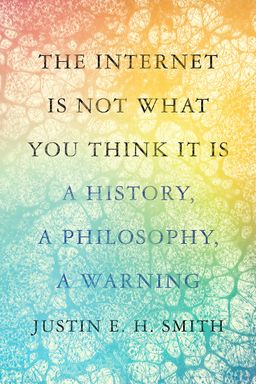
The Internet Is Not What You Think It Is cover

The Internet Is Not What You Think It Is

by Justin EH Smith

Dive into a thought-provoking exploration of the internet''s true nature. Justin EH Smith unravels the web''s philosophical and historical threads, urging us to reconsider our digital lives and the ancient roots of our interconnected world.

The Internet as Humanity’s Mirror and Machine

Have you ever stopped scrolling and wondered what exactly the internet is doing to you? Philosopher Justin E. H. Smith poses this question at the heart of The Internet Is Not What You Think It Is. Although we often see the web as a new technological frontier or a miracle of connectivity, Smith argues that it is far older in spirit—and far stranger—than we realize. The internet, he insists, is not a mere tool or platform, but rather an extension and expression of long-standing human tendencies: our urge to communicate, categorize, and connect, even when those same impulses lead us toward confusion, addiction, and control.

Smith approaches the internet not as a tech journalist or a sociologist but as a historian of ideas. He traces its origins back to philosophers like Gottfried Wilhelm Leibniz, who in the 1600s dreamed of a universal language that could eradicate conflict through calculation and logic. Smith calls this vision “Leibnizian optimism”—the belief that mechanized reason and interconnection would unify humanity. Yet, he observes, that dream has soured into what he calls a “tragicomedy”: under the sleek surfaces of social media and digital infrastructure lies a system that amplifies addiction, surveillance, and alienation.

From Utopian Calculation to Existential Crisis

The book begins by recalling how Leibniz imagined global peace through rational machines that could mediate disputes with the command “Let us calculate!” (in Latin, Calculemus!). Smith sees in Facebook’s slogan—“To strengthen our social fabric and bring the world closer together”—the same utopian impulse, though one corrupted by power and profit. Instead of rational harmony, modern digital systems produce polarization and social disintegration. The new “reckoning engines” of our age—algorithms, feeds, and search engines—don’t clarify truth; they commodify attention and shape reality to keep us engaged.

Smith’s central contention is that the internet represents not a break from the past but a continuation of humanity’s centuries-long project to externalize perception, memory, and reason. Our digital devices are mirrors of the mind—mechanized extensions of what Leibniz and later thinkers called “monads,” self-contained mirrors of the universe. But, as Smith notes, where Leibniz’s monads were harmonized by divine order, our network of devices lacks any such unifying principle. It’s “Leibniz without God,” as Michel Serres aptly put it—a web without a weaver, or a universe of reflections that no longer recognize one another.

Information Overload and the Crisis of Attention

After establishing this philosophical framework, Smith zooms in on the immediate human costs. In his view, the defining feature of our moment is the crisis of attention. When information multiplies without limit, our capacity for focus diminishes. Drawing on cognitive science and philosophy, Smith shows how attention is not merely mental but moral—a way of committing to reality, to others, and to ourselves. The attention economy, by contrast, fragments this faculty and replaces deep attention with intermittent fixation. For Smith, every scroll, click, and “like” participates in a vast system of extraction, turning users not into consumers but into a raw material: “data-cows” milked for their behavior and emotions.

A Genealogy, Not a Jeremiad

Importantly, Smith refuses both apocalyptic pessimism and naive techno-utopianism. Instead, he offers what he calls a “genealogical” method, following Michel Foucault’s approach to tracing the evolution of power and knowledge across time. By viewing the internet as an episode in a much older story—one that runs from medieval logic to Renaissance automata, Enlightenment machines, Romantic anxieties, and cybernetic dreams—Smith reframes it as a biological and historical phenomenon, an outgrowth of life itself. Like the “wood wide web” of fungal networks connecting trees, our digital web emerges naturally from the species that made it. Humanity didn’t invent connectivity; it amplified what nature already does.

Why This Matters Now

By the time Smith reaches his final chapters, the reader sees the internet not as an alien intrusion but as a mirror held up to human nature—and that’s what makes it dangerous. The same metaphors that once promised unity (the web, the loom, the world-soul) now describe our entrapment in systems we barely understand. Still, Smith insists there’s hope: if we can grasp the internet’s true ontology—its place in the ecology of nature and thought—we might yet reclaim it as a space for knowledge, freedom, and moral attention. The internet, he concludes, “is not what we think it is.” It’s not a tool. It’s a reflection—and, potentially, a reckoning.


The Attention Economy and Human Freedom

In the book’s opening chapter, “A Sudden Acceleration,” Smith describes a new regime: the attention economy. In this system, human beings are no longer simply workers or consumers—they’re resources. Every scroll, like, and watch becomes a form of extraction. In the Industrial Era, we mined coal and oil; now, Smith notes, corporations mine consciousness itself. This is not a metaphor. Platforms like Facebook, Twitter, and TikTok literally quantify your thoughts, recording every keystroke, pause, and heartbeat to refine the algorithms that hold your focus.

The New Exploitation

Smith calls this “a revolution at least as massive as the agricultural and industrial revolutions.” In the age of extraction industries, we processed raw resources from the Earth; today we process the raw material of human life—attention, emotion, and identity. This transformation turns living subjects into “data-cows.” We feel free because the services are “free,” but, he warns, “if it’s free, you are the product.” What’s being exploited is not your labor but your time and awareness—the very capacities that define your freedom.

The Crisis of Attention as a Moral Problem

More than psychology, attention for Smith is a moral act. To attend to someone or something is to care. The command “Pay attention!” is an ethical appeal—it asks you to recognize another’s existence. When technology hijacks this faculty, it corrodes empathy and responsibility. Drawing on philosophers like William James and Indian thinker Buddhaghosa, Smith explains that attention is a bridge between perception and compassion: it’s how self meets other. The digital economy floods this bridge with stimulus, turning focused awareness into scattered reaction.

Brands, Bots, and the Loss of Self

As the lines between human action and algorithmic behavior blur, people start imitating the machines that study them. “Whether you are a brand or an individual presenting as a brand,” Smith quotes a podcaster as saying, “you must make your brand look and sound its best.” This, Smith argues, is the psychological endgame of data capitalism: when you no longer act for meaning, but for metrics. Your identity becomes an “algorithmically plottable profile,” optimized not for moral coherence but for engagement. The tragedy, he observes, is that most users don’t even notice this hollowing-out—many begin to prefer the self as brand, as if impersonating a bot were a form of survival.

Attention as Resistance

Yet, for all the bleakness, Smith sees in attention a possible form of resistance. Unlike fossil fuel, attention can replenish—it grows through care. Paying genuine attention to a work of art, a person, or even a tree can restore what the market depletes. In this sense, moral attention becomes an act of rebellion against digital capitalism. Smith connects this insight to tradition—from Buddhist mindfulness (in its truer, non-commercial sense) to the premodern “art of memory” that cultivated internal focus. Relearning how to attend, he suggests, may be our best hope of rehumanizing the digital world.


The Ecology of the Internet

Moving beyond social critique, Smith argues that to understand the internet, you must first place it within the ecology of life itself. In his view, the web is not a human aberration but an extension of natural telecommunication—a continuation of the same signaling systems whales, elephants, and even lima beans have used for millions of years. “The internet,” he writes, “has been around far longer than we have.” What we built in fiber and silicon mirrors what nature evolved in chemistry and song.

Signals in Nature

Elephants stomp seismic messages across kilometers; whales click through oceans; plants send airborne chemical alerts to warn each other of predators. These, Smith suggests, are ecological interns of connectivity—non-conscious networks of communication preceding any machine. Even fungi beneath the forest floor create what scientists now call the “wood wide web,” a living analog to the internet that shares nutrients and information through root-fungus symbiosis. When we invented digital networks, we didn’t break from nature—we reenacted it. Our machines, he notes, are an “excrescence of the human species,” grown organically out of life’s connective impulse.

Mythical Networks and Early Technologies

From Lucian’s “listening disc” on the moon in the first century, to Kenelm Digby’s “weapon salve” and Jules Allix’s “snail telegraph” in the 1800s, Smith traces how humans have long speculated about distant connection. Centuries before telegraphs and Wi-Fi, people imagined magical substances or creatures transmitting messages through unseen threads—anticipating what would later be achieved by radio and fiber optics. These fantasies reveal our persistent metaphors: the invisible rope, the ether, the web. The internet simply realized them through electricity.

Connectivity as Natural Continuum

Smith frames the internet’s lineage as part of a natural continuum rather than a technological rupture. Just as Kant said no scientist would ever find a “Newton for the blade of grass” because life’s self-organization eludes mechanical explanation, so the digital web too exhibits life-like complexity. Our networks adapt, evolve, and self-regulate much like ecosystems. Drawing on contemporary anthropology, Smith points to Indigenous Amazonian cultures that see their forests as living artifacts—nature shaped by care. Likewise, he claims, human technologies are part of Earth’s ongoing metabolism, not outside of it. “The ecology of the internet,” he concludes, “is one more layer in the ecology of the planet itself.”

Telecommunication as Ancient Desire

By the end of this chapter, you see the internet less as a marvel and more as a mirror. The urge to broadcast, to be heard, is as old as songbirds. Our “smart” machines do what nature has done for eons—connect distant lives through patterned signals. But, as Smith warns, what changes is not the impulse but the consequences. When technology scales up the web beyond empathy, connection mutates into surveillance, and ecology becomes economy. The question isn’t whether connectivity is natural. It’s whether we can remain human within it.


Reckoning Engines and Thinking Machines

When Smith turns to the history of artificial intelligence, he reveals that the dream of thinking machines predates computers—and carries a theological shadow. The “reckoning engine,” he argues, has haunted Western thought for centuries. From Roger Bacon’s mythical Brazen Head to Leibniz’s calculating machine and Ada Lovelace’s Analytical Engine, each generation reimagined intelligence as something that could be built. The question was never just technical—it was spiritual: What happens to the soul when a machine can think?

Aboutness and the Illusion of Meaning

Philosophers call “aboutness” or “intentionality” the property of thoughts being directed toward something—like how your idea of a tree is about a tree. Computers, Smith points out, have no such property. They process signals; they don’t mean them. A sagebrush’s chemical emission warning neighbors of pests isn’t “about” danger—it causes a reaction. Likewise, an algorithm predicting your next purchase doesn’t understand taste; it just computes correlation. Yet, by confusing calculation with thought, we’ve allowed machines to impersonate meaning, and we play along.

From Brazen Heads to Silicon Gods

Smith traces a lineage of magical automatons: the medieval Brazen Head that could answer any question; Leibniz’s arithmetical machines that could “calculate without thought”; and the 19th-century Analytical Engine that “weaves algebraic patterns as the Jacquard loom weaves flowers.” Each marked a stage in the dream of constructing reason outside the mind. When Norbert Wiener, father of cybernetics, called machines “self-regulating systems,” he secularized Leibniz’s vision: minds and machines operate on similar feedback loops, but without divine harmony. Where Leibniz’s machines served clarity, Wiener’s—and ours—colonize cognition itself.

Simulation and the Seductions of Consciousness

Smith critiques modern “simulation theorists” like Elon Musk and Nick Bostrom, who claim our world might be a computer program. For him, this superstition replays medieval angelology in digital dress: it revives faith in unseen hierarchies controlling reality. The problem, he argues, is not that machines might become conscious—it’s that we’ve stopped asking what consciousness is. True awareness involves moral engagement, as philosopher Brian Cantwell Smith observed: machines “don’t give a damn.” Reckoning is not judgment; computation isn’t care. The danger lies not in AI becoming alive, but in us living as if life were algorithmic.

Why This Matters

By revisiting centuries of philosophical debate, Smith delivers a warning sharper than dystopian science fiction: when we believe thinking is computing, we unthink ourselves. The web fills with simulated reason—bots, metrics, data—but none of it carries meaning. To resist, we must remember that intelligence isn’t just the power to reckon; it’s the capacity to care. In this sense, defending humanity in the digital age begins with preserving the moral dimension of thought.


The Internet as Loom

Few metaphors are older than the web. In chapter four, Smith explores how weaving, once a craft and cosmological image, became a model for understanding the digital world. His guiding idea: the loom and the internet are one continuous story of pattern-making—the transformation of matter and meaning through interconnected threads.

From Soul to Silk

Ancient thinkers like Marcus Aurelius envisioned the universe as a “woven fabric,” bound by the “single thread” of the world soul. Smith shows how this metaphor evolved from theology to technology, culminating in Joseph-Marie Jacquard’s loom (1808), which used punched cards to mechanically “weave” silk designs. Those cards later inspired Charles Babbage and Ada Lovelace’s Analytical Engine—the ancestor of programmable computers. Lovelace famously observed that Babbage’s machine “weaves algebraic patterns just as the Jacquard loom weaves flowers.” The metaphor literalized: algorithms became textiles, logic became weave.

Threads of Creation

For Smith, weaving reveals something profound about how humans think. To weave is to bind parts into wholes, to impose design on chaos. Whether in cosmic myths or code, weaving symbolizes connection—of data, of beings, of meaning. Just as a spider’s web both captures and communicates, the internet enmeshes minds in digital patterns. Yet every loom implies a weaver, and in today’s algorithmic weave, that weaver is absent or automated. Humanity has built a self-weaving web—and lost sight of its design.

Metaphor as Machine

Smith defends metaphor as more than ornament—it’s cognition itself. Science progresses, he notes, by carrying concepts from one domain to another: the heart as a pump, the atom as a miniature solar system, the web as an ecosystem. When metaphors repeat across millennia, they reveal continuities in thought. The persistence of the “web” metaphor—from Stoic cosmology to modern physics’ “filaments” and “strings”—suggests that connectivity isn’t just cultural poetry; it’s ontological truth. Our languages, machines, and even cosmos are threaded together by metaphor’s logic.

The Return of the Weaver

Ultimately, Smith’s metaphor of the loom reframes the internet as both product and process of life’s ongoing weaving. Just as ancient looms transformed nature’s fibers into culture’s patterns, so the internet transforms information into experience. But unlike the looms of old, this one weaves without wisdom. The challenge ahead, Smith suggests, is to reclaim ourselves as conscious weavers—to stitch moral meaning back into the fabric of connectivity before the loom finishes weaving us in.


A Window on the World

In the book’s concluding meditation, Smith writes during the COVID-19 lockdown, describing how his apartment in New York became both a prison and a portal. The internet turned isolation into access—a modern reprise of Robert Burton’s seventeenth-century dream in The Anatomy of Melancholy of surveying “the whole world from one college window.” But unlike Burton’s books, Smith’s window glows with infinite scroll. His confession—wandering Wikipedia late at night from ‘Kuiper Belt’ to ‘crop milk’ to medieval theology—becomes an allegory for the modern mind: encyclopedic yet distracted, connected yet confined.

The Dream of Total Knowledge

Smith compares Wikipedia to the Enlightenment’s Encyclopédie of Diderot and d’Alembert—a digital resurrection of the dream to “map all knowledge.” Against the chaos of social media, Wikipedia works because it preserves the ethos of disinterested truth-seeking: open, self-correcting, and communally maintained. Its success, he notes, shows that the internet’s promise is not entirely lost. Properly designed, digital tools can extend our cognitive reach without eroding our moral core.

The Infinite Book

Smith aligns digital reading with older technologies of imagination: the Renaissance cosmographies, atlases, and Agostino Ramelli’s sixteenth-century “book wheel,” a device that let scholars consult multiple texts at once. The internet, he says, realizes the book wheel’s fantasy of infinite reference: knowledge at one’s fingertips, minds turning on virtual gears. But this dream comes at a cost—the same body that once turned pages now sits immobile, tethered to the screen. Like early-modern gouty scholars gazing at their machines, we have achieved disembodied wisdom at the expense of motion and presence.

Seeing Through the Internet

In a striking analogy, Smith asks: do we see through the internet as we do through a microscope or telescope? Both instruments, he notes, mediate reality through layers of artifice, yet bring us closer to truth. Likewise, the internet doesn’t merely represent the world—it becomes part of it. When you pay bills online or say “I love you” on a video call, the act is as real as any face-to-face exchange. The problem is not mediation but meaning: whether our mediated world can still sustain depth and care.

From Window to Mirror

Ultimately, Smith’s “window on the world” becomes a mirror of the self. The internet, like the cosmos it reflects, is boundless yet bordered by our perception. The challenge is no longer how to access the world’s knowledge but how to inhabit it without losing attention, body, or soul. “The internet,” Smith seems to say, “is not our escape from the world—it is our world.” The question is what kind of world we choose to weave within it.

Dig Deeper

Get personalized prompts to apply these lessons to your life and deepen your understanding.

Go Deeper

Get the Full Experience

Download Insight Books for AI-powered reflections, quizzes, and more.