
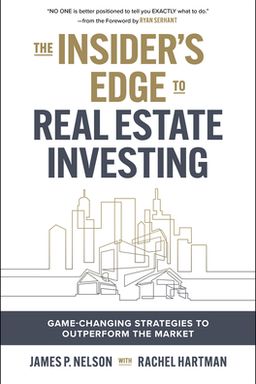
The Insider''s Edge to Real Estate Investing cover

The Insider''s Edge to Real Estate Investing

by James P Nelson with Rachel Hartman

The Insider’s Edge to Real Estate Investing offers beginner and intermediate investors a comprehensive guide to building a successful portfolio. Through cutting-edge strategies and expert insights, the book demystifies the complexities of the market and enables readers to confidently embark on their real estate journey.

Building the Insider’s Edge: Outperforming the Real Estate Market

Have you ever wondered why some real estate investors seem to always find the perfect properties while others struggle to even get started? In The Insider’s Edge to Real Estate Investing, veteran broker and investor James Nelson argues that the difference lies not in luck or wealth, but in access — access to the right people, the right knowledge, and the right approach. His central claim is that real estate investing is an insider’s game, and to master it, you need to learn both the mechanics and the mindset that insiders use to spot, evaluate, and capitalize on opportunities before everyone else does.

Drawing from over two decades of experience brokering and managing billions in real estate transactions, Nelson distills the process into ten actionable steps that guide you from identifying your first property to reaping lasting profits. Through a blend of practical strategy, personal storytelling, and case studies from legendary investors, he delivers a complete roadmap for finding, financing, managing, and exiting real estate investments — whether you’re a beginner or scaling a growing portfolio.

Real Estate as an Insider’s Game

For Nelson, transparency is what separates the stock market from the real estate market. In stocks, he notes, everyone sees the same information — it’s highly efficient and regulated. But in real estate, the playing field is far murkier: there’s no single database with every property for sale, and many deals occur off-market through personal relationships. That’s why insiders — the brokers, developers, and investors who know the players and neighborhood dynamics — have a tremendous advantage. His goal in this book is to help you close that gap, giving ordinary people insider-level access by teaching the same principles that America's leading pros use to find undervalued properties and structure profitable deals.

From Story to System

Nelson structures the book as a methodical system of ten steps, each representing a crucial stage in the lifecycle of an investment. He begins by helping you identify your niche (Step 1: Find the Right Property Type), then moves through learning who the players are (Step 2), spotting hidden gems (Step 3), and analyzing deals (Step 5: Underwriting). Later chapters tackle raising capital, closing transactions, repositioning properties for higher returns, and ultimately harvesting your gains through refinancing or selling. The book culminates with a “Bonus Step” on creating your dream team — a reminder that success in real estate depends as much on your network as on your analytics.

Lessons from a Lifetime in Real Estate

To ground theory in reality, Nelson weaves in stories from his career, starting with his own unlikely entry into New York’s hyper-competitive property scene. Raised far from the skyscrapers he would later sell, he started with no family connections or formal training — only tenacity and an appetite for learning from mentors. Through anecdotes of his grandfather’s rental properties, the growth of his own firm at Massey Knakal, and partnerships at Avison Young, he illustrates lessons about relationship-building, risk-taking, and ethical conduct. Each narrative reinforces a larger point: you don’t need to be a billionaire to invest in real estate, but you do need the curiosity and courage to look where others aren’t.

Why This Matters Now

In an age where investment markets shift fast and volatility is high, Nelson argues that real estate remains the most reliable means of creating wealth — not because it’s easy, but because it’s controllable. Unlike the stock market, real estate allows you to add value directly: renovate, re-tenant, refinance, and repeat. Used smartly, it offers leverage, tax advantages, and long-term stability. Yet, most people fail to take advantage of it simply because they don’t understand how — or they’re too intimidated by the complexity. The Insider’s Edge demystifies that complexity and invites you to approach real estate like a professional — thoughtful, ethical, and strategic.

Whether you’re scouting your first duplex, managing multiple commercial assets, or working toward passive income through syndication, Nelson’s framework promises to make you the kind of investor who doesn’t just buy property, but creates opportunity and value wherever you invest. As he puts it, success comes down to one word his grandfather taught him early: tenacity. If you pair that persistence with insider knowledge, the “edge” is yours.


Finding Your Niche: Choosing the Right Property Type

Every aspiring investor dreams of owning prime real estate — the landmark high-rise, the bustling retail center, or the trophy multifamily building. But according to James Nelson, the less glamorous truth is this: you have to start where your resources and interests match your opportunity. In Step 1, he breaks down the U.S. real estate market into four key asset classes — multifamily, retail, office, and land — and helps you define your niche by balancing return potential with risk and management intensity.

The Multifamily Advantage

Nelson calls multifamily “the foundation of American real estate wealth.” Apartments account for most transactions by dollar volume, and for good reason — people always need a place to live. For first-time investors, small multifamily buildings (two-to-four units) are an ideal on-ramp. You can occupy one unit, finance the others with a residential loan, and learn management hands-on. For those buying larger complexes, he cautions that management becomes increasingly demanding, but the income stability outweighs the effort. Even losing one tenant doesn’t sink your revenue, unlike a single-tenant commercial property.

Nelson uses data to prove multifamily’s dominance: in 2021, over $340 billion in apartment buildings changed hands — more than double any other asset class. Its appeal lies in resilience and scale. Still, he urges investors to consider highest and best use: Can a single-family home be converted into multiple rentals, or vice versa? The right answer depends on local demand and zoning, which again underscores the theme of being a well-informed insider.

The Retail Reality

Retail offers higher rent potential, Nelson notes, but also greater risk and more complex leases. He demystifies the common lease types — single net, double net, triple net (NNN), and percentage leases — helping you see how expenses are divided between landlords and tenants. National “credit tenants” like Walgreens or Starbucks often sign triple-net leases where they pay all operating costs, offering steady payments but lower yield. Conversely, mom-and-pop tenants may bring personal charm but pose higher default risk. For beginners, Nelson recommends starting with multi-tenant or mixed-use properties that combine retail below and apartments above, balancing retail’s volatility with residential stability.

The Office Equation and Land Development

Office investments, particularly post-pandemic, require caution. These properties are capital intensive, slow to lease up, and heavily influenced by remote-work trends. Nelson advises that only experienced, well-capitalized investors pursue full office repositioning projects. Similarly, investing in land or development sites carries the highest risk but also the potential for spectacular returns. He recalls horror stories of sites sitting idle for a decade awaiting approvals — urging newcomers to stick with “shovel-ready” projects where plans and permits are already in place.

Risk Profiles: Core to Opportunistic

Beyond property type, understand your risk comfort level. Nelson outlines a spectrum: Core properties are fully leased, low-risk investments with stable returns (like owning a CVS under a long-term lease). Core Plus adds light renovations for moderate upside. Value-Add — his personal favorite — involves solving problems like under-market rents or poor management to unlock major gains. And Opportunistic deals — ground-up developments or distressed assets — demand expertise and capital depth but can yield double-digit returns.

Close to Home: Leveraging Local Knowledge

Your first investment, Nelson insists, should be in an area you deeply understand. Local familiarity — your “insider geography” — gives unmatched context about rents, demand drivers, and demographics. As he quips, after studying a sub-market for just 90 days, you’ll know more than 90% of competing investors. Post-COVID trends allow people to explore new regions, but starting close to home allows hands-on management and fast learning. The takeaway? Don’t chase glamour or trends. Start small, local, and smart — then scale big over time.


Knowing the Players: Building Your Real Estate Team

No investor succeeds alone — certainly not in real estate, an inherently interconnected industry. In Step 2, Nelson emphasizes that success is a team sport. To compete with insiders, you must develop a circle of brokers, lenders, attorneys, contractors, property managers, and partners who can spot, structure, and close deals alongside you. The right team doesn’t just support you — it multiplies your opportunities.

The Core Relationship: Broker and Investor

Nelson starts with brokers because, as one of New York’s top investment sales professionals himself, he knows they’re the gatekeepers to great deals. Most commercial sales, he notes, are brokered — often over 90% in active markets like Florida and New York. A strong broker provides market intelligence, comps, and — most importantly — access to off-market deals. However, Nelson cautions that credibility is currency: if brokers see you as unprepared or flaky, your calls will go unanswered. To build loyalty, be informed, transparent, and decisive; a serious investor gets the first call when a hidden gem appears.

Key Professionals You’ll Need

  • Attorneys handle every legal element — from transactional closings to zoning questions. Nelson distinguishes four types: transactional, landlord-tenant, tax, and land-use attorneys, all of whom safeguard you from expensive missteps.
  • Mortgage brokers bridge you to financing. They translate your deal into bankable language and shop your loan among lenders — saving you time and often improving terms.
  • Architects and contractors bring your physical vision to life, turning renovations or redevelopments into functional, marketable spaces.
  • Accountants and property managers keep the numbers straight, maintain tenant satisfaction, and manage day-to-day operations.

Nelson admits assembling this roster can feel daunting. But the secret, he says, is to start early — before you need them — and grow relationships gradually. Over coffee chats and small favors, you’ll gain insight and trust that later translate into seamless deals. Bruce Ratner, who developed Brooklyn’s Barclays Center, reiterated this point to Nelson on his podcast: he mentioned the words “team” and “people” over fifty times in a single interview.

Sponsors and Partners: The Investment Backbone

A sponsor — sometimes called an operator or general partner — leads the charge, identifying opportunities, raising funds, and executing a business plan. Limited partners, on the other hand, provide equity but stay passive. For beginners, Nelson suggests partnering with seasoned sponsors whose track records earn lenders’ confidence. Even if you sacrifice some profits initially, you’ll gain priceless experience and credibility — your key ingredients for scaling future deals.

Networking as Leverage

Nelson’s bigger message extends beyond staffing a project: relationships are strategy. One appraiser might tip you off to an estate sale; a zoning lawyer might mention an upcoming rezoning. The value is often in casual exchanges, not boardrooms. (This echoes Keith Ferrazzi’s insight in Never Eat Alone: networking isn’t transactional, it’s relational.) Cultivate authentic connections, stay consistent, and soon you’ll see why insiders rarely act alone.


Spotting the Gems: How to Find Undervalued Opportunities

In Step 3, Nelson moves from theory to the art of discovery — finding properties others miss. His mantra: Buy right; you can fix everything else. He learned this first-hand from his early partnership with developer Matt Blesso, when they bought a West Village mixed-use building at a steep discount, renovated it into condos, and later sold it for millions in profit. That success, he admits, came from recognizing a hidden gem others overlooked.

Understanding Market Exposure

Nelson classifies deal types by how visible they are. On-market deals — listed publicly or through major brokers — draw competition and higher prices. Off-market opportunities, however, often trade quietly between insiders and usually offer better pricing but higher due diligence risks. The ultimate skill, then, lies in developing the network and persistence to find sellers before they list — through conversations with property managers, letters to owners, or community involvement.

The Anatomy of a Great Buy

What makes a property a “deal”? Nelson lists eight markers that insiders look for:

  • A motivated seller — often driven by estate sales, partnership disputes, or financial distress.
  • Low or nonexistent marketing — properties not broadly listed or mismatched with the wrong broker.
  • Neglected management or deferred maintenance that you can correct quickly.
  • Repositioning potential — the ability to reimagine or repurpose the property, such as converting rentals to condos.
  • Neighborhoods on the rise — where infrastructure or demographic shifts predict appreciation.
  • Zoning changes or underused air rights that allow expansion.
  • Inefficient rent structures or below-market tenants.
  • An ability to see value others don’t — creativity is your edge.

He illustrates this with cases from Manhattan, where zoning updates or transit expansions transformed overlooked blocks into gold mines. Investors who noticed “the neighborhood about to pop” secured multi-million-dollar appreciation simply by connecting coming infrastructure to existing assets. (Jane Jacobs would call it “reading the street.”)

Work with, Not Against, Brokers

While it’s tempting to hunt solo, Nelson insists that brokers amplify opportunity. Call them regularly, ask what’s in their “pipeline,” and show dedication. Many investors, he explains, lose deals because they don’t stay top of mind. Send your acquisition criteria, follow up monthly, and offer insights back — relationships feed reciprocity. In time, brokers will bring deals to you first.

Ultimately, spotting gems is equal parts hustle, creativity, and pattern recognition. As Nelson puts it, you don’t need the biggest wallet — you need the sharpest eyes. And that’s something anyone can learn.


Underwriting the Deal: Making Numbers Work for You

Numbers may not tell the whole story, Nelson admits — but they tell you whether your story will have a happy ending. Step 5 dives deep into the financial backbone of every real estate purchase: underwriting. If finding the gem is the art, underwriting is the science — the disciplined process of analyzing risk, revenue, and return under different scenarios.

What Is Underwriting?

Rooted in the 17th-century origins of Lloyd’s of London, underwriting literally meant “writing under” a risk one agreed to take. In real estate, that translates to quantifying the deal’s risk-reward profile before committing capital. Lenders use it to decide if they’ll issue a loan; investors use it to decide if the return justifies the risk. Nelson explains the key metrics every investor must master: cap rate (income over purchase price), cash-on-cash return (cash yield on equity), ROI (total return), and IRR (annualized return over the lifecycle).

Passive Income vs. Active Oversight

Nelson dispels the myth of “passive income.” Real estate, he says, is active by nature — even if you hire managers, you still monitor performance and make decisions. Quoting author Doug Marshall (Mastering the Art of Commercial Real Estate Investing), Nelson notes that true financial freedom comes not from doing nothing, but from doing the right kind of work: routinely evaluating financials, adjusting operations, and reinvesting gains.

The Tools and Documents

When assessing a property, you’ll receive a broker’s “set-up” or full offering memorandum (OM), containing rent rolls, expenses, and projections. Nelson walks readers through analyzing these documents: distinguishing “actual” from “projected” figures, reviewing trailing-12 income statements, and checking that expenses (like property taxes) align with reality. If financials seem inflated, adjust them conservatively — underwriting rewards skepticism, not optimism.

Comparable Sales as Compass

Even the best spreadsheet is meaningless without market context. Like an appraiser, calculate your cap rates against comparable sales — adjusting for tenancy quality, condition, and location. Nelson advises talking regularly to brokers, reading quarterly reports, and following data services like Reonomy or Traded.co. Numbers tell you what happened; relationships tell you why.

Underwriting, ultimately, is about discipline — knowing when to walk away. Nelson admits he’s made mistakes by going outside his expertise or overpaying based on emotion. The lesson? Be curious, creative, but rigorous. In real estate, you don’t win because you underpay — you win because you understand what you’re paying for.


Raising Capital and Structuring the Deal

Money makes deals move — but it’s credibility that unlocks the money. In Step 6, Nelson tackles the most intimidating hurdle for beginners: raising capital. His message is encouraging: you don’t need millions; you need a great deal, honest communication, and the right structure.

The Benchmark Blueprint: Jordan Vogel’s Story

Nelson highlights developer Jordan Vogel, who in 2009 raised $6 million in 30 days to buy two Greenwich Village buildings during the recession. Starting with a friends-and-family network, Vogel and his partner offered transparent terms — an 8% preferred return to investors and a 25% profit share to themselves. They nearly missed their 90-day closing window but ultimately succeeded. That fund became Benchmark Real Estate Group, later investing over $1 billion. The moral: it starts with one credible raise.

Skin in the Game and Sweat Equity

Nelson urges you to always put something on the line — either cash or “sweat equity.” If you find a great deal but lack funds, bring it to a partner and negotiate a small ownership percentage for orchestrating it. That’s how you build experience and a track record without writing big checks. But never, he warns, commit to deals you can’t close; reputation spreads fast in this business.

Structuring Capital: The Stack

Nelson provides rare clarity on how deals are financed through a “capital stack” — layers of funding from least to most risky: senior debt (banks), mezzanine debt (secondary loans), preferred equity (investors promised fixed returns), and common equity (owners and partners). Understanding how these interact is crucial: senior lenders always get paid first, but equity investors reap unlimited upside last. A balanced stack keeps risk manageable and rewards aligned.

Documentation and Transparency

A professional capital raise requires clear documentation — a deck presenting the business plan and projected returns, a sources and uses statement that matches every dollar raised to every use, and a joint venture agreement outlining roles, fees, and profit splits. Avoid hype, Nelson warns: never promise “guaranteed returns.” Besides violating SEC rules, it erodes trust. Investors, especially family, will appreciate honesty about both upside and risk.

Funds and Incentives

Once you’ve completed multiple successful deals, consider starting a fund, as Nelson did with his partners at RiverOak. Funds pool investor capital for quicker execution and allow diversification across projects. At every level, explore government incentives — such as historic preservation or energy efficiency tax credits — which can offset costs and increase investor confidence.

Ultimately, raising capital isn’t about asking for money — it’s about offering an opportunity. Bring professionalism, a great deal, and a clear plan, and investors will line up. In Nelson’s words: “Don’t shy away from raising capital — most high-net-worth individuals are looking for real estate diversification with a trusted partner.”


Closing, Repositioning, and Reaping the Rewards

The final steps in Nelson’s framework — closing the deal, repositioning the property, and eventually exiting or refinancing — reveal the culmination of the insider’s edge: execution. Deals are won not just at signing but in how you manage and maximize them after acquisition.

Closing the Deal

Closing, Nelson explains, is more paperwork than glamour — but small mistakes can cost fortunes. Carry out thorough due diligence: inspect the title, review leases, ensure environmental compliance, and verify financial statements. Attorneys and title agents are indispensable. He recounts developer MaryAnne Gilmartin’s hair-raising story at Forest City when a missing $86 million credit letter nearly derailed a major Brooklyn project. Her persistence saved the deal — proof that real estate rewards determination and preparedness.

Repositioning for Value

Acquisition is only the beginning. The real profit often comes from repositioning — changing a property’s look, use, or operations to raise value. Nelson defines four value-add moves: improving management, renovating units, upgrading amenities, and re-tenanting with higher-paying occupants. He shares cautionary tales, like his ill-fated Connecticut multifamily purchase where poor tenant management wiped out expected profits, balanced by success stories such as Jeff Ravetz’s revival of downtown Hartford. Ravetz converted a derelict hotel into apartments and reenergized a struggling city — proof that great investments create both financial and civic returns.

Holding, Refinancing, or Selling

After stabilization comes the strategic decision: hold, refinance, or sell. Holding builds long-term cash flow; refinancing extracts equity through improved terms; selling realizes gains but triggers taxes. Nelson explains how investors use the IRS’s 1031 exchange to defer capital gains by reinvesting profits into similar “like-kind” properties — rolling growth forward indefinitely. But he cautions: never buy just for tax reasons; the deal itself must stand on its own merits.

The Compass of Integrity

Throughout, Nelson returns to ethics as the real insider advantage. In an industry where reputation travels fast, honesty and follow-through are nonnegotiable. One honest interaction today may yield a partnership years later. His parting message echoes in his final chapter “Create Your Dream Team”: aim not just for profit but for impact, relationships, and legacy. Real estate, at its best, is not merely a transaction — it’s a people business that transforms neighborhoods and lives.

Dig Deeper

Get personalized prompts to apply these lessons to your life and deepen your understanding.

Go Deeper

Get the Full Experience

Download Insight Books for AI-powered reflections, quizzes, and more.