
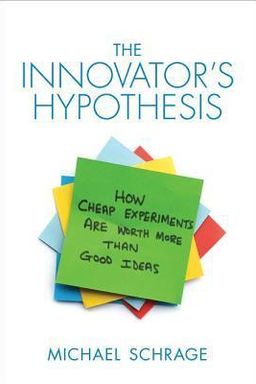
The Innovator’s Hypothesis cover

The Innovator’s Hypothesis

by Michael Schrage

The Innovator’s Hypothesis reveals how businesses can shift from expensive R&D to agile, cost-effective experimentation. Discover the 5x5 model that empowers teams to innovate rapidly, align initiatives with core values, and prepare for a future driven by AI-enhanced recommendations.

The Innovator’s Hypothesis: Why Cheap Experiments Beat Big Ideas

Have you ever wondered why the best ideas in your company seem to die in planning meetings, while simpler experiments from unlikely sources lead to breakthroughs? In The Innovator’s Hypothesis, Michael Schrage — innovation researcher at MIT and author of Serious Play — argues that the future belongs not to thinkers with brilliant ideas, but to teams that test small, cheap hypotheses fast. His audacious claim: creative experimentation within constraints is worth far more than chasing big ideas without boundaries.

Schrage challenges the corporate faith in brainstorming and conceptual brilliance, showing how this fixation leads to slow, expensive failures. He insists that “ideas are the enemy” when they delay action. In a world where innovators like Amazon, Google, and Toyota thrive on rapid iteration, the question shifts from “What’s the big idea?” to “What small experiment will teach us the most right now?” This book reveals how to redesign innovation culture around learning-by-doing, applying a simple but powerful methodology called the 5×5 — a way for organizations to craft fast, frugal experiments that generate useful insight without risking millions.

The Core Argument: Innovation as Investment in Learning

Schrage frames innovation as a kind of investment portfolio. Instead of betting everything on the next “big idea,” smart organizations diversify through small, low-cost experiments. The goal isn’t revolution—it’s evolution at high speed. By managing experiments like financial assets, leaders can explore risk and reward intelligently. Warren Buffett, famous for buying a dollar for fifty cents, becomes the model for innovation investors: great innovators buy a dollar’s worth of insight for a fraction of the cost by testing assumptions fast.

He urges you to think like Buffett and ask: “What experiment will buy us a dollar’s worth of innovation insight for fifty cents—or even twenty?” The methodology turns innovation into a measurable asset rather than a vague hope. Experiments don’t just produce answers; they create learning systems. They make organizations smarter at assessing what customers will actually value. In this sense, Schrage sees experimentation as human capital development—it transforms your people and your customers into better innovators.

The 5×5 Framework: Fast, Frugal, Impactful

At the heart of the book lies the 5×5 method: gather five people, give them five days to design five experiments that cost less than $5,000 each and run for no more than five weeks. The results don’t have to be perfect—they just need to deliver roughly 80% of valuable insight for 20% of the time and resources. This is Schrage’s 80/20/20 vision: 80% of useful information, 20% of the usual time, using 20% of the cost. It’s designed to provoke learning rather than prove ideas right.

Schrage’s experiments are cultural engines as much as analytical tools. When teams run them, they display the practical creativity every leader craves. People move from planning to acting; from analyzing risk to learning how to manage it. The impact ripples across organizations: experiments become diagnostic mirrors for revealing cultural resistance. As Schrage’s painful story of Blockbuster shows, rejecting simple experiments often exposes a company’s fear of learning and change—the surest sign of decline.

From Ideas to Actions: “Experimenting with Experimentation”

The book’s deeper philosophy is behavioral. Innovation, Schrage reminds us, “is less an act of intellect than an act of will” (echoing economist Joseph Schumpeter). You innovate not by brilliance, but by doing. Experiments cultivate that will. They replace intellectual arrogance with curiosity and humility—the traits of great experimenters and great learners. Schrage pushes readers to view hypotheses as the simplest form of action: “If we do X, we expect Y.” You’re not confirming truth; you’re testing value creation.

Across chapters, Schrage builds his case through examples both heroic and humbling. Amazon’s recommendation system, born from a quick hack by Greg Linden, became a billion-dollar platform. Apple’s mouse prototype began with Dean Hovey buying roll-on deodorant balls from Walgreens to create a cheap test model for Steve Jobs. Psychologists Daniel Kahneman and Amos Tversky, with tiny pencil-and-paper experiments, reshaped global economics. These stories prove one lesson: small experiments can have enormous impact.

Why This Matters: A New Economics of Innovation

Schrage’s message speaks directly to anyone frustrated by corporate inertia. In industries overloaded with PowerPoint decks and risk committees, this book is a wake-up call. He contends that imagination isn’t scarce—but courage, speed, and simplicity are. The 5×5 model teaches teams to make experimentation habitual and learning continuous. Experiments reduce uncertainty faster than analysis ever can. They don’t just tell you whether your idea works; they teach you why.

Schrage’s central thesis

“Creative experimentation, within constraints, makes high-impact innovation simpler, safer, and more successful.”

It’s not about revolutionary ideas; it’s about disciplined curiosity. The future, he says, belongs to organizations that learn faster than they plan.

In this summary, you’ll explore Schrage’s key principles: why ideas can be toxic distractions, how simple experiments drive smarter innovation, how to invest in experimental portfolios like Warren Buffett invests in stocks, how experimentation diagnoses culture, and what it takes to build a learning organization in the digital age. You’ll leave understanding one powerful truth: if you can’t afford to fail cheaply, you can’t afford to innovate at all.


Ideas Are the Enemy

Schrage begins with a provocative claim: most good ideas are bad investments. They look brilliant on paper, raise hopes, and then destroy value in reality. Companies like DuPont, Xerox, Sony, and General Motors have lost billions chasing 'great ideas' that turned toxic. Why? Because ideas seduce you into analysis rather than action. They make you believe that thinking harder will solve problems that only iteration can fix.

In his chapter "Ideas Are the Enemy," Schrage compares idea obsession to addiction. “Business ideaholics,” he writes, are like junkies chasing the next high. The more you pursue ideas without testing, the more you destroy value. Schrage dismantles the intellectual elitism behind this addiction, taking aim at John Maynard Keynes’s famous dictum that “the world is ruled by ideas.” He counters that the world is built by tinkerers, engineers, and doers—from James Watt and Henry Ford to Steve Jobs and Sam Walton. Innovation requires will, not intellect.

Implementation, Not Ideation

Schrage argues that the implementation—not the idea—is the true unit of analysis for value creation. The best innovators focus on the verbs, not the nouns: “What should we do?” “What should we test?” “What can we try tomorrow?” Ideas don’t create value until used; implementations redefine ideas through iteration. He uses Walmart as a case study. Sam Walton didn’t invent retail ideas—he borrowed what worked, replicated them with disciplined excellence, and made them profitable through scale and process.

When Walmart developers were required to perform the actual jobs they coded software for, the results improved dramatically. That practice, Kevin Turner explained, forced teams to overcome “implementation resistance” and create usable systems faster. Walmart’s success, Schrage concludes, isn’t about big ideas; it’s about relentless execution, making implementability itself the innovation challenge.

From Prototypes to Hypotheses

To replace idea obsession, Schrage introduces one simple pivot: see prototypes as hypotheses. A prototype isn’t just a model—it’s a guess about value. Every design choice is an implicit “what if?” statement waiting to be tested. Testing prototypes turns intentions into evidence. When Greg Linden at Amazon hacked a few lines of code to suggest products to customers, he was testing a hypothesis: “If we recommend items during checkout, people will buy more.” That experiment became Amazon’s recommendation engine, a multi-billion-dollar innovation born not from analysis, but from a quick test.

Expressive Experimentation

Schrage defines expressive experimentation as the act of making ideas tangible fast enough to learn from them. Watt’s brass syringe, Jobs’s mouse prototype, and Linden’s code snippet each turned thought into form—their expressiveness invited insight. This expressiveness links design thinking with experimentation: ideas are elevated when acted upon, not reduced to practice but raised through experience. Prototypes are persuasive hypotheses about the future; if they don’t persuade through results, they fail. This changes creativity from talking into testing.

Core lesson

To innovate well, stop glorifying ideas and start designing experiments. Every idea must earn its place by surviving cheap, fast tests. Implementation trumps imagination.


Simple, Fast, Cheap, Smart, Lean, Important

Innovation success, Schrage contends, depends on six attributes: simple, fast, cheap, smart, lean, and important. These aren’t buzzwords—they’re operational imperatives for any team serious about results. The 5×5 model embodies them by forcing constraints that spark ingenuity: limited time, money, and scope make people think creatively.

The Power of Constraints

Constraints are the secret engines of creativity. Schrage calls this “the virtue of necessity.” By enforcing frugality and speed, you unlock insight faster. He illustrates this with the story of a business simulation firm whose marketers were losing customers due to mandatory email registrations. Instead of running surveys, two employees tried a cheap experiment: they delayed the sign-in request until after users tried the demo. Conversion skyrocketed. In two days, the team solved what analysts failed to fix in months. The low-cost test shifted culture: “Why experiment?” became “Why not experiment?”

Speed and Simplicity

Fast experiments deliver faster learning. Schrage reminds you that speed multiplies value—Google’s search engine isn’t great because it’s accurate, but because it’s instant. He uses the example of radar pioneer Robert Watson-Watt’s “Law of the Third Best”: give them the third best solution now; the second best comes too late, and the best never comes. Innovation rewards timing over perfection. “Speed of experiment” becomes a competitive advantage—McDonald’s wins not just because it sells food, but because it sells fast food. Likewise, Google’s value lies in instant insight.

Cheap as Strategic Advantage

Cheap isn’t stingy—it’s strategic. Low-cost experiments lower risk, making boldness accessible. Schrage retells psychologist Daniel Kahneman and Amos Tversky’s Nobel-winning studies on irrational decision-making: tiny paper tests exposed massive cognitive biases that rewrote economics. Their simplicity gave their ideas credibility. Likewise, General Mills solved a multimillion-dollar production problem by running $10,000 worth of quick tests with line workers instead of outsourcing analysis. Cheap experiments created smarter teams—not just smarter data.

Schrage encapsulates the lesson in a mantra: “Huge ideas don’t need huge experiments.” The six ingredients—simple, fast, cheap, smart, lean, important—form a playbook for everyday innovators. The best experiment isn’t the most complex—it's the one you can finish tomorrow and learn from immediately.


Stealing from Warren Buffett: Innovation as Value Investing

When Schrage met Warren Buffett early in his career, he discovered a philosophy that redefined innovation for him: treat experiments like investments. Buffett’s maxim “Price is what you pay; value is what you get” became Schrage’s mantra for innovation management. He invites you to ask, “How can we buy a dollar’s worth of innovation insight for fifty cents—or even less?”

The Margin of Safety

Buffett’s concept of the margin of safety—avoiding overpayment for assets—maps perfectly to experimentation. A company shouldn’t spend millions chasing glamorous R&D projects when a few thousand dollars can test the same hypotheses. Apple’s most famous early experiment proves it. Steve Jobs challenged a small firm, Hovey-Kelley, to make a Xerox-style computer mouse for less than $25 when the original cost $400. The team hacked deodorant balls from Walgreens to build the prototype. In less than a week and under $1,000, they validated mass producibility. That experiment bought Apple credibility, scale, and profits—proving that frugal experiments can create luxurious results.

Frugality as Innovation Fuel

Inspired by frugal innovators like Jeff Bezos, Schrage explores Amazon’s culture: “Frugality drives innovation.” Bezos’s teams run thousands of micro-experiments daily, optimizing customer decisions rather than chasing big bets. When Amazon couldn’t afford advertising budgets in its early days, it created an affiliate program instead—a frugal experiment that became a billion-dollar growth channel. Frugality isn’t constraint—it’s discipline that converts creativity into continuous progress.

Value Innovating vs. Value Investing

Schrage extends Buffett’s method into “value innovating.” Innovators must think like portfolio managers: diversify hypothesis investments, minimize downside risk, and maximize learning yield. Procter & Gamble exemplifies this shift. It replaced physical test markets like Peoria with digital ones, running concept tests online “at one-hundredth the cost and time.” The savings allowed P&G to run 10,000 times more experiments per year than before, transforming its innovation culture into a perpetual learning engine.

Core insight

Cheap experimentation buys insight at a discount. Innovators, like Buffett, succeed not by betting big on brilliance but by investing small in discovery.


Experimentation as Investment Portfolio

In one of the book’s most sophisticated chapters, Schrage blends finance, design thinking, and science to show that experiments should be managed like portfolios. Just as investors balance risk and return across diversified holdings, innovators balance speed, cost, and insight across multiple tests. The question becomes: What kind of experiment investor do you want to be?

Financial Theory as Design Guide

Drawing on Harry Markowitz’s portfolio theory, Schrage explains that experiments, like stocks, have risk/reward ratios. A smart innovation portfolio combines “safe experiments” (predictable learning) with “wild cards” (high insight potential). Blending them reduces volatility. Constraint becomes the investment principle: five weeks, five grand, five people. This forces productivity the way budget caps drive efficiency.

Design Thinking Meets Finance

Design thinking adds the human dimension. Like IDEO’s approach, good experimental design is empathetic and elegant—it transforms prose into poetry. Great experiments illuminate rather than complicate. Schrage reminds readers that design is about “adding value, meaning, and persuasion,” not just testing functionality. When a car advisory company experimented with instant messaging to advise buyers, the results reshaped engagement across departments. The test bridged customer experience and corporate learning.

Science as Constraint-Based Creativity

Finally, scientific discipline grounds the approach. Real scientists test hypotheses within constraints—limited time and resources sharpen focus. Claude Bernard’s maxim “Observation is passive; experimentation is active” defines modern innovation. Schrage’s teams leverage constraints as features, not bugs, turning finance, design, and science into a virtuous cycle. You learn fast, fail cheap, and iterate meaningfully.

Treating experiments as assets reframes innovation from cost to capital. A company investing in experiment portfolios isn’t spending; it’s building an insight bank whose compounding interest pays in growth, agility, and capability.


Diagnosing Culture Through Experiments

Some experiments fail spectacularly—and Schrage argues that’s where their hidden value lies. His infamous case study of Blockbuster shows how rejecting a simple test can expose deep cultural rot. In 2000, Blockbuster faced backlash over late fees. Schrage proposed a $12,000 experiment using email reminders to see if customers wanted help returning movies on time. Executives dismissed him angrily, fearing loss of revenue. Months later, Blockbuster launched a costly nationwide reform that ended in lawsuits and bankruptcy. A cheap test could have saved them millions.

Resistance Reveals Reality

Schrage realized that proposing fast, frugal experiments is the best way to diagnose culture. When teams respond with “We can’t do that because…,” the reasons reveal their true values. It’s not about the test—it’s about the fear behind it. One financial firm blamed legal restrictions; another manufacturer blamed R&D ego. Through these resistances, Schrage discovered what he calls innovation MRI: cheap experiments become cultural x-rays exposing organizational dysfunction.

Learning from Others’ Refusals

He compares Blockbuster’s blindness to economist Julian Simon’s experiment in the airline industry. For years, airlines overbooked flights and faced angry passengers. Simon proposed a simple auction system letting volunteers give up seats for money. Airlines mocked him. A decade later, regulators forced trials—and overbooking chaos vanished. Simple experiments solved complex problems that endless planning couldn’t touch.

Schrage calls these stories “mirrors for management.” If your team refuses to test assumptions cheaply, you’ve diagnosed your innovation culture: it prefers comfort to curiosity. Designing cheap tests, then observing the organizational reaction, becomes a form of cultural anthropology—a way to see what your people truly value.


Building High-Performance X-Teams

X-teams are the engines of the 5×5 methodology. These small, diverse squads embody collaborative experimentation. Schrage distills their success factors into five behaviors: high business impact focus, alignment with management priorities, simplicity, pleasant surprises, and scalability. When teams display these, their portfolios persuade even skeptical leaders.

From Talent to Teamwork

The 5×5 model thrives on diversity—technical experts, marketers, analysts, and designers working side by side. The best teams debate passionately but collaborate productively. In Brazilian and Chinese firms Schrage advised, diverse X-teams reframed innovation from solving problems to testing learning. They changed questions like “What should we build?” into “What can we learn fast?” This shift from planning to hypotheses nourished cross-functional trust.

Five Habits of Winning Teams

  • High business impact: Choose experiments that visibly affect customers or strategy.
  • Align with leadership: Connect hypotheses to the CEO’s declared priorities.
  • Keep it simple: Clear, intuitive experiments win attention faster than complex analyses.
  • Design for surprise: Pleasant revelations energize leaders who crave novelty.
  • Plan for scale: Show how tests can evolve into processes or product lines.

Culture of the Imperfect

Echoing radar pioneer Robert Watson-Watt’s motto “Give them the third best to go on with,” Schrage advises teams to aim for clear, convincing results quickly rather than perfection. Excellence slows learning; iteration accelerates it. The courage to implement imperfect experiments is the mark of high performance.

Essential insight

“Talk is cheap. Action is capital.” The best X-teams don’t just design hypotheses—they run them. They prove that innovation is a contact sport, not a committee meeting.


The Future: Experimenting with Experimentation

Schrage closes with a vision of what’s next: an era where experimentation itself becomes automated, pervasive, and social—a shift from research and development (R&D) to experiment and scale (E&S). The infrastructure of innovation will allow anyone to run instant tests as easily as sending a tweet. The age of “cheap experiments” becomes exponential.

Automation and Algorithms

Drawing on examples like IBM’s Watson and the robot scientist Adam, Schrage imagines machines collaborating with humans to design hypotheses and run experiments autonomously. Artificial intelligence will enable “freestyle innovation,” reminiscent of Tyler Cowen’s centaur model in chess—human intuition paired with machine pattern recognition. To stay valuable, you must master epistemic humility: knowing when to question and when to trust data.

Networking Innovation

Networkification—the linking of networks across industries—creates a global laboratory. As data becomes ubiquitous, experimentation itself scales. Jim Manzi of Applied Predictive Technologies calls this “experimentation as a service.” Cloud computing lets you zoom tests from local to global instantly. Companies move from R&D pipelines to E&S portfolios, continuously iterating and expanding like living ecosystems. Innovators will run 5×500 or even 5×500,000 experiments simultaneously.

Humans as Experimental Designers

Despite automation, Schrage emphasizes human creativity. Machines answer questions, but humans must ask better ones. Experimenters become question engineers, turning uncertainty into structured curiosity. Kevin Kelly’s insight—that science expands ignorance faster than knowledge—becomes Schrage’s final metaphor: the more we learn through experiments, the more we realize what we still need to know. That endless curiosity is the heart of sustainable innovation.

The future formula

Instant + Social + Recommended + Automated + Pervasive = Exponential experimentation. The best innovators won’t just run experiments—they’ll continuously experiment with experimentation.

Dig Deeper

Get personalized prompts to apply these lessons to your life and deepen your understanding.

Go Deeper

Get the Full Experience

Download Insight Books for AI-powered reflections, quizzes, and more.