
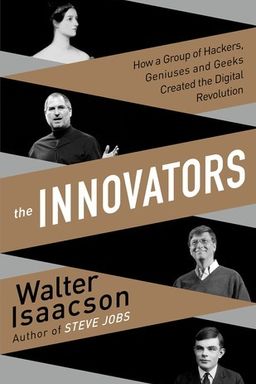
The Innovators cover

The Innovators

by Walter Isaacson

The Innovators by Walter Isaacson delves into the collaborative spirit that fueled the digital revolution. Through captivating stories of pioneering figures like Ada Lovelace and Tim Berners-Lee, this book reveals how teamwork and shared vision transformed technology, shaping the modern world.

The Evolution of Human‑Machine Partnership

The history of computing is not simply the story of faster machines. It is the story of how people imagined, built, and then reimagined tools that amplify thought. Across two centuries, visionaries—from Ada Lovelace to Alan Turing, Grace Hopper, Douglas Engelbart, Tim Berners‑Lee, and modern AI designers—transformed the idea of computation from mechanical arithmetic into human‑machine symbiosis. This book traces that arc: invention; abstraction; electronic revolution; programming; networks; and digital culture.

From Calculation to Imagination

Ada Lovelace planted the first conceptual seed. Working with Charles Babbage’s Analytical Engine in 1843, she recognized that a machine could manipulate symbols, not merely numbers. Her published algorithm for Bernoulli numbers anticipated loops, conditional statements, and even reusable code libraries. Her “poetical science” balanced rigor with imagination—she believed that how machines extend human creativity matters as much as what they compute. Alan Turing later formalized this leap: his universal machine proved that any calculation could be simulated if described correctly, making programmability the essence of computing.

Theory Meets Engineering

In the 1930s, Claude Shannon showed how Boolean logic could become electrical circuits—bridging abstraction with hardware. Meanwhile, wartime needs pushed these theories into practice. Mechanical “calculators” evolved into vacuum‑tube machines that crunched trajectories and decrypted codes. When John von Neumann articulated the stored‑program architecture, software took center stage. Grace Hopper and the women of ENIAC invented frameworks—subroutines, debugging, compilers—that carved out the human side of hardware: how to express intention to a machine.

Electrons, Transistors, and Silicon Ecosystems

Bell Labs’ transistor breakthrough (1947) miniaturized and accelerated computation. William Shockley’s later managerial failure in Palo Alto paradoxically birthed Silicon Valley, as the “traitorous eight” formed Fairchild Semiconductor and paved the way for the venture‑capital model. Then Robert Noyce and Jack Kilby solved the “tyranny of numbers” with integrated circuits, allowing chips to scale. Gordon Moore’s 1965 observation—that transistor density would double regularly—became a guiding prophecy for planning technological growth. Intel’s founders, Noyce, Moore, and Andy Grove, built a culture that united autonomy, technical excellence, and operational intensity—a living alloy of leadership.

Programming the World

With the microprocessor’s birth (Intel 4004, 1971), computation became portable and programmable. Ted Hoff’s insight—to replace many specialized chips with one general‑purpose processor—redefined economics: software could now define hardware behavior. That pivot empowered the hacker culture at MIT and entrepreneurs at Atari to discover interactive computing’s joy. From Spacewar to Pong, creative play made computers personal.

Networks, Collaboration, and Openness

J. C. R. Licklider’s dream of man‑computer symbiosis and an “intergalactic network” drove ARPA to fund time‑sharing, then the ARPANET. The first message—“Lo”—linked UCLA and SRI in 1969, launching distributed connection as a civic infrastructure. Tim Berners‑Lee later merged hypertext with the Internet, making the Web open and free (CERN’s public‑domain release). Mosaic’s graphical browser made the Web accessible, launching the publishing era of digital life. Simplicity shaped history: Andreessen’s visual focus shifted the Web toward read‑only mass communication rather than collaborative editing—until blogs, wikis, and Wikipedia reintroduced participatory authorship.

Economies, Communities, and the Cultural Web

Software became the true engine of value. Bill Gates and Paul Allen’s Altair BASIC formed Microsoft’s foundation for proprietary software; Stallman and Torvalds countered with GNU and Linux, emphasizing freedom and transparency. Meanwhile, modems and bulletin boards democratized access—ordinary homes joined the digital commons. When AOL and CompuServe attracted millions, cultural shock followed: 1993’s “Eternal September” symbolized the irreversible public flooding into cyberspace. Berners‑Lee’s open protocols ensured that anyone could publish, and Google’s PageRank algorithm later organized the chaos—turning collective human linking into machine intelligence.

The Persistent Idea: Symbiosis

Across all eras, one insight repeats: technology grows not through replacement, but through partnership. Ada Lovelace’s caution—that machines do not originate ideas—remains prophetic. Modern AI systems from Deep Blue to Watson amplify rather than replicate human insight. Licklider’s and Engelbart’s visions of augmentation endure in collaborative computing, search engines, and neural networks. Ultimately, innovation is cultural, institutional, and poetic. The computer’s story is our story—how we encode imagination into machinery and, in doing so, remake ourselves.


From Ada to Algorithms

Every revolution begins with imagination. Ada Lovelace’s 1843 “Notes” on Babbage’s Analytical Engine transformed a mechanical design into a conceptual prototype for programmable logic. She distinguished between machines that merely calculate and those that represent symbols, foreseeing that computation could handle words, music, and art. This poetic framing made her both mathematician and visionary.

The Analytical Engine and Its Legacy

Babbage’s Difference Engine automated table generation, but Ada saw the Analytical Engine as qualitatively different: a general-purpose architecture with separate “store,” “mill,” and “reader.” Her analogy—like a Jacquard loom weaving algebraic patterns—suggested that software (punched cards) could shape behavior. Her published algorithm for Bernoulli numbers introduced iteration, branching, and modularity—concepts that now define programming.

Turing's Universal Machine and Shannon's Logic

A century later, Alan Turing and Claude Shannon extended Ada’s dream. Turing’s universal machine defined computational equivalence, revealing that one machine could emulate any other given the right code. Shannon translated Boolean algebra into electrical circuits, demonstrating that logic could be physical. (Note: Together they made “digital” synonymous with both logic and electronics.) Their work bridged pure thought and material design—the beginning of modern computer science.

Lovelace’s Objection, Reinterpreted

Ada’s remark that machines “cannot originate anything” became known as the Lovelace Objection. Far from denying AI, she warned that creativity stems from human purpose. Alan Turing later revisited the phrase to frame questions of machine learning. Today it reminds you that algorithms extend imagination, but do not replace it. The bridge she built—between mathematics and artistry—still supports computing’s philosophy: technology gains meaning only when joined with human intention.


The Digital Revolution and the Rise of Electronics

Between the 1930s and 1950s, abstract theory met pragmatic engineering. Babbage’s mechanical sketches evolved into electromechanical relays and then electronic circuits. This technological convergence produced digital systems capable of universal logic and rapid computation.

From Relays to Tubes

Claude Shannon’s 1937 thesis proved that electrical switches could implement logical expressions. George Stibitz’s relay calculators, Konrad Zuse’s binary Z3 (1941), and Atanasoff’s partial vacuum‑tube design each tackled pieces of the puzzle: binary representation, programmability, and high-speed operation. The defining shift was from analog approximation to discrete digital states—bits became the new currency of reasoning.

ENIAC and the Distributed Inventor Model

The ENIAC (1945) was the first fully operational electronic general-purpose computer. Designed by Eckert and Mauchly, it showed computation at wartime scale. But as Isaacson and historians emphasize, invention was collaborative: dozens of thinkers and institutions contributed. Judge Earl Larson’s later ruling crediting Atanasoff legally underscored that technological progress is not a lone-genius phenomenon.

Education from Engineering

You learn from this era that theory gains traction through engineering practice. Concepts like binary logic and universality mattered only when linked to concrete devices. Each instrument, from Zuse’s tape reader to ENIAC’s switches, taught programmers to think modularly. The modern notion of computing—an abstract logic embodied in electrical systems—was born from this marriage of idea and artifact.


Programming and Human Expression

Programming connects human thought with machine behavior. In the 1940s–50s, pioneers like Grace Hopper and the ENIAC women redefined what it meant to instruct a computer. Their work turned mechanical reconfiguration into linguistic expression—a transformation that made silicon responsive to syntax.

Grace Hopper and Legible Code

Hopper approached programs as communication. Her Mark I manual described computation as storytelling, insisting that instructions be modular, reusable, and clear. When she later built the A‑0 compiler and inspired COBOL, she translated machine logic into human symbols. This philosophy laid the foundation for modern software languages.

Women Programmers as Founders of Practice

The six women who programmed ENIAC—Jean Bartik, Betty Holberton, Ruth Teitelbaum, and others—transformed mathematical equations into cable configurations and discovered debugging, looping, and subroutines. Their invisible labor invented what we now call software engineering. They proved that creativity often emerges where formal training is absent but persistence and collaboration thrive.

Stored‑Program Architecture and Compilers

Von Neumann’s stored‑program concept allowed code and data to share memory, making programs easily modifiable. Hopper’s later compiler translated symbolic instructions into machine language, democratizing programming. Debugging culture and reuse libraries stem from these origins. Today, every computing abstraction—from classes to APIs—echoes Hopper’s principle: organize complexity through language, not wiring.


Transistors, Silicon, and Entrepreneurial Networks

Hardware evolution accelerated when Bell Labs fused research with management. The 1947 transistor invention marked a shift from fragile vacuum tubes to solid-state reliability. Its discovery—part accident, part teamwork—illustrates how collaboration, not isolation, drives invention.

Bell Labs and Collective Genius

John Bardeen’s theory, Walter Brattain’s experiment, and William Shockley’s ambition converged. Their transistor, demonstrated with germanium and gold contacts, enabled miniaturization and efficiency. Bell Labs’ open corridors and cross-disciplinary culture fostered breakthroughs—Shannon’s information theory and quantum materials intersected daily.

From Shockley to Silicon Valley

Shockley’s management failures led eight engineers, including Robert Noyce and Gordon Moore, to found Fairchild Semiconductor. Venture capitalist Arthur Rock financed them, inventing the modern startup model. Fairchild’s spin-offs created Silicon Valley’s ecosystem of risk, autonomy, and capital synergy. The transistor’s portability catalyzed an entrepreneurial geography as well as a technical revolution.

Integrated Circuits and Moore’s Law

Jack Kilby at Texas Instruments and Noyce at Fairchild separately pioneered integrated circuits—combining many components on one chip. Moore later quantified the trend toward exponential miniaturization. Intel embodied those ideals: Grove enforced discipline, Noyce encouraged collaboration, and Moore provided the vision. Together they showed that leadership design can mirror technical design—complementary parts forming stable alloys.


Microprocessors and Interactive Culture

The microprocessor condensed an entire computing architecture onto one chip, enabling software to drive hardware. Intel’s 4004 (1971) exemplifies how a technical simplification can ignite cultural change—from factory controllers to personal gadgets.

Ted Hoff’s Radical Proposal

Faced with Busicom’s demand for twelve custom chips, Ted Hoff proposed designing one programmable chip instead. With Stan Mazor, he created a general-purpose CPU, and Robert Noyce ensured Intel retained its rights. That negotiation was strategic brilliance: owning the architecture enabled an open ecosystem of devices built on the same chip model.

From Hackers to Entrepreneurs

Microprocessors invited personal experimentation. MIT’s hackers crafted Spacewar on early displays; Nolan Bushnell transformed that playfulness into Atari’s arcade empire with Pong. Both embodied interaction as value—the notion that fun and feedback are computing’s richest interfaces.

Human‑Centered Design as the Next Step

Games and interactivity taught programmers about usability, responsiveness, and iteration. Bushnell showed simplicity could become a business model. By understanding user delight, the microprocessor era established design as part of engineering—a lesson later echoed in Apple’s success and user‑experience culture.


Networks and the Birth of the Internet

When computing expanded, the next revolution emerged through connection. Time‑sharing replaced batch processing; ARPA’s funding linked universities; packet switching made communication resilient. This network revolution laid the foundation for global digital society.

Licklider’s Vision

Licklider’s “Man‑Computer Symbiosis” imagined interactive links between thinkers and machines. At ARPA’s IPTO, he funded time-sharing systems and network experiments—a humanistic mission inside a defense bureaucracy. His idea of an “intergalactic network” became a blueprint for distributed collaboration.

Packet Switching and ARPANET

Paul Baran and Donald Davies proposed dividing messages into packets; Larry Roberts and Bob Taylor realized the concept. IMPs (Interface Message Processors) built by BBN linked the first nodes in 1969. Stephen Crocker’s “Request for Comments” memos established a democratic process for protocols—early open-source governance. The ARPANET embodied collaboration and experimentation, not hierarchy.

Culture of Openness

That open culture persisted in university circles and eventually shaped the Internet’s DNA: rough consensus, running code, and interoperability. These meritocratic ideals would reappear in Berners‑Lee’s HTTP and HTML standards decades later. The network’s evolution demonstrates how social systems and technical design intertwine.


Web, Software, and the New Commons

Tim Berners‑Lee turned a technical network into a cultural platform. His invention of the World Wide Web made information accessible through hyperlinks, browsers, and open standards. The Web’s simplicity and freedom reshaped communication, business, and collective creativity.

Open Standards and Accessibility

Berners‑Lee’s decision at CERN to make HTTP and HTML free ensured global adoption. Mark Andreessen’s Mosaic then gave the Web a visual, user-friendly face. This publishing emphasis established the familiar Web we use—largely read‑only at first—but it paved the way for mass participation when blogs and wikis arrived.

Blogs and Wikis as Civic Tools

Justin Hall’s personal blogging and Ev Williams’s Blogger simplified expression; Ward Cunningham’s WikiWikiWeb allowed anyone to edit instantly; Wikipedia scaled that idea with self-governing volunteerism. These platforms embodied openness and mutual improvement—a digital commons echoing the ethos of Licklider and Berners‑Lee.

Software Economies

Bill Gates and Paul Allen monetized software ownership, while Stallman and Torvalds championed free code. Both ecosystems coexist today—one building profit structures, the other sustaining community stewardship. The enduring insight: openness and property are alternate strategies to coordinate creativity; each balances freedom and sustainability.


Search, AI, and Ada’s Modern Mirror

The explosion of web content produced a new challenge: how to find meaning in abundance. Google’s founders, Larry Page and Sergey Brin, transformed humans’ linking behavior into algorithmic relevance. Their PageRank showed how collective judgment could guide machines—a realization that echoes Ada Lovelace’s idea of symbolic manipulation informed by human input.

Human Signals, Machine Logic

PageRank is recursive: links from reputable pages raise credibility; relevance emerges statistically from collective attention. This architecture of trust converts massive human activity into mathematical order. It exemplifies human‑machine symbiosis—algorithms amplifying patterns we create unconsciously.

From Search to Artificial Intelligence

Later systems like IBM’s Deep Blue and Watson pursued intelligence by brute computation. They mastered narrow tasks yet lacked comprehension. The book urges caution against overclaiming—machines process symbols; humans generate meaning. The future lies in cooperative cognition, not replacement.

Ada’s Enduring Lesson

Ada Lovelace foresaw this duality: machines extend imagination but require human vision. Licklider’s and Engelbart’s augmentation models remain guideposts—design computers that enhance our judgment, creativity, and empathy. The most advanced technology still fulfills Ada’s earliest ideal: symbolic engines woven with human purpose.

Dig Deeper

Get personalized prompts to apply these lessons to your life and deepen your understanding.

Go Deeper

Get the Full Experience

Download Insight Books for AI-powered reflections, quizzes, and more.