
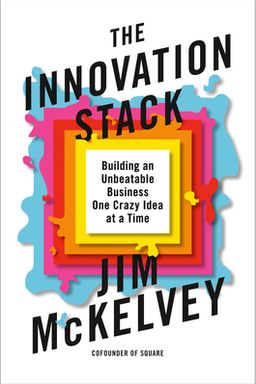
The Innovation Stack cover

The Innovation Stack

by Jim McKelvey

The Innovation Stack uncovers the journey of Jim McKelvey and Jack Dorsey as they build Square, a billion-dollar company, by addressing unsolved problems with ingenuity and humor. Learn how innovation stacks empower entrepreneurs to challenge giants like Amazon by sticking to core principles.

Entrepreneurship Beyond the Walls of the Known

Have you ever felt stuck in your business or creative life—like every idea you think of has already been done? In Jim McKelvey’s The Innovation Stack, he poses a radical challenge: what if instead of trying to copy success, you stepped completely outside of what’s known and comfortable? McKelvey argues that true entrepreneurship isn’t about imitation—it’s about exploration. It’s the willingness to leave the safety of what everyone understands and venture into the unknown to solve problems no one else has touched.

Most businesses thrive by copying what works. McKelvey even admits that copying can be profitable—the chain restaurant Shake Shack, for example, took existing burger ideas from Steak ’n Shake and custard recipes from Ted Drewes, then repackaged them beautifully. But he insists that while copycat companies can succeed financially, they rarely drive change. They stay inside what he calls the circle of known ideas—the stone wall that protects the city of “business as usual.”

Leaving the Safety of the Wall

To illustrate this point, McKelvey uses the metaphor of medieval Edinburgh. Its citizens lived behind high stone walls that were supposed to protect them from the wilderness beyond. Life inside those walls was cramped, filthy, and limited—but at least it was familiar. Outside lay danger, monsters, and uncertainty. Yet, the people who pushed beyond the walls, who asked “What could be out there?” were the ones who discovered new worlds. That’s exactly what real entrepreneurs do—they venture into territory that everyone else fears or deems impossible.

When you choose to explore beyond the walls of what’s known, you risk failure and ridicule. But McKelvey sees that risk as the very definition of entrepreneurship. Just like explorers who set out across uncharted seas, innovators face the unknown not because it’s safe, but because it’s exciting. They act on curiosity rather than certainty, creating something that changes the game, not just plays within it.

The Circle of Known Commerce

Inside that circle lie businesses that duplicate trends and chase predictable market share. You’ll find endless versions of similar apps, restaurants, devices, or services—comfortable products built on existing templates. But step outside the circle, and you encounter problems no one else has tried to solve. McKelvey calls these “perfect problems”—issues that are perfectly matched to your abilities, interests, and persistence. He discovered his own perfect problem when he lost a simple sale because his small glass-blowing studio couldn’t accept American Express cards.

From that problem came Square—a business defined not by imitation but by invention. McKelvey’s frustration with the unfairness of credit-card systems led him to build something entirely new: a portable card reader and payment platform that made transactions easy for small businesses. That single act of stepping beyond the safe zone revolutionized how millions of entrepreneurs worldwide process payments.

“Entrepreneurship is about treading uncharted territory.” McKelvey insists that if you create something truly new, there’s no map. You’ll have to figure out every step yourself—sometimes solving one problem just exposes ten more. Yet that continued discovery is what creates an innovation stack: a series of solutions that build a uniquely resilient company.

Why This Matters for You

McKelvey’s perspective matters because it redefines success. In an age obsessed with rapid scaling and replicating proven formulas, he reminds you that the businesses that truly shift the world—like Square, or historic predecessors such as A.P. Giannini’s Bank of Italy—do so precisely because they wander off the edge of the known. They create their own ecosystems of innovation rather than competing in someone else’s.

So if you’ve ever wondered why your startup feels derivative, or why your work seems caught in comparison, McKelvey offers a challenge: find your perfect problem. Don’t chase what’s already been solved. Start where you see unfairness, inefficiency, or opportunity that others ignore—and build your way forward, one creative leap at a time. What happens next may not just grow your business; it could redefine an entire industry.

Across the rest of The Innovation Stack, McKelvey explores how navigating uncertainty leads to breakthrough solutions, how authenticity and transparency can transform investment dynamics, how stacked innovations form the backbone of enduring success, and how principle-driven resilience defeats even the most powerful competitors (like Amazon). Ultimately, his book asks you to be more than a businessperson—it invites you to become a fearless explorer in a world crowded with imitators.


Finding the Perfect Problem

Jim McKelvey’s journey began with frustration, not inspiration—a lost sale that turned into a revolution. When a customer wanted to buy a glass spout using American Express, McKelvey discovered his studio couldn’t process that card. He lost a small transaction but uncovered a massive issue affecting millions of entrepreneurs. This moment led to the creation of Square—the company that made card payments simple for small business owners.

The Anatomy of a Perfect Problem

A perfect problem, McKelvey explains, doesn’t necessarily mean the biggest or hardest—it’s “perfect” because it fits you. It aligns with your interests, skills, and stubbornness to solve it. You may not know anything about the field at first (McKelvey knew little about banking), but your curiosity and persistence drive you deeper until you understand what others overlook.

When McKelvey began researching credit-card systems, he discovered systemic unfairness. Large corporations were charged tiny fees—0.04 cents per dollar—while small merchants paid 1.8 cents per dollar, meaning the credit-card companies profited 45 times more from small business owners. It was an outrageously uneven system, and McKelvey realized that fixing it wasn’t just an opportunity—it was an ethical imperative.

Turning Frustration Into Innovation

Perfect problems often begin as annoyances. Losing that sale wasn’t catastrophic—it was annoying. But when you explore the root of such frustrations, they can reveal deep flaws in established systems. McKelvey joined forces with Jack Dorsey (of Twitter fame) and set out to “square up” the payment world. Their company name reflected the mission: fairness, transparency, and accessibility for everyone.

What’s powerful about this idea is how it encourages personal alignment. Instead of choosing problems based purely on market demand or profit potential, McKelvey asks you to notice what bothers you personally—what feels unjust or broken. That’s your entry point into innovation. Your authentic engagement keeps you motivated even when solutions get messy and complex.

McKelvey writes that “the perfect problem is the one you care enough to keep solving even when you don’t know how.” This persistence—the drive to learn what you don’t yet understand—becomes the seed of innovation that others can’t replicate.

From One Sale to Global Transformation

Within a few years, Square transformed payment systems globally. But it all began with one craftsman losing one sale. That’s the power of spotting your perfect problem—the seemingly small issue that reveals a vast opportunity. (In Zero to One, Peter Thiel similarly argues that great businesses start by solving problems others ignore.) For McKelvey, that loss wasn’t failure; it was the spark that turned a personal frustration into a multi-billion-dollar solution.

When you look at your own life—what you wish worked better, what frustrates you about systems or tools—you might find your version of McKelvey’s “impossible sale.” Don’t dismiss it as trivial. It might just be the perfect problem waiting for you to build your innovation stack around.


The Power of Transparent Pitching

When the time came to seek investors, McKelvey and Dorsey didn’t just pitch; they reinvented the act of pitching itself. Their demonstration was playful yet impactful—they asked each investor to hand over a credit card, swiped it using their new card reader, and charged them between one and forty dollars depending on how much they “liked” them. The investors could see the transaction instantly appear in their bank accounts. It was proof of concept delivered with humor and flair.

The “140 Reasons Square Will Fail” Slide

Beyond the live demo, the most shocking part of the pitch was a slide listing “140 Reasons Square Will Fail.” Traditional business presentations highlight success metrics and optimistic projections. McKelvey’s slide did the opposite—it openly listed every risk the company faced, from fraud and regulatory hurdles to absurd threats like robot uprisings. The effect was electrifying. One managing partner on Sand Hill Road called it the best pitch he had ever seen.

This transparent approach flipped the typical “attack and defend” dynamic of investment meetings. Instead of hiding weaknesses, McKelvey and Dorsey surfaced them, showing investors that they were deeply aware of every threat and ready to confront them. That honesty built trust faster than any revenue projection ever could.

Authenticity as Strategy

McKelvey’s radical transparency demonstrates that vulnerability can be a strategic advantage. By showing humility and foresight, the founders established themselves as serious problem-solvers, not idealistic dreamers. Investors saw not just a product but a team capable of navigating the complex world of financial regulation and innovation.

(Note: This mindset echoes the ideas Adam Grant explores in Think Again—that intellectual humility can make teams more innovative and resilient.) McKelvey reminds you that being open about challenges isn't weakness—it’s proof of strength and strategic maturity.

By revealing how Square might fail, McKelvey and Dorsey convinced investors it was less likely to. Transparency signaled preparedness; preparedness signaled confidence.

If you ever pitch your own idea, McKelvey’s story offers a powerful lesson: confidence doesn’t come from pretending your idea is flawless—it comes from showing you’ve thought through its potential flaws and still believe in it enough to move forward. That kind of honesty builds credibility that dazzles far more than polished slides ever could.


Building Your Innovation Stack

Square began with one solution—making card payments accessible—but quickly stumbled into a labyrinth of new problems. Each solution created a new challenge: regulatory issues, pricing conflicts, and scalability pressures. Over time, these problem-solution chains built what McKelvey calls an innovation stack—a series of interconnected inventions that together form a company’s unique DNA.

How Stacks Evolve, Not Plan

McKelvey emphasizes that an innovation stack can’t be designed in advance. It only emerges when you’re forced to keep innovating to survive. When Square launched, it violated 17 different payment regulations—it was, technically, illegal. Instead of giving up, the team found creative solutions to each problem, developing new systems, relationships, and technologies to make their product work legally and ethically.

Each new solution became part of their stack: a flat-rate pricing structure, simple onboarding, transparent fees, and minimalist design. When one problem solution led to another, Square’s distinct set of innovations became impossible for competitors to replicate. It was this interconnectedness that later protected Square from even giant threats like Amazon.

Simplicity Breeds Power

The elegance of Square’s approach—transparent pricing at 2.75 percent for every transaction—created trust in an industry notorious for hidden charges. That simplicity appealed to small businesses and made customers loyal. However, Square initially lost money on small charges because it still had to pay transaction fees to credit networks. That forced McKelvey’s team to innovate again—finding ways to increase transaction volume and efficiency to make the economics sustainable.

Innovation stacks grow through necessity, not planning. You can’t craft one intentionally—you build it step by step, each creative solution intertwining with the next until you’ve formed a living system that competitors can’t copy.

For entrepreneurs, understanding this process means accepting imperfection. Don’t wait for the perfect design or business model—begin solving the first concrete problem. As you do, new ones will appear, and each will invite you to innovate further. What emerges isn’t chaos—it’s your innovation stack, the structure that will ultimately define your uniqueness and resilience.


Surviving Giants Through Principles

In 2014, Square faced a formidable predator: Amazon. The tech behemoth copied Square’s card reader, improved it, and sold it cheaper. By all logical predictions, Square should have been crushed. But instead, by 2015, Amazon quietly withdrew its competing product. How did the smaller company defeat the giant? McKelvey reveals that the answer lies not in aggression but in adherence to principles.

Principles Over Panic

When Amazon entered the market, Square could have responded defensively—redesigning, dropping prices, compromising its values. But McKelvey and Dorsey refused to abandon Square’s founding principles, especially its commitment to beautiful design and customer trust. Their reader was elegant enough to be displayed in museums like MoMA and the Smithsonian. Amazon’s reader was bulkier and uglier, even if technically superior. Rather than competing on Amazon’s terms, Square stayed true to its vision of simplicity and aesthetics.

By doing nothing, Square displayed something powerful: confidence. It didn’t chase the competition—it deepened its authenticity. Within a year, Amazon’s product vanished. McKelvey’s lesson is clear: an innovation stack isn’t just made of products—it’s made of principles. That stack of values is what holds a company steady when predators appear.

Principled Resilience

Square’s response to Amazon shows how integrity can be a competitive advantage. Many businesses panic when giants enter their space, diluting their identity in a desperate rush to survive. But real innovators stand firm. They understand that imitation doesn’t destroy originality—it exposes it. By refusing to compromise, Square demonstrated a rare strength that no competitor could mimic.

“Sometimes doing nothing is the most strategic move.” McKelvey realized that endurance isn’t about fighting harder—it’s about protecting what makes you unique while the competition exhausts itself trying to copy you.

This story teaches you not to abandon your values when threatened. Whether you’re an artist, entrepreneur, or innovator, your core principles are part of your innovation stack. They keep you authentic—and in a world of constant imitation, authenticity is the most powerful weapon of all.


A.P. Giannini and the Original Innovation Stack

McKelvey searched history for truly entrepreneurial role models—and found one in A.P. Giannini, founder of the Bank of Italy (which later became Bank of America). In the early 1900s, Giannini saw a corrupt, elitist banking system that ignored small businesses and women. Instead of copying existing practices, he created what McKelvey describes as the first complete innovation stack in modern banking.

Focusing on the “Little Man”

Giannini believed small entrepreneurs were the heart of the economy, even though banks of his era preferred wealthy industrial clients. He opened his doors to small business owners, created easy-access loans, and helped countless people start enterprises that fueled local prosperity.

Championing Women Entrepreneurs

Giannini broke another barrier by recognizing women as capable businesspeople. He launched a Women’s Banking Department allowing women to open accounts independently—a revolutionary idea when the financial world was still predominantly male. When U.S. women earned the right to vote, Giannini’s inclusive approach positioned his bank as a pioneer for equality and innovation.

A Legacy of Layered Innovation

Each new idea—branch banking, customer-focused service, inclusive lending—became one block in Giannini’s innovation stack. His approach eventually transformed the financial industry, turning the once-small Bank of Italy into the largest bank in the world. (Note: McKelvey sees Giannini as proof that true entrepreneurship transcends generations—the same principles apply to tech startups today.)

Giannini didn’t just innovate once—he built a system of continual, ethical innovation. His story reminds us that entrepreneurship grounded in fairness and inclusivity creates lasting impact.

By tracing these historical roots, McKelvey helps you see innovation not just as technological progress but as moral progress. The courage to square up unfair systems—whether in banking or business—echoes across generations. And by following the principles of Giannini and Square, you too can build a legacy that changes the world by solving problems no one else has dared to face.

Dig Deeper

Get personalized prompts to apply these lessons to your life and deepen your understanding.

Go Deeper

Get the Full Experience

Download Insight Books for AI-powered reflections, quizzes, and more.