
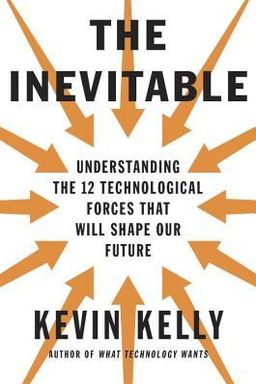
The Inevitable cover

The Inevitable

by Kevin Kelly

The Inevitable offers a captivating exploration of 12 technological forces shaping the future. Author Kevin Kelly delves into how these trends will redefine society, enhancing our lives and interactions. Prepare for a world of constant evolution and opportunity.

The Technium: Humanity’s Evolving Partnership with Technology

Kevin Kelly argues that the central story of our time is not simply technological advance but becoming—a continuous process of co-evolution between humans and the technium, his term for the total system of technologies and human life intertwined. In this view, every invention we create alters us, and every adaptation changes the next generation of tools, in a feedback loop of accelerating transformation. You live inside an unfolding process rather than a finished world, and thriving means learning to collaborate with that flux rather than resist it.

Kelly’s core message is practical as well as philosophical. Technology, he says, is not a set of finished products but an ecology of ongoing processes—constantly upgrading, learning, and interweaving. The right stance is stewardship over resistance: you can’t stop the technium, but you can guide its direction, much as you steer a growing garden rather than sculpt inert stone.

From Products to Processes

In the early chapters, Kelly introduces the idea of becoming. Everything you interact with—software, networks, even organizational practices—shifts from static nouns to dynamic verbs. You no longer buy a thing; you join a process. A smartphone, for instance, evolves weekly through updates; your job description morphs as tools change beneath it. The practical implication is humility: you’ll remain a perpetual newbie, required to relearn systems that never settle. (He notes the short lifespan of apps and the constant turnover of digital platforms as evidence of this perpetual flux.)

Kelly calls this condition “protopia”—a world of small, continuous improvements rather than perfect utopias or catastrophic dystopias. Every new layer of technology solves some problems and births others. Instead of expecting endpoints, you should aim for manageable progress: iterative, experimental, and adaptive.

The Cognification and Flow of Everything

Once everything is in motion, the next great force is cognifying: embedding artificial intelligence into every object, service, and process. Kelly portrays AI not as a single conscious being but as a global network of narrow intelligences distributed in the cloud. Tools like IBM’s Watson and Google’s ranking algorithms exemplify this planetary mind: millions of small AIs interlinked through billions of user interactions. Their collective learning power drives a new economy of augmented tasks where humans and machines combine strengths (the “centaur” model seen in chess and other fields).

Meanwhile, the world’s content shifts from fixed stocks to flows. Digital networks make copying effortless; therefore, value migrates to qualities that cannot be copied—like immediacy, authenticity, and personalization. Music streaming, cloud software, and always-on feeds illustrate this “flowing” economy. You don’t own a product; you access or subscribe to an ongoing stream of service, updated in real time.

Access, Sharing, and the Move Beyond Ownership

As flows dominate, ownership becomes optional and sometimes a burden. Cars turn into rides via Uber; films into subscriptions via Netflix; computing power into the cloud. You rent what you need when you need it. Kelly sees this shift enabled by dematerialization—more function from fewer atoms—and by decentralized systems like blockchain, which restore trust without centralized intermediaries. Ownership yields control, but access yields flexibility. The smart user, he advises, chooses deliberately between the two based on context.

Alongside access comes sharing. Kelly describes peer creation—open-source code, Wikipedia edits, collective tagging—as a new form of digital socialism. Millions voluntarily create and refine commons-managed goods. Yet even bottom-up collaboration benefits from light-touch curation; healthy networks mix crowds and coordination. Platforms like Kickstarter, GitHub, and Kiva exemplify an emergent hybrid economy where reputation, learning, and participation complement money as motivators.

Attention, Personalization, and the Age of Filters

Abundance creates its own scarcity—attention. With billions of options, you depend on filters: algorithms, peers, and brands that triage relevance. From Amazon’s recommender systems to Netflix’s personalization engines, filters now mediate nearly all discovery. But they are not neutral; each optimizes for engagement, sales, or retention. The challenge is managing them consciously—combining algorithmic efficiency with social serendipity while avoiding echo chambers and “filter bubbles.”

In parallel, Kelly forecasts mass personalization: an avatar economy where data about your body, preferences, and networks enables bespoke products and services, from custom pills to tailored travel. This Universal You gives extraordinary convenience but raises ethical questions about privacy and control. Every new layer of data adds both power and vulnerability.

Interaction, Presence, and the Global Mirror

The next evolutionary step is full-body interaction—VR, AR, wearables, and sensors transforming screens into immersive environments. Presence and interactivity redefine media: instead of watching, you inhabit experiences. At the same time, self-tracking technologies turn you into data. The Quantified Self movement, lifelogging, and wearable sensors give you feedback loops for behavior and health. Yet they also feed into what Kelly calls the holos: the emerging planetary mind formed by billions of connected devices, cameras, and AIs.

Against fears of surveillance, Kelly advocates coveillance—mutual transparency rather than one-way control. In a fully observed world, safety and accountability require that watching be reciprocal. Privacy, he suggests, will become selective and situational, balanced by rights of access, audit, and correction.

Taken together, these forces—becoming, cognifying, flowing, accessing, sharing, filtering, and tracking—constitute the real project of our century: building a humane relationship with a living, learning technological ecology. You are not merely surrounded by tools; you are enmeshed in an intelligent, evolving network that mirrors and magnifies human agency. Kelly’s invitation is neither alarmist nor utopian. It is to participate intentionally in the technium’s growth, shaping its direction while accepting that everything is becoming.


Becoming: Living in Perpetual Beta

Kevin Kelly’s notion of becoming reframes technology as a living system that never stops updating itself. You live not in a steady-state civilization but in an ecosystem of upgrades. Every device you own, every system you use, and even your habits are versions awaiting the next patch. This world, Kelly reminds us, demands a shift of attitude from mastery to adaptability.

Perpetual Upgrades and the Hygiene of Change

Kelly’s anecdote about his Apple II—useless until connected to a modem—captures the pivot from isolated machines to interconnected processes. Once connected, systems depend on each other’s updates. Today you see this in phones and software that auto-update as a matter of hygiene. Delaying change is riskier than embracing it. To thrive, you must treat upgrading as routine care, not disruption.

Endless Newbie, Endless Learning

In a world where apps vanish after a few months and new interfaces replace old ones overnight, you are destined to be an endless newbie. Kelly notes this humility isn’t a flaw but a virtue; your lifelong learning becomes professional survival. You master curiosity and graceful onboarding more than any fixed skillset.

Protopia: Incremental Betterment

Protopia, Kelly’s term, names the realistic goal: daily, small-scale improvements that create a world slightly better each year. Unlike utopias, protopia accepts tradeoffs; even as new tools solve problems, they generate fresh ones. But the net drift, when guided responsibly, is positive. The moral is not blind optimism but practical stewardship—tuning progress rather than freezing it.

(Note: think of this as a mindset aligned with Nassim Taleb’s Antifragile—systems that evolve by accommodating disturbance. In Kelly’s protopia, technological change is not an enemy to manage but an environment to co-design.)


Cognifying: Intelligence as Utility

Kelly foresees a world where adding intelligence to everything becomes as common as adding electricity was a century ago. He calls this trend cognifying. Artificial intelligence isn’t a single conscious HAL; it is a universe of narrow, embedded minds distributed across cloud servers and devices. Each instance becomes smarter the more you and others use it—the collective benefit of billions of queries, clicks, and corrections.

The Networked Mind

You can already see this planetary-scale mind in Google Search and IBM’s Watson. They improve collectively through user interaction—intelligence as a public utility. Kelly lists three enablers: cheap parallel computation (GPUs), massive data, and deep learning algorithms. Together these drive an explosion of narrow, reliable AIs that supplement rather than rival humans.

Humans + Machines: The Centaur Advantage

The goal, Kelly argues, isn’t replacement but collaboration. Chess grandmaster Garry Kasparov’s “centaurs”—teams combining humans and multiple engines—outperform either alone. The lesson generalizes: professionals who learn to work with AI outperform those resisting automation. The question for you becomes not “Will AI take my job?” but “How can AI extend my capability?” (Note: this anticipates today’s co-pilot model of AI assistants.)

Kelly’s pragmatic formula—“take X and add AI”—summarizes the opportunity space. When intelligence becomes cheap and embeddable, every tool can learn. The most transformative changes come not from conscious robots but from millions of quiet cognified objects making everyday systems adaptive, responsive, and increasingly invisible.


Flowing and Access: The Economy of Streams

Digital networks copy everything effortlessly. In this condition of near-zero reproduction cost, value migrates from owning fixed things to accessing continuous flows. Kelly’s equation: when copies are free, you sell what cannot be copied—experience, immediacy, personalization, and authenticity. This marks the shift from stocks to flows.

From Possession to Participation

Streaming music, subscription software, and on-demand rides illustrate the flow model. The product becomes a service—Spotify instead of CDs, Dropbox instead of disks. Owning feels clunky next to accessing anything instantly via the cloud. The Uber model—instant, location-aware delivery—extends to every domain, made possible by smartphones, sensors, and payment networks.

Generatives: What Holds Value

Kelly identifies eight generatives—qualities created in real time that remain valuable despite free copies: immediacy, personalization, interpretation, authenticity, accessibility, embodiment, patronage, and discoverability. Services now compete on these layers. Spotify personalizes your playlists; Netflix recommends precisely; fans support artists directly on Patreon. What you pay for is engagement and convenience, not possession.

Decentralization and the Cloud Commons

Access relies on trust infrastructures. Kelly explores blockchain’s role in distributing verification so that no single entity controls the flow. Mesh networks like FireChat—phones relaying messages peer-to-peer—test ownerless communication webs. Underneath, cloud computing supplies the bones of the access economy, letting thin devices act as portals into shared, scalable intelligence.

Convenience replaces control, but this trade invites reflection: which assets should you own, which can you rent? Kelly’s counsel is pragmatic—own what needs permanence and privacy; access everything else. Future prosperity depends less on material holdings than on graceful participation in flows.


Sharing and Remixing: The Social Fabric of Creation

Kelly sees digital collaboration as the next great production system. From Wikipedia to open-source projects, billions now cooperate without central command. He calls this movement digital socialism: a voluntary pooling of attention and effort that generates common goods. Participants often trade time for reputation or learning rather than money.

Degrees of Collaboration

Drawing on Clay Shirky’s framework, Kelly outlines four levels: sharing (posting, tagging, liking), cooperation (coordinated lists like Yelp), collaboration (large integrated outputs like Linux), and collectivism (emergent governance and shared ownership). The higher the level, the more complex the product and the coordination required. Successful systems add minimal top-down structure to sustain quality.

Remixing as Innovation

All this collaborative energy produces a culture of remixing. Innovation becomes recombination. From mashups on YouTube to software built from open libraries, creators recombine existing parts to spawn new forms. Economists Paul Romer and W. Brian Arthur support Kelly’s claim that most growth comes from new combinations rather than brand-new materials.

Transformation, Not Copying

Legal frameworks lag behind. Kelly advances a simple test: has the remix transformed the original? If so, it contributes new value and deserves protection as new creation. He predicts that improved attribution tools and micro-compensation models will normalize sharing while rewarding transformation. (This logic now underlies Creative Commons and open licensing movements.)

In this cooperative world, your advantage lies in curation and contribution—knowing what to remix, what to share, and how to channel collective intelligence. The future’s giants, Kelly implies, will be platform gardeners who cultivate participatory creativity, not monopolists hoarding content.


Filtering, Personalization, and the Attention Economy

After abundance comes overload. Kelly calls filtering the primary survival skill of the digital age. Every platform you use—Google, Netflix, Spotify, Twitter—is a vast filter optimizing for goals that may not always match yours. The hidden question behind every interface is: what is this system optimizing for—your satisfaction, or its own revenue?

How Filters Work

Recommendation systems weight billions of signals—your clicks, others’ clicks, dwell time—and continuously A/B test to refine predictions. By 2014, Amazon’s “more-like-this” algorithm drove a third of sales, demonstrating that good filters create measurable value. But algorithms alone produce echo chambers. The healthiest ecosystems blend algorithmic personalization with social and editorial filters that reintroduce diversity.

Managing Your Attention

Attention is the ultimate scarce resource. Kelly quantifies it: television earns about $0.20 per hour of human attention; the internet around $3.60. Because attention is low-yield per hour, platforms must capture enormous volume to profit—hence the race for engagement. Your defense is intentional filtering: maintaining a portfolio of trusted curators, exploratory channels, and countervailing filters that periodically challenge your preferences.

Avatars and Mass Personalization

Filtering evolves into personalization. Machines learn you as a multidimensional avatar—body stats, tastes, networks, vitals—and use that profile to customize medicine, travel, and recommendations. The Universal You may fabricate custom-tailored clothes or pills at home. This deep personalization turns your data into a service, offering convenience but concentrating power. Kelly urges you to determine which aspects of yourself remain opaque to algorithms and which you willingly expose for value gains.

Filtering thus becomes a moral act: selecting not only what to attend to but who gets to decide on your behalf. Awareness of optimization goals—and occasional deliberate randomness—becomes as essential as privacy itself.


Interacting, Tracking, and the Global Holos

The final movement of Kelly’s argument examines how human experience itself becomes interactive and datafied. Technologies of presence—virtual and augmented reality, smart sensors, wearables—now extend your senses into digital space and return real-time feedback. Combined with vast personal and planetary tracking, these create what Kelly calls the holos, an emerging global mind that perceives and learns collectively.

Embodied Interaction and Presence

Virtual reality exploits presence: put on goggles and your body reacts to illusions. Augmented reality (AR) overlays data on the real world through glasses and phones, merging pixels with atoms. These tools turn “screen culture” into embodied participation. You don’t merely view data; you inhabit it. Eye-tracking, gesture control, and haptic feedback make interfaces empathic—reading your gaze, heartbeat, or mood to respond intelligently.

The Quantified Self

Kelly helped found the Quantified Self movement, encouraging individuals to track themselves—steps, sleep, biometrics, emotions. Each of us becomes a living experiment, an N=1 research project. Such tracking can improve well-being but also risks self-delusion unless supported by accurate sensors and AI analytics. Yet the long-term result is profound: humanity collectively generates an empirical dataset of ourselves at unprecedented scale.

Coveillance and the Transparent Society

As billions of sensors watch everything, secrecy dissolves. Kelly rejects futile absolutist privacy battles and proposes symmetry instead: coveillance, or mutual watching that holds both citizens and institutions accountable. Like small-town visibility scaled globally, symmetric transparency discourages abuse more effectively than one-way surveillance. Anonymity remains valuable for the vulnerable, but widespread accountability prevents manipulation.

All this data, aggregated across billions of devices, makes the holos—the whole digital organism—self-aware. Its intelligence dwarfs individual parts: billions of minds plus trillions of chips. You stand at its dawn, both contributor and beneficiary. Kelly’s final exhortation: don’t fear this evolution; participate wisely in designing transparency, fairness, and agency into the planetary mind you’re helping build.

Dig Deeper

Get personalized prompts to apply these lessons to your life and deepen your understanding.

Go Deeper

Get the Full Experience

Download Insight Books for AI-powered reflections, quizzes, and more.