
Idea 1
Why Improbable Events Happen All the Time
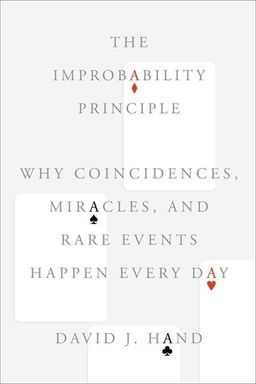
Have you ever experienced a coincidence so unlikely that it made you question reality—a call from an old friend you were just thinking about, or two unrelated stories lining up perfectly by chance? In The Improbability Principle, statistician David J. Hand argues that such astounding events aren’t supernatural at all—they’re inevitable. The universe, governed by the laws of probability, virtually guarantees that highly improbable events will occur with surprising regularity. Hand’s overarching claim is that what we perceive as unbelievable coincidences, miracles, or luck are, in truth, consequences of built-in mathematical laws operating within everyday life.
Hand introduces what he calls the Improbability Principle—a set of interrelated laws that explain why rare events happen constantly. These five laws work together like threads in a rope: the Law of Inevitability (something must happen), the Law of Truly Large Numbers (with enough opportunities, anything can occur), the Law of Selection (we notice what we choose to look at), the Law of the Probability Lever (small changes create massive probability shifts), and the Law of Near Enough (similar events are often treated as identical). When these laws interact, they make the improbable practically unavoidable. From déjà vu to winning the lottery twice, Hand contends that once you understand these mathematical forces, you’ll stop being astonished by “freak” coincidences.
The Human Fascination with Unlikely Events
Hand begins by acknowledging our deep discomfort with randomness. Humans crave patterns and meaning—when mysterious coincidences happen, we instinctively seek hidden causes. Throughout history, people have invoked gods, fate, or psychic forces to explain improbable events. But Hand argues that probability, not mysticism, is the real governing mechanism. Science, he writes, has replaced superstition by uncovering the laws that describe uncertainty just as cleanly as gravity explains motion. Understanding these laws demystifies miracles, prophecies, and paranormal claims, revealing them as predictable results of mathematical inevitability.
From Miracles to Mathematics
To set the stage, Hand recounts examples that seem unfathomable: Anthony Hopkins randomly finding the annotated copy of a lost novel he was meant to star in, or a mother photographing her child, losing the film, and later buying a roll years afterward that turned out to contain the same image. Such stories invite mystical explanations, but Hand insists they can be fully accounted for through probability. He channels earlier thinkers like Émile Borel, who stated that “events with sufficiently small probability never occur.” This concept—known as Borel’s Law—sets the philosophical backdrop: when probabilities become unimaginably small, we define them as impossible at human scales. Yet Hand flips this on its head to show that when billions of opportunities exist (for example, billions of people having billions of experiences every day), even one-in-a-billion chances are bound to happen constantly.
The Five Laws of the Improbability Principle
Each of Hand’s five laws reveals a different facet of why improbability is routine:
- The Law of Inevitability: Out of all possible outcomes, one must occur—so something unexpected always will.
- The Law of Truly Large Numbers: When there are enough opportunities, even highly unlikely things happen regularly.
- The Law of Selection: We select—and remember—particular events after they happen, giving coincidences false importance.
- The Law of the Probability Lever: Tiny shifts in conditions can cause massive changes in outcomes, magnifying risks and surprises.
- The Law of Near Enough: When two events are similar enough, we treat them as the same—making coincidences seem more exact than they are.
Hand shows how these principles explain phenomena across human experience—from miraculous recoveries, prophetic dreams, and psychic predictions to stock market fluctuations, disease clusters, and even the physical parameters of the universe. (Similarly, in Thinking, Fast and Slow, Daniel Kahneman reveals parallel psychological biases—like hindsight or confirmation bias—that make us misjudge probability and surprise.) Hand’s framework roots such mistakes not in mystery but in misperception.
Why Understanding Improbability Matters
Ultimately, Hand’s goal is to liberate you from superstition and fear of randomness. Recognizing that rare events are mathematically inevitable changes how you interpret the world—from judging scientific results to processing everyday coincidences. It encourages humility: we live in an interconnected system of staggering complexity, where “freak” events are normal. By grasping the Improbability Principle, you can see through the illusion of miracles to the beautiful regularity beneath them. Hand’s message is both scientific and philosophical: improbable doesn’t mean impossible—it means you haven’t considered how vast the opportunity space really is.