
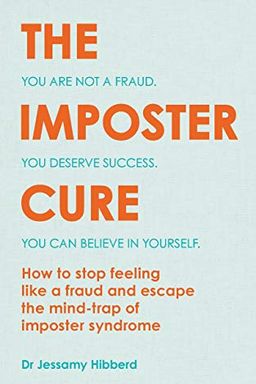
The Imposter Cure cover

The Imposter Cure

by Dr Jessamy Hibberd

The Imposter Cure by Dr. Jessamy Hibberd offers a profound exploration of imposter syndrome, equipping readers with practical tools to boost self-confidence, overcome doubts, and embrace their true potential for a fulfilling life.

Escaping the Mind Trap of Imposter Syndrome

Have you ever achieved something amazing—an impressive project at work, an award, or a big milestone—only to feel like you somehow conned everyone into believing you deserved it? Dr. Jessamy Hibberd’s The Imposter Cure is written precisely for that moment of dissonance between accomplishment and self-doubt. A clinical psychologist with years of experience helping high-achievers crippled by self-suspicion, Hibberd argues that imposter syndrome is not a sign of incompetence but an unexamined psychological pattern rooted in fear, perfectionism, and outdated beliefs about success. Her mission: to help you see that you are not a fraud—you are human.

According to Hibberd, imposter syndrome—the persistent belief that one's success is undeserved—is a widespread psychological illusion. Roughly seventy percent of people feel like imposters at some point, and research backs this up (originally identified by psychologists Pauline Clance and Suzanne Imes in 1978). The author reframes it not as a rare psychological defect but as a collective human experience driven by distorted thinking and self-criticism. She writes to help readers dismantle these illusions systematically: first by understanding how the belief forms, then by unlearning destructive coping mechanisms such as overwork and avoidance, and finally by building self-compassion, balance, and a realistic image of oneself.

Understanding the Pattern Beneath the Feeling

At its core, imposter syndrome is a faulty internal narrative—an entrenched story you tell yourself that attributes success to luck, timing, likability, or others’ errors instead of your ability. It’s also an emotional survival strategy. When you can’t reconcile how others see you with how you see yourself, your brain creates cognitive dissonance. To protect against shame or the risk of failure, you overcompensate by working too hard—or you avoid engaging altogether. Hibberd calls these the “imposter twins.” The result is exhaustion, fear, and disconnection from reality.

Hibberd argues that the belief isn’t about being a fraud; it’s about misinterpreting normal human emotions. Everyone feels uncertain when stepping outside their comfort zone or caring about an outcome, but imposters mistake this discomfort for evidence of deficiency. Her central proposition—“feelings are not facts”—is the foundation for change.

How the Mind Reinforces the Myth

Through accessible psychology, Hibberd explains why we struggle to "update the belief" that we are good enough. Cognitive biases, particularly confirmation bias, make us cling to old stories. When we feel fear or shame, our ancient threat system (the amygdala) hijacks thinking processes, turning minor uncertainties into existential danger. This mechanism once protected early humans but now misfires in a world of deadlines rather than predators. Imposters continuously gather evidence that they are not good enough while dismissing actual achievements, creating a self-perpetuating loop of anxiety.

Childhood conditioning and personality traits also play a role. Through her clinical cases, Hibberd shows how perfectionism, conditional parental approval (“love only when you perform”), or being labeled as either the “clever one” or “hard worker” build early schemas of self-worth. These beliefs, left unexamined, harden into lifelong narratives that success feels undeserved.

From Self-Doubt to Self-Compassion

In the book’s second half, Hibberd outlines a practical three-step transformation: understand the theory, challenge the belief, and practice new strategies. She treats recovery as a learning process similar to acquiring a new language—it feels strange at first, but practice rewires the brain. A crucial turning point is cultivating compassion. Far from indulgent, self-compassion quiets the inner critic, reduces anxiety, and makes growth sustainable. Hibberd cites Kristin Neff’s research on self-compassion as “the antidote to self-criticism.” Instead of motivating yourself through shame (“I must be perfect”), you learn to motivate through care (“I’m learning and improving”).

Her practical exercises—writing achievement lists, testing avoidance behavior, reframing perfectionism, embracing failure as a teacher—prove that confidence grows from action, not affirmation. Recognizing that every expert once started as a beginner helps normalize self-doubt and reframe it as part of growth, not proof of fraudulence.

Reclaiming Your Life

Ultimately, The Imposter Cure isn’t just about easing anxiety but about reclaiming freedom—the ability to enjoy success without fear of being “found out.” Hibberd argues that you don’t overcome imposter syndrome through more credentials or accomplishments but through shifting how you relate to yourself. When you accept imperfection, allow joy, and stop interpreting fear as failure, you gain back creativity, confidence, and genuine connection. The cure, then, is not a single revelation but an ongoing practice: self-awareness, compassion, realism, and courage. It’s about living as a whole, capable human—not a performance of one.

“You’re not a fraud. You’re human. It’s not proof that you’re failing—it’s proof that you’re trying.”

By the end of Hibberd’s method, what begins as an exposure of self-doubt becomes a manifesto for grounded confidence. You discover that success isn’t an exam to pass; it’s an experience to inhabit. That shift—from fearing exposure to accepting imperfection—is what makes The Imposter Cure so powerfully transformative.


The Psychology of Imposter Syndrome

Hibberd defines imposter syndrome as an ‘internal experience of intellectual phoniness.’ It’s the chronic inability to internalize success despite clear evidence of competence. Unlike a temporary lack of confidence, it’s a persistent identity-level belief that you don’t deserve your achievements. Originally observed among high-achieving women by Clance and Imes in 1978, it’s now recognized across all genders, races, and professions—from college students to CEOs.

How It Feels and Who It Affects

Those affected may feel like Eve, a character Hibberd introduces early on: successful on the surface, but terrified of exposure. Eve’s perfectionism, over-preparing, and frantic work ethic create the illusion of control—but they’re coping mechanisms, not cures. The more she achieves, the worse she feels, because each success raises the stakes. Hibberd uses cases like Eve and James—a businessman convinced he’s a fraud in his own home—to reveal how internal shame erodes joy and authenticity.

Anyone can experience these feelings, especially during transitions: new roles, promotions, or places where you stand out (studied by Valerie Young and others). The book stresses that imposter syndrome thrives in competitive or perfectionistic cultures, where external validation replaces internal self-worth.

The Mind–Body Connection

Fear activates the body’s fight-or-flight response. To the amygdala, public speaking or a promotion can feel as dangerous as a predator. Adrenaline spikes, your heart races, and the sensations confirm your fear—this must mean danger. The brain cannot distinguish between life-threatening and ego-threatening situations. This physiological hijack reinforces the belief that you’re unsafe in success.

Recognizing this loop is empowering. Once you identify that your anxiety is a false alarm, you can respond differently: pause, breathe, gather evidence. Feelings are not reliable facts—they’re data to interpret, not commands to obey.


Beliefs That Built the Imposter

To dismantle imposter syndrome, Hibberd invites readers to trace where their beliefs began. Self-doubt isn’t random—it’s often inherited. During childhood, we absorb unspoken family ‘rules’ about competence and worth. Conditional love, inconsistent praise, or comparisons between siblings embed messages like ‘I’m only lovable when I achieve,’ or ‘If I’m not perfect, I fail.’ Over time, those become identity statements.

The author highlights how personality interacts with environment. A naturally anxious or conscientious child (high in neuroticism) is more likely to internalize critical messages. Even subtle cues like a parent saying, “You always do so well—it’s easy for you!” can backfire, teaching a child that effort invalidates ability. As adults, these outdated beliefs act like mental operating systems—unquestioned and automatic.

The Role of Family and Culture

Family labels (“the clever one,” “the disorganized one”) and social norms influence who develops imposter feelings. Self-promotion might have been considered boastful at home; modesty may have been moralized. For some, especially first-generation professionals, family definitions of success don’t align with modern achievement, creating conflict: no matter how well you do, it feels illegitimate. Hibberd relates Dexter’s story—a gifted flautist raised to downplay every win—showing how modesty hides self-acknowledgment.

This chapter reframes introspection as investigation, not blame. Seeing where beliefs begin allows you to edit them consciously. What protected you as a child—perfectionism to gain love—now keeps you anxious. Updating belief systems is the first step in healing.


The Survival Strategies That Backfire

Once you believe you’re a fraud, your brain builds survival strategies to hide it. Hibberd calls these the “imposter twins”: overworking and avoidance. Both aim to manage anxiety but end up reinforcing it.

Overworking

Overworkers like William push themselves to exhaustion, convinced they must constantly prove worth. Fear-driven diligence is rewarded externally—but internally it drains joy. Hibberd compares this to swallowing the “Old Lady Who Swallowed a Fly”: each new worry demands a bigger, more exhaustive strategy. Companies often exploit such personalities because anxiety fuels productivity. Yet no success feels safe enough to rest; every win becomes the baseline for the next impossible climb.

Avoidance

Avoiders, in contrast, protect their egos by not trying. Procrastination disguises itself as perfectionism (“I’ll start when I’m fully ready”) but masks fear. Cara, who delays sending her résumé after a promising meeting, demonstrates how avoidance preserves the illusion of competence—if she never tries, she never fails. Both coping mechanisms keep imposters trapped in limbo, unable to update beliefs with new evidence.

Real growth starts when you test the theory: what if you are not an imposter, and your success is based on reality?

Breaking these cycles requires discomfort. Doing less, saying no, and allowing imperfection prove that your worth isn’t tied to performance. Only through testing new behavior can logic replace fear.


Rewriting the Imposter Belief

Hibberd argues that imposter syndrome persists because it’s emotionally wired, not logically chosen. To change it, you must challenge emotional reasoning and confirmation bias. Like the cult members in Leon Festinger’s famous study who doubled down after a failed prophecy, imposters cling harder to false beliefs when evidence contradicts them.

The cure: collect contradictory evidence deliberately. Hibberd’s core exercise asks you to build a dossier of achievements—degrees, promotions, compliments, goals met—without excuses. Seeing success “in black and white” interrupts emotional reasoning. This new internal record acts as proof that you are capable, even when feelings lag behind.

Emotion vs. Evidence

Because beliefs entwine with emotion, changing them requires patience. “You may know it, but not feel it yet,” Hibberd reminds readers. She encourages keeping a reflective notebook to log achievements and moments of courage. Over time, as the emotional charge fades, facts replace fear, and your self-narrative shifts from “I fooled them” to “I’ve earned this.”

This chapter bridges science with practicality, teaching that belief change isn’t positive thinking—it’s empirical self-reeducation.


Compassion Over Self-Criticism

If imposter syndrome runs on self-criticism, compassion is the antidote. Hibberd reframes self-compassion not as coddling but as courage—the willingness to meet struggle with kindness. Drawing on Kristin Neff’s research, she explains its three parts: mindfulness of suffering, self-kindness instead of judgment, and recognizing common humanity.

Why Criticism Fails

Self-criticism masquerades as motivation but leads to burnout and avoidance. Alf, a talented television worker, believes harsh self-talk keeps him sharp—until anxiety cripples him. Hibberd helps him see that self-criticism narrows perspective, while compassion unlocks learning and resilience. Exercising compassion doesn’t dull ambition; it refines it by aligning effort with care rather than fear.

The Two-Step Practice

Step one: notice your inner dialogue. Externalize it—a “goblin voice” or overzealous coach—to see it’s not your true self. Step two: rewrite it in the tone of a wise, supportive friend. Replace “You’re useless” with “This is tough, but you’re learning.” Daily repetition reshapes neural patterns. Over months, compassion becomes instinctual, buffering against relapse into shame.


From Self-Doubt to Confidence

Hibberd champions insecurity as a normal human feature, not evidence of inferiority. From an evolutionary perspective, self-doubt kept our ancestors safe—it prevented reckless risks and ensured social cooperation. In modern life, that same mechanism misfires, creating chronic comparison and performance anxiety.

Luke, convinced everyone else at work is brilliant, doubts himself until he sees his boss—once intimidating—ask for reassurance after meetings too. The revelation? No one feels certain all the time. There are no “grown-ups” who have it all figured out; maturity means embracing imperfection, not erasing it. Hibberd emphasizes that confidence and insecurity are complementary—confidence grows by mastering self-doubt, not eliminating it.

Rather than chase permanent certainty, you can reflect daily, accept discomfort as natural, and turn insecurity into empathy. Self-awareness replaces self-judgment, making vulnerability a source of connection and credibility—a theme also echoed in Brené Brown’s Daring Greatly.


Perfectionism, Failure, and Letting Go

Perfection doesn’t exist—yet imposters act as if it does. Hibberd likens perfectionism to chasing a mirage: the closer you get, the farther it moves. The pursuit of flawlessness becomes an addiction—exhilarating but destructive. Matilda, a theatre student who keeps raising her bar after every success, illustrates this relentless cycle. Her friend’s question, “What would your 18-year-old self think of you now?” snaps her perspective back to gratitude.

Healthy conscientiousness—the drive to do well without self-punishment—is what Hibberd advocates instead. Letting go doesn’t mean abandoning standards; it means recognizing diminishing returns. Working to 80% capacity is often enough. The chapter exposes perfectionism’s costs: burnout, anxiety, strained relationships, and inability to enjoy achievement.

She lists the “five regrets of the dying” (from nurse Bronnie Ware) to reframe priorities: wishing they hadn’t worked so hard ranks near the top. The goal isn’t to be perfect—it’s to live meaningfully, balancing ambition with well-being.


Redefining Success and Sustaining Change

In the final chapters, Hibberd helps readers reconstruct a sustainable, joyful life free from the imposter’s grip. She guides reflection on what success means now—not societal metrics, but personal fulfillment across relationships, creativity, and self-care. True success, she asserts, is integrated rather than isolated; it’s living fully, not performing perfectly.

Through journaling, mindful breathing, gratitude, and setting boundaries, you maintain gains and prevent relapse. Practical exercises—like listing strengths, verbalizing achievements, or embracing “empty time”—anchor the new self-view. Confidence becomes a practice, not a personality trait.

Hibberd closes with an empowering reminder: change is ongoing. The voice of doubt may return, but now you recognize it. You’re not trying to silence it—you’re choosing not to believe it. Success becomes a mosaic of small, conscious choices toward self-trust. And that, Hibberd concludes, is the lasting cure for the imposter within.

Dig Deeper

Get personalized prompts to apply these lessons to your life and deepen your understanding.

Go Deeper

Get the Full Experience

Download Insight Books for AI-powered reflections, quizzes, and more.